
Prologue: The City Beneath the Concrete
In the bustling heart of Shijiazhuang, a modern metropolis of steel and glass in Hebei province, the rhythm of life is dictated by the hum of traffic and the glow of neon lights. It is a city of the future, a sprawling industrial hub that barely pauses for breath. But beneath the asphalt of the Chang’an district, under the very foundations of high-rise apartments and shopping malls, lay a secret that had been sleeping for two thousand years.
For centuries, historians and locals alike knew of "Zhending" (真定)—a name that echoes through the annals of the Han Dynasty as a place of immense strategic and political weight. But the physical reality of its ancient capital—the seat of power where kings plotted, armies gathered, and empresses were born—had vanished into the mists of time, its location a subject of scholarly debate and folklore. The city had simply disappeared, swallowed by the shifting sands of the Hutuo River and the relentless march of urbanization.
That was until the shovels of modern progress hit something hard, something deliberate, something ancient.
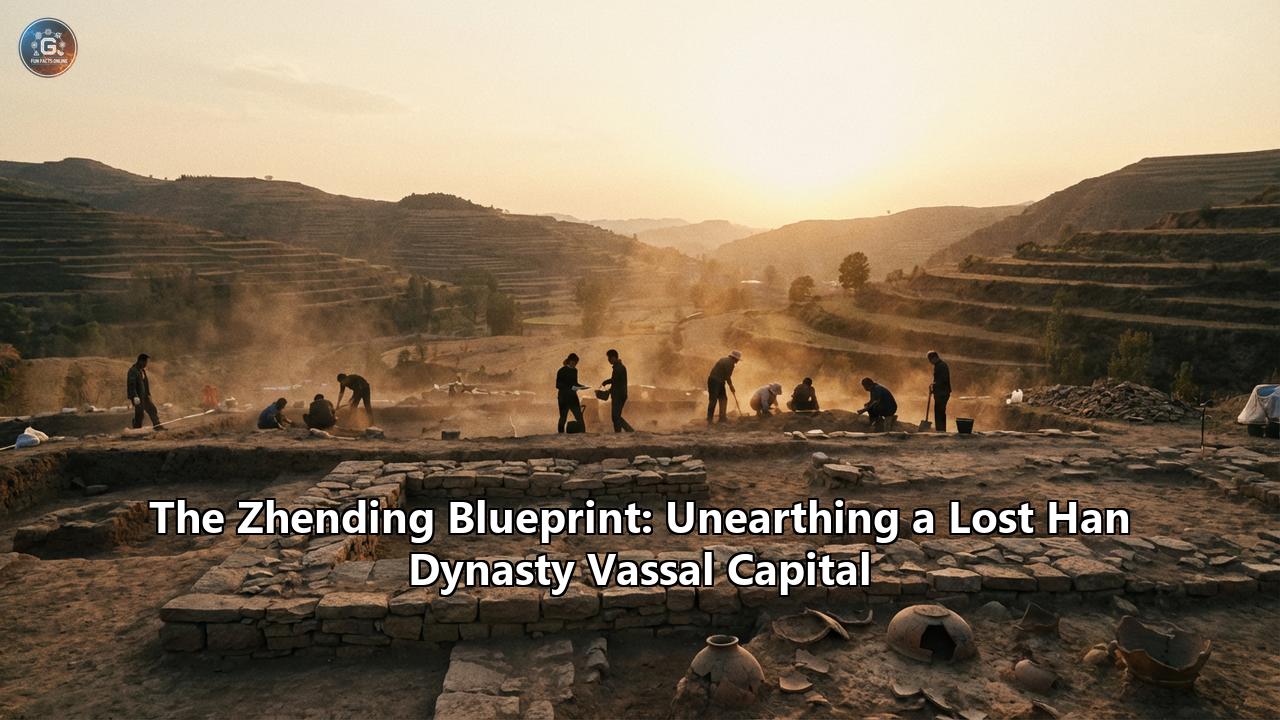
What emerged from the earth was not just a collection of potsherds or a few scattered coins. It was a phantom city, a sprawling urban ghost that had retained its skeleton long after its flesh had rotted away. This was the Dongyuan Ancient City (东垣古城), the lost capital of the Zhending Kingdom.
As archaeologists peeled back the layers of soil, they didn't just find a city; they found a blueprint. The "Zhending Blueprint" is more than just a map of walls and streets; it is a revelation of the political DNA of the Han Dynasty. It offers us a rare, high-definition glimpse into how the Han emperors projected their power into the provinces, how vassal kings lived in a perilous imitation of the imperial court, and how a single city in the dusty plains of Hebei once held the fate of China’s most celebrated dynasty in its hands.
This is the story of that city—its rise, its golden age of intrigue and romance, its forgotten daily life, and its spectacular resurrection.
Part I: The Anatomy of a Ghost City
The Unveiling
The discovery at Dongyuan was akin to finding a lost page in a favorite book—a page that suddenly makes the entire plot make sense. The site, covering a staggering 2.76 square kilometers, is not merely a ruin; it is a fossilized imprint of imperial ambition.
When the Hebei Provincial Institute of Cultural Relics and Archaeology announced their findings, the academic world was stunned by the clarity of the city's preservation. Unlike many ancient sites that are a jumble of overlaid eras, Dongyuan offered a pristine snapshot of the mid-to-late Western Han Dynasty (206 BC – 24 AD) and the early Eastern Han (25 – 220 AD).
The excavation revealed a city that was not grown organically from a village, but designed. It was a grid of power, a physical manifestation of the Confucian order that the Han Dynasty sought to impose on the world.
The Palace Complex: A Miniature Chang'an
The crown jewel of the excavation is the massive palace complex located in the central-northern part of the city. Measuring 125 meters from east to west and 23 meters from north to south, this was no provincial governor's residence. This was a royal court.
The foundations are constructed of rammed earth (hangtu), a technique where layers of soil are pounded until they are as hard as stone. This method, labor-intensive and costly, was the hallmark of elite construction in ancient China. The sheer scale of the rammed earth platforms at Dongyuan suggests structures that would have towered over the surrounding plains, visible for miles—a psychological weapon as much as an architectural one.
Archaeologists uncovered brick-paved floors that still bore the sheen of use, extensive corridors that once whispered with court gossip, and sophisticated drainage systems that speak of a city obsessed with order and hygiene.
But the most telling artifact was a simple building material: the eave tile.
In the debris of the palace, researchers found circular tile ends inscribed with the characters "Zhending Changle" (真定长乐) and "Fuchang Changle" (Wealth and Prosperity, Eternal Joy).
To the untrained eye, these are just pleasant well-wishes. To a historian, they are a bombshell.
"Changle" (Eternal Joy) was the name of the Changle Palace in the imperial capital of Chang'an, the residence of the Empress Dowager and one of the most sacred sites of Han power. By stamping "Zhending Changle" on their roof tiles, the Kings of Zhending were not just wishing for happiness; they were explicitly linking their authority to the imperial center. They were declaring their capital to be a "Little Chang'an," a mirror image of the emperor's seat. It was a statement of loyalty, yes, but also of immense pride and near-imperial pretension.
The Urban Grid
Beyond the palace, the "Zhending Blueprint" reveals a city divided by function. The layout follows the classic Chinese principle of cheng (walls) and shi (markets). A crisscrossing network of wide roads dissected the city into functional zones.
To the south and west of the palace lay the residential districts, where the city's elite would have lived in multi-story compounds. Further out were the workshops. Excavations have identified pottery kilns and metal-casting sites, the industrial engines that kept the city running. These were not small-scale operations; they were state-controlled industries producing weapons, tools, and the endless stream of ceramic vessels needed for daily life and ritual burial.
Outside the city walls, archaeologists found two large cemeteries. The placement of the dead was as regulated as the living, with clearly defined hierarchies visible in the size and richness of the tombs. This strict zoning is the "blueprint" in action—a city where every person, living or dead, had their assigned place in the cosmic and social order.
Part II: The Kingmaker and the Restoration
To understand why this provincial city was built with such grandeur, we must travel back to one of the most turbulent periods in Chinese history: the fall of the Western Han and the rise of the Eastern Han.
The Dongyuan Ancient City was the stage for a drama that would determine the course of Chinese history for the next two centuries. The protagonist was Liu Yang, the King of Zhending.
The Crisis of Legitimacy
In 9 AD, the usurper Wang Mang seized the throne, ending the Western Han Dynasty and establishing his own Xin Dynasty. The Liu imperial clan was decimated, stripped of their titles, and scattered. The vast empire fractured into chaos, with peasant rebellions—the "Red Eyebrows" and "Green Forests"—tearing the countryside apart.
In this vacuum of power, Zhending became a fortress of stability. The Liu family, who had ruled Zhending as a vassal state since the time of Emperor Jing, managed to hold onto their local power base.
Enter Liu Yang (刘杨). He was a direct descendant of the Han emperors, a man of royal blood with a distinct advantage: an army. While other pretenders to the throne were scrambling for support, Liu Yang sat securely behind the high walls of his capital, commanding a force of over 100,000 troops. He was the "King of Zhending" in all but name, a warlord with a royal pedigree.
The Arrival of the Dragon
In 23 AD, a young and charismatic member of the Liu clan, Liu Xiu (the future Emperor Guangwu), arrived in the region. He was ostensibly on a mission to pacify the north for the Gengshi Emperor, a rival claimant. But Liu Xiu was in a precarious position. He was outnumbered, underfunded, and surrounded by enemies, including a pretender named Wang Lang who had declared himself emperor in nearby Handan.
Liu Xiu needed a miracle. He needed Zhending.
The meeting between Liu Xiu and Liu Yang at the Zhending capital was one of history’s great turning points. Liu Yang held all the cards. He could have crushed Liu Xiu and claimed the throne for himself, or joined Wang Lang. Instead, he saw something in the young general.
But ancient alliances were rarely built on trust alone; they were built on blood.
The Deal
To seal the alliance, Liu Yang offered his niece, Guo Shengtong, in marriage to Liu Xiu.
This was no simple wedding. It was a merger of military might and imperial legitimacy. Guo Shengtong was a woman of exceptional pedigree—her father was a wealthy landowner and her mother was a Han princess. By marrying her, Liu Xiu gained not just a wife, but the 100,000 swords of the Zhending army.
With the Zhending forces at his back, Liu Xiu swept through the north. He crushed Wang Lang, pacified the peasant rebels, and in 25 AD, proclaimed himself Emperor Guangwu, the restorer of the Han Dynasty.
The city of Zhending had played its hand perfectly. It was now the hometown of the Empress, the power base of the new dynasty's military, and the "maternal home" of the restoration. The "Zhending Blueprint" had proven its worth not just as a city plan, but as a political strategy.
Part III: The Tragedy of the Two Empresses
If the walls of Dongyuan could speak, they would tell a story of two women: the one who helped build an empire, and the one who stole the Emperor’s heart.
The rise of Zhending came with a hidden cost, manifested in the rivalry between Empress Guo Shengtong and Yin Lihua.
The Political Empress
Guo Shengtong, the niece of the Zhending King, was the first Empress of the Eastern Han. She bore Liu Xiu his first son, Liu Jiang, who became Crown Prince. For years, she reigned supreme. Her family, the Guos of Zhending, were showered with titles and wealth. Their capital city flourished, expanding and beautifying to reflect its status as the "second home" of the imperial family.
But her marriage was a political transaction. Liu Xiu had another wife—his childhood sweetheart, Yin Lihua, whom he had married before he needed the Zhending army. When he became Emperor, he wanted to make Yin his Empress, but the political reality of Zhending's military power forced his hand. He made Guo the Empress and Yin a consort.
The Rebellion of Liu Yang
The golden age of Zhending was threatened from within. In 26 AD, just a year after the restoration, rumors reached the Emperor that Liu Yang, the King of Zhending and the Empress's uncle, was plotting a rebellion.
It is a mystery that historians still debate. Was Liu Yang truly rebelling? Or had he simply become too powerful, a "kingmaker" who overshadowed the King? Some records suggest he was using distinct talismans and prophecies to claim he was destined to rule.
Emperor Guangwu acted with ruthless efficiency. He sent generals to Zhending, not to fight, but to negotiate. During a meeting, Liu Yang was assassinated.
In a normal timeline, this would have meant the extermination of his clan. But Liu Xiu was a pragmatic ruler, and Guo Shengtong was still his Empress. He spared the Zhending family, allowing Liu Yang’s son to inherit a reduced title. The city of Zhending was spared the torch, but the shadow of suspicion had fallen over its rammed-earth walls.
The Fall of Guo
For 16 years, Guo Shengtong sat on the Phoenix Throne. But as the Zhending military faction’s influence waned and the empire stabilized, Liu Xiu’s heart began to govern his head. He grew increasingly distant from Guo, citing her "resentful behavior."
In 41 AD, in an unprecedented move, Emperor Guangwu issued an edict deposing Empress Guo. He claimed she lacked the virtue of a "mother of the state." He installed his true love, Yin Lihua, as Empress.
Guo Shengtong was not killed—a rarity in Chinese history. She was demoted to the "Princess Dowager of Zhongshan" and allowed to live out her days in comfort, likely back in the region of her birth. But the political centrality of Zhending was broken. The city that had birthed the dynasty’s power was slowly pushed to the periphery, its "blueprint" for dominance rendered obsolete by the shifting affections of the Emperor.
Part IV: Life in the Vassal Capital
While kings and emperors played their game of thrones, life in the Zhending capital hummed with a vibrancy that rivaled Chang'an itself. Thanks to the "Zhending Blueprint" and the nearby excavation of the Mancheng Han Tombs (resting place of Liu Sheng, a related Han prince), we can reconstruct the daily existence of the city’s inhabitants in vivid technicolor.
The Architecture of Luxury
The palace at Dongyuan was a sensory experience. The rammed earth walls would have been plastered and painted, likely in the auspicious red of the Han court. The roof tiles, with their "Eternal Joy" inscriptions, capped heavy timber roofs that curved gracefully towards the sky.
Inside, the floors were not cold dirt but paved with patterned bricks. These bricks were often hollow, designed to insulate against the biting Hebei winters and the humid summers. The layout included vast halls for audiences, intimate chambers for the harem, and towering que (gate towers) that served as watchtowers and status symbols.
A World of Jade and Lacquer
The elite of Zhending lived in a world of exquisite craftsmanship. If we look to the artifacts of the region, we see a society obsessed with the afterlife and the preservation of the body.
The Jade Burial Suits, found in the tombs of Han princes like Liu Sheng, were likely manufactured in workshops within or near Zhending. These suits, made of thousands of plaques of jade sewn together with gold thread, were believed to prevent the body from decaying. The presence of such craftsmen in the city implies a highly specialized workforce of lapidaries and goldsmiths.
Daily life was equally opulent. The Zhending nobility dined off lacquerware, a material more valuable than bronze. These cups and plates were painted with red and black swirls, depicting clouds, dragons, and immortals. They drank wine fermented from millet or rice, playing drinking games with 18-sided dice (embedded with gold and silver) and tossing bronze tokens into pots—a game called touhu.
The Light of the Palace
One of the most famous artifacts from this region and era is the Changxin Palace Lantern. While found in the nearby Mancheng tomb, it bears the inscription of the "Changxin Palace"—the residence of the Empress Dowager. It is highly probable that similar masterpieces of bronze engineering illuminated the nights in the Zhending palace.
Imagine the King of Zhending sitting in his hall, the gilded shutter of a bronze lantern adjusted to cast a beam of light on a bamboo scroll, while the smoke was cleverly funneled into the lamp’s body to keep the air clean. This was a civilization that married high art with high utility.
The Sound of the City
The streets of Zhending would have been a cacophony of commerce. The "market" section of the blueprint reveals a city that traded far and wide. Iron tools from local foundries, ceramics from the kilns, and silks from the south would have changed hands here.
The sound of the zheng (zither) and the zhong (bells) would drift from the palace district, where musicians entertained the court with the solemn, ritualistic music of the Confucian rites, interspersed with the livelier folk songs of the Yan and Zhao regions—songs known for their mournful, heroic melodies.
Part V: The Lost Engineering
The "Zhending Blueprint" is also a marvel of ancient engineering. The excavation of Dongyuan reveals a city that fought against the elements.
The Water System
Shijiazhuang sits on the alluvial fan of the Taihang Mountains. Water management was critical. The city planners of Zhending built an intricate system of ceramic drainage pipes. These were not crude ditches but interlocking pottery tubes, some laid beneath the brick floors of the palace, others running along the broad avenues.
They gathered rainwater and wastewater, channeling it out of the residential zones and into the moat that surrounded the city. This focus on sanitation was a key feature of Han urbanism, preventing the disease outbreaks that plagued many ancient cities.
The Defense Network
The city was a fortress. The rammed earth walls were likely over 10 meters high, thick enough to drive a chariot along the top. The gates were the weak points, and so they were fortified with barbicans and archer towers.
The "Zhending Blueprint" shows a city designed for war as much as for peace. This was necessary; the Hebei plain was the highway for nomadic invasions from the north. The Xiongnu were a constant threat, and a vassal capital like Zhending was the first line of defense for the Imperial heartland.
Part VI: The Great Shift and the Vanishing
If Zhending was so magnificent, why was it lost?
The answer lies in the shifting sands of politics and geography.
The Rise of the "New" Zhending
Following the deposition of Empress Guo and the demotion of the Zhending kings, the city’s prestige began to wane. But the death blow was likely environmental and administrative.
In the chaotic years of the late Han and the Three Kingdoms period, the region was a battleground. Warlords like Yuan Shao and Gongsun Zan fought across these plains. The old city of Dongyuan, damaged by war and perhaps suffering from the silting of local waterways, became less viable.
During the Sui and Tang Dynasties, the administrative center was moved a few kilometers to the north, to what is today the "Zhengding Ancient City" (正定). This new city became the site of the famous Longxing Temple and the pagodas that tourists visit today.
As the bureaucrats and the merchants moved to the new Zhengding, the old capital of Dongyuan was abandoned. Its palaces were stripped of their timber and tiles to build the new city. The rammed earth walls slowly eroded into mounds, eventually being flattened by farmers to create fields for wheat and corn.
By the 20th century, the "Grand Capital" was nothing more than a few bumps in the landscape of a village named Dongyuan. When the modern city of Shijiazhuang exploded in size during the industrial boom, the site was almost swallowed by the urban sprawl.
The Rediscovery
It was only the diligent work of the Hebei Provincial Institute of Cultural Relics and Archaeology that saved the site from oblivion. As Shijiazhuang planned its subway lines and new districts, the "save" archaeologists went in.
What they found confirmed the legends. The sheer density of the tile shards, the massive scale of the foundations, and the undeniable stamp of "Changle" proved that this was the lost seat of the Zhending Kings.
Conclusion: The Legacy of the Blueprint
The unearthing of the Dongyuan Ancient City is more than just an archaeological triumph; it is a restoration of memory.
For too long, the history of the Han Dynasty has been viewed through the lens of the imperial capitals, Chang'an and Luoyang. The "Zhending Blueprint" forces us to look at the periphery, to the vassal kingdoms that were the muscles and sinews of the empire.
It tells us that the Han culture was not just a monolith radiating from the center, but a replicated network of "mini-capitals," each with its own court, its own economy, and its own ambitions. Zhending was a city that dared to dream it could be a Kingmaker. It was a city that produced an Empress, saved a Dynasty, and then paid the price for its own power.
Today, as you walk the streets of modern Shijiazhuang, with its high-speed trains and skyscrapers, it is humbling to think that beneath your feet lies the ghost of another metropolis. A city of rammed earth and high ambition, where the "Eternal Joy" of the Han Dynasty still echoes in the broken tiles of a lost palace.
The Zhending Blueprint has been unearthed, and with it, the lost soul of Hebei’s ancient glory.
Epilogue: Visiting the Ghost City
While the Dongyuan site is currently an active archaeological zone, plans are underway to transform it into the Dongyuan Ancient City Archaeological Site Park. In the coming years, visitors will be able to walk the ancient grid, stand on the rammed earth platforms where King Liu Yang once plotted the future of China, and see the "Zhending Changle" tiles that whispered of imperial dreams. Until then, the artifacts from the site are finding their way to the Hebei Museum, joining the jade suits and bronze lanterns of Mancheng to tell the complete story of the Han Dynasty’s northern stronghold.Reference:
- https://nga.gov.au/exhibitions/life-in-the-emperors-tomb/
- https://www.chinadailyasia.com/hk/article/626979
- https://global.chinadaily.com.cn/a/202601/13/WS6965898da310d6866eb3351d.html
- https://www.quora.com/Why-did-the-An-Lushan-Rebellion-cause-the-Tang-dynasty-to-decline-and-never-recover-its-golden-period
- https://exhibitions.asianart.org/exhibitions/tomb-treasures-new-discoveries-from-chinas-han-dynasty/
- https://news.cgtn.com/news/2019-09-05/A-glimpse-of-the-past-The-lavish-burial-custom-in-Han-Dynasty-JIyVy7Zh4Y/index.html