
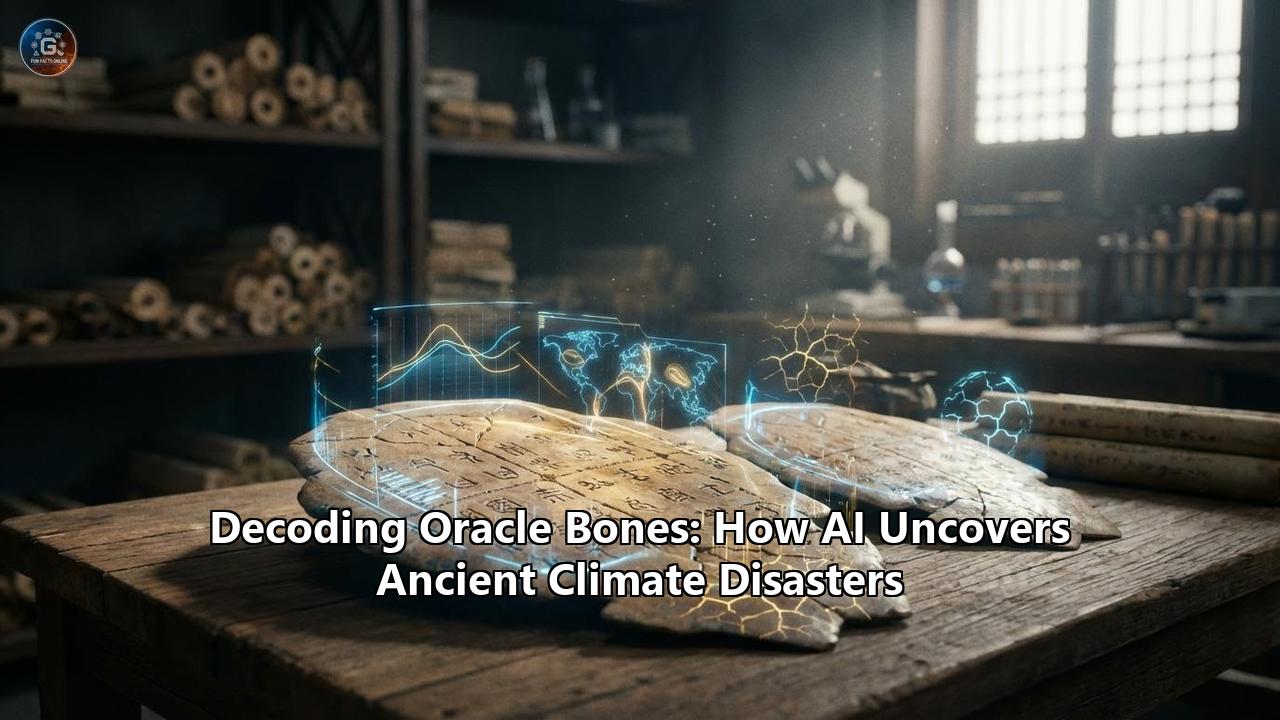
The flickering light of a bronze brazier casts long shadows across the earthen floor of a royal chamber. A diviner, draped in the ceremonial garb of the Shang Dynasty, holds a heated bronze rod to the polished belly shell of a tortoise. As the bone cracks with a sharp snap, the diviner traces the splintered lines to read the will of the heavens. Will the rains come? Will the river rise? Will there be disaster? He then carves the question, and the cosmic answer, into the shell.
This scene played out over 3,000 years ago in the Central Plains of China. Today, those carved fragments—known as oracle bones—are recognized as the earliest known systemic Chinese writing, bearing witness to the dawn of East Asian recorded history. But for over a century, these fragmented remnants have guarded their secrets fiercely. Only a fraction of their texts have been fully deciphered by human scholars, leaving gaping holes in our understanding of the ancient world.
That is, until artificial intelligence entered the excavation site.
By turning ancient divination into massive, computable datasets, modern researchers have deployed cutting-edge AI and machine learning models to decipher these enigmatic scripts. In doing so, they have unlocked a forgotten chapter of human history. Recent breakthroughs have revealed that these 3,000-year-old "hard drives" contain the desperate records of a society battling an existential threat: catastrophic climate change. Through the lens of artificial intelligence, we are now watching the ancient world grapple with mega-typhoons, intense El Niño events, and societal collapse—an eerie mirror to our own modern climate anxieties.
The First Information Revolution
To understand the magnitude of this technological achievement, we must first understand the medium. Between 1250 and 1046 B.C., the Shang Dynasty ruled the Yellow River valley in what is now central China. They were a sophisticated bronze-age civilization, wielding enormous power, wealth, and military might. But their true superpower was the invention of a radical new technology: writing.
The Shang utilized pyromancy—divination by fire. They used the scapulae (shoulder blades) of oxen and the plastrons (belly shells) of turtles as a communicative bridge to their ancestors and deities. Over 160,000 of these oracle bones have been unearthed since 1899, predominantly around the ancient capital city of Anyang. They cover an incredible breadth of human experience, detailing royal lineages, military campaigns, agricultural harvests, dental aches, and, overwhelmingly, the weather.
Yet, the study of oracle bones is a famously agonizing endeavor. Imagine trying to assemble a million-piece jigsaw puzzle where the pieces are scattered across global museums, many are crushed into fingernail-sized fragments, and the image on the puzzle is a language that hasn't been spoken in three millennia. Of the roughly 4,500 distinct oracle bone characters discovered, human paleographers have only been able to conclusively decipher about a third.
For decades, the field of oracle bone decipherment advanced at a glacial pace. Scholars relied on manual ink rubbings, painstakingly comparing archaic strokes with modern Chinese characters. It was a discipline governed by subjective judgment and immense historical attrition. But the dawn of the AI era has abruptly shifted the paradigm.
Enter the Silicon Diviners
The challenge of the oracle bones is essentially a massive data-processing problem—exactly the kind of puzzle that modern neural networks devour. Over the past few years, major tech giants and academic institutions have launched digital restoration projects to unearth the meaning behind the remaining unrecognized characters.
One of the most foundational tasks in this digital archaeology is simply figuring out which broken pieces belong together, a process known as conjugation. Researchers from universities across China have deployed Convolutional Neural Networks (CNNs) to classify oracle bone morphology. Before AI can read a word, it must determine if a fragment belongs to a turtle shell or an ox bone, as mixing the two would corrupt the textual sequence. The algorithms analyze the cellular texture and curvature of the bone fragments at a microscopic level, digitally reattaching shards that have been separated for 3,000 years.
Once the "hardware" is reassembled, the "software" decoding begins. Unsupervised machine learning models like "Bone2Vec" have completely revolutionized character analysis. Because the original scribes carved the bones by hand, variations in handwriting made standardization nearly impossible. But Bone2Vec can extract vertical and horizontal strokes to cluster characters into discernible patterns. In a fascinating 2024 study, this algorithm was even able to determine the dominant hand of the scribes, revealing that the vast majority of ancient Shang diviners were right-handed.
The scale of AI application has only accelerated. By late 2025 and early 2026, Chinese tech titan Tencent partnered with the AI research institute of Xiamen University to integrate large language models—including architectures like DeepSeek and Tencent's own Hunyuan—to build the world's largest multimodal dataset of oracle bone inscriptions. This staggering database contains 1.43 million ideographic characters and pixel-level aligned rubbings, turning fragmented ink blobs into crisp, high-dimensional data. Similarly, Microsoft Research Asia collaborated with Capital Normal University to develop AI models capable of restoring blurred characters and finding astronomical links, such as ancient meteor showers and solar eclipses.
By training these sophisticated algorithms on the known database of characters, the AI acts as a digital Rosetta Stone. It highlights spatial relationships between symbols, predicts missing characters based on contextual sequences, and flags recurring atmospheric phenomenons. When AI was unleashed on the weather-related characters of the Shang dynasty, the results were apocalyptic.
"Will There Be a Disaster?"
For a long time, historians believed the Shang Dynasty fell to the invading Zhou people primarily due to political corruption and military overextension. However, when scientists unleashed pattern-recognizing AI on over 55,000 pieces of weather-related oracle bone scripts spanning the dynasty's final two centuries (1250 to 1046 B.C.), a terrifying new variable emerged.
According to landmark research published in Science Advances in March 2026, the oracle bones revealed a society experiencing a total climate meltdown.
First, the AI helped researchers quantitatively analyze the frequency and context of specific weather terms. They discovered a massive, statistically abnormal spike in divinations regarding heavy rains and water-related disasters during the middle-to-late period of the era. The ancient rulers were panicked. They were repeatedly carving questions like, "Will there be a disaster?" and "Is this rain auspicious?".
The characters themselves paint a grim picture. AI pattern recognition helped clarify that the Shang character for "disaster" specifically resembled a series of cresting, violent water waves. Another frequently appearing character, resembling a locust, was used interchangeably to represent both the autumn harvest season and devastating locust plagues—which historically followed severe droughts.
By constructing ~200-year indexes representing drought, flood, and rainfall conditions from these AI-processed scripts, researchers obtained an uninterrupted climate record straight from the Bronze Age. The data proved that extreme weather events were abruptly intensifying. But what was causing this prehistoric climate crisis?
To find out, paleoclimatologists cross-referenced the AI-decoded oracle bone data with geological and meteorological evidence. They looked at sediment layers, tree rings, and ancient ground water levels. The archaeological data mirrored the oracle bones perfectly: flood layers in the Chengdu Plain (home to the neighboring Shu kingdom) confirmed that massive inundations were wiping out settlements concurrently with the Shang's scribal panic.
The culprit, it turns out, was a devastating combination of intense, millennial-scale El Niño activities and mega-typhoons.
Mega-Typhoons and the Fall of an Empire
Today, we understand the El Niño-Southern Oscillation (ENSO) as a periodic fluctuation in sea surface temperatures that radically disrupts global weather. Through modern physics-based modeling integrated with the oracle bone records, scientists concluded that around 3,000 years ago, inland China was subjected to a deadly era of extreme coastal typhoons.
These typhoons pushed deep into the Central Plains—the "cradle of Chinese civilization"—bringing with them astronomical levels of rainfall. To put this in perspective, the models show that these ancient mega-typhoons would have dumped rainfall comparable to modern catastrophic floods. The Yellow River, known historically as "China's Sorrow" for its lethal propensity to overflow, would have transformed into a relentless, destructive force, annihilating crops, drowning livestock, and washing away entire urban centers.
Simultaneously, the volatile El Niño patterns triggered severe, prolonged droughts in the region. When El Niño creates north wind anomalies, it chokes off the water vapor supply to northern China, leading to arid conditions. The oracle bones vividly documented this whiplash effect. The Shang people were trapped in a horrifying cycle: crippling droughts that birthed locust plagues capable of stripping the land bare, followed immediately by typhoon-induced mega-floods that destroyed whatever was left. The AI models noted that the oracle bone indexes for "flood" and "drought" would sometimes spike simultaneously, pointing to rapid, violent swings in climate extremes.
The resulting societal upheaval was absolute. Facing starvation, displacement, and a loss of faith in their rulers (whose primary job was to divine and appease the weather gods), the Shang population experienced an abrupt, massive drop. The extreme climatic stress acted as a threat multiplier, fatally weakening the dynasty's infrastructure and military. When the Zhou armies marched on the Shang capital, they were conquering a civilization that had already been brought to its knees by the atmosphere.
A Warning from the Bronze Age
The irony of this discovery is profound. The Shang dynasty attempted to control their future by carving data into bone, creating a permanent archive of their civilization's struggles. Now, an entirely new form of intelligence—one built on silicon and deep learning—is reading those archives to warn us about our own future.
The intersection of artificial intelligence and landscape archaeology is fundamentally rewriting human history. Traditional archaeology has always been constrained by human limitations: the speed at which we can dig, the subjective biases in how we interpret artifacts, and our inability to mentally process millions of data points simultaneously. AI removes these bottlenecks. By correlating 3,000-year-old carved turtle shells with advanced paleoclimate models, satellite LiDAR imagery, and deep-learning linguistics, we are no longer just guessing at history; we are quantifying it.
But beyond the technological marvel of algorithms parsing ancient dialects lies a stark, deeply human resonance. The oracle bones remind us that we are not the first society to look up at the sky in fear of changing weather patterns. The Shang kings, sitting in their palaces surrounded by the finest bronze and jade the ancient world had ever seen, could not buy their way out of a shifting climate. Their civilization was pushed to the brink by typhoons and droughts, and their desperate pleas to the heavens remain etched in bone as a testament to their vulnerability.
Today, as sea levels rise and extreme weather events become the defining feature of our century, we are engaged in our own frantic data collection. We build supercomputers and train vast neural networks to model incoming storms, map ocean currents, and predict agricultural yields. We are, in essence, practicing a high-tech form of pyromancy—reading the data to ask the very same question the ancient diviners asked: Will there be a disaster?
By decoding the oracle bones, AI has not just solved an ancient linguistic mystery. It has resurrected the voices of a fallen empire, providing an urgent, 3,000-year-old case study on the catastrophic societal impacts of climate extremes. The Shang dynasty's final, desperate logs have finally been read. It is now up to us to heed their warning.
Reference:
- https://www.livescience.com/archaeology/ancient-china/climate-disasters-caused-societal-upheaval-3-000-years-ago-in-china-study-of-oracle-bones-hints
- https://arxiv.org/html/2407.03900v1
- https://chinain5.substack.com/p/the-oracle-bone-legacy-how-anyang
- https://www.livescience.com/animals/science-news-this-week-cannibal-orcas-in-russia-oracle-bones-that-reveal-climate-disaster-in-ancient-china-humming-black-holes-and-a-barefoot-volcanologist
- https://eartharxiv.org/repository/view/4878/
- https://eartharxiv.org/repository/object/4878/download/9692/
- https://fhnews.az/en/news/dunya/climate-disasters-caused-societal-upheaval-3000-years-ago-in-china-study-of-oracle
- https://news.microsoft.com/source/asia/features/microsoft-university-researchers-use-ai-to-aid-in-study-of-ancient-script-on-chinas-oracle-bones/
- https://window-to-china.de/2025/11/05/ai-helps-to-decipher-oracle-bone-characters-2/
- https://medium.com/syncedreview/chinese-researchers-use-cnns-to-classify-3000-year-old-oracle-bone-scripts-b3404e3771d7
- https://www.oreateai.com/blog/when-ai-technology-meets-ancient-civilizations-from-oracle-bone-script-deciphering-to-cultural-heritage-in-the-intelligent-era/0ecaa354a0bcb9d7d5477d7a2e36739e
- https://singularityhub.com/2020/05/07/the-new-indiana-jones-ai-heres-how-its-overhauling-archaeology/
- https://www.scmp.com/news/people-culture/article/3278486/recent-study-ancient-chinese-oracle-bones-highlights-how-ai-changing-archaeology
- https://www.researchgate.net/publication/366911533_Oracle_bone_script_records_explain_the_impact_of_climate_extremes_in_ancient_China