
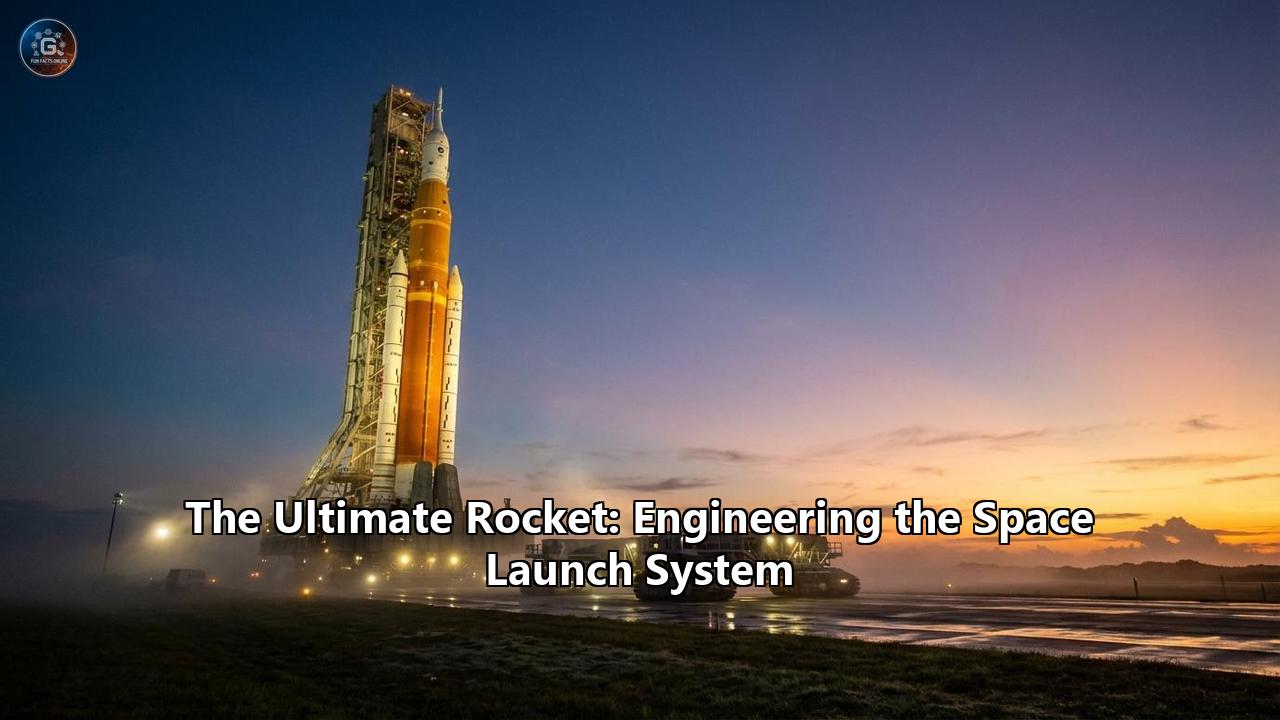
The roar of a rocket is not merely sound; it is a profound physical event, a seismic wave that hammers the chest and reverberates through the ground for miles. When the Space Launch System (SLS) ignites, it generates 8.8 million pounds of thrust, unleashing an inferno that briefly creates its own localized weather system. This immense leviathan is the backbone of NASA’s Artemis program, the most ambitious deep-space exploration initiative of the 21st century. Designed to return humanity to the Moon and eventually forge a path to Mars, the SLS is a machine of contradictions—a futuristic spacecraft built upon the legacy hardware of the Space Shuttle era, a marvel of modern aerospace engineering, and the subject of intense political and economic debate.
To understand the Space Launch System is to understand the extreme limits of materials science, fluid dynamics, and orbital mechanics, as well as the intricate dance of congressional funding and aerospace procurement. As of early 2026, the SLS stands at a critical juncture. The triumphant uncrewed flight of Artemis I in 2022 proved the vehicle's immense capabilities, and the aerospace world now holds its breath as the crewed Artemis II mission prepares for its historic launch. Simultaneously, sweeping changes to the rocket's future design have redefined the architecture of human spaceflight for the next decade.
Here is the ultimate, comprehensive guide to the engineering, history, and future of the Space Launch System.
Genesis of a Leviathan: From Constellation to SLS
The origins of the Space Launch System are deeply rooted in the ashes of a canceled dream. In the mid-2000s, NASA’s Constellation program aimed to replace the aging Space Shuttle fleet with two new rockets: the Ares I for crew and the Ares V for heavy cargo. However, by 2010, the Augustine Commission—a panel of aerospace experts convened to review the program—concluded that Constellation was severely behind schedule and fundamentally underfunded. The Obama administration subsequently canceled the Constellation program, leaving a massive gap in America’s deep-space capabilities.
Congress, however, was unwilling to abandon the heavy-lift capability and the vast network of aerospace contractors and jobs distributed across the United States. The NASA Authorization Act of 2010 mandated the creation of a new heavy-lift launch vehicle that would repurpose Space Shuttle and Constellation technologies. The mandate explicitly directed NASA to utilize existing inventories of Space Shuttle Main Engines (SSMEs) and Solid Rocket Boosters (SRBs).
Because of its congressional origins, critics frequently derided the rocket as the "Senate Launch System," arguing that it was a jobs program designed to sustain legacy contractors like Boeing (handling the core stage), Aerojet Rocketdyne (handling the engines), and Northrop Grumman (manufacturing the solid rocket boosters). Yet, from an engineering standpoint, reusing proven, flight-tested hardware reduced the catastrophic risks associated with designing a super-heavy-lift vehicle entirely from scratch. The SLS was conceived not as a completely new invention, but as the ultimate evolution of the Space Shuttle's propulsion systems, stacked in-line rather than side-mounted.
Anatomy of the Core Stage: A Cryogenic Behemoth
At the center of the SLS is the Core Stage, the tallest rocket stage ever constructed by humanity. Built by Boeing at NASA’s historic Michoud Assembly Facility in New Orleans—the very same factory that built the Saturn V’s first stage and the Space Shuttle’s External Tanks—the Core Stage is an absolute monolith of aerospace manufacturing.
Dimensions and Construction
The Core Stage towers 212 feet (64.6 meters) high and measures 27.6 feet (8.4 meters) in diameter—matching the exact width of the Space Shuttle’s External Tank. Unfueled, it weighs approximately 188,000 pounds (85,275 kilograms). The structure is composed primarily of Aluminum 2219, a high-strength aerospace alloy. To assemble the immense barrel sections, domes, and rings, engineers at Michoud utilized self-reacting friction-stir welding, a state-of-the-art technique that uses frictional heat and mechanical pressure to seamlessly meld metals together without melting them, resulting in joints that are incredibly strong and free of defects.
The stage is divided into five primary sections: the forward skirt (housing avionics and flight computers), the liquid oxygen (LOX) tank, the intertank, the liquid hydrogen (LH2) tank, and the engine section. Like the Shuttle’s external tank, the entire exterior of the Core Stage is coated in a rust-colored spray-on polyurethane foam insulation. This foam prevents the super-chilled propellants from boiling off in the Florida heat and prevents the formation of heavy ice on the rocket's exterior, which could shed and damage the vehicle during ascent.
The Cryogenic Propellants
The lifeblood of the SLS is its cryogenic propellant. The Core Stage holds a staggering 537,000 gallons (over 2 million liters) of liquid hydrogen and 196,000 gallons (741,941 liters) of liquid oxygen. The temperatures required to maintain these elements in a liquid state are mind-boggling: −423°F (−252.8°C) for the liquid hydrogen and −297°F (−182.8°C) for the liquid oxygen.
The sheer thermal shock of loading these cryogens causes the aluminum structure of the Core Stage to literally shrink. When fully fueled, the liquid hydrogen tank contracts by about 6 inches (15 cm) in length and 1 inch (2.5 cm) in diameter, while the liquid oxygen tank shrinks by 1.5 inches (3.8 cm) lengthwise. The rocket's intricate plumbing, attach points, and fuel lines are all engineered with flexible joints and bellows to accommodate this immense thermal contraction without fracturing.
The Beating Heart: RS-25 Engines
Affixed to the bottom of the Core Stage are four RS-25 engines, built by Aerojet Rocketdyne (now L3Harris). These are not merely derived from the Space Shuttle; for the first several SLS flights, they are the actual engines that flew on the Space Shuttle. Following the retirement of the Shuttle fleet in 2011, NASA retained 16 flight-proven RS-25 engines. These historic engines, which safely carried astronauts to low Earth orbit for decades, have been refurbished and upgraded for the Artemis program.
Unmatched Performance and Specific Impulse
The RS-25 is widely considered the Ferrari of rocket engines. It operates on a fuel-rich dual-shaft staged combustion cycle, making it one of the most efficient liquid-fuel rocket engines ever devised. In rocketry, fuel efficiency is measured in "specific impulse" (Isp). The RS-25 boasts a phenomenal specific impulse of 452 seconds in a vacuum and 366 seconds at sea level.
Each engine generates 418,000 pounds of thrust at sea level and 512,000 pounds of thrust in a vacuum. The engines operate at 109% of their original Space Shuttle rated power level to accommodate the massive weight of the SLS. The internal conditions of the engine are apocalyptic: the high-pressure fuel turbopump (HPFTP) spins at over 35,000 revolutions per minute, generating upwards of 71,000 horsepower just to force the liquid hydrogen into the combustion chamber. Inside that chamber, the propellants burn at a temperature of 6,000°F (3,300°C)—hot enough to boil iron—yet the walls of the engine nozzle are kept from melting by circulating the ultra-cold liquid hydrogen through hundreds of microscopic cooling tubes lining the nozzle before it is combusted.
The Tragedy and Economics of Expendability
During the Space Shuttle era, the RS-25 engines were designed to be reusable. After each mission, the orbiters returned to Earth, and the engines were meticulously inspected, overhauled, and prepared for their next flight. However, the SLS is an expendable launch vehicle. Once the Core Stage completes its 500-second burn and pushes the Orion spacecraft toward orbit, the stage—along with its four priceless, historically significant engines—plummets back into the Earth's atmosphere and is destroyed over the Pacific Ocean.
Expendability fundamentally changes the economics of the engine. NASA and Aerojet Rocketdyne have recognized that overhauling a reusable engine for a single use is highly inefficient. Therefore, once the initial stockpile of 16 legacy Shuttle engines is depleted (which will occur after Artemis IV), NASA will transition to the RS-25E (Expendable). The RS-25E is currently in testing and utilizes modern manufacturing techniques, such as 3D printing and simplified flexible hosing (since the SLS engines do not need to gimbal, or pivot, as widely as the Shuttle engines did). These optimized expendable engines cost roughly 30% less to produce than their reusable predecessors, while actually outputting slightly more thrust, rated at 522,000 pounds per engine.
Riding the Fire: Solid Rocket Boosters (SRBs)
While the four RS-25 engines provide incredible efficiency and sustained thrust, they alone cannot lift the multi-million-pound SLS off the launch pad. To break the suffocating grip of Earth's gravity, the SLS relies on two massive Solid Rocket Boosters (SRBs), manufactured by Northrop Grumman.
Together, the twin SRBs provide more than 75% of the total 8.8 million pounds of thrust at liftoff. Each booster stands 177 feet tall, measures 12 feet in diameter, and weighs 1.6 million pounds when fully loaded.
The Five-Segment Upgrade
Like the core stage engines, the SRBs are heavily derived from the Space Shuttle program. However, to lift the heavier payloads of the Artemis missions, Northrop Grumman modified the traditional Shuttle booster by adding a fifth propellant segment.
The fuel inside these steel casings is a carefully cast mixture called polybutadiene acrylonitrile (PBAN). It has the consistency of a hard rubber eraser and burns with unparalleled ferocity. Once ignited, a solid rocket booster cannot be throttled down or turned off; it will burn until its fuel is completely exhausted. During the first 126 seconds of flight, each SLS booster burns through approximately six tons of PBAN propellant every single second.
The thrust profile of the five-segment booster is specifically tailored to the aerodynamics of the SLS. The hollow core of the solid fuel is shaped like an intricate star pattern near the top, which creates a massive surface area for initial ignition, producing peak thrust to clear the launch tower. As the booster climbs and the atmosphere thins, the internal shape of the burning propellant shifts to a simple cylinder, slightly lowering the thrust to prevent the rocket from tearing itself apart when it experiences Max-Q (the point of maximum aerodynamic pressure).
Like the RS-25 engines, the SLS solid rocket boosters are optimized for single-use. Whereas Shuttle boosters parachuted into the Atlantic Ocean for recovery and refurbishment by retrieval ships, the SLS boosters simply detach, fall away, and impact the ocean, ultimately sinking to the seafloor.
The Upper Stage Saga: From ICPS to the February 2026 Overhaul
The Core Stage and the SRBs are designed to get the payload out of the dense lower atmosphere and into a suborbital trajectory. Once those stages detach, the responsibility of pushing the Orion capsule all the way to the Moon falls to the upper stage. The evolution of the SLS upper stage has been one of the most turbulent and politically charged elements of the entire Artemis program, culminating in a massive architectural overhaul in early 2026.
The Block 1 Configuration and the ICPS
For the initial Artemis flights (Artemis I, II, and III), the SLS utilizes the Block 1 configuration. This version is topped with the Interim Cryogenic Propulsion Stage (ICPS), built by United Launch Alliance (ULA). The ICPS is a slightly modified version of the upper stage used on the commercial Delta IV rocket, powered by a single RL10 engine that produces roughly 24,800 pounds of thrust. While reliable, the ICPS is limited; it restricts the SLS Block 1's translunar payload capacity to about 27 metric tons. This is sufficient to send the Orion capsule to the Moon, but it cannot carry large co-manifested cargo, such as heavy habitat modules for the planned Lunar Gateway space station.
The Dream of the Exploration Upper Stage (EUS)
To solve this limitation, NASA contracted Boeing to build the Exploration Upper Stage (EUS) for the upgraded "Block 1B" and "Block 2" configurations of the SLS. The EUS was designed to be vastly larger, holding 284,000 pounds of liquid hydrogen and liquid oxygen, and powered by four RL10C-3 engines producing over 97,000 pounds of thrust. This would have increased the lunar payload capacity to an impressive 38 metric tons, allowing NASA to launch both the crewed Orion and a 10-ton cargo module simultaneously.
However, the EUS became a developmental nightmare. Plagued by chronic manufacturing issues and quality control problems at the Michoud Assembly Facility, the project schedule continuously slipped. A devastating 2024 report from NASA's Office of Inspector General (OIG) revealed that Boeing's development of the EUS was nearly seven years behind schedule. The contract cost had ballooned from an initial $962 million in 2017 to an estimated $2.8 billion. The OIG projected that the total cost of developing the SLS Block 1B upgrade would reach a staggering $5.7 billion before it even flew its first mission.
The February 2026 Shockwave: Pivoting to Centaur V
In 2025, during his second term, President Donald Trump released a budget proposal that threatened to terminate the SLS and Orion programs entirely after Artemis III, citing the rocket's exorbitant $4 billion per-launch cost. Congress fought back, and on July 4, 2025, the "One Big Beautiful Bill Act" was signed into law. While this legislation secured funding for Artemis IV and V, it included a strict congressional directive forcing NASA to investigate commercially available alternatives to the delayed and over-budget Exploration Upper Stage.
This political and financial pressure reached a climax on February 26, 2026. NASA Administrator Jared Isaacman officially announced the outright cancellation of the Exploration Upper Stage, effectively killing the SLS Block 1B and Block 2 upgrade paths. Instead, Isaacman declared that NASA would standardize the SLS fleet on a "near-Block 1 configuration" to ensure a reliable and sustainable launch cadence.
To replace the ICPS and the canceled EUS, NASA formalized a contract to integrate United Launch Alliance’s Centaur V upper stage into the SLS architecture starting with Artemis IV. The Centaur V, which possesses a proven flight heritage from ULA's Vulcan rocket, offers a highly capable and cost-effective alternative. Furthermore, engineering evaluations from the Marshall Space Flight Center determined that the Centaur V was vastly superior in terms of infrastructure compatibility compared to other commercial options (such as Blue Origin's New Glenn upper stage). Crucially, the Centaur V requires only minor modifications to NASA's existing Mobile Launcher 1 (ML1) and easily fits within the height constraints of the Vehicle Assembly Building.
By pivoting to the Centaur V, NASA has sacrificed the maximum theoretical lift capacity of the EUS in favor of launch rate, cost control, and schedule reliability.
Artemis I: Triumph and the Heat Shield Anomaly
The incredible theoretical power of the SLS became reality on November 16, 2022, when Artemis I lifted off from Launch Complex 39B at the Kennedy Space Center. Launching an uncrewed Orion spacecraft, Artemis I successfully proved that the Core Stage, SRBs, and ICPS could execute perfectly. The SLS propelled Orion further into deep space than any human-rated spacecraft had ever traveled.
However, the mission was not without its engineering mysteries. Following Orion's splashdown in the Pacific Ocean on December 11, 2022, recovery teams noted unexpected damage to the spacecraft's heat shield. The heat shield is coated in a specialized ablative material called Avcoat, designed to slowly burn away and carry heat away from the capsule as it slams into the Earth's atmosphere at nearly 25,000 mph (39,590 km/h), enduring temperatures exceeding 5,000°F (2,760°C).
Engineers discovered that in over 100 specific locations on the shield, the Avcoat had not uniformly ablated as predicted; instead, large chunks of the charred material had cracked and liberated from the spacecraft. This "char loss" sparked a rigorous, months-long investigation.
To return from lunar velocity safely, Orion utilized a novel "skip-entry" maneuver. It dipped into the upper atmosphere to bleed off speed, literally skipped back out into space using aerodynamic lift, and then plunged back in for final descent. NASA ultimately identified that during this specific reentry profile, the heating rates early in the atmosphere were too low to properly "cook" the outer layer of Avcoat into a porous, permeable char. Later in the descent, as intense heat penetrated deeper into the shield, subterranean gases formed inside the Avcoat. Because the top layer had not become sufficiently porous, these gases became trapped. The internal pressure built up until it physically fractured the material, blowing chunks of the shield off the spacecraft.
Despite this violent shedding, the internal cabin temperatures of Orion never fluctuated, remaining safely in the mid-70s Fahrenheit. Still, NASA refused to risk human lives on the upcoming Artemis II mission without addressing the issue. By altering the entry trajectory parameters for Artemis II to ensure optimal heat soaking and char permeability, NASA successfully mitigated the risk, allowing the crewed mission to press forward.
Artemis II: The Crewed Return (Current March 2026 Status)
Right now, the world is watching the culmination of these engineering triumphs and fixes. Following a series of delays due to the heat shield analysis and ground system testing, the Artemis II mission is currently targeting a launch of No Earlier Than (NET) April 1, 2026.
Artemis II is the mission that changes everything. For the first time since Apollo 17 in December 1972, humanity will break the chains of low Earth orbit and venture into deep space. Riding atop the mighty SLS will be a crew of four: NASA astronauts Reid Wiseman (Commander), Victor Glover (Pilot), and Christina Koch (Mission Specialist), alongside Canadian Space Agency astronaut Jeremy Hansen (Mission Specialist).
The Road to the Pad
The preparations for the April 1 launch date have been intense. In late February 2026, during a critical countdown test known as a "wet dress rehearsal," engineers discovered an issue with the flow of helium used to purge propellant lines in the ICPS upper stage. Because the fault could only be accessed inside a controlled environment, NASA made the agonizing decision to roll the massive 11-million-pound SLS stack back from Pad 39B to the Vehicle Assembly Building (VAB).
Inside the VAB, technicians not only repaired the helium leak but refreshed the rocket's flight termination system batteries, replaced seals on the liquid oxygen feed lines, and charged the Orion launch abort system. With the hardware cleared, the final rollout began.
On the night of Thursday, March 19, and stretching into Friday, March 20, 2026, NASA’s legendary Crawler-Transporter 2 picked up the entire SLS rocket and its Mobile Launcher. Moving at a glacial 1 mile per hour along the crawlerway, the rocket made its triumphant four-mile return to Launch Complex 39B. Meanwhile, the Artemis II crew entered official quarantine in Houston to ensure flawless health leading up to their journey.
The 10-Day Lunar Flyby
When the SLS ignites on April 1, it will propel the crew on a 10-day mission. They will spend an initial period in Earth orbit, manually testing Orion's life support, communication, and piloting interfaces. Then, the ICPS upper stage will ignite one final time, hurling them on a free-return trajectory around the Moon. They will fly nearly 6,400 miles (10,300 km) beyond the far side of the lunar surface—further into deep space than any human beings have ever traveled. Relying entirely on gravity, this precise trajectory will automatically whip the spacecraft back toward Earth, culminating in a blistering reentry and a splashdown in the Pacific Ocean.
Artemis III, IV, and the Shifting Timeline
While Artemis II will return humans to lunar orbit, the goal of stepping foot on the lunar surface has been subject to immense architectural and political shifting. Originally, Artemis III was slated to be the historic mission that landed the first woman and next man on the Moon.
However, landing on the Moon requires a Human Landing System (HLS), which NASA has contracted to private companies—specifically SpaceX (using a modified Starship) and Blue Origin (using the Blue Moon lander). Delays in the development of these commercial landers, alongside the complexities of on-orbit propellant transfer, necessitated a dramatic overhaul of the Artemis flight manifest.
In late February 2026, NASA officially announced that Artemis III—now expected to launch in mid-2027—will no longer land on the Moon. Instead, it will be repurposed as a highly complex test mission in low Earth orbit. The SLS will launch the Orion crew capsule to rendezvous and dock with the commercial SpaceX Starship HLS and/or the Blue Origin Blue Moon lander right here in Earth orbit. This will allow astronauts to test the crucial docking mechanisms and the brand-new Axiom Extravehicular Mobility Unit (AxEMU) spacesuits without the profound risks of being 240,000 miles away from home. The mission profile has been heavily compared to Apollo 9, which tested the Lunar Module in Earth orbit prior to attempting a lunar descent.
The profound honor of the first lunar landing of the 21st century has now been shifted to Artemis IV, scheduled for early 2028. Artemis IV will be the first SLS mission to utilize the newly adopted ULA Centaur V upper stage, flying an Orion capsule directly to the Lunar Gateway, where a waiting commercial lander will take two astronauts down to the unexplored lunar South Pole.
The Economics and Controversies of the Ultimate Rocket
To appreciate the engineering of the SLS is to also acknowledge the bitter economic controversies that have plagued its existence. From its inception, the SLS has been criticized as being financially unsustainable. NASA’s Office of Inspector General has repeatedly warned that the operating costs of the SLS, combined with the Orion capsule and ground systems, exceed $4 billion per single launch.
In an era where commercial spaceflight companies like SpaceX are achieving rapid reusability and drastically lowering the cost of access to space, the expendable nature of the SLS has drawn immense scrutiny. When a Falcon Heavy or Starship launches, the booster lands to be flown again. When the SLS launches, billions of dollars of high-grade aerospace hardware, including four historic RS-25 engines, are intentionally destroyed in the ocean.
This dynamic reached a boiling point in May 2025, when the second Trump administration’s budget proposal explicitly targeted the SLS and Orion programs for cancellation after Artemis III, citing the $4 billion price tag as indefensible. It took massive congressional intervention via the "One Big Beautiful Bill Act" of July 2025 to secure the vehicle's survival for Artemis IV and V, though this came at the cost of sacrificing Boeing's Exploration Upper Stage in favor of the much cheaper commercial Centaur V alternative.
Defenders of the SLS point out that commercial rockets, while cheaper, currently do not possess the integrated, human-rated deep space lift capacity that the SLS provides right now. The SLS is a known quantity—it has flown, it works, and it offers unmatched payload mass and volume for direct-to-moon trajectories without requiring complex in-orbit refueling architectures. The "Senate Launch System" may have been born of political compromise, but the physical vehicle standing on Launch Pad 39B is an undeniable masterpiece of brute-force engineering.
Conclusion
As the countdown clock ticks toward April 1, 2026, the Space Launch System represents the pinnacle of humanity's mechanical reach. It is a bridge between eras. In its tanks and engines, it carries the physical remnants of the Space Shuttle, honoring a generation of low-Earth-orbit exploration. In its payload fairings and mission profile, it points squarely toward the Moon and the Martian horizons beyond.
The SLS has survived program cancellations, intense political budget wars, manufacturing crises, and harsh economic scrutiny. The engineering modifications forced upon it—from the meticulous reworking of Orion's heat shield to the dramatic integration of the ULA Centaur V upper stage—demonstrate a space agency learning to balance ambition with pragmatic survival.
When those twin solid rocket boosters ignite and the four RS-25 engines scream into the Florida sky, the debates over cost and politics will momentarily vanish, drowned out by 8.8 million pounds of thrust. The Space Launch System is not just a rocket; it is the physical manifestation of our collective will to return to the deep dark. It is the vessel that will ferry the next generation of explorers back to the lunar surface, firmly cementing its legacy as the ultimate rocket of our time.
Reference:
- https://www.nasa.gov/reference/sls-space-launch-system-block-1b/
- https://spaceflightnow.com/2021/04/29/core-stage-for-nasas-first-space-launch-system-rocket-towed-into-vehicle-assembly-building/
- https://en.wikipedia.org/wiki/Artemis_program
- https://en.wikipedia.org/wiki/Artemis_III
- https://www.apollothirteen.com/article/nasa-replaces-sls-upper-stage-with-ula-centaur-5/
- https://en.wikipedia.org/wiki/Artemis_II
- https://en.wikipedia.org/wiki/Exploration_Upper_Stage
- https://en.wikipedia.org/wiki/Space_Launch_System_core_stage
- https://en.wikipedia.org/wiki/Space_Launch_System
- https://spacepolicyonline.com/news/nasa-ig-blasts-boeing-on-block-1b/
- https://www.nasa.gov/reference/space-launch-system-core-stage/
- https://www.airport-technology.com/projects/nasas-space-launch-system/
- https://www.l3harris.com/all-capabilities/rs-25-engine
- https://www.quora.com/How-much-thrust-does-an-SLS-RS-25-engine-produce-Is-it-enough-to-lift-the-spacecraft-without-the-use-of-solid-boosters
- https://en.wikipedia.org/wiki/RS-25
- https://encyclopedia.pub/entry/30884
- https://www.slideshare.net/slideshow/space-launch-system-solid-rocket-booster/255088773
- https://www.nasa.gov/reference/space-launch-system-solid-rocket-booster/
- https://www.vaticanobservatory.org/sacred-space-astronomy/nasa-tests-solid-rocket-boosters-space-launch-system/
- https://www.nasa.gov/reference/sls-space-launch-system-solid-rocket-booster/
- https://www.nasa.gov/wp-content/uploads/2024/09/sls-4904-sls-solid-rocket-booster-fact-sheet-sep2024-508.pdf?emrc=10b476
- https://www.rmg.co.uk/stories/space-astronomy/nasa-moon-mission-artemis-program-launch-date
- https://www.asc-csa.gc.ca/eng/astronomy/moon-exploration/artemis-missions.asp
- https://www.space.com/space-exploration/artemis/the-artemis-1-moon-mission-had-a-heat-shield-issue-heres-why-nasa-doesnt-think-it-will-happen-again-on-artemis-2
- https://gizmodo.com/nasa-artemis-orion-heat-shield-issue-crewed-mission-1851040127
- https://www.nasa.gov/news-release/nasa-shares-orion-heat-shield-findings-updates-artemis-moon-missions/
- https://www.nasa.gov/missions/artemis/nasa-identifies-cause-of-artemis-i-orion-heat-shield-char-loss/
- https://www.reddit.com/r/spaceflight/comments/1hb4z35/nasa_announced_last_week_it_had_resolved_the/
- https://spacepolicyonline.com/news/nasa-now-targeting-april-1-for-artemis-ii-launch-around-the-moon/
- https://www.skyatnightmagazine.com/news/when-will-artemis-ii-launch
- https://www.nasa.gov/blogs/missions/2026/03/18/nasa-finalizes-artemis-ii-rollout-crew-begins-quarantine/
- https://www.nasa.gov/blogs/missions/2026/03/20/artemis-ii-moon-rocket-heads-back-to-launch-pad/
- https://www.space.com/news/live/artemis-2-nasa-moon-rocket-rollout-march-19-2026
- https://www.nasa.gov/humans-in-space/artemis/