
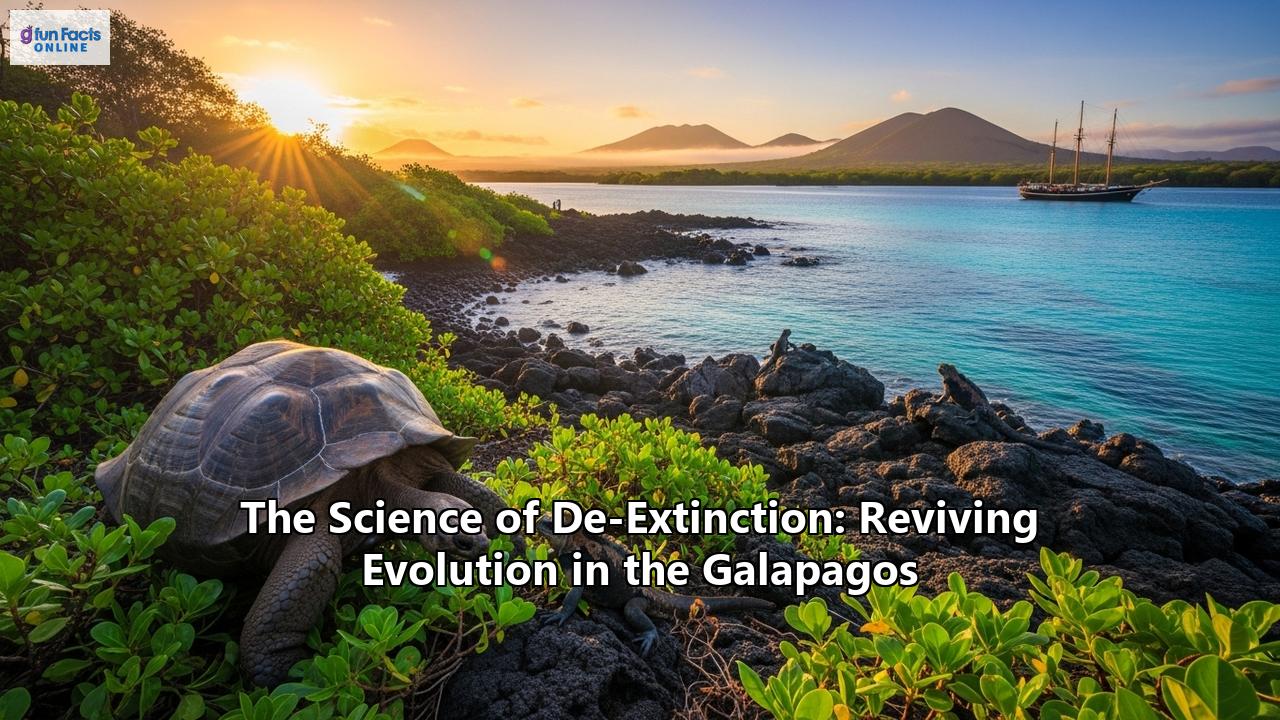
The Lazarus Project: How Science is Reviving Evolution in the Galápagos
The story of the Galápagos Islands is inextricably linked with the slow, deliberate march of evolution. It was here, amongst the stark volcanic landscapes and uniquely adapted wildlife, that Charles Darwin forged his theory of natural selection. Yet, the same isolation that gave rise to such biodiversity also made it tragically vulnerable. For centuries, the islands' most iconic inhabitants, the giant tortoises, were plundered to the brink of annihilation. Entire species vanished, leaving silent gaps in the ecosystem and a permanent scar on the planet's biological heritage. But today, in an extraordinary turn of events, science is attempting to rewrite the finality of extinction. In the quiet, dedicated labs and breeding centers of the Galápagos, a groundbreaking effort is underway not just to conserve what is left, but to revive what was lost. This is the science of de-extinction, a story of genetic ghosts, ecological architects, and a bold attempt to turn back the evolutionary clock.
A Paradise Plundered: The Great Tortoise Decline
Before the arrival of humans, the Galápagos archipelago was a tortoise empire. It is estimated that over 250,000 of these gentle giants roamed the islands, shaping the very landscapes they inhabited. Their reign, however, proved fragile. The story of their decline is a grim tale of human exploitation that began in the 1600s with the arrival of buccaneers and pirates. They discovered that the tortoises were a perfect living larder; these remarkable creatures could survive for months, sometimes even over a year, without food or water, stacked in the dark holds of ships. They provided a steady source of fresh meat and even water from their bladders on long sea voyages.
The 18th and 19th centuries saw the onslaught intensify with the arrival of commercial whalers and fur-sealers. Ship logbooks from the 1800s grimly quantify the devastation. One of the largest recorded takes occurred in December 1831, when whalers collected an astonishing 585 tortoises from Española Island alone. The exploitation wasn't just for sustenance; tortoises were also harvested for their oil, which was used to light the lamps of Quito, hundreds of miles away on the mainland.
The pressure mounted further with the California Gold Rush in the mid-1800s. Ships carrying hopeful prospectors to San Francisco made regular stops at the islands. The tortoises became a sought-after luxury food item, fetching enormous prices in the booming city. Records show one schooner arriving in San Francisco in 1851 with over 25,000 pounds of "terrapin" from the Galápagos.
Beyond direct hunting, the settlers and mariners brought with them a host of invasive species that proved catastrophic. Goats, pigs, donkeys, cats, and, most devastatingly, black rats, were introduced to islands that had no natural defenses against them. Goats and other large mammals decimated the native vegetation that tortoises relied on for food, while rats preyed relentlessly on their eggs and hatchlings. On Pinta Island, a few goats released by fishermen in 1959 exploded into a population of 40,000 by the 1970s, completely destroying the tortoise habitat. The combined pressures were overwhelming. By the 1970s, the once-mighty tortoise population had plummeted to an estimated 15,000 individuals, a mere fraction of their historical numbers. Four of the fifteen distinct tortoise species were declared extinct. The age of the tortoise was seemingly over.
The Ghost in the Volcano: A Genetic Revelation
The story of Galápagos de-extinction begins not with a futuristic cloning machine, but with a stroke of historical luck and the painstaking work of genetic detectives. The key lay hidden on Wolf Volcano, a remote and rugged shield volcano on the northern tip of Isabela Island.
Scientists had long been puzzled by the presence of tortoises on Wolf Volcano that possessed an unusual "saddleback" shell morphology, distinct from the native domed-shell tortoises of Isabela. This saddleback shape was characteristic of tortoises from other islands, including Floreana and Pinta—islands where the native tortoise species were thought to be entirely extinct. The Floreana tortoise (Chelonoidis niger niger) had been wiped out by the 1850s, a casualty of intense harvesting by whalers who favored the island. The Pinta Island tortoise (Chelonoidis abingdonii) was declared extinct in 2012 with the death of its last known survivor, the world-famous Lonesome George.
The leading theory, a "happy accident" of history, was that whalers, having loaded their ships with tortoises from various islands like Floreana, would later discard them near Isabela to make room for more valuable cargo like whale blubber. These castaway tortoises, survivors of the high seas, would have swum to the nearest land—Wolf Volcano—and interbred with the local population, creating a unique hybrid community.
For decades, this was just a compelling hypothesis. The proof arrived in the 21st century, thanks to advances in genetic sequencing. An international team of researchers, led by scientists from Yale University, embarked on an ambitious project. They began by building a genetic library, extracting ancient DNA from museum specimens of the extinct Floreana and Pinta tortoises collected over a century ago. This gave them a "genetic footprint" of the lost species.
Then, they turned their attention to the living. In a series of expeditions to the treacherous slopes of Wolf Volcano, researchers from the Galápagos National Park Directorate (GNPD) and Galápagos Conservancy tranquilized, measured, and took blood samples from hundreds of tortoises. The landscape was so difficult that helicopters were sometimes used to airlift the giant reptiles. The blood samples were then compared against the genetic blueprints of the extinct species.
The results were electrifying. In 2008, an analysis of 1,600 samples revealed that 105 of the tortoises on Wolf Volcano were hybrids, carrying the genetic legacy of the long-lost Floreana tortoise within their DNA. A later expedition in 2015 focused on capturing these genetically valuable individuals. Of 150 saddleback tortoises sampled, 35 were identified as having Floreana ancestry, and 32 of them were airlifted to a special breeding center on Santa Cruz Island to become the founders of a new generation.
Even more astonishing was the discovery related to the Pinta tortoise. After Lonesome George’s death, all hope seemed lost. Yet, the genetic survey of Wolf Volcano tortoises identified 17 individuals with partial Pinta Island ancestry. In a 2020 expedition, the team found a young female with a significant percentage of Pinta genes, suggesting she was a direct descendant of a purebred Pinta tortoise that might still be alive and roaming the vast, unexplored territory of the volcano. The ghost of Lonesome George, it turned out, was not so lonely after all.
The Lazarus Project: Breeding Back the Dead
With living "ghost genes" identified, the stage was set for one of the most audacious conservation projects ever conceived: to breed an extinct species back into existence. This isn't the high-tech de-extinction of Jurassic Park, involving cloning and artificial wombs. The chosen method is a more patient, yet scientifically rigorous, form of "selective breeding," a practice farmers have used for centuries, but now guided by cutting-edge genetic analysis. As Dr. Adalgisa Caccone of Yale University, a key figure in the project, explained, "Theoretically, we can rescue a species that has gone extinct... Our lab calls it the Lazarus project."
The process is methodical and deliberate. At the Fausto Llerena Tortoise Center on Santa Cruz Island, the captured hybrid tortoises from Wolf Volcano form the core of the breeding program. The goal is to maximize the genetic representation of the extinct Floreana tortoise (C. niger) in subsequent generations.
Scientists use sophisticated genetic tools to guide the process. By analyzing genetic markers, specifically microsatellites and single nucleotide polymorphisms (SNPs), they can determine which individuals have the highest percentage of pure Floreana DNA. This allows them to create a genetic "studbook," pairing males and females that are most likely to produce offspring with an even greater concentration of the target genes.
The work involves complex modeling and simulations. Researchers run forward-in-time simulations to explore different breeding strategies, figuring out the optimal arrangement of tortoises in breeding corrals to maximize genetic diversity and Floreana ancestry while minimizing inbreeding. Studies found that organizing the tortoises into smaller breeding groups was more effective at retaining overall genetic diversity.
Even the incubation of the eggs is a precise science. The sex of Galápagos tortoise hatchlings is determined by the temperature at which the eggs are incubated. Temperatures around 28°C (82.4°F) tend to produce more males, while temperatures around 29.5°C (85.1°F) produce more females. To accelerate population growth, the team aims to produce more females, a critical factor for a species where females can lay multiple clutches of eggs each year.
The project is a long-term commitment. Scientists estimate it could take several generations—a century or more—to produce tortoises that are 90% or even 95% genetically identical to the original Floreana species. While a perfect 100% replica may be impossible, the resulting animals will be ecologically functional proxies, capable of reclaiming their ancestral role on Floreana Island.
As of early 2025, the program has been a remarkable success, with about 400 baby tortoises with high percentages of Floreana DNA hatched in captivity. These young tortoises, reared in the safety of the center until they are about five years old and large enough to be safe from predators, represent the first chapter in the resurrection of their species.
Restoring a World: The Floreana Ecological Restoration Project
Bringing back the Floreana tortoise is not just about reviving a single species; it is about resurrecting an entire ecosystem. Giant tortoises are "ecosystem engineers," keystone species whose actions profoundly shape their environment. Their disappearance left a gaping hole in the ecological fabric of Floreana. The revival of the tortoises is therefore the centerpiece of a much larger and even more ambitious endeavor: the Floreana Ecological Restoration Project.
This comprehensive initiative, led by the Galápagos National Park Directorate in partnership with organizations like Island Conservation and the Charles Darwin Foundation, aims to rewild the entire island. The ultimate goal is to reintroduce 13 locally extinct species. Besides the giant tortoise, this list includes four species of Darwin's finches, the Galápagos hawk, the Floreana mockingbird, and the Floreana racer snake.
The first, and most critical, step has been the eradication of the invasive species that drove the native wildlife to extinction and prevent their return. This has been a monumental undertaking, described as one of the largest and most complex invasive species removal projects ever attempted on an inhabited tropical island. In late 2023, after more than a decade of planning, a massive campaign was launched to eliminate invasive black rats and feral cats from the 17,000-hectare island. This involved the carefully targeted dispersal of bait, often using drones and helicopters, while ensuring the safety of the local human population, their livestock, and native species. To protect native predators during this phase, for example, 65 short-eared owls were temporarily captured and moved to Santa Cruz for safekeeping, to be returned once the island is declared rodent-free.
With the invasive predators gone, the island can begin to heal, making it safe for the return of its original architects. The reintroduction of the giant tortoises, planned for early 2024, will be a watershed moment. Their impact will be transformative. As the dominant herbivores, they will:
- Disperse Seeds: Tortoises are crucial for seed dispersal. They consume the fruits of plants like the prickly pear cactus (Opuntia), a keystone resource, and deposit the seeds far and wide in their dung, which acts as a natural fertilizer. This helps plants colonize new areas and is vital for maintaining the health of the plant community.
- Shape the Landscape: Through grazing and trampling, tortoises prevent woody shrubs and trees from dominating the landscape, maintaining the open, savanna-like habitats that many other species rely on. On Española Island, where a successful tortoise repatriation program has been ongoing for decades, their return has helped clear overgrown areas, creating the bare ground that the critically endangered waved albatross needs for its nesting and takeoff runways.
- Create Mosaics of Habitats: By clearing paths, disturbing the soil, and creating sunny clearings, tortoises create a diverse mosaic of micro-habitats that supports a greater variety of plants and animals. Research has shown that their presence leads to a shift from woody vegetation towards grasses.
The restoration of the Floreana tortoise is, therefore, the restoration of a fundamental ecological process. It is the engine that will drive the recovery of the entire island ecosystem, paving the way for the return of the other lost species and turning Floreana into a global blueprint for ambitious ecological restoration.
The Ethical Frontier: Debates and Dilemmas
The prospect of de-extinction, even through the relatively low-tech method of selective breeding, opens a Pandora's box of ethical questions and scientific debates. While the work in the Galápagos is widely celebrated as a triumph of conservation, it is not without its complexities and critics.
One of the central debates revolves around the very definition of "de-extinction." Some scientists argue that what is happening with the Floreana tortoise is not a true resurrection but rather the creation of a "proxy" species. Because these new tortoises will not be 100% genetically identical to their extinct ancestors, they are, in a sense, a new creation. The IUCN has even drafted guidelines for the creation of such "proxies of extinct species." The counterargument is that this is a semantic distraction. The goal is to restore ecological function, and if a 95% genetically similar tortoise can perform the same role as an ecosystem engineer, the distinction is academic.
Another major concern is animal welfare and the allocation of resources. De-extinction projects are incredibly expensive and time-consuming. Critics argue that these vast sums of money could be better spent protecting the numerous species that are currently on the brink of extinction, rather than trying to revive those that are already gone. The argument is one of triage: should we focus on the dying or the dead? The Galápagos projects, however, present a unique case where the "de-extinction" effort is deeply intertwined with the restoration of a whole ecosystem, benefiting many other threatened species in the process.
There is also the question of unintended consequences. Introducing a species, even a native one, back into an ecosystem from which it has been absent for over 150 years carries risks. The environment on Floreana has changed, and while the tortoises are expected to restore it, their initial impact is not entirely predictable. The complexity of the hybrid tortoises' genomes, which can carry DNA from more than two ancestral species, adds another layer of unpredictability.
Finally, there is the philosophical question of "playing God." Should humanity intervene in the natural process of evolution and extinction to this degree? For many involved in the Galápagos project, the answer is a resounding yes. They argue that since human actions—overhunting, habitat destruction, and the introduction of invasive species—caused these extinctions in the first place, we have a moral obligation to undo the damage. This isn't about hubris; it's about taking responsibility.
The Future of Evolution in the Enchanted Isles
The work in the Galápagos is a beacon of hope in an age of ecological crisis. It demonstrates that with dedication, scientific innovation, and long-term vision, even the finality of extinction can sometimes be challenged.
The future on Floreana looks promising. As the first generation of selectively bred tortoises is released onto the newly predator-free island, they will begin the slow, deliberate work of re-engineering their ancestral home. It will take centuries for the ecosystem to fully recover its former state, but the process has begun. The success of this project, along with the remarkable recovery of the Española tortoise population from just 15 individuals to over 3,000 today, serves as a powerful model for conservation efforts worldwide.
The story is not over. The discovery of a young female with direct Pinta Island ancestry has ignited hope that Lonesome George's species might also one day be revived through a similar selective breeding program. Expeditions continue to search the vast wilderness of Wolf Volcano for a purebred Pinta tortoise, a discovery that would change everything. Elsewhere, the rediscovery of a Fernandina giant tortoise, a species thought extinct for over a century, adds another chapter to this unfolding saga of loss and recovery.
The science of de-extinction is still in its infancy. The path forward is fraught with challenges, both technical and ethical. But in the Galápagos, on the very islands that taught us how life evolves, we are now learning how it can be revived. It is a profound and humbling endeavor, a testament to the resilience of nature and the growing power of science to mend a world broken by our own past mistakes. The tortoises are slowly returning, and with them, a lost piece of evolution itself.
Reference:
- https://en.wikipedia.org/wiki/Gal%C3%A1pagos_tortoise
- https://www.quora.com/What-are-the-ecological-effects-of-cloning-extinct-species-back-into-existence
- https://scholar.google.fr/citations?user=ggqRHVYAAAAJ&hl=th
- https://galapagosconservation.org.uk/wp-content/uploads/2025/03/The-Galapagos-Giant-Tortoise-and-tracking-information.pdf
- https://www.galapagos.org/newsroom/a-short-history-of-the-galapagos-tortoise-in-celebration-of-world-turtle-day/
- https://www.galapagos.org/about_galapagos/lonesome-george/
- https://www.galapagos.org/about_galapagos/history/
- https://pubmed.ncbi.nlm.nih.gov/35116195/
- https://biblio.eui.eu/discovery/fulldisplay?docid=cdi_proquest_miscellaneous_2524222727&context=PC&vid=39EUI_INST:39EUI_INST&lang=en&search_scope=MyInst_and_CI&adaptor=Primo%20Central&tab=Everything&query=sub%2Cequals%2Cconservation%20decision-making%20%2CAND&mode=advanced&offset=0
- https://galapagosconservation.org.uk/history-galapagos-giant-tortoise/
- https://news.yale.edu/2010/01/15/genetic-analysis-gives-hope-extinct-tortoise-species-may-live-again
- https://www.yalescientific.org/2010/09/bringing-back-the-dead-reviving-an-extinct-tortoise-species/
- https://m.naharnet.com/stories/en/61924-scientists-galapagos-tortoise-can-be-revived
- https://www.islandconservation.org/surviving-relative-lonesome-george-pinta-giant-tortoise/
- https://pubmed.ncbi.nlm.nih.gov/35906184/
- https://en.wikipedia.org/wiki/Pinta_Island_tortoise
- http://molecularecology.flinders.edu.au/wp-content/uploads/2021/11/199_capttort_CB.pdf
- https://www.livescience.com/21272-lonesome-george-cloning.html
- https://theg-cat.com/tag/backbreeding/
- https://www.youtube.com/watch?v=XKJF1yc1TD4
- https://www.researchgate.net/profile/James-Gibbs-8
- https://www.youtube.com/watch?v=zbx4lgG9VPY
- https://galapagosonline.wordpress.com/2012/02/06/floreana-tortoise-back-from-extinction/
- https://www.smithsonianmag.com/science-nature/galapagos-giant-tortoises-are-ecosystem-engineers-180983101/
- https://www.prnewswire.com/news-releases/rewilding-giant-tortoises-engineers-plant-communities-a-study-reveals-the-impact-of-megafauna-restoration-on-galapagos-ecosystems-301871395.html
- https://pmc.ncbi.nlm.nih.gov/articles/PMC6265789/
- https://en.wikipedia.org/wiki/De-extinction
- https://www.galapagos.org/newsroom/extinct-for-112-years-galapagos-giant-tortoise-rediscovery-confirmed/
- https://from.ncl.ac.uk/saving-the-galapagos-fantastic-giant-tortoise-from-extinction