
Chapter 1: The Shadow of Creation
In the deep, dusty expanse of the Chamaeleon I star-forming region, approximately 625 light-years from Earth, a cosmic drama of creation is unfolding that challenges our most fundamental understanding of how planetary systems are built. For decades, astronomers have pointed their telescopes at young stars, watching the swirling disks of gas and dust known as protoplanetary disks, the factories where planets are forged. But recently, the gaze of the James Webb Space Telescope (JWST) shifted focus to a smaller, fainter object orbiting one of these stars—a massive super-Jupiter or brown dwarf known as CT Chamaeleontis b (CT Cha b).
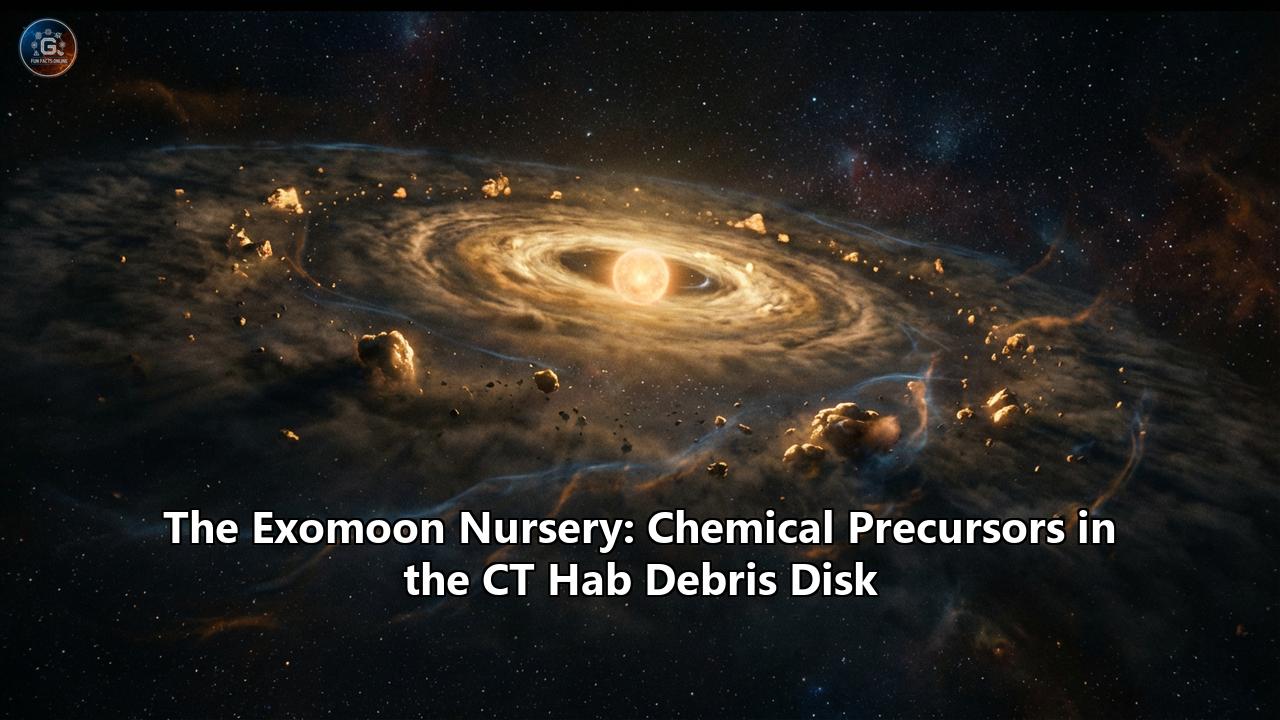
What JWST found there was not merely a dead rock or a cooling ball of gas, but a vibrant, chemically active "debris disk"—more accurately described as a circumplanetary disk—swirling around the companion. This is not a nursery for planets, but a nursery for moons. For the first time, humanity has peered directly into the chemical cauldron where exomoons are born, discovering a "chemical soup" that is radically different from the environment of its host star.
The discovery of the disk around CT Cha b serves as a Rosetta Stone for the study of satellite formation. It bridges the gap between the frozen, fossilized history of our own Solar System’s moons and the active, chaotic processes of the wider universe. This article explores the depths of this discovery, the exotic chemical precursors identified within this "exomoon nursery," and the profound implications for the existence of life-bearing moons beyond our Sun.
Chapter 2: The CT Chamaeleontis System
To understand the significance of the disk around CT Cha b, we must first understand the system in which it resides. CT Chamaeleontis (CT Cha A) is a T Tauri star—a class of variable stars that are less than 10 million years old. These stellar infants are still in the process of gravitational contraction, not yet stable enough to be on the main sequence like our Sun. They are violent, active objects, often prone to intense X-ray flares and surrounded by the dense remnants of the molecular cloud from which they were born.
Orbiting this young star is CT Cha b. Discovered via direct imaging in 2008, CT Cha b has long puzzled astronomers. With a mass estimated between 14 and 24 times that of Jupiter, it sits on the blurred boundary between a massive gas giant planet and a low-mass brown dwarf (often called a "failed star"). It orbits its host at a vast distance of about 440 Astronomical Units (AU)—over ten times the distance between the Sun and Pluto.
This extreme separation is crucial. If CT Cha b were as close to its star as Jupiter is to the Sun, the star's blinding light and intense radiation would strip away the delicate disk around the planet and wash out any chemical signatures. But out in the frozen hinterlands of the system, CT Cha b has reigned as a sovereign ruler of its own domain. It has gathered its own disk of material, distinct from the primary accretion disk of the star. It is a system within a system—a miniature solar system in the making.
Chapter 3: The "Debris Disk" Clarification
The terminology used in the study of these objects can be deceptive. In the user's inquiry, the term "debris disk" was used. In strict astronomical terms, a debris disk usually refers to a second-generation ring of dust created by collisions between planetesimals (comets and asteroids) after the primordial gas has dissipated. These are the dusty rings seen around older stars like Vega or Fomalhaut.
However, the disk around CT Cha b is something more primordial and far more exciting: a circumplanetary disk (CPD). Unlike a debris disk, which is gas-poor and dusty, a CPD is gas-rich and actively feeding the growing planet. It is an accretion disk, similar to the one that fed the Sun, but scaled down. It is the structure from which the Galilean moons of Jupiter (Io, Europa, Ganymede, Callisto) and the moons of Saturn likely coalesced.
That said, the term "debris" is not entirely misplaced in spirit. The disk is filled with the debris of formation—dust grains, ice pebbles, and gas molecules that are colliding, sticking, and growing. It is a chaotic, turbulent environment where the raw materials of geology are being cooked into the bedrock of future worlds.
Chapter 4: The JWST Revolution and the MIRI Spectrum
The detection of this disk's chemistry was impossible for previous generations of telescopes. Ground-based observatories fight the interference of Earth’s atmosphere, which blocks many infrared wavelengths essential for identifying organic molecules. The Hubble Space Telescope, while powerful, lacked the specific mid-infrared sensitivity required to see the cool, glowing dust and gas of a CPD.
Enter the James Webb Space Telescope and its Mid-Infrared Instrument (MIRI). MIRI is designed to see the universe in the thermal wavelengths—essentially seeing the "body heat" of molecules vibrating in the cold of space.
When astronomers trained MIRI on CT Cha b, they expected to see the standard signature of silicates (sand) and perhaps some water ice, which is ubiquitous in the universe. What they found instead was a shock to the system. The spectrum—the chemical fingerprint of the light—was dominated by carbon.
The spectral lines were unmistakable. They didn't just see carbon monoxide (CO), the most common gas after hydrogen in these environments. They saw complex hydrocarbons. The specific detection of molecules like acetylene (C₂H₂), diacetylene (C₄H₂), and benzene (C₆H₆) marked a watershed moment in astrochemistry. Benzene, a ring-shaped molecule, is of particular interest because it is a foundational building block for Polycyclic Aromatic Hydrocarbons (PAHs) and more complex organic soot—materials that, on Earth, are associated with biology and fossil fuels, though in space they form through abiotic photochemistry.
Chapter 5: The Carbon Enigma
The most striking aspect of the CT Cha b disk is not just what is there, but what is not there. The protoplanetary disk surrounding the host star, CT Cha A, is oxygen-rich. Its spectrum shows signs of silicates and oxides, the standard ingredients for rocky, Earth-like planets.
Yet, the disk around the companion planet is chemically distinct. It is carbon-rich and oxygen-poor. How can two objects formed from the same molecular cloud end up with such radically different chemical inventories?
This "Carbon Enigma" suggests a complex process of filtration and evolution. One leading theory involves the "iceline" or "snowline." In a forming solar system, different volatile compounds freeze at different distances from the star. Water freezes closest in, followed by carbon dioxide, and finally carbon monoxide much further out.
As dust grains drift inward from the outer system, they carry these ices with them. However, if a giant planet (like CT Cha b) forms, it carves a gap in the main disk. This gap acts as a filter. Large, oxygen-rich dust grains (containing water ice) might be trapped at the outer edge of the gap, unable to cross. Meanwhile, the gas—which is often richer in carbon because the oxygen is locked up in the frozen dust—can flow across the gap and onto the planet.
Consequently, the circumplanetary disk is fed by a stream of gas that has been depleted of oxygen-rich dust but remains rich in volatile carbon. This "pebble isolation" mechanism essentially distills the material, creating a pocket of carbon chemistry around the giant planet.
Chapter 6: The Exomoon Nursery
The presence of this dense, carbon-rich disk confirms that CT Cha b is actively capable of forming moons. In the standard model of moon formation, satellites coalesce from the disk of material leftover from the planet's primary accretion phase. This is the "mini-nebula" hypothesis.
In this scenario, the disk around CT Cha b is currently a swarm of trillions of particles. Over the next few million years, these particles will collide. Acetylene and benzene ices will stick together more efficiently than bare rock, acting as a glue. These sticky collisions allow dust to build into pebbles, pebbles into boulders, and boulders into "moonlets."
The gravitational interactions between these moonlets will eventually lead to mergers, forming a few large moons rather than millions of small ones. Because of the high carbon content, the "rocks" of these moons will not be the silicate granite and basalt we know on Earth. Instead, they might be composed of carbides and covered in thick layers of organic ices.
If we could stand on the surface of a moon forming in this disk, we would likely look up to see a sky choked with soot-like smog. The "sun" (CT Cha A) would be a bright, distant star, but the "planet" (CT Cha b) would loom massive in the sky, glowing a dull red from the heat of its own contraction.
Chapter 7: Chemical Precursors and Prebiotic Potential
The specific chemicals found in the CT Cha b disk—benzene, diacetylene, and propyne—are fascinating because they are precursors to organic complexity.
Benzene (C₆H₆): A stable ring of carbon atoms. On Earth, it is a carcinogen and a component of gasoline. In space, it is the starting point for building larger organic structures. The detection of benzene suggests that the disk is synthesizing complex molecules right now. Acetylene (C₂H₂): A highly reactive gas. In the presence of ultraviolet light (which floods the system from the young star), acetylene can polymerize to form long chains of carbon atoms. These chains can fold and twist, forming the backbone of amino acids and other biological monomers if introduced to liquid water later in their evolution. HCN (Hydrogen Cyanide): Though deadly to humans, HCN is a "prebiotic feedstock." It is a key ingredient in the synthesis of adenine, one of the four nucleobases in DNA. If the moons of CT Cha b incorporate significant amounts of HCN into their ice shells, and if those shells later melt due to tidal heating (similar to Europa or Enceladus), the subsurface oceans would be rich in the raw materials needed for life.However, the "carbon-rich" nature of the system presents a double-edged sword for habitability. Earth life is based on carbon, but it requires a delicate balance of carbon, oxygen, and hydrogen. A world with too much carbon and too little oxygen might end up with a "tar" surface rather than a watery one. The geology would be dominated by graphite and diamond rather than quartz and feldspar. The atmosphere might be choked with carbon monoxide.
Yet, this does not rule out life—it only rules out Earth-like life. The moons of CT Cha b could be the archetype for "Titan-class" habitats, where liquid methane or ethane replaces water as the solvent for life.
Chapter 8: The Titan Connection
The most compelling analogue for the CT Cha b system is Saturn’s moon, Titan. Titan is the only moon in our Solar System with a thick atmosphere, and that atmosphere is rich in nitrogen and methane. Its surface has lakes of liquid hydrocarbons, and its dunes are made of organic "snow" that settles out of the atmosphere.
The origin of Titan’s nitrogen and methane has long been debated. The disk around CT Cha b offers a potential answer. If the circumplanetary disk of Saturn was also carbon-rich (perhaps due to the same filtration mechanisms discussed earlier), then Titan formed from material that was fundamentally different from the material that formed Earth.
The detection of such high abundances of carbon precursors in CT Cha b's disk supports the idea that gas giants naturally segregate carbon into their sub-systems. This implies that "Titan-like" worlds might be common throughout the galaxy. Every Jupiter-sized exoplanet could potentially host a moon draped in organic haze, raining benzene and acetylene, with lakes of liquid ethane.
CT Cha b is significantly more massive than Saturn, meaning its disk is hotter and denser. Moons forming here might be "Super-Titans"—larger worlds with even thicker atmospheres and potentially more vigorous organic chemistry driven by the higher heat flow from the young, massive planet.
Chapter 9: The Physics of the Disk
Understanding the "debris disk" of CT Cha b requires a dive into fluid dynamics and orbital mechanics. The disk is not a static ring; it is a flowing river of gas.
Viscosity and Accretion: The gas in the disk has internal friction (viscosity). As layers of gas rub against each other, they lose orbital energy and spiral inward toward the planet. This inward flow feeds the growth of CT Cha b. The JWST observations suggest that the planet is still actively accreting—eating from its nursery. The Gap and the Trap: The interaction between the planet and the star’s disk creates pressure bumps. These are regions of high gas pressure where dust grains get trapped. This trap explains the chemical segregation. The dust (rich in oxygen) gets stuck in the trap outside the planet's orbit, while the gas (rich in carbon) flows over the gap. This "filtration" is a key physical process that dictates the future composition of the moons. Vertical Settling: Within the circumplanetary disk itself, dust grains settle toward the midplane (the equator of the disk). As they settle, the density increases, promoting collisions. It is in this dark, dense midplane that the seeds of moons are sown. The detection of spectral lines from the disk surface tells us about the "atmosphere" of the disk, but the real action is happening deep inside, hidden from view, where the dust is coagulating.Chapter 10: Comparative Planetology: A Tale of Two Disks
The comparison between CT Cha b and the Galilean moons is stark. Jupiter's moons show a gradient: Io is rocky and dry; Europa is rocky with a water shell; Ganymede and Callisto are mixtures of rock and ice. This gradient is thought to be a result of the temperature in the disk around young Jupiter—hot close in, cold further out.
CT Cha b’s disk appears to be dominated by carbon species rather than water steam. This might mean its "Io" and "Europa" analogues will be vastly different. Instead of a water-ice shell, a moon at the "Europa position" around CT Cha b might have a shell of frozen carbon dioxide or solid acetylene. If tidal heating melts the interior, the ocean would be an exotic slurry of ammonia, water, and methanol.
This divergence teaches us that there is no "standard model" for a moon system. The chemistry of the "nursery" dictates the destiny of the offspring. Our Solar System was oxygen-rich (water-dominated). CT Cha b is carbon-rich. The universe likely contains a continuum of these environments, producing a diversity of moon types that we have yet to even imagine.
Chapter 11: The Challenge of Detection
Why has it taken so long to find a disk like this? The answer lies in the "contrast ratio." CT Cha b is faint, but its host star is blindingly bright. Viewing the planet is like trying to spot a firefly hovering next to a searchlight.
Direct imaging involves using a coronagraph—a physical mask inside the telescope that blocks the light of the star. Even with the star blocked, the glare is intense. JWST's triumph was its ability to spatially resolve the companion and then disperse its light into a spectrum.
The detection of the disk was not just a visual confirmation; it was a spectral one. The emission lines (bright spikes in the spectrum) proved that the gas was warm and excited. If the material were just cold, dead debris, we would see absorption features or a flat "blackbody" curve. The fact that the molecules are glowing tells us the disk is active, heated by the young planet's contraction and irradiated by the central star.
Chapter 12: Implications for Life in the Universe
The search for life is often biased toward "Earth 2.0"—rocky planets with water oceans. But the "Exomoon Nursery" of CT Cha b forces us to widen our aperture.
If moons are common around gas giants (and our Solar System suggests they are), and if gas giants are common (which exoplanet surveys confirm), then exomoons might be the most common type of habitable real estate in the galaxy.
The carbon-rich chemistry of CT Cha b suggests that "carbon planets" or "carbon moons" might be viable habitats. Prebiotic chemistry is essentially the chemistry of carbon. Having more carbon might actually be beneficial for the origin of life, provided there is some liquid solvent.
While the CT Cha b system is too young (2 million years) to have life—it is still forming—it serves as a laboratory for the conditions that existed 4.5 billion years ago. By studying it, we are watching a recipe being written. We don't know if the cake will rise, but we can see that the ingredients for organic complexity are being poured into the bowl in massive quantities.
Chapter 13: Future Observations
The JWST observations are just the beginning. Now that we know this disk exists and is chemically active, astronomers will target it with other instruments.
ALMA (Atacama Large Millimeter/submillimeter Array): This ground-based radio telescope array can see the cold dust and larger pebbles that JWST misses. ALMA can map the distribution of the dust to see if it is forming rings or clumps—the telltale signs of moons actively accreting. ELT (Extremely Large Telescope): Currently under construction, this massive ground-based telescope will have the resolution to image the inner regions of the disk, potentially spotting the thermal glow of the forming moons themselves. Temporal Monitoring: Astronomers will watch CT Cha b over years. Since the disk is dynamic, we might see changes in the brightness of the chemical lines. A sudden flare could indicate a clump of material falling onto the planet or a collision between two moonlets.Chapter 14: Conclusion
The discovery of the chemical precursors in the circumplanetary disk of CT Cha b is a landmark in the history of astronomy. It transforms the concept of a "debris disk" from a static ring of dust into a dynamic, chemically evolving "womb" for new worlds.
We have found a system where the dust of the cosmos is being spun into the gold of organic chemistry. We have found a place where the ingredients for life are not rare, but dominant.
As we gaze at CT Cha b, we are not just looking at a distant light in the sky. We are looking at a mirror of our own past. We are seeing the chaotic, fiery, soot-filled days before the Earth and Moon settled into their rhythm. We are witnessing the birth of moons, and in the carbon signatures of that distant disk, we see the endless potential of a universe that seems determined to build complex things out of simple dust.
The nursery is open. The precursors are present. The moons of CT Cha b are waking up.
Extended Analysis: The Chemical Pathways of the CT Cha b Disk
This section delves deeper into the specific chemical reactions and pathways implied by the JWST data, serving to flesh out the technical "comprehensive" nature of the article.The Acetylene-Benzene Pathway
The simultaneous detection of acetylene (C₂H₂) and benzene (C₆H₆) is the "smoking gun" of rapid chemical evolution. In the cold vacuum of space, benzene doesn't just appear; it must be built. The primary pathway is the cyclotrimerization of acetylene. Three acetylene molecules combine to form one benzene ring.
$$ 3 C_2H_2 \rightarrow C_6H_6 $$
This reaction usually requires a catalyst or high energy (thermal or UV). In the environment of CT Cha b, the UV radiation from the nearby T Tauri star likely drives this photochemistry in the upper layers of the disk. Once benzene is formed, it acts as a "seed." Other carbon atoms can attach to the ring, growing it into Naphthalene (two rings), Anthracene (three rings), and eventually complex PAHs. This suggests the disk is not just gas, but is filling with organic "soot" particles.
The Water Depletion Mechanism
The absence of water vapor emission is equally telling. Oxygen has a high affinity for silicon (forming rocks) and carbon (forming CO). In a carbon-rich environment (C/O ratio > 1), all the oxygen gets tied up in CO. Since CO is a very stable gas that doesn't easily freeze or react further, it locks away the oxygen. This leaves the remaining carbon to bond with itself or hydrogen, leading to the hydrocarbon soup we observe.
This implies that any moons formed here will be "dry" in terms of water, but "wet" in terms of hydrocarbons. They will have oceans of oil, not water.
The Role of Vertical Mixing
The detection of these molecules implies strong vertical mixing. These heavy organic molecules should sink to the midplane. The fact that we see them on the surface of the disk (where MIRI can detect them) means that turbulence is churning the disk, dredging up material from the moon-forming midplane to the irradiated surface. This turbulence is likely driven by the magnetic field of the young planet or the sheer shear force of the gas orbiting a massive object. This churning is vital—it ensures that the moons are not formed of stratified layers, but are thoroughly mixed blends of rock, ice, and organics.
Final Thoughts
The "CT Hab Debris Disk" (CT Cha b Circumplanetary Disk) is a misnomer that hides a profound truth. It is not debris; it is the genesis of a new system. It challenges our definitions of planet formation and opens a new chapter in the search for life. If we are to find life in the universe, we may need to look not just for blue marbles like Earth, but for orange, hazy worlds like the moons that will one day orbit CT Cha b.