
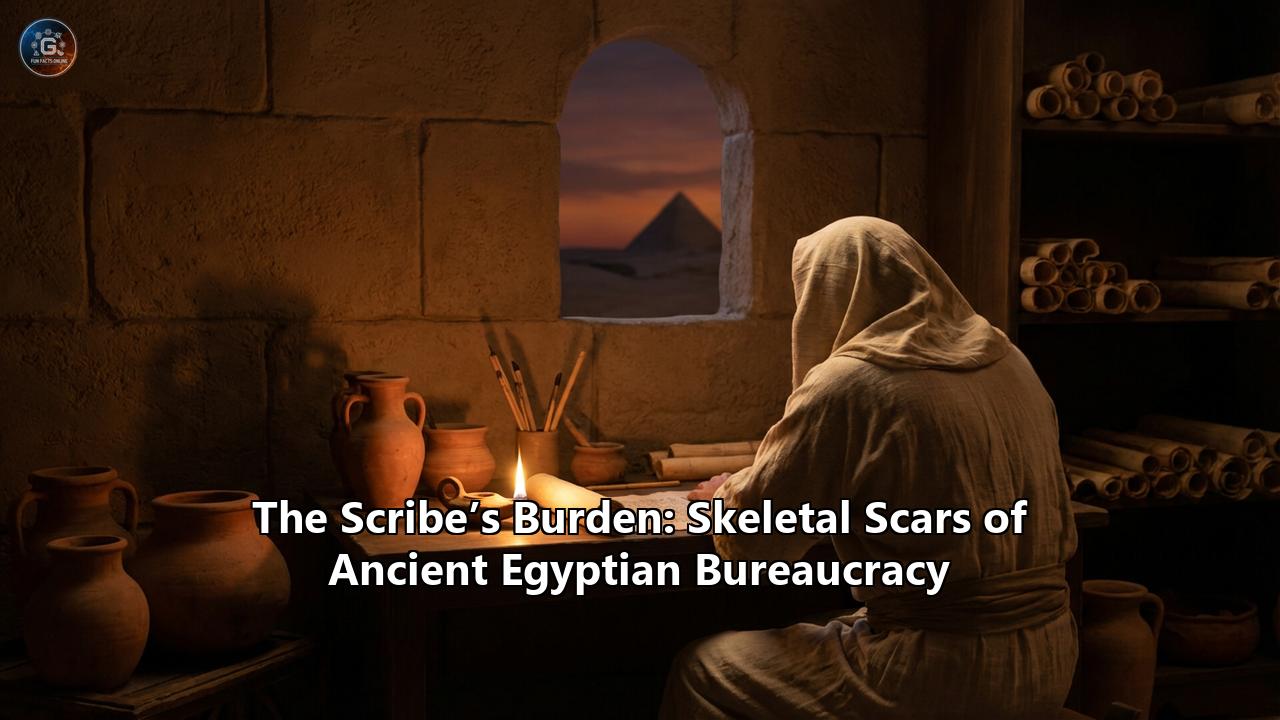
The sun beats down on the limestone plateau of Abusir, roughly 4,500 years ago. Inside a cool, mud-brick administrative office, a man sits in silence. He is a scribe of the Old Kingdom, a member of the elite, a keeper of the Pharaoh’s secrets. To the outside world, he is a figure of envy—exempt from the back-breaking labor of the fields, spared the lash of the overseer, and guaranteed a tomb for eternity.
But if you were to look closer, you would see the grimace that flashes across his face as he dips his rush pen into ink. You would hear the subtle crack of his jaw as he chews the end of a fresh reed to fray it into a brush. You would see him shift his weight uncomfortably, his knees screaming in protest after hours of sitting cross-legged on the hard floor.
For decades, Egyptologists have studied the words of these men, marveling at their administrative genius and their beautiful hieroglyphs. But until recently, no one had truly looked at the men themselves.
A groundbreaking 2024 study emerging from the necropolis of Abusir has shattered the romantic image of the pristine, pampered intellectual. By analyzing the skeletal remains of these ancient bureaucrats, scientists have uncovered a history of pain written not on papyrus, but on bone. It turns out that the "cushy" office job of the ancient world came with a brutal physical price—one that eerily mirrors the ailments of the modern digital age.
This is the story of the Scribe’s Burden.
The Abusir Revelation: Reading the Bones
For over a century, the necropolis of Abusir has been a treasure trove for archaeologists. Located between Giza and Saqqara, it served as the final resting place for the elite of the Fifth Dynasty. Among the pyramids and mastabas, excavators from the Czech Institute of Egyptology uncovered the tombs of high-ranking officials, priests, and, crucially, scribes.
In a landmark study published in Scientific Reports, a team of anthropologists led by Petra Brukner Havelková undertook a forensic analysis of 69 adult male skeletons buried at Abusir between 2700 and 2180 BC. Of these, 30 were identified through tomb inscriptions as career scribes. The remaining 39 served as a control group—men of similar social standing but who did not perform scribal duties.
The researchers were looking for "occupational markers"—subtle changes in bone structure caused by repetitive motions and sustained postures. What they found was a catalogue of chronic agony that defined the scribal profession.
The skeletons of the scribes were statistically distinct from their peers. They showed significantly higher rates of degenerative osteoarthritis, stress fractures, and bone deformations in specific areas: the jaw, the neck, the right shoulder, the right thumb, and the knees. Taken together, these scars paint a vivid picture of a life spent hunched, chewing, pinching, and squatting in service of the state.
The Jaw: The Taste of Bureaucracy
Perhaps the most shocking finding was the condition of the scribes' jaws. In the ancient world, osteoarthritis of the temporomandibular joint (TMJ) was relatively rare compared to other joints. Yet, the Abusir scribes showed extreme wear and tear in their jaw joints—damage so severe it likely caused chronic headaches, clicking sounds, and pain while eating.
Why would a writer have a damaged jaw? The answer lies in the tools of the trade.
The ancient Egyptian pen was not a quill dipped in ink, nor was it the reed calamus used in later periods. During the Old Kingdom, scribes used the stems of the rush plant (Juncus maritimus). These stems were tough and fibrous. To create a writing tip, a scribe couldn't simply cut the stem; he had to chew the end of it.
Every morning, and repeatedly throughout the day, a scribe would take a fresh rush stem and gnaw on the tip, crushing the fibers until they frayed into a fine, brush-like point. As the "brush" wore down or clogged with dried ink, he would cut off the tip and chew a new section.
Imagine the repetitive mechanical stress of gnawing on tough, woody plant matter every single day for thirty or forty years. The study found that this action placed an enormous load on the TMJ, grinding down the cartilage and bone. For the Egyptian scribe, the act of writing literally left a bad taste in his mouth—and a permanent scar on his skull.
The Neck and Spine: The Weight of Knowledge
If you walk through the Egyptian wing of any major museum, you will likely see the famous statue of the "Seated Scribe." He sits cross-legged, a papyrus scroll stretched across his taut kilt, his eyes alert. But look at his posture. He is not leaning back in a chair; he is holding himself upright, unsupported.
In reality, the working posture was often more severe than the statues suggest. To write precise, tiny hieroglyphs or hieratic script on a scroll resting on his lap, a scribe had to hunch forward. The head, which weighs roughly 4.5 to 5 kilograms (10-11 lbs), would hang forward, shifting the center of gravity and placing immense strain on the cervical spine.
The Abusir skeletons revealed the consequences of this "forward head posture"—a condition remarkably similar to the "tech neck" seen in modern smartphone users. The scribes suffered from significant degeneration in the cervical vertebrae (the neck) and the upper thoracic spine.
This wasn't just bad posture; it was structural damage. The constant tension required to keep the head stabilized while looking down at a lap-bound scroll caused the vertebrae to grind together, leading to spondylosis and osteoarthritis. The silence of the scriptorium was likely punctuated by the cracking of stiff necks and the rubbing of sore upper backs.
The Right Hand: The Grip of Authority
The scribe’s right hand was his livelihood, and the bones of the Abusir scribes show just how hard that hand worked. The researchers found distinctive osteoarthritis in the right shoulder (specifically the clavicle and humerus) and the right hand, particularly the thumb.
This damage tells a story of repetitive strain. The scribe wrote without a desk. His arm was often unsupported, hovering over the papyrus. This required the muscles of the shoulder and rotator cuff to remain in a state of static tension for hours to stabilize the arm. Over decades, this ground down the articular surfaces of the collarbone and shoulder socket.
Further down the arm, the thumb bore the brunt of the fine motor work. The rush pen was held in a pinch grip, squeezed tightly to maintain control over the delicate brush tip. The study identified significant wear on the trapezium and the first metacarpal bone—the base of the thumb.
This is the ancient equivalent of carpal tunnel syndrome or "gamer's thumb." Every tax record, every royal decree, every spell from the Book of the Dead was paid for with the microscopic destruction of the scribe’s hand joints.
The Legs: The Squatting Facet
While the upper body battled the strain of writing, the lower body battled the strain of sitting. Chairs existed in ancient Egypt, but they were often reserved for high-status leisure or specific ceremonial contexts. The daily work of a scribe was done on the floor.
The skeletal analysis revealed that scribes didn't just sit cross-legged (the tailor's seat). They frequently utilized a kneeling-squatting position: the left leg folded under the body to create a seat, while the right leg was stepped up, creating a makeshift table for the papyrus.
This asymmetry left specific markers on the bones. The scribes exhibited "squatting facets"—flattened surfaces on the talus bone of the ankle—and deep indentations in the kneecaps (patella). These markers are formed when the joints are compressed in extreme flexion for long periods.
The right knee, often used as the writing desk, showed different wear patterns than the left, which bore the weight of the torso. To stand up after a ten-hour shift in this position must have been an agonizing ordeal of stiff joints and numb limbs.
The Paradox of Privilege
It is easy to look at these ailments and feel pity, but it is important to contextualize them within Egyptian society. These scars were badges of honor. In a world where life expectancy was low and manual labor could break a body by age 30, the "Scribe's Burden" was a luxury.
The "Satire of the Trades," a famous ancient Egyptian text, contrasts the scribe’s life with other professions to encourage young students. It mocks the metalworker ("his fingers are like the claws of a crocodile"), the barber ("he strains his arms to fill his belly"), and the mason ("his loins are ruined").
The text boasts: "Be a scribe! It saves you from toil, it protects you from all manner of labor."
The skeletal evidence from Abusir adds a layer of irony to this ancient propaganda. The scribe was protected from the sun and the whip, but he was not saved from toil. His toil was simply internal. While the peasant’s back broke under the weight of stone, the scribe’s neck broke under the weight of administration. While the soldier’s body was scarred by battle, the scribe’s jaw was destroyed by his own pen.
A Mirror to the Modern Era
The most haunting aspect of the Abusir study is not how different the scribes were from us, but how similar they are. The ailments identified—TMJ disorders, cervical spine degeneration, shoulder impingement, and thumb arthritis—are the exact same diagnoses filling the waiting rooms of modern orthopedists and physical therapists.
We have replaced the rush pen with the mouse and keyboard. We have replaced the papyrus scroll with the smartphone and the monitor. We have replaced the cross-legged squat with the ergonomic (or non-ergonomic) office chair. But the result is the same.
We, too, hunch forward, straining our cervical spines. We, too, suffer from repetitive strain in our dominant hands. We, too, grind our jaws (though now from stress rather than chewing reeds). The ancient Egyptian scribe is the ancestor of the modern knowledge worker, and his skeleton serves as a 4,500-year-old warning: the human body was moved to move, not to sit, freeze, and focus for endless hours.
Conclusion: The Human Cost of Eternity
The pyramids of Abusir are crumbling, their limestone casings stripped away by time and thieves. But the skeletons of the men who tallied the stones, who organized the labor, and who recorded the glory of the kings remain.
Thanks to the work of the Czech Institute of Egyptology, these silent witnesses have finally spoken. They tell us that the bureaucracy of ancient Egypt—the machine that built one of the greatest civilizations in history—was powered by human flesh and bone.
The beautiful hieroglyphs we admire in museums were not just art; they were physical feats of endurance. Every line was a pinch of the thumb, every column a hunch of the neck, every brushstroke a grind of the jaw. The scribe paid for his immortality with his body, leaving behind a legacy of knowledge and a skeleton scarred by the very tools that built his world.
In the end, the "Scribe's Burden" teaches us that greatness is never free. It is always carried on the shoulders—and the necks, and the knees—of those who serve.
Reference:
- https://www.smithsonianmag.com/smart-news/ancient-egyptian-scribes-were-worked-to-the-bone-180984628/
- https://knewz.com/ancient-egyptian-scribes-suffered-arthritis-unique-bone-damage-study/
- https://www.sciencenews.org/article/ancient-egyptian-scribe-work-skeleton
- https://english.radio.cz/ancient-egyptian-scribes-faced-similar-risks-todays-office-workers-says-new-8822182
- https://www.biznews.com/health/ancient-scribes-back-pains-desk-workers
- https://popular-archaeology.com/article/archaeology-occupational-hazards-for-ancient-egyptian-scribes/
- https://www.newsweek.com/ancient-egyptian-scribes-faced-occupational-risk-too-1917888
- https://www.researchgate.net/publication/381774637_Ancient_Egyptian_scribes_and_specific_skeletal_occupational_risk_markers_Abusir_Old_Kingdom
- https://www.ancient-origins.net/news-history-archaeology-history-ancient-traditions/ancient-egyptian-scribes-0021009
- https://www.iflscience.com/ancient-egyptian-scribes-had-the-same-bad-posture-as-you-74909
- https://pubmed.ncbi.nlm.nih.gov/38937484/
- https://www.theguardian.com/science/article/2024/jun/27/egyptian-scribes-work-related-injuries-study
- https://ancientegyptonline.co.uk/scribe/
- https://news.artnet.com/art-world/ancient-egyptian-scribes-back-pain-2507600
- https://www.livescience.com/archaeology/ancient-egyptians/ancient-egyptian-office-workers-had-terrible-posture-just-like-us-disfigured-skeletons-reveal