
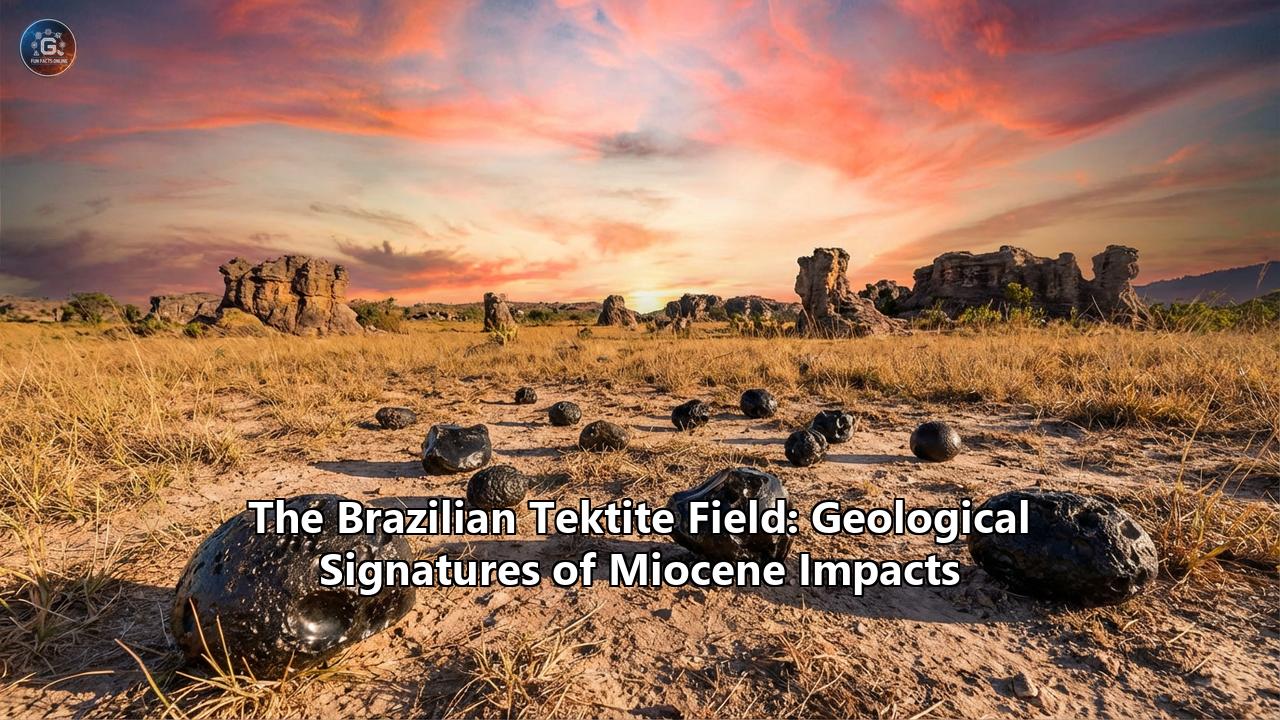
The Earth is a celestial target, continuously drifting through a cosmic shooting gallery. For billions of years, our planet has endured a relentless bombardment from space, yet the scars of these violent encounters are often erased by the very forces that make Earth habitable: tectonic subduction, glacial carving, relentless erosion, and the persistent march of biology. Because of this dynamic planetary recycling, the terrestrial impact record is notoriously incomplete, particularly in regions dominated by vast rainforests and ancient, weathered cratons. South America has long been a missing piece in this global puzzle, boasting only a handful of confirmed impact structures.
However, the geological narrative of the continent has been forever altered. Deep within the heart of Brazil, an extraordinary discovery has breached the surface, revealing the cataclysmic signature of a massive extraterrestrial strike that occurred approximately 6.3 million years ago. Researchers have unearthed the first confirmed tektite strewn field in Brazil—and the whole of South America—ushering in a new era of planetary science. The remnants of this ancient cosmic collision are not giant craters or devastated landscapes, but rather small, aerodynamic pieces of natural glass known as geraisites.
This comprehensive exploration dives into the genesis of the Brazilian Tektite Field, the extreme physics required to create these enigmatic glassy fragments, the sophisticated geochemical detective work used to date them, and the ongoing hunt for the colossal, hidden crater left behind in the Earth's crust.
The Science of Tektites: Forged in Cosmic Fire
To truly appreciate the magnitude of the Brazilian discovery, one must first understand what tektites are and the apocalyptic conditions required to forge them.
Tektites are not meteorites. They are not pieces of an asteroid or a comet that survived the fiery descent through Earth's atmosphere. Rather, tektites are born from the Earth itself, transformed by the unfathomable energy of a hypervelocity impact. When a massive extraterrestrial body—measuring hundreds of meters to several kilometers in diameter—strikes the Earth's surface at speeds exceeding 15 to 20 kilometers per second, the kinetic energy released is equivalent to millions of nuclear warheads detonating simultaneously.
In a fraction of a second, the target rock at the epicenter is subjected to pressures and temperatures so extreme that it doesn't just shatter; it vaporizes and melts instantly. This superheated, liquefied terrestrial rock is then ejected upward and outward at hypersonic speeds, forming an expanding plume that punches through the Earth's atmosphere and briefly touches the vacuum of near-space.
As this molten ejecta travels along suborbital ballistic trajectories, it rapidly cools in the freezing temperatures of the upper atmosphere. The chaotic tumbling and atmospheric drag sculpt the liquid rock into distinct aerodynamic shapes: spheres, teardrops, dumbbells, discs, and complex twisted forms. Upon re-entering the denser layers of the atmosphere, the rapidly solidifying glass undergoes secondary melting, creating the pitted, intricately textured surfaces characteristic of tektites. Finally, these glassy fragments rain back down onto the Earth, blanketing vast geographical areas known as "strewn fields."
The Rarity of Tektite Strewn Fields
Despite the violence and frequency of impact events throughout Earth's history, tektite strewn fields are exceptionally rare. Before the Brazilian discovery, the global scientific community formally recognized only a few major tektite fields:
- The Australasian Field: The youngest (approx. 790,000 years old) and largest, covering roughly 10% of the Earth's surface, yet its source crater remains famously elusive.
- The Central European Field (Moldavites): Approximately 15 million years old, associated with the Ries crater in Germany, known for their vivid, gem-quality green color.
- The Ivory Coast Field: Roughly 1.1 million years old, linked to the Bosumtwi crater in Ghana.
- The North American Field (Bediasites and Georgiaites): Around 35 million years old, originating from the Chesapeake Bay impact structure.
- The Central American Field: Discovered in Belize and surrounding regions, dating back approximately 800,000 years, with the Pantasma crater in Nicaragua as a proposed, albeit debated, source.
The emergence of the Brazilian tektite field effectively adds a new, major chapter to this exclusive geological catalog, establishing a definitive impact strewn field on a continent where such evidence was previously nonexistent.
Unveiling the Geraisites: South America’s Cosmic Glass
The story of the Brazilian tektite field begins in the vast, resource-rich state of Minas Gerais—the second most populous state in Brazil, historically celebrated for its gold, diamonds, and complex geology. It is here that researchers first identified anomalous glassy stones that defied local geological explanations.
Led by geologist and senior professor Álvaro Penteado Crósta from the Institute of Geosciences at the State University of Campinas (IG-UNICAMP), an international team of scientists launched a rigorous investigation into these mysterious fragments. Recognizing their unique origin, the team officially christened the newly discovered tektites geraisites, honoring the state where they were first brought to light.
Physical Morphology and Aerodynamic Sculpting
Since the initial identification, the scope of the discovery has expanded exponentially. By mid-2025, researchers had collected around 500 specimens, a number that rapidly grew to over 600 distinct fragments.
The physical diversity of the geraisites provides a masterclass in hypervelocity fluid dynamics. The specimens range dramatically in size, from microscopic glassy beads weighing less than a single gram to substantial, hefty fragments reaching 85.4 grams and measuring up to 5 centimeters along their longest axis.
Their macroscopic shapes are a direct physical record of their chaotic flight through the upper atmosphere. The collection features perfectly rounded spheres formed by surface tension in a zero-gravity-like freefall, elongated ellipsoids and teardrops stretched by aerodynamic drag, and complex dumbbell shapes created when rapidly spinning molten blobs began to pull apart just before solidifying.
Visual and Optical Characteristics
At first glance, to the untrained eye, a geraisite might easily be mistaken for an ordinary, unremarkable black stone or a piece of terrestrial volcanic glass. They are characteristically dark, opaque, and heavily textured. The outer surfaces are aggressively pitted, displaying numerous small, intricate cavities. These surface vesicles are the frozen remnants of volatile gas bubbles that aggressively boiled out of the superheated silica melt and escaped just as the material flash-froze in the atmosphere.
However, the true beauty of a geraisite is revealed under intense illumination. When backlit by a strong, focused light source, the seemingly impenetrable black glass becomes brilliantly translucent, exposing a haunting grayish-green hue. This optical signature is notably distinct from the famous moldavites of Central Europe, which exhibit a bright, vibrant, almost emerald green that has made them highly prized in jewelry since the Middle Ages. The subdued, smoky grayish-green of the geraisite is a direct reflection of its unique geochemical parentage.
The Geochemical Fingerprint: Separating Cosmic Glass from Earthly Magma
The definitive classification of a stone as a tektite cannot rely on physical appearance alone. Throughout history, tektites have frequently been misidentified as obsidian—a terrestrial volcanic glass formed by the rapid cooling of silica-rich lava. To prove beyond a shadow of a doubt that the geraisites were forged by an asteroid impact rather than a volcanic eruption, Crósta’s team turned to advanced geochemical and spectroscopic analyses.
The Water Content Litmus Test
One of the most profound and decisive criteria for distinguishing an impact-derived tektite from volcanic obsidian is its water content. The Earth's crust is inherently "wet." Magma formed deep within the Earth absorbs water and other volatiles. Consequently, terrestrial volcanic glasses like obsidian retain a significant amount of this hydration, typically containing between 700 parts per million (ppm) to as much as 2% water.
Tektites, conversely, are notoriously and exceptionally dry. The cataclysmic energy of an asteroid impact superheats the target rock to temperatures far exceeding normal volcanic magma, instantaneously boiling off nearly all water and volatile compounds. When Crósta's team subjected the geraisites to rigorous infrared spectroscopy, the results were unequivocal: the water content of the Brazilian glass ranged strictly between 71 and 107 ppm. This ultra-low hydration level is a smoking gun, chemically impossible for terrestrial lava and an absolute confirmation of an extreme, hypervelocity impact origin.
Silica, Alkalis, and Trace Elements
Further chemical dissection of the geraisites revealed a high-silica composition, with silicon dioxide (SiO2) levels ranging from 70.3% to 73.7%. This places them firmly in the realm of acidic, felsic rock derivatives.
Interestingly, the Brazilian tektites exhibit a combined sodium oxide and potassium oxide (Na2O + K2O) content ranging from 5.86% to 8.01%. This alkali concentration is notably higher than the averages found in many other major tektite fields, suggesting a unique specific mineralogy of the target rocks at the Brazilian impact site.
The researchers also documented distinct variations in trace elements, which serve as crucial forensic clues. Chromium levels were measured at 10 to 48 parts per million, and nickel concentrations ranged from 9 to 63 parts per million. This slight variance is highly significant. Tektite melts, because they are formed and cooled in a matter of minutes, rarely have the time to mix and homogenize completely. The fluctuating trace element signatures in the geraisites indicate that the original target material was a complex, heterogeneous mixture of rocks, and possibly hints at minute contaminations from the vaporized meteorite itself.
The Lechatelierite Proof
Perhaps the most dramatic microscopic evidence found within the geraisites is the presence of rare inclusions of lechatelierite. Lechatelierite is an amorphous, glassy form of pure silica (SiO2). Unlike quartz, which forms distinct crystal structures over thousands of years, lechatelierite is formed when quartz grains are subjected to instantaneous, extreme heat—specifically, temperatures exceeding 1,700°C (3,090°F).
Such temperatures are virtually unattainable in normal geological processes at the Earth's surface. The presence of lechatelierite inclusions frozen suspended within the geraisite matrix is irrefutable proof that the glass was subjected to flash-melting events far beyond the capabilities of even the hottest volcanic eruptions.
Dating the Cataclysm: The Argon-Argon Clock
Establishing the exact age of the impact was paramount to understanding its place in Earth's history. To accomplish this, the research team utilized one of the most precise geochronological tools available: Argon-Argon (⁴⁰Ar/³⁹Ar) radiometric dating.
This technique relies on the natural, radioactive decay of potassium-40 into argon-40 over immense spans of time. When rock is melted during an impact, the pre-existing argon gas trapped within the mineral lattice escapes, effectively "resetting" the radiometric clock to zero. By measuring the precise ratio of argon isotopes trapped within the cooled tektite glass today, scientists can calculate exactly how much time has passed since the glass solidified.
The analysis of multiple geraisite samples yielded three incredibly tight, clustered age groups: 6.78 ± 0.02 million years, 6.40 ± 0.02 million years, and 6.33 ± 0.02 million years.
These distinct yet highly constrained dates are entirely consistent with a single, massive impact event. The slight variance is a known phenomenon in tektite geochronology; the oldest date (6.78 Ma) likely represents a sample that retained a microscopic fraction of inherited argon from the ancient target rock that failed to completely "degas" during the flash-melting.
Therefore, the scientific consensus places the absolute maximum age of the impact at approximately 6.3 million years ago. This precise temporal anchor firmly situates the cataclysm at the very end of the Miocene epoch.
The Miocene Epoch: A World in Transition
To fully grasp the reality of the Brazilian tektite event, we must rewind the clock 6.3 million years and visualize the world as it was. The late Miocene epoch (specifically the Messinian age) was a period of profound ecological and climatic transition.
Global temperatures were slowly dropping, leading to the expansion of grasslands and a retreat of dense forests globally. The polar ice caps were fluctuating, causing significant changes in global sea levels.
In South America, the geological and biological landscape was spectacularly unique. The continent was an island, entirely isolated from North America (the Isthmus of Panama had not yet fully formed to connect the Americas). The mighty Andes mountains were still undergoing periods of intense uplift, radically altering the continent's weather patterns and driving the formation of the nascent Amazon river basin.
The fauna roaming the Brazilian landscape 6.3 million years ago would be unrecognizable today. The continent was dominated by bizarre, endemic megafauna. Giant ground sloths, massive armored glyptodonts (relatives of the modern armadillo, but the size of a small car), and large, hoofed mammals known as notoungulates grazed the expanding savannas. The apex predators were not jaguars or pumas, but rather massive, flightless "terror birds" (phorusrhacids) and marsupial saber-toothed predators (sparassodonts).
It was upon this thriving, isolated, and highly specialized ecosystem that the sky suddenly fell.
The Day the Fire Rained
While we do not yet know the exact size of the impactor, the extent of the tektite field guarantees it was a catastrophic event. We can construct a scientifically grounded scenario of what transpired 6.3 million years ago.
Without warning, a massive asteroid or comet entered the upper atmosphere. Traveling at hypervelocity, it would have compressed the air in front of it, creating an incandescent shockwave brighter than the sun. The intense thermal radiation from the incoming bolide would have instantly ignited forests and scorched the earth for hundreds of miles before the object even made contact.
The subsequent impact would have triggered a seismic event that violently shook the entire South American tectonic plate. A blast wave of unimaginable force rushed outward, flattening landscapes, instantly vaporizing localized river systems, and obliterating flora and fauna.
Simultaneously, the hyper-heated impact plume shot violently into the stratosphere and beyond, carrying millions of tons of vaporized continental crust. Within minutes, this plume cooled and condensed into the molten glass droplets we now call geraisites.
Because the Earth is rotating, and atmospheric winds at extreme altitudes play a role in dispersal, this rain of molten glass was swept across a massive geographic corridor. For the animals and plants that survived the initial flash and shockwave, the sky would have darkened, followed by a lethal, widespread bombardment of hot, aerodynamic glass raining down from the heavens, setting secondary fires and further devastating the late Miocene ecosystem.
The Hunt for the Missing Crater
One of the most compelling and frustrating mysteries surrounding the Brazilian Tektite Field is the distinct lack of a corresponding impact crater. Despite identifying the undeniable ejecta from the event, the "ground zero" remains stubbornly hidden.
However, as Professor Crósta points out, this absence is far from unusual in planetary geology. Craters are transient features on a geologically active planet. Of the six globally recognized major tektite fields, only three have definitively linked source craters (the Ries crater in Germany, the Bosumtwi crater in Ghana, and the Chesapeake Bay crater in the USA). The source of the massive Australasian field, which is much younger than the Brazilian field, has completely evaded discovery despite decades of intensive searching.
Erased by Time and Tectonics
Over the course of 6.3 million years, a massive crater could easily be obscured by the Earth's natural processes.
- Erosion: Heavy tropical rainfall and the relentless action of rivers could weather the crater rims down to ground level, filling the depression with sediment.
- Sedimentary Burial: Changes in local hydrography could have turned the crater into a basin that subsequently filled with millions of years of sand, clay, and organic matter, effectively burying the impact structure under hundreds of meters of modern soil.
- Vegetation: The dense canopy and thick undergrowth of the Brazilian landscape are incredibly efficient at hiding geological anomalies from satellite imagery and aerial surveys.
Geochemical Clues: Pointing to the São Francisco Craton
Despite the physical crater remaining hidden, the geraisites themselves carry an internal, atomic map that points directly to the impact's location.
Through complex isotopic geochemistry, researchers analyzed the specific isotopic signatures locked within the tektite glass. These signatures act as a barcode for the original target rock that was melted. The data revealed something astonishing: the molten material originated from deeply ancient, felsic, granitic continental crust dating back roughly 3.0 to 3.3 billion years.
This extreme age firmly places the target rock in the Archean Eon, the era when the Earth's first permanent continents were forming. This geological constraint drastically narrows the search area, pointing researchers directly toward the São Francisco Craton.
A craton is an old, stable block of the Earth's lithosphere that forms the deep, ancient core of a continent. The São Francisco Craton dominates a massive portion of eastern Brazil, encompassing much of Minas Gerais and Bahia. It is one of the oldest and most geologically stable regions in South America.
The fact that the tektite melt perfectly matches the 3-billion-year-old isotopic profile of this specific craton strongly suggests that the impact occurred squarely within its boundaries. The crater is out there, somewhere in the vast expanse of the Brazilian highlands, likely waiting beneath a blanket of soil or dense foliage.
The Expanding Footprint: A Continental Strewn Field
Initially, the discovery of the geraisites was localized. The first fragments were found along a modest 90-kilometer strip in the northern municipalities of Minas Gerais, specifically near Taiobeiras, Curral de Dentro, and São João do Paraíso.
However, as news of the discovery spread within the geological community and further field expeditions were mounted, the known boundaries of the strewn field exploded outward. Following the submission of the initial scientific studies, extensive new deposits of the black, glassy fragments were documented far beyond the original search zone.
Specimens were soon recovered in the neighboring state of Bahia, and shortly thereafter, discoveries pushed even further north into the state of Piauí. This massive expansion means the confirmed distribution of the Brazilian Tektite Field now extends over 900 kilometers.
A strewn field of this immense scale—stretching nearly a thousand kilometers—is entirely consistent with the physics of a major, global-class impact event. It requires extraordinary kinetic energy to eject heavy, molten glass across such vast continental distances. This expansive footprint not only underscores the violence of the 6.3 Ma event but also strongly suggests that the hidden crater, when finally located, will be a structure of formidable dimensions.
Rewriting South America's Impact History
The validation of the Brazilian Tektite Field is a paradigm-shifting event for South American geology. Prior to this discovery, the continent's record of extraterrestrial impacts was conspicuously sparse.
Globally, the Earth Impact Database recognizes over 190 confirmed impact structures. North America, Europe, and Australia are heavily represented. South America, conversely, has historically contributed only about nine formally recognized, large impact structures. Most of these known Brazilian craters—such as the massive Vargeão Dome or the Araguainha crater—are hundreds of millions of years old, relics of the Paleozoic or Mesozoic eras.
This gross underrepresentation was never believed to be a cosmic anomaly; asteroids do not preferentially avoid South America. Rather, it is an artifact of preservation and exploration bias. Dense tropical rainforests, rapid rates of geomorphological change in the Andes and Amazon, and historically lower rates of systematic, localized geological surveying compared to North America or Europe have kept South America's impact scars hidden.
The discovery of the geraisites shatters this bias. It fills a critical, glaring gap in the continent's geochronological record, providing the first undeniable physical evidence of a major Miocene impact in the region. Furthermore, it validates the hypothesis that many more impact signatures remain undetected, silently waiting in the soil. As Professor Crósta emphasizes, tektites and other impactites are likely far more common than previously believed, but they routinely go unnoticed by the public or are mistakenly dismissed by local prospectors as ordinary terrestrial rocks or volcanic slag.
Planetary Defense: Looking to the Past to Protect the Future
The study of ancient impacts like the 6.3 million-year-old Brazilian event is not merely an academic exercise in cataloging the past; it holds profound implications for the future survival of our species.
Understanding the frequency, scale, and environmental consequences of hypervelocity impacts is the foundational pillar of Planetary Defense. By mapping the extent of strewn fields like the geraisites and calculating the energy required to create them, scientists can refine impact models, better understanding how the Earth's atmosphere, crust, and biosphere respond to cosmic trauma.
Professor Álvaro Penteado Crósta is acutely aware of this modern relevance. Beyond his rigorous academic research at UNICAMP, he is actively engaged in scientific outreach. In an era where misinformation spreads as rapidly as scientific discovery, sensationalist and unscientific interpretations of meteor strikes and "doomsday asteroids" are rampant on the internet.
To combat this, Crósta, alongside a team of dedicated undergraduate students, actively manages the Instagram profile @defesaplanetaria (Planetary Defense). Through this platform, they translate complex geosciences into accessible knowledge, educating the public on the real science of near-Earth objects, the actual risks of cosmic impacts, and the importance of scientific literacy. By bridging the gap between deep-time geology and modern digital communication, the team ensures that the violent legacy of the geraisites is used to foster awareness rather than fear.
Conclusion: The Enduring Mystery of the Geraisites
The confirmation of the Brazilian Tektite Field is a monumental achievement in the geosciences. It elevates South America's profile in the global study of hypervelocity impacts and adds a crucial new dataset to our understanding of the volatile late Miocene epoch.
The hundreds of small, aerodynamic black glasses—the geraisites—scattered across a 900-kilometer swath of Brazil are silent, frozen testaments to a day when the sky burned and the earth melted. They represent a violent intersection of astronomy and geology, capturing a fraction of a second of cosmic fury and preserving it for 6.3 million years.
Yet, as with all great scientific leaps, this discovery generates as many questions as it answers. The ultimate origin point of the blast—the massive crater carved into the ancient 3-billion-year-old bedrock of the São Francisco Craton—remains a phantom. Did the impact fundamentally alter regional river systems? Did the massive ejection of material cause localized extinctions among the bizarre megafauna of Miocene South America? How many more cosmic scars are buried beneath the dense vegetation of the Amazon or the deep soils of the Cerrado?
Science advances by refining its mysteries. The identification of the geraisites has provided researchers with an indisputable physical map. The hunt is now on, utilizing advanced satellite gravimetry, ground-penetrating radar, and deep geological surveying to find the missing impact structure. Until that crater is found, the Brazilian Tektite Field remains a brilliant, glassy puzzle—a profound reminder that the history of our planet is written not just by the slow, earthly forces beneath our feet, but by the sudden, catastrophic rocks that fall from the sky.
Reference:
- https://scitechdaily.com/6-3-million-years-ago-something-slammed-into-brazil-now-scientists-have-the-proof/
- https://www.eurekalert.org/news-releases/1117250
- https://news.ssbcrack.com/brazil-discovers-first-known-field-of-tektites-expanding-south-americas-impact-history/
- https://www.ynetnews.com/environment/article/b1vnedkowe
- https://www.bizsiziz.com/a-miocene-cosmic-collision-in-brazil-why-did-it-go-undetected-for-millions-of-years/
- https://indiandefencereview.com/meteor-impact-brazil-6-3-million-years-ago/