
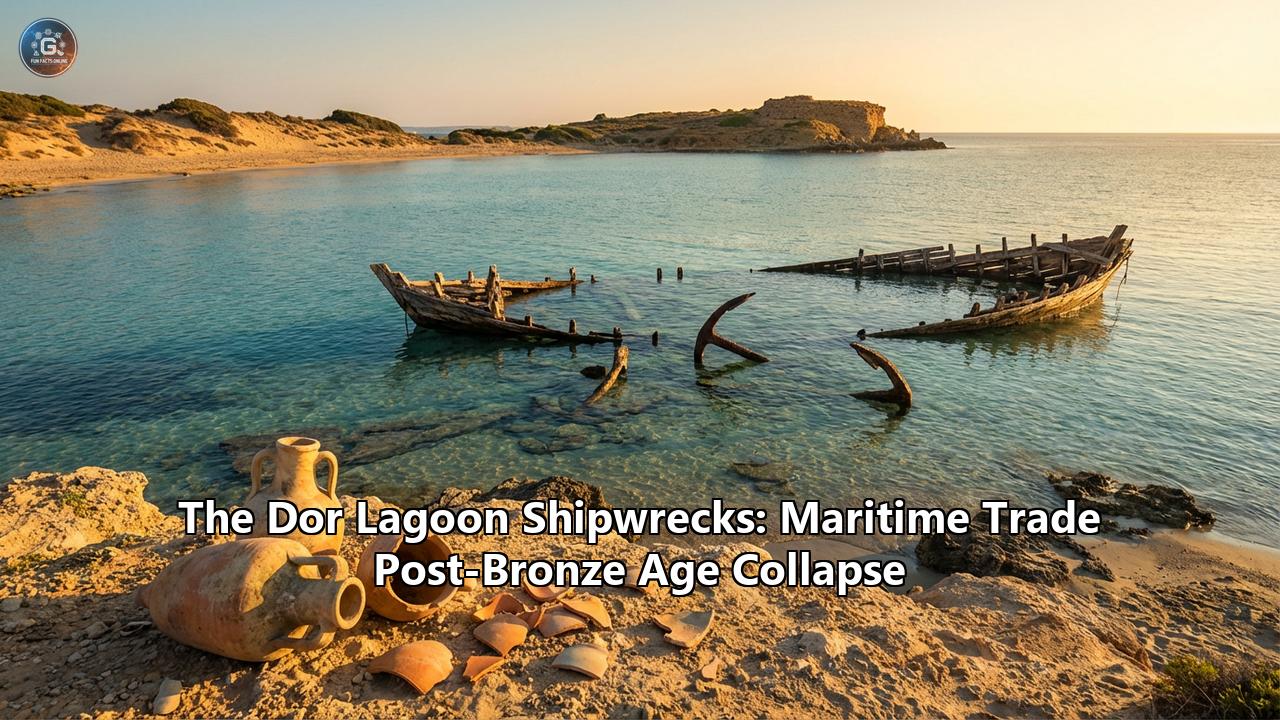
Beneath the turquoise, sun-dappled waters of Israel’s Carmel Coast lies a natural harbor that has silently guarded the secrets of ancient mariners for over three millennia. Protected by a string of small islets and rocky outcrops, the Tantura Lagoon—also known as the Dor Lagoon—once served as a vital sanctuary for vessels navigating the treacherous eastern Mediterranean. Yet, the very geographic features that offered refuge also made the lagoon a notorious "trap for ships". Over the centuries, storms, navigational errors, and shallow sandbars claimed countless vessels, turning the seabed into an unparalleled underwater museum of maritime history.
For decades, underwater archaeologists have explored the lagoon, cataloging the scattered remains of at least 26 shipwrecks spanning various eras, including the renowned Byzantine Dor 2001/1 vessel, which provided crucial evidence of early frame-based shipbuilding. However, the most enigmatic and transformative chapter of Mediterranean history—the Iron Age—remained stubbornly elusive in the deep. That is, until the winter excavation seasons of 2023 and 2024, when a joint expedition from the University of California, San Diego (UCSD) and the University of Haifa made a discovery that would fundamentally rewrite the story of human resilience, economics, and seaborne trade.
The discovery of three superimposed Iron Age shipwrecks, published in the prestigious journal Antiquity in 2025, has shattered long-held historical assumptions. Lying just meters apart and preserved under a thick blanket of anaerobic sand and silt, these three wrecks—cataloged as Dor M, Dor L1, and Dor L2—represent the first Iron Age ship cargoes ever found within the context of an ancient port city in Israel. Spanning from the 11th to the 6th century BCE, they offer a tangible, chronological map of how humanity recovered from one of the greatest civilizational collapses in history.
The Cataclysm: The Late Bronze Age Collapse and the "Dark Age" Myth
To understand the sheer magnitude of the Dor Lagoon discoveries, one must first understand the world that existed before these ships set sail. Around 1200 BCE, the eastern Mediterranean experienced a catastrophic, system-wide failure known as the Late Bronze Age collapse. Prior to this period, the Mediterranean was a thriving, interconnected super-network. The Egyptian Pharaohs, the Hittite Empire in Anatolia, the Mycenaeans in Greece, and the wealthy Canaanite city-states engaged in a complex, globalized trade of copper, tin, gold, ivory, and exotic goods.
Then, within the span of a few decades, it all violently unraveled. Megacities burned, empires fractured, and written languages vanished. Historians have long debated the causes—citing a "perfect storm" of prolonged droughts, devastating earthquakes, internal rebellions, and the sudden, violent incursions of mysterious marauders known as the "Sea Peoples". In the aftermath, the thriving maritime trade networks that had bound the ancient world together disintegrated.
For generations, scholars believed that the subsequent period, the early Iron Age, was a "Dark Age" characterized by isolated, impoverished populations terrified of the sea. It was assumed that international maritime commerce ground to an absolute halt, and that civilizations turned inward. The three ghost ships of the Dor Lagoon prove definitively that this narrative is false. Far from a dead sea, the Mediterranean of the early Iron Age was a dynamic, pulsing theater of risk, innovation, and recovery.
The City of Dor: A Resilient Maritime Hub
The ancient city of Tel Dor, situated perfectly between modern-day Haifa and Tel Aviv, was established around 2000 BCE during the Middle Bronze Age. By the time the Late Bronze Age collapse swept through the region, Dor was a fortified, wealthy Canaanite seaport. Unlike many of its contemporaries, Dor survived the widespread destruction, albeit under new management.
In the immediate aftermath of the collapse, the city fell under the control of the Sikil, one of the seafaring tribes collectively remembered as the Sea Peoples. The Hebrew Bible briefly mentions Dor during this era, noting in the Book of Judges that the Israelite tribe of Manasseh failed to drive out "the inhabitants of Dor and her towns". As centuries passed, the city would repeatedly change hands, folding into the Kingdom of Israel, and later falling under the imperial shadows of the Neo-Assyrian and Neo-Babylonian empires.
Because the city survived and adapted through these turbulent transitions, its harbor remained active. The ships that sank in the Tantura Lagoon did so in shallow waters. While the valuable wooden hulls were likely scavenged by opportunistic locals—as timber was an incredibly precious resource in antiquity—the heavy cargoes plummeted to the seafloor, quickly swallowed by the shifting sands. This sand created an oxygen-poor (anaerobic) environment, perfectly preserving ceramics, stone anchors, and even delicate organic materials like resin and seeds for 3,000 years.
When the UCSD and University of Haifa team, co-directed by Professor Thomas E. Levy and Professor Assaf Yasur-Landau, deployed high-resolution sonar, GPS-aligned 3D mapping, multispectral imaging, and precision underwater dredging, they did not just find scattered potsherds. They found an underwater stratigraphy—shipwrecks stacked upon each other like the historical layers of an archaeological tell.
Dor M: The Dawn of Recovery (11th Century BCE)
The deepest and oldest of the three wrecks, cataloged as Dor M, dates to the 11th century BCE. This was the immediate wake of the Bronze Age collapse, a time when the Mediterranean was supposedly locked in a profound Dark Age. Yet, the cargo of Dor M tells a story of audacious resurgence.
Dor M represents the "renaissance of long-distance trade," illustrating how, barely a century after the global economy shattered, intrepid merchants were already rebuilding their networks. The wreck's cargo includes a significant number of storage jars that originated in Egypt, Lebanon, and Cyprus, indicating that the Sikil rulers of Dor were actively engaging with polities across the sea.
Perhaps the most breathtaking artifact recovered from Dor M is a single-holed stone anchor inscribed with Cypro-Minoan script. Cypro-Minoan is an undeciphered syllabic writing system used primarily on the island of Cyprus during the late Bronze Age and early Iron Age. Finding an anchor bearing this script in the waters of the Levant is a smoking gun for direct, specialized maritime interaction between the coast of Canaan and Cyprus.
The findings of Dor M beautifully parallel one of the most famous literary texts of ancient Egypt: The Report of Wenamun. Written around the same time as the sinking of Dor M, the text recounts the disastrous voyage of an Egyptian priest named Wenamun, who traveled to the port of Dor (which he explicitly states was ruled by the Sikil) to purchase cedar wood for the sacred barque of the god Amun. In the story, Wenamun is robbed in the harbor of Dor and becomes embroiled in a bitter diplomatic dispute. For years, historians debated whether Wenamun’s tale was historical fact or historical fiction. The discovery of Dor M, with its Egyptian storage vessels and Cypriot anchors, provides stunning physical proof that the geopolitical landscape described by Wenamun was entirely real. The sea was alive with merchants, diplomats, and pirates.
Dor L1: Coastal Trade Under the Israelite Kingdom (9th–8th Centuries BCE)
Centuries passed. The Sikil faded into history, and the geopolitical map of the Levant was redrawn by the emergence of new regional powers, most notably the Kingdom of Israel. The second shipwreck, Dor L1, dates to the late 9th or early 8th century BCE, a period during which the Israelites had consolidated control over the northern coastal plains.
The cargo of Dor L1 presents a fascinating contrast to its predecessor. Rather than the far-flung, international connections seen in the 11th-century wreck, the artifacts in Dor L1 suggest a highly localized, regionalized trade network. The cargo primarily consists of Phoenician-style storage jars (amphorae) and simple galley wares—the everyday ceramics used by sailors to cook and eat at sea.
Remarkably, some of the ceramic bowls recovered from Dor L1 bore mending holes. In antiquity, if a bowl cracked, it was not simply thrown away; sailors would drill small holes on either side of the fracture and bind the pieces together with lead or organic cordage. This deeply human detail serves as a poignant reminder of the frugal, rugged lives of the Iron Age mariners who repaired their meager possessions while pitching on the Mediterranean swells.
The Dor L1 wreck also yielded precious organic data: archaeologists found grape seeds preserved inside one of the jars, offering direct evidence of the agricultural commodities being traded along the coast. Professor Yasur-Landau notes that the trade during this era was likely designed to supply regional coastal ports rather than massive, far-flung empires. This localized economic footprint aligns perfectly with biblical and historical descriptions of the Kingdom of Israel during the 9th century BCE, a time when regional kingdoms formed localized economic alliances, such as the famous partnerships between the Israelite kings and the Phoenician monarchs of Tyre.
Dor L2: Empires of Iron and the Globalized Sea (7th–6th Centuries BCE)
As the Iron Age progressed, the era of localized, independent Levantine kingdoms came to a violent end. The relentless expansion of the Neo-Assyrian Empire, followed by the Neo-Babylonian Empire, swallowed the Mediterranean coast. Tel Dor was absorbed into these massive imperial machines. The youngest of the three shipwrecks, Dor L2, dates to the late 7th or early 6th century BCE and reflects the sheer scale of this new, globalized, imperial economy.
The Dor L2 cargo is the most complete of the three wrecks and reveals a massively expanded trade zone. The seabed was littered with Cypriot-style, basket-handle amphorae—distinctive jars designed with high, looping handles that made them easy to pass from hand to hand while loading a rocking ship. Chemical residue analysis of these jars revealed traces of resin, olive oil, and wine, showcasing the bulk transport of luxury agricultural goods. The wreck also contained exotic volcanic and quartz-rich ballast stones, which geologists can trace to distant shores, proving the ship had traversed the wider Mediterranean before meeting its doom in the Dor Lagoon. Furthermore, the ship was equipped with an advanced wood-and-lead anchor, a technological step up from the simple stone anchors of earlier centuries.
But the most groundbreaking artifacts found in the Dor L2 cargo were nine porous, metallic masses known as "iron blooms".
The Iron Age is named for the revolutionary adoption of iron metallurgy, which replaced bronze as the primary material for tools and weapons. However, extracting iron from ore is vastly more complex than smelting copper or tin. It requires reaching temperatures that ancient furnaces struggled to achieve, resulting in a spongy, slag-filled mass called a "bloom." Blacksmiths then had to repeatedly heat and hammer this bloom to drive out the impurities and forge usable wrought iron.
Finding nine iron blooms in a shipwreck cargo is an extraordinary rarity. It proves that by the 7th century BCE, iron was no longer just a luxury oddity forged locally; it had become a bulk commodity. The maritime network was transporting raw, semi-processed industrial materials across the sea to feed the insatiable military and agricultural demands of the Assyrian or Babylonian empires. The Dor L2 wreck is a masterclass in ancient macroeconomics, capturing the exact moment when the Mediterranean shifted into an advanced, heavy-industry trade network.
The Science of the Silt: Reconstructing Ghost Fleets
The retrieval and interpretation of these three eras of history is a testament to the staggering advancements in modern marine archaeology. Underwater excavation is famously one of the most difficult and expensive disciplines in the scientific world. Working in the shallow surge zone of a lagoon presents immense physical challenges: visibility is often reduced to inches by suspended sand, and the violent tidal action can easily destroy fragile organic remains the moment they are exposed.
Because of these logistical and financial hurdles, the majority of maritime archaeology in the Mediterranean has traditionally focused on the later Hellenistic, Roman, and Byzantine periods, leaving the Iron Age largely ignored. As Professor Levy noted, prior to this discovery, only about a dozen Iron Age wrecks were known across the entire Mediterranean basin. The Tantura Lagoon expedition singlehandedly increased the region's underwater record for this epoch by orders of magnitude.
To achieve this, the UCSD and Haifa teams did not rely solely on traditional scuba diving and dredging. They employed a suite of high-tech methodologies. Before a single grain of sand was moved, the seabed was subjected to high-resolution sonar scanning and multispectral imaging to detect anomalies buried deep within the silt. Once the targets were identified, the team used an advanced 3D stereoscopic imaging kit to map the entire debris field in perfect scale, aligning every amphora handle and ballast stone with precise global GPS coordinates.
This non-destructive, digital-first approach means that the wrecks can be studied in virtual reality by experts all over the world. Furthermore, the archaeologists made the deliberate choice to raise only a small portion of the exposed material. Each jar, anchor, and iron bloom that was brought to the surface is currently undergoing rigorous laboratory analysis. Isotope analysis of the lead and iron will pinpoint the exact mines from which the metals were extracted. Gas chromatography and mass spectrometry of the ceramic pores will reveal the molecular signatures of ancient wines, oils, and resins, breathing life into the diets and economies of a vanished world.
As for the ships themselves, the researchers firmly believe that beneath the layers of ballast stones and sand, the waterlogged wooden keels and lower hull strakes of these Iron Age vessels are still intact. Leaving them buried in the anaerobic mud ensures their preservation until specialized conservation facilities are prepared to receive them.
The Legacy of the Lagoon
The Tantura Lagoon is much more than a geographical indentation on the Israeli coast; it is an enduring chronometer of human civilization. The ships that rest in its sands tell a continuous story of survival. From the Dor M vessel proving that brave sailors defied the apocalypse of the Bronze Age collapse to forge new connections, to the Dor L1 mariners quietly sustaining the Kingdom of Israel, to the Dor L2 merchants feeding the iron-hungry empires of Mesopotamia, the lagoon encapsulates the unrelenting human drive to connect, trade, and endure.
This legacy of maritime importance did not stop in the Iron Age. Centuries later, the exact same lagoon would claim the Dor 2001/1, a 16.9-meter Byzantine coaster loaded with building stones that sank in the early 6th century CE. Discovered a mere 70 meters offshore, the Dor 2001/1 yielded its own revolutionary data, proving that the crucial transition from "shell-first" to "frame-based" shipbuilding occurred in the Mediterranean 500 years earlier than previously believed. For over two millennia, from the Sikil to the Byzantines, the merchants of the Mediterranean risked the treacherous sandbars of Dor because the economic rewards of the sea were simply too great to ignore.
As Professor Levy remarked, this groundbreaking research is "just the beginning of an unbelievable Iron Age project". To date, only 25 percent of the Dor Lagoon sandbar has been excavated. What other secrets lie waiting in the dark, cold silt? Are there wrecks from the elusive Sea Peoples themselves? Are there royal cargoes dispatched by the kings of Judah or Tyre?
Whatever the future holds, the discovery of the Dor Lagoon ghost fleet has irrevocably altered our perception of antiquity. The "Dark Age" was not entirely dark, and the sea was never empty. Driven by necessity, innovation, and an indomitable spirit, the ancient mariners of the Iron Age hoisted their sails, navigated by the stars, and slowly, stubbornly, stitched a broken world back together.
Reference:
- https://arkeonews.net/ghost-fleet-of-the-iron-age-three-ancient-shipwrecks-rewrite-the-story-of-mediterranean-seafaring/
- https://www.timesofisrael.com/in-first-three-shipwrecks-from-biblical-times-uncovered-off-the-coast-of-israel/
- https://greekreporter.com/2025/10/09/shipwrecks-israel-coast/
- https://allthatsinteresting.com/israel-tantura-lagoon-ancient-shipwrecks
- https://www.jpost.com/archaeology/article-870308
- https://www.tandfonline.com/doi/abs/10.1111/1095-9270.12029
- https://dor.huji.ac.il/Download/Article/mor_Kahanov_2001shipwreck_summary.pdf
- https://archaeologymag.com/2025/10/shipwrecks-rewrite-iron-age-mediterranean-trade/
- https://www.reddit.com/r/Shipwrecks/comments/1o5beei/3_iron_age_shipwrecks_discovered_off_dor_israel/
- https://www.discovermagazine.com/ancient-shipwreck-cargo-sheds-light-on-iron-age-trade-and-a-lost-mediterranean-seaport-48146
- https://armstronginstitute.org/1271-three-ancient-wrecks-analyzed-off-israelite-coast
- https://www.smithsonianmag.com/smart-news/three-shipwrecks-discovered-off-the-coast-of-israel-shed-new-light-on-the-history-of-iron-age-maritime-trade-180987555/
- https://biblearchaeology.org/current-events-list/5248-new-study-analyzes-the-cargoes-of-iron-age-shipwrecks-from-dor,-israel
- https://cris.haifa.ac.il/en/publications/the-dor-20011-byzantine-shipwreck-israel-final-report/
- https://www.cambridge.org/core/journals/radiocarbon/article/abs/1st-millennium-ad-mediterranean-shipbuilding-transition-at-dortantura-lagoon-israel-dating-the-dor-20011-shipwreck/E068FC4F02E494AAAAEF3982EE6BDDFE
- https://www.researchgate.net/publication/229810440_The_Dor_20011_Shipwreck_Israel-a_Summary_of_the_Excavation