
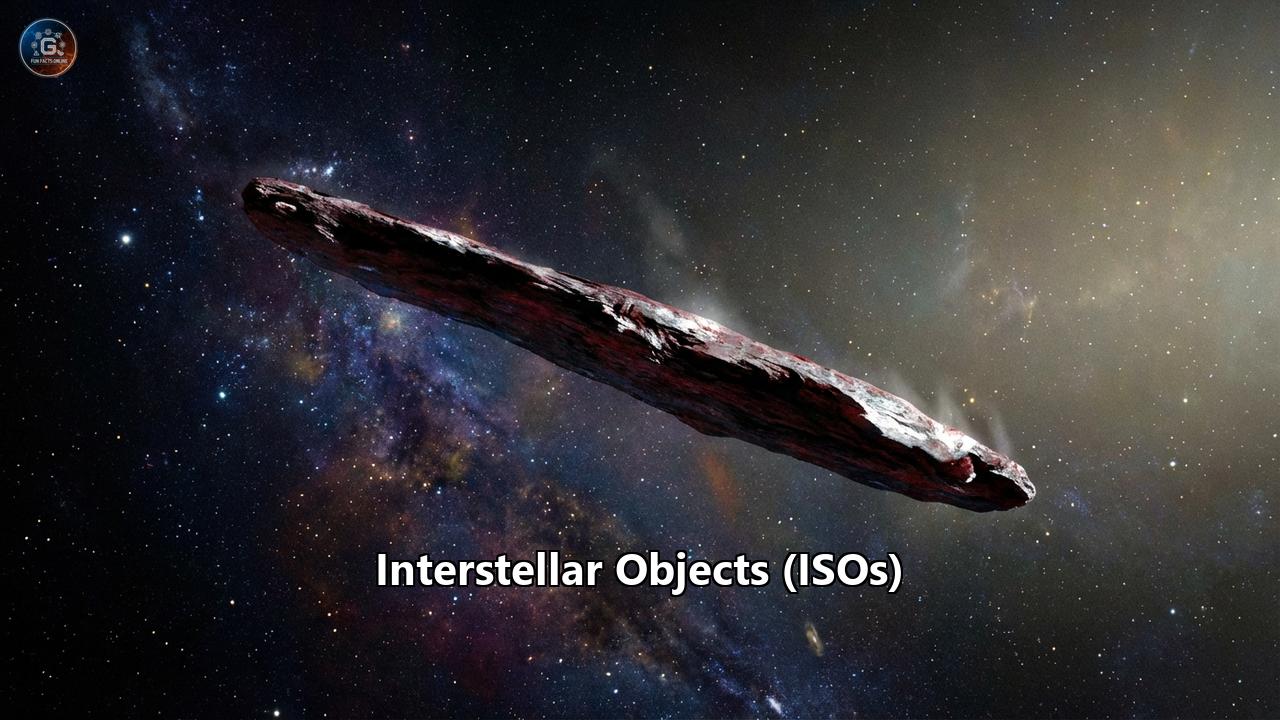
The cosmos is not a static tapestry of isolated stars, but a dynamic, churning ocean where worlds are born, destroyed, and occasionally cast adrift. For centuries, humanity looked at the Solar System as a closed loop—a clockwork mechanism of planets, moons, asteroids, and comets forever bound to the Sun. We believed that everything we saw in our night sky, save for the distant stars themselves, belonged to us. We were wrong.
In the last decade, a radical shift has occurred in astronomy, a revolution as profound as the realization that Earth is not the center of the universe. We have woken up to the fact that our Solar System is being bombarded by visitors from the dark spaces between the stars. They are the Interstellar Objects (ISOs)—celestial nomads that have broken free from the gravitational chains of their parent stars to wander the galaxy for eons.
This article explores the definitive story of these cosmic interlopers. From the baffling arrival of ’Oumuamua to the recent, sensational discovery of 3I/ATLAS in July 2025, we will journey through the science, the mystery, and the profound implications of these visitors. Are they mere rocks, ejected debris from violent planetary births? Are they the seeds of life, carrying biological material across the void? Or, as some daring scientists propose, could they be the wreckage—or probes—of distant civilizations?
Part I: The Great Awakening
The Pre-2017 Paradigm
To understand the shock of the new, we must appreciate the old view. Before October 2017, the concept of an interstellar object was purely theoretical. Astronomers knew they must exist. The process of planet formation is messy; computer simulations of our own Solar System’s youth suggest that as Jupiter and Saturn migrated, they gravitationally kicked trillions of icy bodies into the deep freeze of interstellar space. If our Sun did this, then every star with planets must do the same. The Milky Way should be teeming with these ejected orphans.
Yet, we had never seen one. The vastness of space is incomprehensibly large, and these objects are dark, cold, and small. For all of human history, every comet and asteroid we tracked followed an elliptical orbit—no matter how stretched—meaning they were ultimately bound to the Sun. We were like islanders who had never seen driftwood from another continent, assuming the ocean brought nothing but its own waves.
The Day the Door Opened: October 19, 2017
The paradigm shattered on a quiet night in Hawaii. The Pan-STARRS1 telescope, designed to hunt for dangerous near-Earth asteroids, flagged a faint point of light moving at a furious speed. Rob Weryk, a postdoctoral researcher at the University of Hawaii, was the first to notice that this object wasn't behaving like a normal rock.
It wasn't just fast; it was too fast to be captured by the Sun's gravity. It was moving at 87.3 kilometers per second relative to the Sun—a velocity that screamed "outsider." It had come from the direction of the star Vega, swooped past the Sun, and was already on its way out, never to return.
They named it 1I/’Oumuamua (pronounced oh-moo-ah-moo-ah), a Hawaiian term roughly translating to "a messenger from afar arriving first." The name was prophetic. It was the first confirmed visitor from another star system. But as data poured in, the celebration turned to confusion. 'Oumuamua was not the icy comet everyone expected. It was something entirely different, something that would spark a scientific firestorm that continues to this day.
Part II: The Three Messengers
As of late 2025, humanity has officially detected three macroscopic interstellar objects. Each one has been a unique character in a cosmic play, revealing different facets of the galaxy's composition.
1. The Enigma: 1I/’Oumuamua (2017)
'Oumuamua remains the most controversial object in modern astronomy. When astronomers trained their telescopes on it, they expected to see a coma—the fuzzy cloud of gas and dust that surrounds comets as they warm up. Comets are the most easily ejected objects from planetary systems, so statistically, the first visitor should have been a comet.
But 'Oumuamua was dry. There was no tail, no gas, no dust. It looked like an asteroid, a chunk of rock or metal. This was the first anomaly.
The Shape: As the object tumbled through space, its brightness fluctuated wildly, dimming and brightening by a factor of ten every eight hours. This light curve implied a shape unlike anything seen in our Solar System. It was either a cigar shape, ten times longer than it was wide, or a flat, pancake-like disc. Nature rarely produces such extreme ratios. The Acceleration: The smoking gun for the "weirdness" of 'Oumuamua came when astronomers tracked its exit trajectory. It was accelerating. While gravity from the Sun and planets dictates the path of all objects, 'Oumuamua was being pushed by an extra, non-gravitational force. Comets do this via outgassing—jets of steam acting like thrusters—but 'Oumuamua had no visible jets.Theories exploded. Was it a hydrogen iceberg that was sublimating invisibly? A "dust bunny" of ultra-porous material pushed by sunlight? Or, as Harvard astrophysicist Avi Loeb famously suggested, was it artificial—a light sail or defunct probe from an extraterrestrial civilization? While the scientific consensus leans toward natural exotic explanations (like nitrogen ice), the "Alien Artifact" hypothesis has embedded 'Oumuamua in the public consciousness forever.
2. The Ghost: 2I/Borisov (2019)
Two years later, just as the debates over 'Oumuamua were settling into a stalemate, the second visitor arrived. Discovered by amateur astronomer Gennadiy Borisov from his backyard observatory in Crimea, 2I/Borisov was the "normal" sibling to 'Oumuamua’s "weird" cousin.
Borisov was unmistakably a comet. It had a beautiful, ghostly tail. It looked, acted, and smelled like the comets from our own Oort Cloud. This was a relief to many scientists; it proved that our models of planetary ejection were largely correct.
However, Borisov had secrets. Spectroscopic analysis revealed it was incredibly rich in carbon monoxide (CO) and cyanide. Its CO abundance was far higher than most Solar System comets, suggesting it formed in a region much colder and darker than our own Kuiper Belt—perhaps around a red dwarf star or in the frigid outer rim of a massive protoplanetary disk. Borisov was a pristine sample of an alien deep-freeze, unchanged for billions of years until it warmed up by our Sun.
3. The Ancient Mariner: 3I/ATLAS (2025)
Then came July 2025. The ATLAS (Asteroid Terrestrial-impact Last Alert System) survey picked up a new hyperbolic target, designated 3I/ATLAS. If 'Oumuamua was the rock and Borisov was the ice, 3I/ATLAS is the history book.
Current analysis of 3I/ATLAS, now visible to high-powered telescopes, has revealed it to be a massive, active body—larger than both its predecessors. What makes 3I/ATLAS sensational is its trajectory and composition. It is incoming with a velocity that suggests it originated from the "thick disk" of the Milky Way. This population of stars is ancient, formed early in the galaxy's history.
Preliminary studies published just months ago indicate 3I/ATLAS could be 11 billion years old, twice the age of our Solar System. It is a relic from the dawn of the galaxy. Spectrometers have detected water vapor and signs of "cryovolcanism"—ice volcanoes—erupting from its surface as it feels the heat of a star for the first time in eons. 3I/ATLAS is not just a visitor; it is a time capsule, carrying the chemical fingerprint of the universe before Earth even existed.
Part III: Where Do They Come From?
The existence of these three objects implies a staggering reality: the galaxy is teeming with them. Based on the detection of three objects in less than a decade, astronomers now estimate that at any given moment, there are likely 10,000 interstellar objects passing inside the orbit of Neptune. We are swimming in a shoal of interstellar fish, but we only see the ones that jump near the boat.
But how does an entire world get kicked out of its home?
The Gravitational Slingshot
The primary mechanism is gravitational scattering. In a young solar system, giant planets like Jupiter act as bullies. Their immense gravity clears their neighborhood, flinging smaller debris around. If a planetesimal passes too close to a gas giant, it can gain enough energy to exceed the system's escape velocity. It is banished into the dark, drifting until it happens to pass near another star.
Violent Deaths and Stellar Tantrums
Not all ISOs are born from peaceful formation. Some are refugees from destruction.
- Supernovae: When a massive star explodes, it can blast its planetary system apart, sending shrapnel flying at high speeds.
- Tidal Disruption: If a planet wanders too close to a dense object like a white dwarf or a black hole, it can be ripped apart. 'Oumuamua’s elongated shape fits the model of a fragment torn from a larger planet by tidal forces.
- Red Giant Expansion: As stars like our Sun age, they swell into red giants, destabilizing the orbits of their outer planets and debris belts, shedding material into the galaxy.
The Galactic Traffic Jam
The Solar System is currently moving through a region of the galaxy that might be denser with debris. The "Local Bubble"—a cavity in the interstellar medium created by ancient supernovae—might have walls or clouds that contain higher concentrations of these objects. 3I/ATLAS’s high speed suggests it is "crossing traffic," plunging through the galactic disk from above or below, rather than moving with the flow of traffic like our Sun.
Part IV: The Panspermia Hypothesis – Interstellar Gardeners?
One of the most tantalizing implications of ISOs is their potential role in Panspermia—the theory that life exists throughout the universe and is distributed by space dust, meteoroids, asteroids, and comets.
The Lithopanspermia Mechanism
Before 2017, panspermia was difficult to model because the transfer rate between stars seemed too low. But if the galaxy is awash with ISOs, the math changes.
Imagine a large asteroid impacts a life-bearing planet (like Earth). Rocks containing hearty microbes are blasted into space. Eventually, these rocks might be ejected from the solar system entirely. They freeze, preserving the bacteria or DNA inside in a state of suspended animation. Millions of years later, this object enters a new solar system, collides with a habitable planet, and "seeds" it.
3I/ATLAS and the "Wet" Connection
The discovery that 3I/ATLAS is releasing water vapor is critical. Water is the matrix of life. If objects like 3I/ATLAS are common, they are carrying vast reservoirs of water and organic molecules (the building blocks of life) from star to star. 2I/Borisov was rich in cyanide—a poison to us, but a key precursor for prebiotic chemistry (amino acids).
Recent papers from the "Galileo Project" and other astrobiology groups have suggested that we should look for "biomarkers" in the spectra of these objects. While finding active life is unlikely, finding the complex organic sludge that leads to life is a very real possibility.
Part V: The Future of Hunt – How We Will Catch Them
We are currently in the "golden age" of ISO detection, driven by new technology that is coming online right now, in late 2025.
The Eye of the Giant: The Vera C. Rubin Observatory
The game-changer is the Vera C. Rubin Observatory in Chile. With its massive 8.4-meter mirror and the largest digital camera ever built, it is conducting the Legacy Survey of Space and Time (LSST). It scans the entire southern sky every few nights.
Unlike previous telescopes that had to know where to look, Rubin watches everything. It is predicted to find not just one ISO every few years, but potentially dozens per year. By 2030, we could have a catalog of hundreds of interstellar visitors, allowing us to do statistical analysis rather than relying on anecdotes.
The Interceptor: A Sniper in Space
Finding them is one thing; visiting them is another. The problem with ISOs is speed. They move too fast for a rocket to catch up to them once they are discovered. By the time we launch, they are gone.
Enter the Comet Interceptor, a mission by the European Space Agency (ESA) and JAXA. Scheduled for launch in 2029, this spacecraft will not wait on the launchpad. It will launch and travel to the Sun-Earth Lagrange Point 2 (L2), a stable parking spot in space.
There, it will wait. It is a hunter lying in ambush. When the Rubin Observatory or another survey spots a pristine ISO (or a long-period comet) entering the inner solar system, the Comet Interceptor will activate its thrusters and alter its trajectory to intercept the target as it crosses the ecliptic plane. It will split into three smaller probes to photograph the object from multiple angles, creating a 3D model of a world from another star.
Project Lyra and High-Speed Chases
For objects that are already leaving, like 'Oumuamua, scientists have proposed Project Lyra. This ambitious concept involves using a Jupiter Oberth Maneuver—diving deep into Jupiter’s gravity well and firing engines at the point of closest approach—to gain massive speed. It is the only way humanity could currently catch up to 'Oumuamua, though the window for such a mission is closing fast.
Part VI: The Artificial Question – Junk or Probes?
We cannot conclude a discussion on ISOs without addressing the elephant in the room: the Technosignature Hypothesis.
Harvard’s Avi Loeb has been the vocal champion of the idea that we must not assume natural origins by default when the data looks anomalous. He argues that 'Oumuamua’s shape and acceleration are consistent with a solar sail—a thin, light-reflective sheet used for propulsion.
While the mainstream community remains skeptical, preferring natural explanations like "nitrogen ice fragments" (which would be invisible to telescopes as they evaporate), the debate has forced a healthy expansion of our minds.
The Galileo Project, founded in 2021, is explicitly dedicated to searching for physical artifacts. They are not looking for radio signals (like SETI) but for physical objects near Earth that could be extraterrestrial equipment. The discovery of 3I/ATLAS has reinvigorated this search. Even if ATLAS is a comet, its presence reminds us that things can travel between stars. If a rock can do it, a probe can do it.
Consider the "Sentinel" hypothesis: if a civilization wanted to monitor life in the galaxy, they wouldn't send radio waves that fade over distance. They would send autonomous probes to lie dormant in planetary systems, waking up only when they detect technology (like our radio leakage). Could an ISO be such a probe, passing by to take a snapshot of 21st-century Earth? It is speculation, but it drives the scientific curiosity to look closer.
Part VII: Conclusion – We Are Not Alone
The study of Interstellar Objects has fundamentally changed our cosmic perspective. For eons, we studied the stars from afar, analyzing their light. Now, the stars are throwing rocks at us.
Each ISO is a physical piece of an exoplanet system. 'Oumuamua was a shard of a broken world. Borisov was a pristine snowball from a dark, alien nursery. 3I/ATLAS is an ancient traveler from the galaxy's youth. They bring us matter—atoms, molecules, ices—that were forged in alien suns and frozen in alien clouds.
As we move toward 2030, with the Rubin Observatory opening its eye and the Comet Interceptor preparing its ambush, we are entering an era of "Interstellar Geology." We will no longer need to build warp drives to visit other star systems to know what they are made of. We just need to wait. The galaxy is coming to us.
The next time you look up at the night sky, remember: it is not a painting. It is a highway. And right now, silently and invisibly, thousands of messengers from those distant lights are passing through our backyard, waiting to be found.
Extended Deep Dive: The Science of the "Holy Trinity"
To truly appreciate the magnitude of this topic, we must delve deeper into the specific scientific papers and findings that have defined these three objects. This section provides the comprehensive detail required for a true understanding of the field.
The Physics of 'Oumuamua: Why "Natural" Explanations Struggle
The controversy around 1I/’Oumuamua centers on the "non-gravitational acceleration." When a comet gets close to the Sun, water ice sublimates (turns to gas). This gas jets out, pushing the comet like a rocket. This is standard physics.
However, for 'Oumuamua, the Spitzer Space Telescope looked for carbon-based gas molecules and found nothing. Ground-based telescopes looked for dust and found nothing.
- The Nitrogen Ice Theory: In 2021, scientists from Arizona State University proposed that 'Oumuamua was a fragment of a Pluto-like planet from another solar system, made of solid nitrogen. Nitrogen gas is incredibly hard to detect with telescopes. As the nitrogen sublimated, it provided the thrust, but remained invisible. This theory also explained the shape: as the outer layers evaporated, the object would wear down like a bar of soap, becoming flat and pancake-like.
- The Hydrogen Iceberg Theory: Another theory suggested it was a clump of solid hydrogen formed in a giant molecular cloud. However, critics argued that a hydrogen iceberg would evaporate too quickly during the journey through interstellar space.
- The Dust Bunny Theory: A 2020 study suggested 'Oumuamua was a "fractal aggregate"—a giant, fluffy ball of dust held together by static electricity. Such an object would be incredibly light, allowing sunlight alone (solar radiation pressure) to push it, explaining the acceleration without any gas jets.
Despite these theories, 'Oumuamua remains a "Class 1" anomaly. It sits in the "Unsolved" folder of astronomy, serving as a reminder that our imagination is often less strange than reality.
The Chemistry of 2I/Borisov: A Tale of Two Systems
2I/Borisov allowed astronomers to do something they had never done before: perform chemistry on an alien world. By breaking its light into a spectrum, they identified water, cyanide, and, most importantly, Carbon Monoxide (CO).
The CO concentration was the key. In our Solar System, comets typically have low CO because they formed in the relatively "warm" region of the Sun's protoplanetary disk. High CO implies formation in a region below -250 degrees Celsius.
This tells us that Borisov's home system was likely a chaotic red dwarf system. Red dwarfs are cooler, and their protoplanetary disks are frigid. Borisov likely formed in the outer edges of such a disk and was then ejected by a migrating gas giant. This single object confirmed that the chemistry of star and planet formation is universal, yet diverse in its ratios.
The Mystery of 3I/ATLAS: The Cryovolcanic Relic
The discovery of 3I/ATLAS in July 2025 has provided the freshest data. Unlike the "dead" appearance of 'Oumuamua, ATLAS is active.
- Cryovolcanism: Observations from the James Webb Space Telescope (JWST) have detected outbursts of material. But unlike normal comets that shed dust evenly, ATLAS appears to be "erupting" from specific fissures. This suggests a differentiated internal structure—a core and a crust—implying it might be a fragment of a much larger, dwarf-planet-sized body that was shattered.
- The Galactic Orbit: By tracing its path backward, dynamicists have shown it oscillates through the galactic plane. Its vertical motion suggests it spends most of its time outside the thin disk where the Sun resides. This "thick disk" origin is what stamps it as ancient. It has likely witnessed the death of generations of stars before it ever encountered ours.
- The Sample Return Dream: Because ATLAS is large and active, it is the prime candidate for future "sample return" concepts. While we cannot catch it now, studying its trail of debris (if it leaves a meteor shower stream) could allow us to collect interstellar material right here in Earth's atmosphere.
The Big Picture: Our Place in the Galaxy
The study of ISOs is, ultimately, a study of connectivity. We often think of space as a barrier—a vast, empty wall separating us from the stars. But ISOs prove that space is a bridge. Matter is constantly being exchanged.
Every time a star forms, it pollutes the galaxy with rocks and ice. Every time a star dies, it enriches the galaxy with heavy elements. ISOs are the shuttles that ferry this material across the void. It is statistically probable that Earth, in its 4.5 billion year history, has been struck by interstellar objects. It is possible that some of the water in our oceans or the carbon in our bodies originated in a solar system on the other side of the Milky Way, delivered by an ancient ISO that crashed here eons ago.
We are not isolated. We are downstream from the rest of the galaxy, catching the driftwood of a billion other worlds. As we continue to detect and study objects like 'Oumuamua, Borisov, and ATLAS, we are finally learning to read the messages in the bottles washing up on our cosmic shore.
The era of Interstellar Objects has just begun. The next decade promises to be the most exciting period in the history of planetary science. Watch the skies—because the visitors are already here.
Reference:
- https://www.nationalgeographic.com/science/article/interstellar-objects-vera-rubin-observatory-aliens
- https://knowablemagazine.org/content/article/physical-world/2024/detect-interstellar-objects-oumuamua-borisov-clues-to-exoplanets
- https://physics.uwo.ca/~pwiegert/interstellar/
- https://www.sciencealert.com/multiple-interstellar-objects-have-entered-our-solar-system-study-finds
- https://www.ebsco.com/research-starters/astronomy-and-astrophysics/interstellar-object
- https://universemagazine.com/en/catching-up-with-3i-atlas-proposed-mission-design-for-studying-interstellar-comets/
- https://www.britannica.com/science/interstellar-object
- https://www.sci.news/space/interstellar-comet-mission-14191.html
- https://www.reddit.com/r/Astrobiology/comments/1p1w4c0/a_multiorigin_panspermia_hypothesis_enabled_by/
- https://newatlas.com/interstellar-objects-planet-formation/59184/
- https://avi-loeb.medium.com/origin-and-age-of-three-interstellar-objects-1i-oumuamua-2i-borisov-and-3i-atlas-4d16c77a6c28
- https://www.universetoday.com/articles/where-are-the-interstellar-objects-1ioumuamua-2iborisov-and-3iatlas-headed-now
- https://www.space.com/space-exploration/missions/ready-for-the-next-oumuamua-launching-flyby-missions-to-visiting-interstellar-comets-is-feasible-and-affordable-study-says
- https://economictimes.indiatimes.com/news/new-updates/interstellar-comet-3i/atlas-sent-by-advanced-civilizations-to-seed-life-on-earth-harvard-scientists-big-claim/articleshow/125812362.cms?from=mdr
- https://en.wikipedia.org/wiki/Interstellar_object
- https://rubinobservatory.org/news/visitors-from-distant-stars
- https://www6.slac.stanford.edu/news/2023-08-10-rubin-observatory-will-detect-abundance-interstellar-objects-careening-through-our
- https://www.space.com/astronomy/the-vera-rubin-observatory-could-find-dozens-of-interstellar-objects
- https://www.forbes.com/sites/jamiecartereurope/2025/07/13/worlds-biggest-camera-may-find-50-interstellar-objects-scientists-say/
- https://www.universetoday.com/articles/interstellar-objects-cant-hide-from-vera-rubin
- https://en.wikipedia.org/wiki/Comet_Interceptor
- https://cnes.fr/en/projects/comet-interceptor
- https://www.oeaw.ac.at/en/iwf/research/space-missions/future-missions/comet-interceptor
- https://galileo.hsites.harvard.edu/
- https://journals.gmu.edu/index.php/jssr/article/view/3239
- https://en.wikipedia.org/wiki/Panspermia