
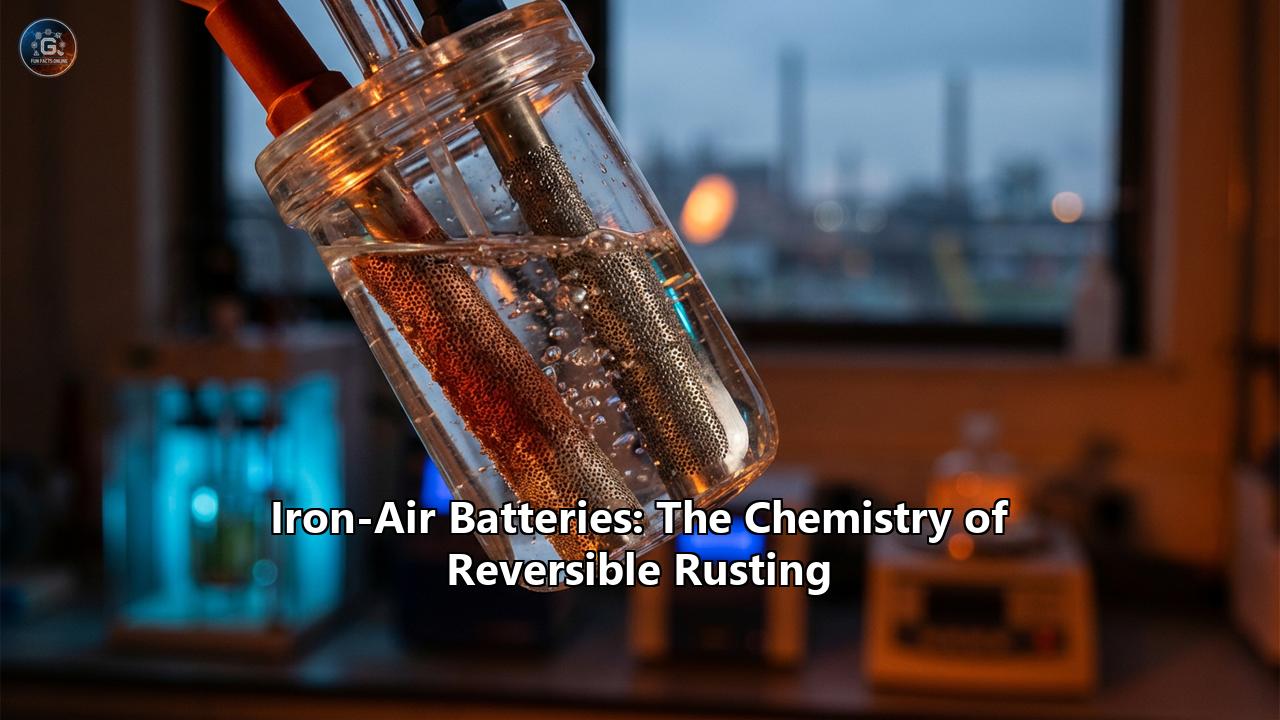
The global energy transition has a timing problem. Solar panels harvest energy only when the sun shines; wind turbines spin only when the breeze blows. But the modern world demands power 24/7, regardless of the weather. For the last decade, lithium-ion batteries—the same technology inside your smartphone and electric vehicle—have been the primary solution to bridge this gap. They are brilliant at providing bursts of power for a few hours. But as we attempt to run entire electrical grids on renewable energy, we face "dunkelflaute"—a German term for "dark wind lull," periods where renewable generation drops to near zero for days or even weeks.
To survive a dunkelflaute without burning fossil fuels, we don't just need a bigger battery; we need a fundamentally different kind of battery. We need a battery that is ultra-cheap, made of earth-abundant materials, and capable of discharging power not for four hours, but for 100 hours or more.
Enter the iron-air battery. It runs on one of the most common chemical reactions on Earth: rusting. By refining and reversing the process of oxidation, scientists and engineers have created a storage system that costs one-tenth the price of lithium-ion and could be the missing link to a 100% renewable grid.
1. The Fundamental Chemistry: How to Bottle Rust
At its core, an iron-air battery is a machine that breathes. It inhales oxygen from the air to discharge energy and exhales oxygen back into the atmosphere to recharge.
The "Reversible Rusting" Mechanism
The chemistry relies on the interaction between iron (Fe), oxygen ($O_2$), and water ($H_2O$).
- Discharge (The Rusting Phase): When the battery is supplying power to the grid, it exposes porous iron plates to oxygen from the air. The iron oxidizes, effectively turning into rust (iron oxide). This reaction releases electrons, which travel through an external circuit to power homes and businesses.
Chemical notation: $2Fe + \frac{3}{2}O_2 \rightarrow Fe_2O_3$ + Energy
- Charge (The De-Rusting Phase): To recharge the battery, an electrical current is applied to the rusted plates. This current drives the oxygen out of the rust, converting it back into metallic iron and releasing the oxygen back into the air. The battery is now "reset" and ready to rust again.
This is a reversal of the natural entropy of the universe. In nature, iron desperately wants to become rust; turning rust back into iron typically requires massive blast furnaces consuming coal and reaching temperatures of 2,000°F. The iron-air battery achieves this reversal electrochemically at relatively low temperatures in a water-based electrolyte.
The Components
Unlike lithium-ion batteries, which require distinct cathode and anode materials (like cobalt, nickel, and graphite) separated by a flammable organic solvent, the iron-air battery is remarkably simple:
- The Anode: Sintered iron pellets or plates. Iron is the fourth most abundant element in the Earth's crust, making the active material effectively unlimited and dirt cheap.
- The Cathode: An "air electrode" that allows the battery to breathe. It usually consists of a carbon-based structure coated with bifunctional catalysts that facilitate both the intake of oxygen (reduction) and the release of oxygen (evolution).
- The Electrolyte: A non-flammable, water-based alkaline solution (typically Potassium Hydroxide, KOH), similar to what is found in a standard AA battery.
2. Engineering the "Rust Cycle": Challenges and Solutions
If the chemistry is so simple, why didn't we do this 50 years ago? In fact, NASA and Westinghouse did experiment with iron-air batteries in the 1970s. They failed because the chemistry, while simple in theory, is messy in practice. Modern success is due to specific breakthroughs in materials science that solved three "killers" of iron-air technology.
The Hydrogen Problem (HER)
The biggest enemy of an iron-air battery is hydrogen. When you try to recharge the battery (converting rust back to iron) in a water-based electrolyte, the electricity prefers to split the water ($H_2O$) into hydrogen gas ($H_2$) rather than converting the iron oxide. This is called the Hydrogen Evolution Reaction (HER).
- The Consequence: Energy is wasted making useless hydrogen gas instead of charging the battery. In the 1970s, this made the batteries inefficient and dangerous (due to gas buildup).
- The Modern Solution: Researchers discovered that adding specific "poisons" to the electrode surface could block the sites where hydrogen forms. Sulfide additives (like Bismuth Sulfide, $Bi_2S_3$) and trace amounts of elements like Lead (Pb) or Bismuth (Bi) dramatically suppress hydrogen formation. These additives raise the energy threshold required to make hydrogen, forcing the electricity to do the useful work of de-rusting the iron instead.
Passivation
During discharge, as the iron turns to rust, it forms a layer of iron oxide. If this layer becomes too dense too quickly, it forms a "skin" that blocks the electrolyte from reaching the iron underneath. The battery "chokes" and stops working even though plenty of fuel (iron) remains.
- The Modern Solution: Nanotechnology allows for the creation of "structured" iron anodes—sintered pellets with microscopic pores that ensure the electrolyte can penetrate deep into the material even as it rusts. This sponge-like structure prevents the oxide layer from sealing off the reaction.
Round-Trip Efficiency
Lithium-ion batteries are like sports cars: highly efficient, returning about 95% of the energy you put in. Iron-air batteries are like diesel locomotives: they only return about 40-50% of the energy put in.
- The Physics: This low efficiency is due to "overpotential"—the extra energy required to drive the oxygen reaction at the air electrode.
- The Economic Reality: Engineers realized that for long-duration* storage, efficiency matters less than capital cost. If the battery is cheap enough (less than $20/kWh), you can afford to waste half the energy and still be profitable, because you are storing "trash" renewable energy (excess solar/wind that would otherwise be curtailed/thrown away).
3. The Global Titans of Rust
After decades of dormancy, the field has exploded with activity, led by companies in the US and Europe.
Form Energy (USA): The Frontrunner
Founded by former Tesla executive Mateo Jaramillo, Form Energy is the face of the iron-air revolution.
- The Tech: Their module looks like a washing machine. Inside, thousands of iron pellets undergo the rust cycle. These modules are aggregated into "power blocks" the size of shipping containers.
- Capabilities: They deliver 100 hours of discharge duration. To put that in perspective, a Tesla Megapack usually offers 4 hours.
- Projects: Form Energy is currently deploying massive pilot projects, including a 10 MW/1,000 MWh system with Xcel Energy in Minnesota and projects with Georgia Power. They have built a dedicated factory in Weirton, West Virginia—fittingly, a historic steel town—to mass-produce these batteries.
Ore Energy (Europe): The Challenger
While Form Energy grabs headlines in the US, a spin-out from Delft University of Technology in the Netherlands, Ore Energy, has achieved a critical milestone.
- The Milestone: In July 2025, Ore Energy connected the world's first iron-air battery to the electrical grid in Delft.
- Strategy: Unlike Form's vertically integrated approach, Ore Energy emphasizes a localized European supply chain, utilizing EU-sourced iron and manufacturing. Their target is 50 GWh of production capacity by 2030, aiming to shore up Europe's energy sovereignty.
Asian Innovation: The "Hydrogel" Breakthrough
In China, research institutes like the Chinese Academy of Sciences (CAS) and Nanjing University are taking a different approach. Recognizing that liquid electrolytes can leak or evaporate, they have developed hydrogel-based iron-air batteries. These use a semi-solid, jelly-like electrolyte that is flexible and can operate in extreme cold (down to -4°F). While still largely in the lab/prototype phase compared to Form's commercial deployments, this technology hints at future "flexible" rust batteries for portable or ruggedized applications.
4. The "Green Steel" Synergy
Perhaps the most fascinating aspect of iron-air technology is its connection to the steel industry. The process of recharging an iron-air battery (turning rust into iron using electricity) is chemically identical to the process of making green steel.
Traditionally, we make steel by using coal to strip oxygen from iron ore (rust) in a blast furnace, releasing massive amounts of $CO_2$.
Form Energy and steel giant ArcelorMittal (a major investor in Form) are exploring a symbiotic relationship:
- Battery as Smelter: The "Direct Reduction of Iron" (DRI) process used to recharge the batteries could be adapted to produce pure iron feedstocks for steelmaking, using renewable electricity instead of coal.
- Circular Economy: A retired iron-air battery isn't hazardous waste. It is essentially a pile of high-grade iron ore. At the end of its 20-30 year life, the battery's "guts" can be dumped directly into an electric arc furnace to become a skyscraper or a car.
5. Economic & Environmental Impact
The Cost Equation
- Lithium-ion: ~$130-$150 per kWh (Capital Cost).
- Iron-Air: Targeted at <$20 per kWh.
This massive reduction in capital cost unlocks applications that were previously impossible. It allows utilities to overbuild renewable capacity and store the excess for days, replacing the need for "peaker plants"—gas-fired power stations that only run during high demand.
Safety and Environment
- Fire Risk: Zero. You cannot set the water-based electrolyte on fire. Unlike lithium-ion, which is prone to thermal runaway, an iron-air battery failure just means it gets wet.
- Supply Chain: Iron is mined on every continent. There is no "cobalt crisis" or reliance on conflict minerals.
- Lifecycle: The materials are 100% recyclable.
6. The Road Ahead: 2026 and Beyond
As we stand in 2026, the era of the "Rust Battery" has officially begun. The pilots in Minnesota and the Netherlands are proving that the chemistry works at grid scale.
The next hurdle is manufacturing scale. Moving from a lab bench to a Gigafactory is difficult. Form Energy's West Virginia plant and Ore Energy's European facilities are the proving grounds. If they succeed, the grid of the 2030s will look very different. It will be a hybrid beast: lithium-ion batteries handling the fast, second-by-second frequency regulation and daily shifting, while massive fields of silent, rusting iron boxes stand ready to power our cities through the longest, darkest storms.
We spent the Iron Age forging weapons and tools. We are now entering a new Iron Age—one where we forge not swords, but resilience.
Reference:
- https://formenergy.com/technology/battery-technology/
- https://formenergy.com/form-energy-unveils-chemistry-of-multi-day-storage-battery-technology/
- https://www.fastcompany.com/91378795/this-new-low-cost-battery-runs-on-rust
- https://tech.eu/2025/07/30/ore-energy-connects-worlds-first-grid-connected-iron-air-battery-in-delft/
- https://www.eqmagpro.com/iron-air-batteries-a-new-class-of-energy-storage-eq-mag/
- https://ngpenergy.com/news/now-form-energy-is-using-its-battery-tech-to-clean-up-iron-and-steel/
- https://www.canarymedia.com/articles/green-steel/now-form-energy-is-using-its-battery-tech-to-clean-up-iron-and-steel
- https://www.ess-news.com/2025/07/30/ore-energy-brings-first-grid-connected-iron-air-battery-online-in-the-netherlands/
- https://www.energystoragenl.nl/en/2025/07/30/ore-energy-schrijft-geschiedenis-met-eerste-op-het-net-aangesloten-ijzer-lucht-batterijsysteem/
- https://www.latitudemedia.com/news/in-a-first-ore-energy-just-hooked-up-an-iron-air-battery-to-the-dutch-grid/
- https://energydigital.com/oil-and-gas/form-energy-receives-funding-power-iron-air-batteries
- https://corporate.arcelormittal.com/media/press-releases/arcelormittal-invests-25-million-in-form-energy
- https://www.globenewswire.com/news-release/2021/07/22/2267180/0/en/ArcelorMittal-invests-25-million-in-Form-Energy.html
- https://www.cretech.com/news/form-energy-is-now-leveraging-its-battery-technology-to-make-iron-and-steel-production-more-sustainable/