
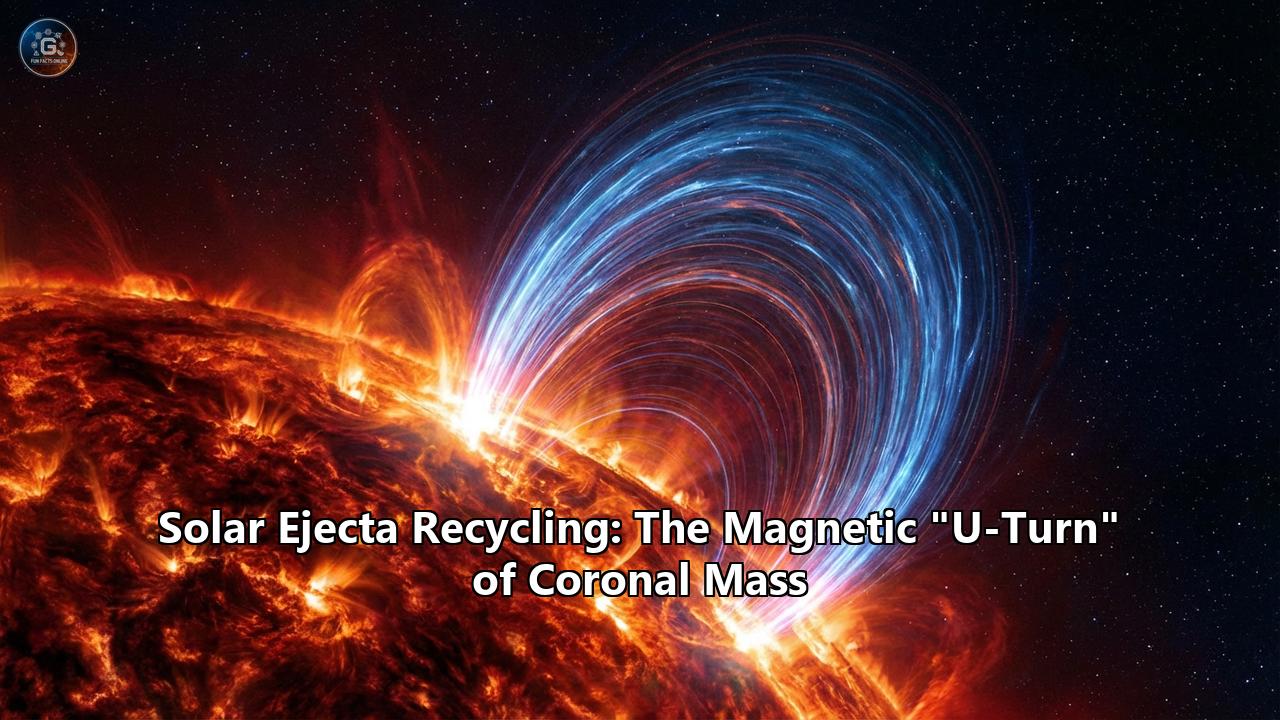
The Sun, our life-giving star, has long been viewed as a generous, albeit violent, celestial cannon. It continuously blasts streams of charged particles—the solar wind—and occasionally coughs up billion-ton clouds of plasma known as Coronal Mass Ejections (CMEs) into the void. For decades, the prevailing assumption in heliophysics was simple: once this material leaves the solar surface with enough energy, it’s gone for good, destined to ripple across the solar system.
But a groundbreaking discovery has shattered this one-way street paradigm. Recent observations, most notably from NASA’s Parker Solar Probe, have revealed a stunning phenomenon: Solar Ejecta Recycling.
In a defiance of our previous understanding of stellar ballistics, the Sun appears to be pulling a "magnetic U-turn." Significant portions of the material we thought were lost to space are being dragged back down into the solar atmosphere. This discovery not only rewrites the textbooks on solar dynamics but fundamentally alters how we predict space weather that threatens Earth.
The Broken Mirror: Shattering the "Outflow Only" Myth
To understand the magnitude of this discovery, one must appreciate the sheer hostility of the environment where it was found. The solar corona—the Sun's wispy outer atmosphere—burns at over a million degrees Celsius, far hotter than the surface below it. It is a realm ruled not by gravity, but by magnetism.
Traditionally, solar physicists divided the Sun’s magnetic field into two main categories:
- Closed Field Lines: Loops that arch out and snap back to the surface, trapping plasma in glowing arcades (helmet streamers).
- Open Field Lines: Magnetic highways that stretch out into the solar system, allowing plasma to escape as the fast solar wind.
When a Coronal Mass Ejection (CME) occurs, it was thought to be a massive rupture—a magnetic bubble bursting outward, tearing through the overlying fields and escaping forever.
However, as the Parker Solar Probe dove closer to the Sun than any spacecraft in history (grazing the solar atmosphere at distances of just a few million miles), its Wide-Field Imager for Solar Probe (WISPR) captured something impossible. Instead of a uniform flow of particles rushing outward, the probe saw blobs of plasma stopping, reversing course, and raining back down toward the Sun.
This was the "U-turn." The Sun was drinking its own exhaust.
The Mechanism: The "Cosmic Vacuum Cleaner"
How does a star reclaim material moving at millions of miles per hour? The answer lies in the violent ballet of Magnetic Reconnection.
When a CME erupts, it pushes through the Sun's existing magnetic field lines, stretching them until they snap. Imagine a rubber band being pulled until it breaks. In the chaos of the eruption, these broken magnetic lines don't just dangle; they seek to repair themselves.
The "recycling" process happens in the wake of the eruption:
- The Tear: The CME punches a hole in the magnetic canopy, dragging field lines out with it.
- The Reconnection: Behind the departing cloud, the stretched magnetic field lines snap back together. This is the critical moment. The reconnection point acts like a pair of cosmic scissors fusing the lines back into a closed loop.
- The Inflow: As these new loops snap shut, they contract rapidly downward, like a slingshot released in reverse. This rapid contraction creates a vacuum-like effect, dragging huge blobs of plasma—material that was moments away from escaping—back down toward the solar surface.
Scientists have dubbed these returning blobs "inflows." They are not merely a light drizzle; they are torrents of magnetized plasma raining down at supersonic speeds, crashing back into the lower corona.
Switchbacks vs. Inflows: A Tale of Two U-Turns
It is crucial to distinguish this new "recycling" phenomenon from the "magnetic switchbacks" discovered earlier by the Parker Solar Probe and confirmed by the ESA’s Solar Orbiter.
- Switchbacks are kinks in the magnetic field itself—like a wave in a whip—traveling outward. They are temporary reversals of the magnetic field direction that race out into the solar system.
- Solar Ejecta Recycling (Inflows) is the actual physical movement of matter (plasma) turning around and falling inward.
While switchbacks show us that the solar wind is turbulent and "kinky," the recycling inflows show us that the Sun is structurally self-regulating. The two are likely related—the same reconnection events that snap loops shut to cause inflows might be launching switchbacks outward as a byproduct. It is a messy, chaotic exchange of energy where some energy escapes as a kick (switchback) while the mass is dragged back home (inflow).
Why "Recycling" Matters: The Missing Mass Mystery
This discovery solves a long-standing accounting error in solar physics. For years, models of CMEs suggested that they should strip the Sun of mass faster than what we observed. If the Sun were constantly losing this much material, the solar wind should be denser, and the Sun's evolution might look different.
The "U-turn" explains the discrepancy. The Sun is a conservationist. A significant percentage of the mass involved in an eruption—sometimes as much as half—never truly leaves. It is recycled back into the lower atmosphere, where it is heated, mixed, and primed for the next eruption. This suggests a "stellar ecosystem" where plasma is caught in a continuous loop of eruption, reclamation, and re-eruption.
Implications for Earth and Space Weather
The realization that the Sun recycles its ejecta is not just an academic curiosity; it has profound implications for our technological society.
1. Changing the Bullet's Trajectory:When we see a CME erupting toward Earth, we rush to predict its arrival time and impact strength. However, if a large chunk of that CME is dragged back into the Sun, the "ghost" of that drag acts on the material that does escape. The "U-turn" process acts like a magnetic anchor, slowing down the escaping CME or altering its direction. This could explain why some solar storms arrive later than predicted or miss Earth entirely—they were held back by the Sun’s attempt to recycle them.
2. The "Loaded Gun" Effect:The material falling back down doesn't disappear. It crashes into the solar surface, dumping massive amounts of kinetic energy. This impact can destabilize other magnetic structures, potentially triggering secondary eruptions. The recycling process essentially reloads the solar cannon, creating a chain reaction of storms. Understanding this could help us predict "clusters" of solar flares that often confuse forecasters.
3. Star Physics:If our Sun does this, likely all stars do. This affects our understanding of stellar mass loss, a critical parameter in determining how fast a star dies. For active stars (like red dwarfs that host many exoplanets), this recycling might mean they retain their atmospheres longer than thought, but it also implies their surfaces are even more violent and chaotic due to the constant bombardment of returning plasma.
The Future of Solar Observation
The discovery of Solar Ejecta Recycling serves as a powerful validation of humanity's daring "touch the Sun" missions. The Parker Solar Probe and Solar Orbiter are operating on the bleeding edge of technology, enduring heat shields that glow cherry-red to bring us these truths.
As the Sun approaches the peak of its 11-year activity cycle (Solar Maximum), these recycling events are expected to become more frequent and violent. Future observations will aim to quantify exactly how much mass is saved versus lost.
We are learning that the Sun is not a simple lightbulb or a fire that burns only outward. It is a complex, breathing engine that inhales almost as violently as it exhales. The magnetic "U-turn" is a reminder that in the cosmos, even the most powerful forces are bound by invisible tethers, recycling the fires of creation in an eternal, violent dance.
Reference:
- https://www.youtube.com/watch?v=VOrl2QlPCMI
- https://www.indiatoday.in/science/story/solar-wind-u-turn-and-magnetic-recycling-revealed-by-nasa-parker-solar-probe-near-the-sun-2835516-2025-12-13
- https://www.miragenews.com/nasas-parker-solar-probe-spies-solar-wind-u-turn-1588404/
- https://science.nasa.gov/missions/parker-solar-probe/nasas-parker-solar-probe-spies-solar-wind-u-turn/
- https://scitechdaily.com/solar-coronal-rain-on-our-sun-links-two-solar-mysteries/
- https://telescope.live/blog/solar-orbiter-finds-compelling-clues-solving-magnetic-switchback-theory
- https://www.esa.int/Science_Exploration/Space_Science/Solar_Orbiter/Solar_Orbiter_solves_magnetic_switchback_mystery
- https://www.sciencenews.org/article/coronal-mass-ejection-magnetic-sun-plasma-eruption
- https://www.independent.co.uk/space/esa-solar-probe-solar-wind-magnetic-field-b2166601.html
- https://www.techexplorist.com/esa-nasa-solar-orbiter-spacecraft-solved-magnetic-switchback-mystery/53721/
- https://www.esa.int/ESA_Multimedia/Images/2022/08/How_a_solar_switchback_is_formed
- https://www.nasa.gov/science-research/heliophysics/switchbacks-science-explaining-parker-solar-probes-magnetic-puzzle/
- https://www.youtube.com/watch?v=UKRdKKEiYmY
- https://www.popularmechanics.com/science/environment/a69520328/surprise-coronal-mass-ejection/
- https://www.sciencedaily.com/releases/2025/08/250820000747.htm