
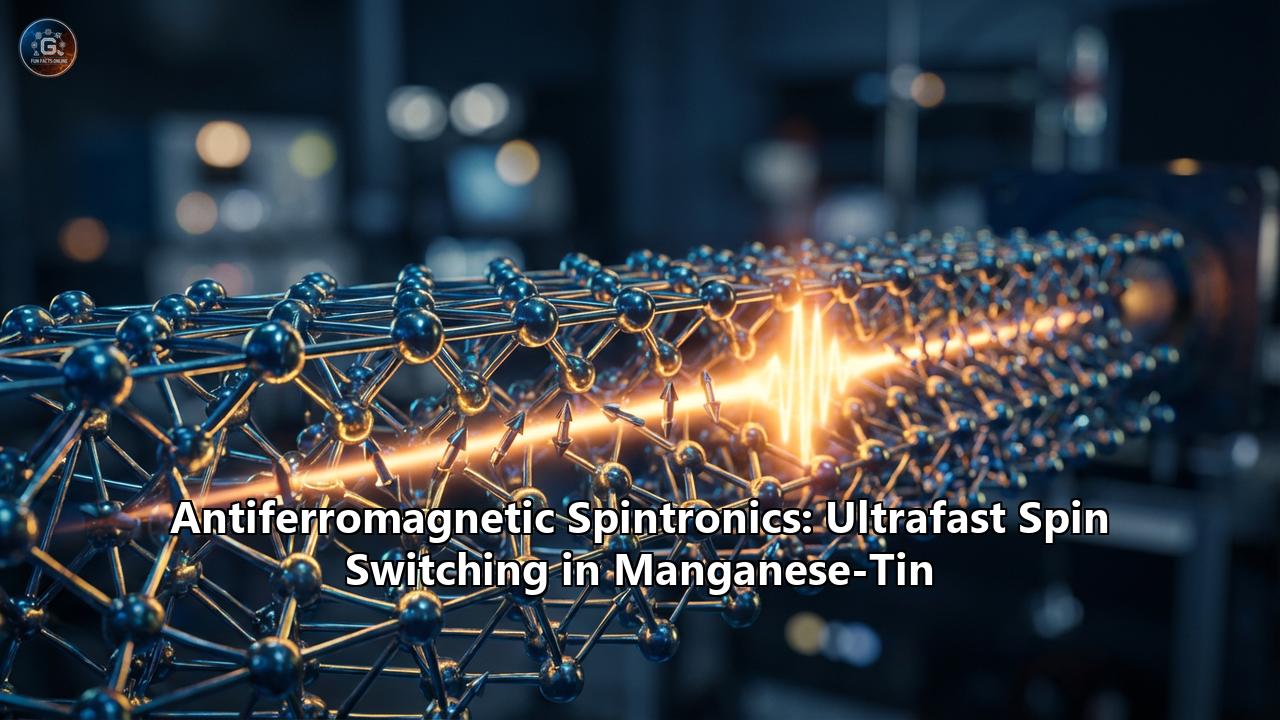
Imagine a data storage drive that can write information thousands of times faster than today’s most advanced solid-state drives, requires a fraction of the energy to operate, and is completely immune to external magnetic interference. Now, imagine that this exact same hardware can simultaneously process data like a biological brain, acting as the foundation for ultra-efficient artificial intelligence. This is not science fiction; it is the imminent future being built right now on the bedrock of a once-obscure branch of physics known as antiferromagnetic spintronics.
At the very center of this technological revolution is a fascinating, almost paradoxical material: Manganese-Tin (Mn3Sn). For decades, materials like Mn3Sn were considered scientific curiosities—magnetically "invisible" to the outside world, yet fiercely active on the inside. Today, thanks to recent, groundbreaking observations of ultrafast spin switching clocking in at 140 trillionths of a second (140 picoseconds), Mn3Sn is poised to completely rewrite the rules of memory, computing, and microelectronics.
To understand how a "hidden" magnet is about to supercharge our technological infrastructure, we must first dive into the quantum choreography of electrons, the architectural beauty of the Kagome lattice, and the relentless ingenuity of modern physicists.
The Physics of the "Invisible" Magnet
To appreciate the leap forward that Mn3Sn represents, we must first look at how traditional data storage works. Conventional magnetic memory, such as the hard disk drives in server farms or the Magnetoresistive Random Access Memory (MRAM) in advanced electronics, relies on ferromagnetism. In a ferromagnet (like iron or cobalt), the intrinsic angular momentum of electrons—a quantum property known as "spin"—aligns in the exact same direction. This uniform alignment creates a macroscopic, net magnetic field. You can read it, write to it, and stick it to your refrigerator.
However, ferromagnets have fundamental physical limits. Because they generate external magnetic fields (stray fields), you cannot pack ferromagnetic memory bits too closely together without them magnetically interfering with one another (crosstalk). Furthermore, flipping a ferromagnetic spin state from "0" to "1" is fundamentally constrained by a speed limit governed by precessional dynamics, usually topping out in the gigahertz (GHz) range.
Enter the antiferromagnet (AFM).
First discovered in the 1930s, antiferromagnets are materials where the electron spins naturally align in opposite directions. For every electron spinning "up," there is a neighboring electron spinning "down." Because they perfectly cancel each other out, the material produces absolutely zero net macroscopic magnetic field. In his 1970 Nobel Prize lecture, physicist Louis Néel famously described antiferromagnets as "extremely interesting from the theoretical viewpoint, but do not seem to have any applications."
For nearly half a century, Néel was right. How do you use a magnet that you cannot easily detect or control?
But the very properties that made antiferromagnets "useless" are exactly what make them the holy grail of modern spintronics:
- Zero Crosstalk (High Density): Because they emit no stray fields, you can pack antiferromagnetic memory cells atomically close together.
- Immunity to Interference: An external magnetic field will not accidentally wipe your data.
- Ultrafast Dynamics: Driven by powerful quantum exchange interactions between the neighboring antiparallel spins, the natural resonant frequencies of antiferromagnets exist in the terahertz (THz) range. They are naturally hundreds to thousands of times faster than ferromagnets.
The challenge was simply figuring out how to "write" to them and "read" from them. That is where Manganese-Tin (Mn3Sn) steps onto the stage.
Mn3Sn: The Topological Wonder and the Kagome Lattice
Mn3Sn is not your standard, run-of-the-mill antiferromagnet. It belongs to a highly exotic class of materials known as non-collinear antiferromagnetic Weyl semimetals. At room temperature, Mn3Sn exhibits properties that are so strange and wonderful they have captivated quantum physicists and materials scientists alike.
The secret to Mn3Sn's power lies in its crystal structure. The manganese atoms in this alloy arrange themselves in a specific geometric pattern known as a Kagome lattice. Named after a traditional Japanese woven bamboo basket, a Kagome lattice is composed of interlaced triangles and hexagons.
When magnetic spins are placed on the corners of these triangles, they experience "geometric frustration". In a standard antiferromagnet, spins just want to point in exactly opposite directions (up and down). But on a triangle, if Spin A points Up, and Spin B points Down, where does Spin C point? The geometry prevents a simple up/down alignment. To resolve this frustration, the spins in Mn3Sn compromise by pointing outward or inward at 120-degree angles to one another, forming an "inverse triangular spin arrangement".
This non-collinear (not in a straight line) arrangement results in two profound physical phenomena:
1. The Magnetic Octupole and Weak FerromagnetismWhile the spins largely cancel each other out, the slight canting of this 120-degree arrangement generates an incredibly faint, almost vanishingly small residual magnetic moment (about 0.002 to 0.003 Bohr magnetons per manganese atom). However, the collective order parameter of this system is defined by a "magnetic octupole". This means the material retains the ultrafast, stray-field-free benefits of an antiferromagnet, while still providing just enough of a "handle" for scientists to grab onto and control using external forces.
2. Non-Zero Berry Curvature and Topological Hall EffectsBecause of its unique Weyl semimetal band structure and broken time-reversal symmetry, electrons flowing through Mn3Sn experience a fictitious magnetic field. This is mathematically described as a "non-zero Berry curvature". Consequently, even though the material has essentially no real magnetic field, it exhibits a massive Anomalous Hall Effect (AHE) at room temperature.
When an electrical current is passed through Mn3Sn, the electrons are deflected to the side, generating a transverse voltage. This is a monumental breakthrough for the "reading" problem: you can read the "0" or "1" state of the antiferromagnet simply by measuring this voltage. You don't need to detect a magnetic field; the quantum geometry of the material does the work for you.
The March 2026 Breakthrough: Capturing the 140-Picosecond Spin Flip
Reading the data via the Anomalous Hall Effect was half the battle. The other half was writing the data—flipping those 120-degree spins on command without melting the device or requiring an external super-magnet.
In a ferromagnet, data is written using Spin-Orbit Torque (SOT) or Spin-Transfer Torque (STT), where a spin-polarized electrical current exerts a torque on the magnetic moment, flipping it over. Scientists theorized this could be done in Mn3Sn, and early experiments successfully achieved all-electrical switching at room temperature. But a burning question remained: How fast is it really happening, and what is the exact mechanism? Is the electric current physically pushing the spins, or is the electrical resistance just heating the material up until the magnetic order melts and resets (a thermal process)?
In March 2026, a groundbreaking study led by Ryo Shimano's team at the University of Tokyo provided the definitive answer, capturing the process in unprecedented detail. The researchers achieved a monumental feat in metrology: they directly observed the electron spins flipping inside the Mn3Sn lattice, frame-by-frame, in real time.
Firing extremely brief, ultrafast electrical pulses into a thin, epitaxial layer of Mn3Sn, the team used precisely timed, ultrafast flashes of laser light to track the material's response. By measuring infinitesimal changes in the light's polarization (the Time-Resolved Magneto-Optical Kerr Effect, or TR-MOKE), they assembled a time-resolved sequence of the magnetic octupole rotating.
What they captured was breathtaking: a deterministic, non-thermal magnetic flip occurring in just 140 trillionths of a second (140 picoseconds).
To put that into perspective, 140 picoseconds is an order of magnitude faster than the absolute fastest theoretical limits of conventional ferromagnetic memory. Furthermore, Shimano's team discovered two distinct switching mechanisms occurring within the material. While one mechanism relied on the heat generated by strong currents, the more revolutionary mechanism bypassed heat altogether. The electric current was directly exerting an intrinsic, non-collinear spin-orbit torque on the Kagome lattice, ripping the magnetic octupole from state "0" to state "1" with supreme energetic efficiency.
"Our present fastest time-resolved observation of electrical switching in Mn₃Sn is 140 picoseconds, mainly limited by how short the current pulses can be generated in our device setup," noted the researchers. "However, our findings suggest that the material itself could switch even faster under appropriate conditions". The ultimate speed limit of Mn3Sn remains to be found, teasing the possibility of sub-picosecond, true Terahertz-frequency memory writing.
Translating Quantum Mechanics to Commercial Technology
The transition from a laboratory marvel to an industrialized technology requires overcoming the hurdles of integration, readout, and power efficiency. The spintronics community is actively tackling these with extraordinary ingenuity.
1. All-Antiferromagnetic Tunnel JunctionsWhile the Anomalous Hall Effect allows for easy readout in thin films, the gold standard for memory devices (like commercial MRAM) is the Magnetic Tunnel Junction (MTJ). An MTJ traditionally consists of two magnetic layers separated by an ultra-thin insulating barrier. The electrical resistance changes depending on whether the magnetic layers are aligned (low resistance) or anti-aligned (high resistance)—a phenomenon known as Tunneling Magnetoresistance (TMR).
For years, TMR was believed to be strictly limited to ferromagnets because it relied on macroscopic spin polarization at the interface. However, researchers have recently shattered this belief, successfully demonstrating finite, room-temperature TMR in all-antiferromagnetic spintronic devices using Mn3Sn. This proves that the momentum-dependent spin splitting in Weyl semimetals can drive tunneling effects, clearing a major hurdle for integrating Mn3Sn into existing semiconductor fabrication lines.
2. Strain Engineering and PiezomagnetismAnother avenue of intense research is how mechanical strain affects the magnetic properties of Mn3Sn. Studies have shown that applying high-stress-constrained compression to Mn3Sn at room temperature actually distorts the atomic lattice. This lattice distortion shifts the spin arrangement, generating an "out-of-plane weak ferromagnetism" (OWFM).
This piezomagnetic effect is staggering: an applied strain of just 0.1% can actually reverse the sign of the anomalous Hall signal by rotating the underlying spin structure. This means that data could potentially be written using microscopic piezoelectric actuators rather than heavy electrical currents, paving the way for ultra-low-power, voltage-controlled memory devices.
3. Enhancing Spin-Orbit Torque with Heavy MetalsTo make the 140-picosecond switching even more efficient, scientists are interfacing Mn3Sn with "spin-source" materials. By layering Mn3Sn with heavy metals like Tantalum (Ta) or low-symmetry topological semimetals like Tungsten Ditelluride (WTe2), researchers can inject massive amounts of spin current into the antiferromagnet. The spin Hall effect in these adjacent layers creates an out-of-plane spin accumulation that perfectly couples with the non-collinear spins of Mn3Sn, allowing for field-free, deterministic switching at microscopic current densities.
Beyond Memory: The Dawn of Neuromorphic Spintronics
If Mn3Sn and antiferromagnetic spintronics were only used to create faster, denser, non-volatile RAM, it would be a multi-billion-dollar paradigm shift. But the implications stretch far beyond data storage. The unique dynamics of antiferromagnets are opening entirely new paradigms in computing architecture.
Wave-Based and Brain-Like ComputingCurrent semiconductor architectures are suffocating under the "von Neumann bottleneck"—the immense energy and time wasted shuffling data back and forth between the processor and the memory. The holy grail of computing is "in-memory computing," where the memory cells themselves perform logic operations, much like the synapses in a human brain.
Antiferromagnetic spintronics is uniquely suited for this. Recognizing this immense potential, major institutional backing is rapidly accelerating. In early 2025, the University of California, Riverside, alongside UC San Diego, UCLA, and Lawrence Livermore National Laboratory, received a nearly $4 million grant from the UC National Laboratory Fees Research Program to pioneer antiferromagnetic computing under the CHIPS Act initiatives.
Distinguished Professor Jing Shi and his collaborators are exploring "magnetic neural networks" using antiferromagnetic materials. In special easy-plane antiferromagnets, spin excitations (magnons) can propagate as waves over incredibly long distances with almost zero energy loss—a quantum state known as "spin superfluidity".
"These pulses can propagate information through multiple neural layers, similar to how signals are processed in biological neural networks," Professor Shi explained. Because Mn3Sn operates in the terahertz frequency range, a neuromorphic chip built on this technology could theoretically train AI models and process neural network weights exponentially faster than modern GPUs, while drawing only a fraction of the wattage.
Terahertz Emitters and 6G CommunicationsFurthermore, because the intrinsic precession of the antiferromagnetic spins in Mn3Sn sits in the THz band, injecting a steady DC current into the material can cause the spins to auto-oscillate, emitting coherent terahertz radiation. Terahertz waves exist in the electromagnetic spectrum between microwaves and infrared light—a notoriously difficult frequency band to generate efficiently. By utilizing Mn3Sn as a nanoscale THz oscillator, we can unlock next-generation technologies ranging from non-destructive medical imaging and security scanners to the ultra-high-bandwidth wireless communication networks that will eventually form the backbone of 6G.
The Road Ahead
The jump from the picosecond laser labs of Tokyo to the commercial foundries of Silicon Valley is a challenging but clearly defined path. The current focus of the global physics and engineering community is optimizing the synthesis of Mn3Sn. Growing high-quality, epitaxial thin films of Mn3Sn on industrial substrates like silicon and magnesium oxide (MgO), and precisely controlling the stoichiometry (the exact ratio of Manganese to Tin, typically requiring a slight excess of Mn) is critical to maintaining the topological Weyl nodes and maximizing the anomalous Hall effects.
Moreover, visualizing the complex domain walls inside these chiral antiferromagnets remains a frontier of its own. As Mn3Sn memory scales down to the nanometer level, understanding how the boundaries between different octupole domains interact, merge, and move under an electric current will dictate the ultimate density limit of the chips. Advanced techniques like Lorentz transmission electron microscopy and scanning nitrogen-vacancy (NV) center microscopy are currently being pushed to their limits to map these "invisible" magnetic landscapes.
Conclusion: A Quiet Revolution
For over half a century, the technological world advanced by miniaturizing the transistor and refining the ferromagnet. We have squeezed nearly every drop of performance out of collinear spins and silicon gates. To continue the exponential march of technology into the eras of artificial general intelligence, edge computing, and beyond, a radical departure from the status quo is required.
Manganese-Tin (Mn3Sn) is the herald of that departure. By beautifully combining the zero-stray-field density of an antiferromagnet, the mind-bending topological physics of a Weyl semimetal, and the geometric frustration of a Kagome lattice, it has solved the "interesting but useless" paradox.
The recent capture of its 140-picosecond spin-switching dynamics is not just a triumph of optical physics; it is the starting gun for a new industrial race. As all-electrical writing, topological read-outs, and room-temperature stability converge, Mn3Sn is proving that the future of electronics will not be dictated by the magnetism we can feel, but by the ultrafast, quantum-level magnetic storms that we cannot. The era of antiferromagnetic spintronics has officially arrived.
Reference:
- https://news.ucr.edu/articles/2025/03/12/advancing-antiferromagnetic-spintronics-next-gen-memory-and-computing
- https://www.sciencedaily.com/releases/2026/03/260303145707.htm
- https://www.researchgate.net/publication/381524731_Antiferromagnetic_Spintronics_in_Magnetic_Memory_Devices
- https://pmc.ncbi.nlm.nih.gov/articles/PMC11197578/
- https://pubs.aip.org/aip/aco/article/1/1/016102/3362105/Atomistic-spin-modeling-of-spin-orbit-torque
- https://mirai-ipts.phys.s.u-tokyo.ac.jp/research/
- https://www.researchgate.net/publication/398331514_Ultrafast_time-resolved_observation_of_non-thermal_current-induced_switching_in_an_antiferromagnetic_Weyl_semimetal
- https://arxiv.org/abs/2207.12885
- https://www.researchgate.net/figure/Fundamental-properties-of-Mn3Sn-A-Schematic-Mn-spin-structures-of-Mn3Sn-viewed-along_fig1_331195873
- https://pubs.aip.org/aip/apm/article/12/9/091114/3312339/Anisotropic-optical-and-magneto-optical-properties
- https://cpb.iphy.ac.cn/EN/article/downloadArticleFile.do?attachType=PDF&id=125994
- https://www.scribd.com/document/879254239/s41563-025-02266-y
- https://www.annualreviews.org/content/journals/10.1146/annurev-matsci-080222-030535
- https://www.tohoku.ac.jp/en/press/a_new_chapter_in_antiferromagnetic_spintronics_is_unfolding.html
- https://www.issp.u-tokyo.ac.jp/maincontents/docs/tayori65-1.pdf