
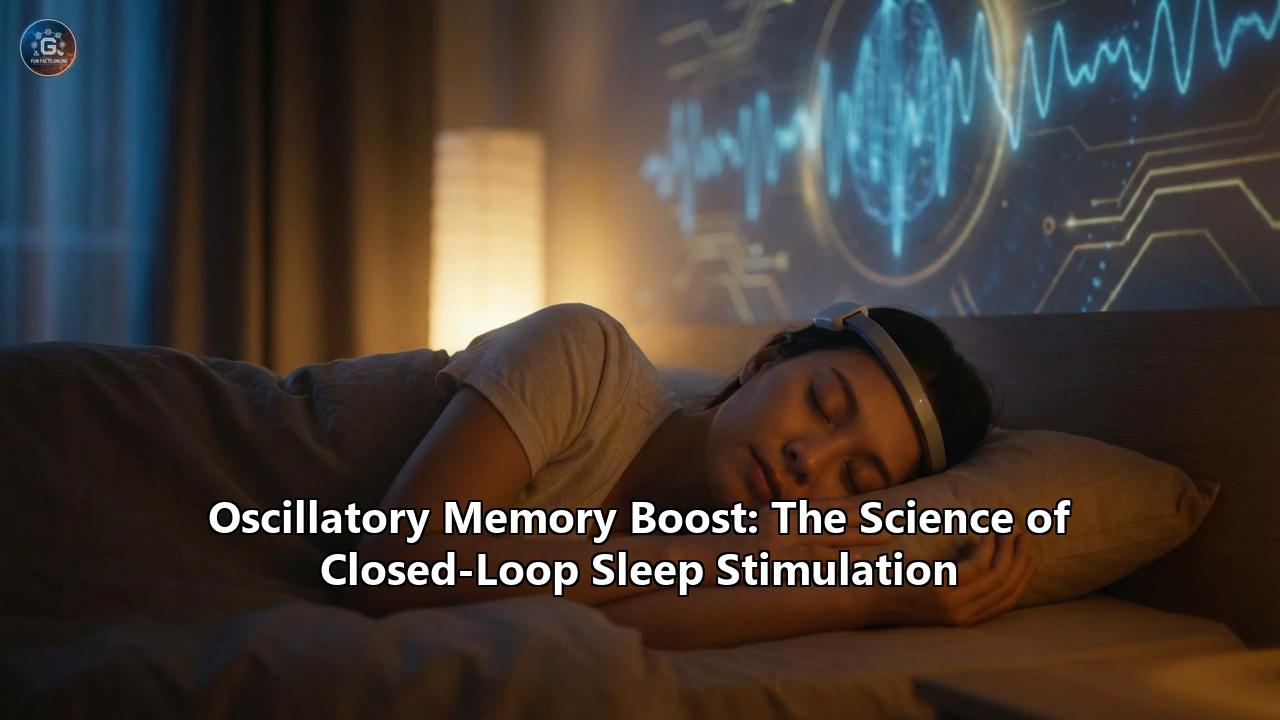
Introduction: The Silent Symphony of the Sleeping Brain
For centuries, sleep was viewed as a passive state—a nightly shutdown where the brain went offline to recharge its metabolic batteries. It was the biological equivalent of parking a car in a garage; the engine was off, and nothing new was happening. But the last two decades of neuroscience have shattered this stillness. We now know that the sleeping brain is not silent. It is, in fact, roaring with activity. It is conducting a complex, rhythmic symphony of electrical impulses that are crucial for what makes us human: our ability to learn, to remember, and to adapt.
Among the most revolutionary discoveries in this field is the realization that we can not only listen to this symphony but also conduct it. This is the science of Closed-Loop Sleep Stimulation, a cutting-edge neurotechnology that uses precisely timed auditory cues—often as simple as a burst of pink noise—to boost the brain’s natural rhythms. The result is an "Oscillatory Memory Boost," a phenomenon that strengthens the neural connections formed during the day, effectively supercharging the brain's ability to consolidate memory while we sleep.
This technology represents a paradigm shift from "sleep tracking" to "sleep engineering." We are no longer just measuring how well we slept; we are actively intervening to make sleep more efficient, more restorative, and more cognitively enhancing. From helping university students master complex languages to offering a potential lifeline for aging populations facing memory decline, the implications of oscillatory memory boosting are profound. This article delves into the intricate science, the fascinating history, and the future potential of this breakthrough technology.
Part 1: The Architecture of Memory and Sleep
To understand how a sound played in the middle of the night can improve a test score the next morning, we must first understand the biological architecture of memory storage.
The Two-Stage Model of Memory
The brain does not store memories in a single location, nor does it store them permanently the moment they are experienced. Instead, neuroscientists rely on the "Two-Stage Model" of memory consolidation.
- The Fast Learner (Hippocampus): When you learn a new fact—say, a friend's new phone number or a historical date—it is initially encoded in the hippocampus. This small, seahorse-shaped structure deep in the brain is the "fast learner." It can capture information instantly. However, it is also temporary and limited in capacity. It’s like a whiteboard; it’s great for jotting things down quickly, but it’s easily erased and has limited space.
- The Slow Learner (Neocortex): For a memory to become long-term (something you remember years from now), it must be transferred to the neocortex—the wrinkled outer layer of the brain responsible for higher-order processing. The neocortex is the "slow learner." It requires repeated activation to weave new information into the vast tapestry of existing knowledge. It is the library archive—permanent, organized, and vast.
The problem is: how do we get information from the whiteboard (hippocampus) to the library archive (neocortex) without interfering with our daily experiences? The answer is Slow-Wave Sleep (SWS).
The Role of Slow-Wave Sleep
Human sleep is divided into cycles, primarily consisting of Rapid Eye Movement (REM) sleep and Non-REM (NREM) sleep. NREM sleep is further divided into light sleep and deep, slow-wave sleep.
SWS is the "deepest" phase of sleep, usually occurring in the first half of the night. During this phase, the brain’s neurons stop firing individually and start firing in synchrony. Millions of neurons fire together, then go silent together, creating massive waves of electrical activity that sweep across the cortex. On an Electroencephalogram (EEG), these look like large, slow, rolling hills—hence the name "Slow Oscillations" (SOs).
These Slow Oscillations are the carrier waves of memory. They act as a metronome, coordinating a dialogue between the hippocampus and the neocortex. This dialogue involves a precise trio of brain rhythms:
- Cortical Slow Oscillations (< 1 Hz): The conductor. These massive waves originate in the neocortex and coordinate the timing of the other events.
- Sleep Spindles (12-15 Hz): Bursts of faster oscillatory activity generated in the thalamus. They act as the "gatekeepers" that facilitate plasticity in the cortex.
- Hippocampal Ripples (80-200 Hz): Extremely fast, high-frequency bursts in the hippocampus that represent the "replay" of specific memories.
When these three rhythms align perfectly—a ripple nestled inside a spindle, riding on the peak of a slow oscillation—information is successfully transferred from the hippocampus to the neocortex. This is the "handshake" of memory consolidation. The goal of Closed-Loop Sleep Stimulation is to make this handshake firmer and more frequent.
Part 2: The Science of Closed-Loop Stimulation
For years, scientists tried to enhance sleep using "Open-Loop" stimulation. This meant playing continuous white noise, music, or rhythmic tones regardless of what the brain was doing. The results were inconsistent. Sometimes it helped; often, it just woke people up or disturbed the natural sleep architecture.
The breakthrough came with the realization that timing is everything.
The "Closed-Loop" Concept
Closed-loop systems are reactive. They monitor a system's state and adjust their output accordingly. In the context of sleep engineering, a closed-loop system involves:
- Sensing: An EEG headband monitors the sleeper’s brainwaves in real-time.
- Processing: An algorithm analyzes the signal to identify the onset of a Slow Oscillation.
- Stimulation: The system delivers a specific auditory cue (usually a short burst of pink noise) at a precise phase of the wave—specifically, just as the wave is rising toward its "Up-State."
Why the "Up-State"?
The Slow Oscillation consists of a "Down-State" (neuronal silence) and an "Up-State" (neuronal firing). The Up-State is a window of opportunity where neurons are highly excitable and ready to process information.
If you play a sound during the Down-State, the brain effectively ignores it, or it might disrupt the rhythm. But if you play a sound exactly as the neurons are ramping up into the Up-State, the sound acts like a swing push. Just as pushing a child on a swing at the exact right moment adds momentum, the auditory click synchronizes the firing of neurons, causing the Slow Oscillation to become larger (higher amplitude) and more rhythmic.
Crucially, this larger Slow Oscillation triggers a cascade effect. A stronger Up-State in the cortex triggers the thalamus to generate a stronger Sleep Spindle. This, in turn, entrains the hippocampus to generate a Sharp-Wave Ripple. By simply pushing the "swing" of the Slow Oscillation, the technology orchestrates the entire memory-transfer sequence.
Pink Noise vs. White Noise
Why use "pink noise"? White noise contains all frequencies at equal intensity, which can sound harsh or hissing (like static). Pink noise, however, has equal energy per octave, meaning the lower frequencies are louder. This sounds more like rushing water, heavy rain, or wind through leaves. It is biologically more soothing and decreases in power at the same rate that human brain waves do (1/f distribution). The auditory system processes pink noise more naturally during sleep, avoiding the "startle" response that sharper sounds might provoke.
Part 3: The Seminal Experiments
The transition from theory to proven science rests on a series of landmark studies, most notably those pioneered by researchers at the University of Tübingen and Northwestern University.
The Tübingen Breakthrough (2013)
In a pivotal study published in Neuron, Dr. Jan Born and his colleagues provided the first robust evidence that this technology worked in humans.
- The Setup: Participants memorized word pairs (e.g., "Bird - Toaster") in the evening. They then slept with an EEG cap.
- The Intervention: On one night, the system played "sham" stimulation (no sound). On another night, it played closed-loop pink noise bursts synchronized to the Up-State of their slow waves.
- The Result: On the stimulation night, the participants' Slow Oscillations were significantly larger. More importantly, when tested the next morning, they remembered significantly more word pairs than on the sham night. The retention improvement was nearly double that of normal sleep.
This study proved two things:
- We can mechanically enhance brain waves from the outside without drugs or electrical shocks.
- Enhancing these waves directly translates to better cognitive performance.
Expanding the Scope: Motor Skills and Language
Following the Tübingen success, researchers began testing different types of memory.
- Declarative Memory: Facts, vocabulary, names. (Consistently improved by stimulation).
- Procedural Memory: Skills like playing piano or typing. (Results have been mixed, suggesting procedural memory relies more on REM sleep or different spindle types, but recent refinements in stimulation timing are showing promise here too).
A study involving "discovery learning" challenged participants to solve a number puzzle that had a hidden shortcut. Participants who received closed-loop stimulation were more likely to "have an epiphany" and discover the shortcut the next day, suggesting the technology helps not just with rote memorization but with problem-solving and insight.
Part 4: Applications for Aging and Cognitive Decline
While helping students pass exams is a lucrative application, the "killer app" for oscillatory memory boosting lies in healthcare—specifically for older adults.
The "Sleep-Dependent Memory Deficit" in Aging
As we age, our sleep changes. The most dramatic change is the reduction of Slow-Wave Sleep. By the time a person reaches their 60s or 70s, they may have lost 70-80% of their deep sleep compared to their 20s.
This loss of SWS is not just a side effect of aging; it is a contributing factor to cognitive decline. The "Handshake" between the hippocampus and neocortex becomes weak because the "metronome" (Slow Oscillations) is too quiet or arrhythmic. The hippocampus fills up with memories but cannot offload them effectively to the cortex. This leads to the classic "forgetfulness" seen in aging—difficulty retaining new names or recent events, even if long-term memories from youth remain intact.
The Northwestern Studies on Older Adults
Dr. Phyllis Zee and Dr. Rany Abend at Northwestern University investigated whether Closed-Loop Stimulation could reverse this age-related decline. Their studies targeted adults over 60.
- Findings: The stimulation successfully enhanced the amplitude of Slow Oscillations in older adults. While the brains of older adults were more "resistant" to entrainment than young brains, the acoustic pulses still worked.
- Impact: Participants showed improvements in memory recall proportional to the enhancement of their sleep waves. Effectively, the technology "artificially restored" the sleep quality of a younger brain, allowing the memory consolidation machinery to function again.
Alzheimer’s Disease and MCI
The implications for Alzheimer’s are staggering. Sleep disruption often precedes Alzheimer’s symptoms by decades. Slow-Wave Sleep is also the time when the glymphatic system (the brain's waste clearance system) flushes out toxic proteins like beta-amyloid and tau.
If Closed-Loop Stimulation can deepen SWS, it might offer a dual benefit:
- Cognitive Prosthetic: Improving memory function despite the disease.
- Therapeutic Intervention: potentially slowing the progression of the disease by enhancing the clearance of toxic plaques.
Early pilot studies in patients with Mild Cognitive Impairment (MCI) are underway. While we cannot yet claim it cures Alzheimer's, the ability to non-invasively boost the specific brain waves responsible for memory and brain cleaning is one of the most promising non-pharmacological avenues in neurology today.
Part 5: The Technology – From Lab to Bedroom
For a decade, this technology was trapped in the "Faraday cage"—expensive, shielded sleep labs requiring technicians to glue electrodes to scalps and monitor computers all night. However, the last few years have seen a democratization of sleep engineering.
The Challenge of Consumer Hardware
Translating clinical EEG to a home wearable is difficult.
- Signal Noise: In a lab, the subject is still. At home, people toss, turn, and have fans on. EEG signals are microvolts (millionths of a volt); distinguishing a Slow Oscillation from a jaw clench or a blink is an algorithmic nightmare.
- Comfort: No one wants to sleep with a wet-electrode cap and chin straps.
- Latency: The "Closed-Loop" requires single-millisecond precision. If the Bluetooth connection lags, the sound plays too late (in the Down-State), potentially disrupting sleep rather than enhancing it.
Current Solutions
Several companies and research prototypes are bridging this gap:
- Smart Headbands: Devices like the Dreem headband (now largely research-focused) and the Muse S (with its "Deep Sleep Boost" features) use dry-sensor EEG on the forehead. They process data on-chip to ensure zero latency, delivering the pink noise via bone conduction or soft speakers.
- Earbuds: In-ear EEG is a growing field. The ear canal is a dark, stable environment close to the brain, making it a surprisingly good place to measure brain waves.
- Mattress Integration: Some tech looks at ballistocardiography (measuring body recoil from heartbeats) to estimate sleep stages, though these generally lack the millisecond precision required for phase-locked stimulation.
The current generation of consumer devices is approaching the "Goldilocks" zone: comfortable enough to wear, accurate enough to work, and affordable enough for the enthusiast.
Part 6: Limitations and Ethical Considerations
Despite the excitement, we must temper our expectations with scientific rigor.
The "Interference" Problem
Memory consolidation is a competitive process. If you boost all memories, do you also boost the bad ones? There is a theoretical risk that enhancing memory consolidation indiscriminately could strengthen traumatic memories in people with PTSD. However, current research suggests SWS primarily consolidates declarative memories and "gists" rather than the emotional intensity of trauma (which is often processed during REM), but caution is needed.
The Ceiling Effect
In healthy young adults, the brain is already very efficient. Some studies show a "ceiling effect," where stimulation doesn't add much benefit because the system is already working at 99% capacity. The technology is most effective in those with a deficit—whether from age, stress, or sleep deprivation.
Habituation
Does the brain get used to the pink noise? Does it eventually stop responding? Longitudinal studies are still determining the long-term efficacy. There is also the question of "dependency"—if you use a machine to sleep deeply for five years, does your brain forget how to generate Slow Oscillations on its own? Current evidence suggests the opposite (it trains the brain), but it is a valid long-term question.
Privacy and "Neuro-Data"
Closed-loop devices generate a nightly map of your brain activity. This data can reveal not just how you slept, but potentially early signs of neurological disease, your stress levels, and even markers of drug use. The ownership and privacy of this "neural data" will be a major ethical battleground in the coming decade.
Part 7: The Future of Oscillatory Memory Boost
Where do we go from here? The roadmap for Closed-Loop Sleep Stimulation is branching into fascinating directions.
Targeted Memory Reactivation (TMR)
Currently, most systems use generic pink noise to boost all memory. TMR takes it a step further.
- The Concept: While you are learning specific material (e.g., a vocabulary list), a specific sound is played (e.g., a bell).
- The Sleep: When the system detects a Slow Oscillation, it doesn't just play pink noise; it plays that specific bell sound.
- The Result: The brain is tricked into reactivating that specific memory trace during the Up-State. Studies show this leads to a highly specific boost for that material. Imagine a future where you can choose which file to "save" to your long-term memory before you wake up.
Integration with Other Modalities
Researchers are combining auditory stimulation with:
- Vestibular Stimulation: Gently rocking the bed at the same frequency as the Slow Oscillations (0.75 Hz). The "hammock effect" significantly boosts deep sleep.
- Transcutaneous Electrical Stimulation: Very weak electrical currents applied to the skin that can entrain brain rhythms.
- Olfactory Stimulation: Using scents (like rose or peppermint) timed to sleep stages to trigger memory replay.
The "Power Nap" of the Future
Closed-loop stimulation is particularly potent for naps. A 20-minute nap with auditory stimulation can provide the cognitive restoration of a 60-minute nap. This has massive applications for pilots, surgeons, truck drivers, and shift workers who need rapid recovery in limited time windows.
Conclusion: Reclaiming the Night
Oscillatory Memory Boost represents a fundamental change in our relationship with sleep. For all of human history, we have been passive observers of our nightly unconsciousness. We surrendered to sleep and hoped to wake up refreshed. Now, science has handed us the baton. We can conduct the symphony.
By understanding the precise language of the brain—the Slow Oscillations, the Spindles, the Ripples—and speaking back to it with gentle, timed pulses of sound, we can unlock potential that lies dormant in our biology. Whether it is giving a grandmother a few more years of clarity with her family, helping a medical student retain life-saving knowledge, or simply helping a stressed worker wake up feeling truly restored, the science of Closed-Loop Sleep Stimulation is not just about better memory. It is about making the most of the one-third of our lives we spend in the dark.
As we look to the future, the boundary between "sleeping" and "optimizing" will blur, turning our beds into not just places of rest, but active incubators for the human mind.
Deep Dive: The Mechanisms of Action
To further satisfy the scientific curiosity of the reader, we will now expand on the specific neurophysiological mechanisms at play.1. The Thalamocortical Loop
The generation of slow waves is not solely a cortical event; it relies on a loop between the cortex and the thalamus. The cortex initiates the "Down-State" (a period of hyperpolarization where neurons stop firing). This silence removes the excitatory input to the thalamus. As a result, thalamic neurons hyperpolarize. This hyperpolarization triggers a "rebound burst" of firing in the thalamus, which sends a massive excitatory volley back to the cortex, triggering the "Up-State."
Closed-Loop Auditory Stimulation works because the auditory pathway feeds directly into the thalamus (specifically the medial geniculate nucleus) and then to the cortex. By sending an auditory signal just as the cortex is starting to depolarize (return to the Up-State), we add external excitation to the thalamic rebound. This ensures that the resulting cortical Up-State is more synchronized (involving more neurons) and higher amplitude.
2. Phase-Amplitude Coupling (PAC)
The effectiveness of memory consolidation is often measured by "Phase-Amplitude Coupling." This refers to the synchronization of the phase of the Slow Oscillation (the slow rhythm) with the amplitude of the Sleep Spindle (the faster rhythm).
- Strong PAC: The Spindle occurs exactly at the peak of the Slow Oscillation Up-State. This is the optimal window for synaptic plasticity (Long-Term Potentiation).
- Weak PAC: The Spindle occurs too late or too early, missing the window of peak cortical excitability.
Closed-Loop Stimulation has been shown to essentially "reset" the phase of the Slow Oscillation, pulling it into alignment. By regularizing the Slow Oscillations, the brain finds it easier to nest the Spindles correctly. It is like a drummer providing a steady beat so the guitarist (spindles) can play a solo in perfect time.
3. Synaptic Renormalization
Another theory for why sleep aids memory is the "Synaptic Homeostasis Hypothesis" (SHY). This theory suggests that during the day, our synapses get stronger and "noisier" as we learn. Sleep is the price we play for plasticity; we need to downscale these synapses to save energy and space.
SWS is thought to be the period when this downscaling happens. The massive, synchronized firing of Slow Oscillations may act to "weaken" the synapses that were not strengthened enough, effectively increasing the signal-to-noise ratio of our memories. By boosting SWS with auditory stimulation, we may be making this "cleaning" process more efficient, leaving behind only the strongest, most relevant memory traces.
The Human Element: Case Studies and Anecdotes
While names are anonymized for privacy, these composites reflect real outcomes from clinical trials and beta tests of consumer devices. The Language Learner:Sarah, a 24-year-old linguistics student, was struggling with Mandarin tones. She participated in a sleep lab study using Closed-Loop Stimulation. During the "sham" night, her retention of new vocabulary was average (about 60%). During the "stimulation" night, the system delivered pink noise pulses. She didn't wake up once. The next morning, her retention jumped to 85%. She reported feeling that the words came to her "without effort," suggesting the consolidation had moved the knowledge from explicit effortful recall to more implicit, automated storage.
The MCI Patient:Robert, 72, had been noticing "brain fog" and difficulty remembering appointments. In a pilot study for home-based therapeutic sleep enhancement, he wore a headband for three months. While his cognitive scores did not jump to genius levels, his wife noted a significant stabilization. "He stopped asking me the same question three times in an hour," she reported. The EEG data showed that his "Delta Power" (the strength of deep sleep), which had been in the bottom 10th percentile for his age, had risen to the 40th percentile.
Navigating the Hype
It is vital to distinguish between Oscillatory Memory Boost and "Sleep Learning" (Hypnopedia).
- Hypnopedia (The Myth): Listening to a recording of French verbs all night to learn French. This does not work. The brain in SWS screens out external sensory input to protect sleep. You cannot "encode" new complex information during deep sleep.
- Oscillatory Memory Boost (The Reality): You must learn the material awake. The stimulation simply helps the brain save what you already learned. It is the difference between writing a book (Wake) and hitting "Save" (Sleep). The stimulation ensures the "Save" button is pressed firmly.
Glossary of Key Terms
- Slow-Wave Sleep (SWS): The deepest stage of NREM sleep, characterized by high-amplitude, low-frequency brain waves.
- Slow Oscillation (SO): A wave of electrical activity < 1 Hz, originating in the neocortex.
- Sleep Spindle: A burst of 11-16 Hz activity generated in the thalamus, crucial for neuroplasticity.
- Closed-Loop: A system that uses feedback (real-time brain sensing) to control output (sound).
- Phase-Locked: When a stimulus is delivered at a specific point in a wave cycle (e.g., the peak or trough).
- Pink Noise: Random noise with equal energy per octave, sounding deeper and more natural than white noise.
- Consolidation: The process of stabilizing a memory trace after initial acquisition.
Final Thoughts
The era of "Oscillatory Memory Boost" is just beginning. As algorithms improve and hardware shrinks, we may soon view an un-augmented night of sleep as a missed opportunity. Just as we take vitamins to supplement our diet, we may soon use sound to supplement our rest, ensuring that every hour of sleep contributes to a sharper, healthier, and more resilient mind. The science is clear: the brain listens while it sleeps, and if we whisper the right things at the right time, it can do extraordinary things.
Reference:
- https://www.researchgate.net/publication/377062931_Acoustic_stimulation_during_sleep_predicts_long-lasting_increases_in_memory_performance_and_beneficial_amyloid_response_in_older_adults
- https://pubmed.ncbi.nlm.nih.gov/20509828/
- https://www.researchgate.net/publication/44637349_Slow-wave_sleep_and_the_consolidation_of_long-term_memory
- https://aesnet.org/abstractslisting/impact-of-closed-loop-auditory-stimulation-on-slow-oscillations-and-sleep-spindles-in-the-thalamus-in-patients-with-epilepsy
- https://www.nsf.gov/news/deep-brain-stimulation-during-sleep-strengthens
- https://www.pnas.org/doi/10.1073/pnas.0400237101
- https://www.youtube.com/watch?v=9KaMufF0rAY
- https://ctv.veeva.com/study/does-acoustic-stimulation-during-sleep-boost-slow-wave-sleep-and-memory-performance
- https://repository.ubn.ru.nl/bitstream/handle/2066/230787/230787.pdf
- https://academic.oup.com/sleep/article/43/12/zsaa111/5850478
- https://pmc.ncbi.nlm.nih.gov/articles/PMC10692948/
- https://www.youtube.com/watch?v=AUoHrAP_ncM
- https://www.medrxiv.org/content/medrxiv/early/2023/07/06/2023.07.02.23292083.full.pdf
- https://www.medrxiv.org/content/10.1101/2025.03.04.25321710v1.full
- https://pmc.ncbi.nlm.nih.gov/articles/PMC6831893/
- https://www.eneuro.org/content/6/6/ENEURO.0306-19.2019
- https://www.technologynetworks.com/neuroscience/news/sound-stimulation-could-support-better-sleep-in-dementia-patients-387958