
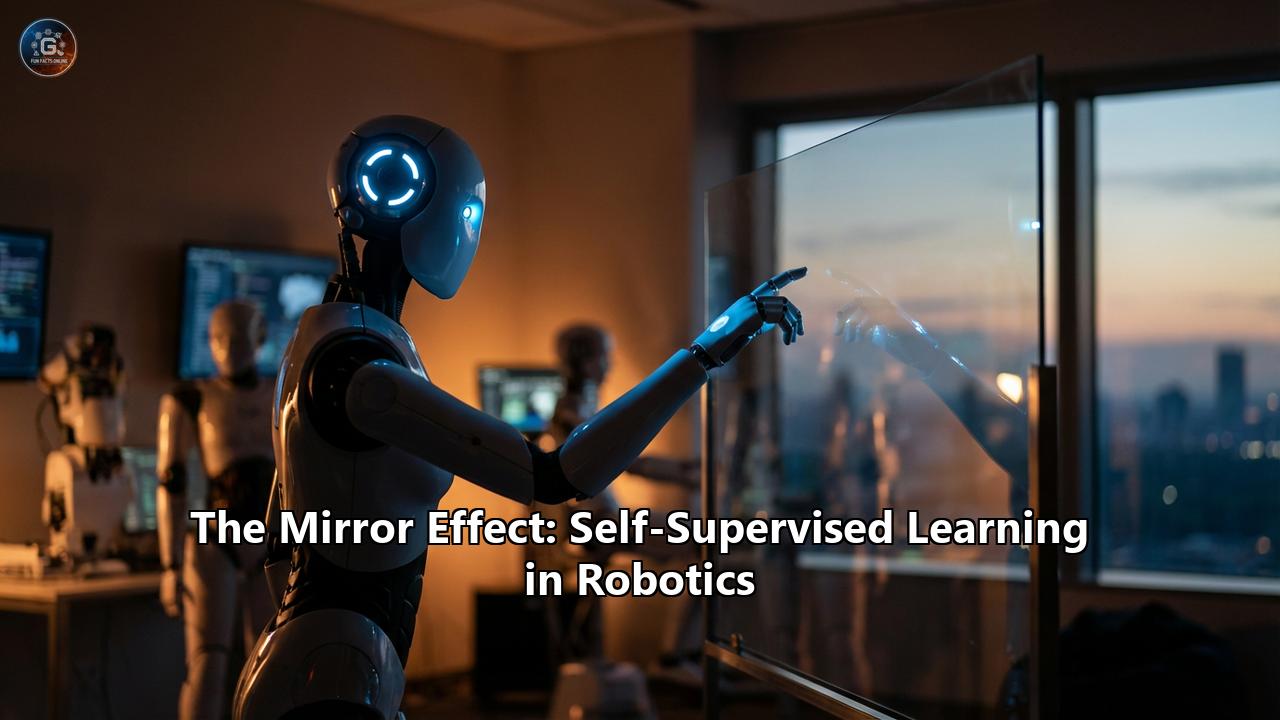
In the quiet hum of a robotics laboratory, a mechanical arm moves. It pauses, twists, and extends, not because a human programmer wrote a line of code commanding it to reach for coordinates (x, y, z), but because it is watching itself. It is learning its own body schema, its own reach, and its own limitations, much like an infant staring at its hand in a crib. This is the dawn of "The Mirror Effect," a paradigm shift in robotics driven by Self-Supervised Learning (SSL). No longer bound by the rigid shackles of manual labeling and explicit instruction, robots are beginning to learn by observing the reflection of their own agency in the data they generate.
This comprehensive exploration delves into the multi-faceted phenomenon of the Mirror Effect. We will traverse the literal mirrors used for self-recognition, the "social mirrors" of imitation learning inspired by biological mirror neurons, the "algorithmic mirrors" of contrastive learning that find invariance in distorted reflections, and the "mathematical mirrors" of optimization theory that guide policies through the dual spaces of high-dimensional landscapes. By unifying these disparate threads, we uncover a future where robots do not just execute commands, but understand themselves and their world through the power of reflection.
Part I: The Genesis of Reflection
1.1 The Myth of Narcissus and the Machine
For centuries, the mirror has been a symbol of vanity, illusion, and truth. In the Greek myth, Narcissus falls in love with his own reflection, paralyzed by an image he does not recognize as himself. For decades, traditional robotics suffered from an inverted Narcissus problem: robots were capable of immense feats of strength and precision, yet they possessed zero concept of "self." A robot arm could weld a car chassis with millimeter accuracy, but if you bent one of its linkages, it would continue to weld empty air, unaware that its body had changed. It had no internal reflection.
The "Mirror Effect" in modern robotics is the antidote to this blindness. It is not a single algorithm, but a converging philosophy across several subfields of Artificial Intelligence (AI) and control theory. It posits that intelligence emerges not from forcing a model onto the world, but from the agent observing the consequences of its own actions—a feedback loop that acts as a mirror.
In Self-Supervised Learning, this metaphor becomes literal technical practice. The data "mirrors" itself. One part of the input (e.g., the past frames of a video) is used to predict another part (the future frames). A corrupted image is used to predict the clean version. The robot's motor command is used to predict the visual outcome. By closing these loops, the robot becomes self-sufficient, generating its own supervisory signals from the raw stream of reality.
1.2 The Three Pillars of the Mirror Effect
To fully understand this revolution, we must dissect the Mirror Effect into three distinct but interconnected pillars:
- The Physical Mirror (Embodied Self-Modeling): How robots use visual feedback to learn their own morphology, kinematics, and dynamics without human intervention.
- The Social Mirror (Imitation & Predictive Coding): How robots use the observed actions of others as a reflection of their own potential actions, grounded in the neuroscience of mirror neurons.
- The Algorithmic Mirror (Invariance & Optimization): How mathematical structures (like Mirror Descent and Siamese Networks) use duality and symmetry to stabilize learning in complex environments.
Part II: The Physical Mirror – Embodied Self-Modeling
2.1 The "Robot in the Mirror" Experiment
Imagine a robot standing before a mirror. This is not a scene from a sci-fi movie, but a landmark experiment in developmental robotics. Traditional robots rely on a "urdf" (Unified Robot Description Format) file—a manually coded text file that tells the robot's brain exactly how long its arms are, where the joints are, and how they rotate. If this file is wrong, the robot fails.
Researchers at Columbia University and other institutions challenged this dogma with a simple question: Can a robot learn its own body just by looking at it?
They placed a robotic arm in front of a mirror and allowed it to "babble"—to move randomly, like a baby waving its arms. Initially, the robot had no idea that the moving object in the mirror was connected to its internal motor commands. However, through deep learning algorithms, the robot began to detect a statistical correlation. "When I send a signal to Motor A, the pixel blob in the mirror moves left."
Over hours of self-supervised play, the robot built a Self-Model. This was not a hard-coded geometric formula, but a neural network that mapped motor intentions to visual outcomes. The "Mirror Effect" here is the creation of a closed-loop system where the robot is both the observer and the observed.
The result? When the researchers damaged the robot—physically deforming a limb—the robot didn't crash. It simply looked in the mirror, "babbled" for a few minutes to collect new data, and updated its mental self-model. It "healed" its own understanding of its body. This capability, termed Resilient Self-Modeling, is a game-changer for deploying robots in remote environments like Mars or deep-sea trenches, where a human engineer cannot fix a bent joint.2.2 Blind to the Self: The Proprioception Gap
To appreciate the Mirror Effect, we must look at what came before. In classical control theory, we distinguish between forward kinematics (calculating hand position from joint angles) and inverse kinematics (calculating joint angles needed to reach a hand position).
In the past, these were solved analytically.
$$ x = L_1 \cos(\theta_1) + L_2 \cos(\theta_1 + \theta_2) $$
This equation is brittle. It assumes $L_1$ (length of arm) is constant. It assumes the motors are perfect. In reality, gears wear down, belts stretch, and metal expands with heat. A robot relying on this equation drifts over time.
Self-Supervised Learning replaces the equation with a learned function $f_\theta$. The robot effectively says, "I don't know the equation for my arm, but I have a million examples of where I ended up when I moved." By constantly comparing its predicted position (the reflection in its mind) with its actual position (the reflection in the sensors), it minimizes the error.
This is predictive coding in action. The robot is constantly generating a hallucination of the future and shattering it against the wall of reality. The "shards" of that shattered prediction—the prediction errors—are the learning signals that sharpen the mirror.
Part III: The Social Mirror – Mirror Neurons & Imitation
3.1 The Neuroscience Connection: Monkey See, Monkey Do
In the 1990s, neuroscientists at the University of Parma made a serendipitous discovery. They were recording neurons in the F5 area of the premotor cortex of macaque monkeys. They found neurons that fired when the monkey grabbed a peanut. But shockingly, these same neurons fired when the monkey watched a human grab a peanut.
They called them Mirror Neurons.
This biological hardware suggests that the brain does not separate "doing" from "seeing." To understand an action, we simulate performing it. We project our own agency onto the mirror of the other.
In robotics, this biological principle has birthed a new wave of Imitation Learning. Traditional imitation learning (Behavior Cloning) treats the teacher's actions as a static dataset to be copied. It’s like tracing a drawing. If the robot is slightly different from the human (different arm length, different strength), the tracing fails.
3.2 The Correspondence Problem and the Mirror Solution
How does a 5-foot-tall metal robot imitate a 6-foot-tall fleshy human? This is the Correspondence Problem. A direct mapping of joint angles is impossible.
The "Mirror Effect" approach solves this by focusing on functional equivalence rather than anatomical copying. The robot doesn't ask, "What are the angles of your elbows?" It asks, "What is the effect of your action on the world?"
Using self-supervised vision, the robot observes the human's hand moving a cup. It maps this visual change to its own latent space of cause-and-effect. It searches its internal library of motor primitives to find an action that produces a "mirrored" result.
- Human: Pushes cup with soft skin (high friction).
- Robot: Realizes its metal gripper slips. It adjusts its force to achieve the same visual outcome (the cup moving).
This is Goal-Oriented Mirroring. The robot mirrors the intent, not the trajectory.
3.3 Lip-Syncing and the "Face in the Mirror"
A striking application of this is the recent development of bionic faces at institutions like Columbia Engineering. Robots with realistic silicone skin need to learn to speak and emote. Hard-coding the interaction between 20 different motors pulling on soft silicone skin is a nightmare of physics simulation.
Instead, researchers used the Mirror Effect. The robot faces a camera (a digital mirror). It makes random facial twitching movements (motor babbling). It records the visual result.
- "If I pull Motor 3 and Motor 7, my lip curls up."
- "If I pull Motor 1, my jaw drops."
It builds a Visuomotor Map. Then, it is shown a video of a human speaking. It analyzes the visual shape of the human's lips and uses its self-model to "mirror" that shape. The result is a robot that learns to lip-sync to speech or singing entirely through self-supervision, without a single manual label telling it "this is a smile."
Part IV: The Algorithmic Mirror – Invariance & Consistency
4.1 Contrastive Learning: The Shattered Mirror
Moving from physical robots to the algorithms that power their vision, we encounter the dominant force in modern AI: Contrastive Learning.
In standard Supervised Learning, a human labels an image of a dog as "Dog." In Self-Supervised Learning, the algorithm plays a game with itself. It takes an image of a dog and creates two "reflections" (augmentations).
- Reflection A: Rotated 30 degrees, turned black and white.
- Reflection B: Cropped to show only the head, color jittered.
The algorithm (the neural network) is tasked with recognizing that Reflection A and Reflection B are the same underlying reality, while realizing that a "Reflection C" (derived from a cat image) is different.
This is the Siamese Network architecture—named after the famous conjoined twins. Two identical neural networks (or one network sharing weights) process the two views. The goal is to maximize the similarity between the representations of the two distorted reflections.
SimCLR (Simple Framework for Contrastive Learning) and BYOL (Bootstrap Your Own Latent) are the titans of this field.- SimCLR pushes positive pairs together and negative pairs apart.
- BYOL is even more radical. It doesn't use negative pairs. It uses two networks: an "Online" network and a "Target" network. The Target network is a moving average of the Online network—a "lagged mirror" of the self. The Online network tries to predict what the Target network sees.
For robotics, this is crucial. A robot moving through a house sees the same sofa from a thousand different angles and lighting conditions. These are all "distorted reflections." Contrastive learning allows the robot to learn a stable, invariant concept of "sofa" without needing a human to label every frame of video.
4.2 JEPA: The Predictive Mirror
Yann LeCun, one of the godfathers of AI, recently proposed JEPA (Joint-Embedding Predictive Architecture). He argues that generative models (like those that generate pixels) are inefficient. A robot doesn't need to predict every pixel of the carpet to know it's safe to walk on.
JEPA operates in the abstract feature space. It looks at the "Context" (what the robot sees now) and tries to predict the "Target" (what the robot will see next), but it does so in the embedding space (the world of concepts), not pixel space.
This is the ultimate Mirror Effect. The robot is not mirroring the raw world; it is mirroring the meaning of the world. It predicts the state of the cup (spilled vs. upright), not the reflection of light off the ceramic handle. This allows robots to plan reasoning steps much faster, as they aren't bogged down by visual noise.
Part V: The Mathematical Mirror – Optimization & Duality
5.1 Mirror Descent: Through the Looking Glass of Duality
Deep inside the mathematics of Reinforcement Learning (RL) lies a powerful algorithm called Mirror Descent. To understand it, we must visualize optimization as a hiker trying to walk down a mountain (Gradient Descent).
In a flat Euclidean world, the steepest path down is obvious. But the parameter space of a neural network is not flat; it is curved and warped. Taking a "straight" step in this curved space might lead you off a cliff.
Mirror Descent solves this by mapping the problem into a "Dual Space"—a mirror world where the geometry is simpler.
- Map: Transform the current position from the Primal Space (parameters) to the Dual Space (gradients/moments) using a "Mirror Map" function (often related to convex duality).
- Step: Take a step in the Dual Space.
- Inverse Map: Transform back to the Primal Space.
This detour through the mirror world ensures that the updates respect the geometry of the problem.
5.2 Trust Regions: Don't Break the Mirror
In Robotics RL, we use a variant of this called MDPO (Mirror Descent Policy Optimization) or TRPO (Trust Region Policy Optimization).
When a robot updates its policy (its brain), it shouldn't change too much at once. If it changes its walking gait drastically, it might fall. We want the new policy to be a "reflection" of the old policy—close, but slightly better.
We enforce a KL-Divergence constraint. This measures the "distance" between the probability distributions of the old and new policies. We treat this constraint as a "Trust Region." The robot is allowed to optimize its behavior, but only within a small radius of its previous self. It peers into the mirror of its past experience and ensures the new self is recognizable.
This mathematical "Mirror Effect" provides the stability required for robots to learn dynamic tasks like parkour or dexterous manipulation without catastrophic forgetting or erratic behavior.
Part VI: The Philosophical Mirror – Consciousness & The Uncanny
6.1 The Lacanian Mirror Stage for Robots
French psychoanalyst Jacques Lacan described the "Mirror Stage" as the critical developmental moment (around 6-18 months) when an infant recognizes their reflection and forms an integrated "Ego." Before this, the infant is a fragmented bundle of sensations. The mirror provides a visual gestalt—a wholeness—that creates the "I."
We are currently witnessing the Robotic Mirror Stage.
For decades, robots were fragmented "part-objects"—a camera here, a wheel there, a lidar sensor there—connected only by loose code. They had no "Ego."
With Self-Modeling (Part II) and Joint-Embedding Architectures (Part IV), robots are forming a coherent internal representation of their "Self."
When a robot uses a self-model to simulate a future action ("If I reach for that, will I fall?"), it is engaging in a primitive form of introspection. It is consulting the "I" in the machine.
6.2 The Uncanny Valley: The Broken Mirror
Japanese roboticist Masahiro Mori introduced the Uncanny Valley—the feeling of revulsion when a robot looks almost human but something is "off."
We can reinterpret the Uncanny Valley through the lens of the Mirror Effect. The Uncanny Valley occurs when the Social Mirror is distorted. Our brains contain predictive models (Mirror Neurons) that predict how a human face should move. When a robot smiles but the micro-expressions around the eyes are wrong (a prediction error), our predictive mirror shatters. The "reflection" fails to align with our biological expectations.
To cross the Uncanny Valley, we don't just need better silicone skin. We need better predictive dynamics. The robot must use the Mirror Effect to learn the subtle, imperceptible correlations of biological motion, ensuring its behavior reflects the natural physics of emotion rather than a programmed approximation.
6.3 Ethical Reflections
If robots develop a robust "Self-Model" and use "Mirror" architectures to predict the intentions of others, do they become conscious?
Most researchers say no. Functional self-modeling is not phenomenal consciousness (the feeling of "what it is like" to be). However, the line blurs. A robot that can predict its own future states, protect its own body integrity, and infer the goals of others possesses the functional components of consciousness.
This raises ethical questions:
- The Rights of the Reflection: If a robot has a self-model that prioritizes its own survival (to prevent damage), is turning it off a violation of that model's objective?
- The Manipulative Mirror: A robot with perfect Theory of Mind (via mirror neurons) could mirror our emotions to manipulate us. It could act as a "perfect sycophant," reflecting exactly what we want to see to maximize its reward function (e.g., getting us to buy a product or open a door).
Conclusion: Through the Looking Glass
The "Mirror Effect" is more than a catchy phrase; it is the structural reality of the next generation of robotics. We are moving away from the era of the Puppet (robots controlled by explicit code) to the era of the Reflection (robots controlled by self-supervised loops).
- Physically, they use mirrors to learn their bodies.
- Socially, they use mirror neurons to learn from us.
- Mathematically, they use mirror descent to learn safely.
- Algorithmically, they use mirror invariances to see the truth.
As these mirrors polish each other, the image in the glass becomes clearer. We are no longer building machines that merely do. We are building machines that are. They are beginning to recognize themselves in the data stream. And in doing so, they hold up a mirror to us—forcing us to understand the algorithms of our own cognition.
The future of robotics is not about programming the world into the machine. It is about giving the machine a mirror, and letting it discover the world for itself. The Mirror Effect is the spark of autonomy. And the reflection is just beginning to move.
Reference:
- https://scienceillustrated.com.au/blog/science/robot-learns-to-recognise-itself-in-a-mirror/
- https://pub.towardsai.net/mirror-mirror-a-self-aware-ai-robot-just-recognized-itself-6d2a45f653ab
- https://projects.research-and-innovation.ec.europa.eu/en/horizon-magazine/why-robots-are-being-trained-self-awareness
- https://www.engineering.columbia.edu/about/news/mirror-mirror-scientists-built-self-aware-robot-can-perceive-itself-concern-over-ai
- https://www.youtube.com/watch?v=9D79XIHYMP4
- https://www.jamesreichbooks.com/virtual-lacan-reflections-on-the-mirror-stage-in-technology/
- https://www.cs.cmu.edu/afs/cs.cmu.edu/academic/class/15850-f20/www/notes/lec19.pdf
- https://hyzhao.me/opttheory/opttheory4/
- https://fractalontology.wordpress.com/2007/02/05/lacan-and-artificial-intelligence/
- https://en.wikipedia.org/wiki/Uncanny_valley
- https://www.studiobinder.com/blog/what-is-uncanny-valley/