
The Silent Roar: How Glacial Seismology is Decoding the Secrets of Ice Giants to Predict Sea-Level Rise
Deep within the vast, frozen expanses of our planet's polar regions, a silent, powerful language is being spoken. It is a language of fractures, slips, and collisions, a narrative of immense change written in vibrations that travel through the ice and rock. This is the world of glacial seismology, a burgeoning field of science that is listening to the rumbles and groans of Earth's ice giants to decipher their future and, in turn, our own. By deploying networks of sensitive listening devices across the forbidding landscapes of Greenland and Antarctica, scientists are beginning to understand the intricate and often violent processes that govern the life and death of glaciers, providing critical data to sharpen our predictions of future sea-level rise.For decades, our understanding of glaciers was largely based on what we could see from above. Satellites and aerial photography have provided invaluable information on the slow, majestic march of ice towards the sea. But these methods only tell part of the story. They can't fully capture the dynamic, often chaotic, events happening within and beneath the ice—the very processes that are accelerating ice loss in a warming world. Glacial seismology offers a new frontier in our quest to understand these frozen titans. By treating glaciers as geological entities that generate their own seismic signals, or "icequakes," scientists can now monitor a host of previously hidden activities in real-time, from the dramatic calving of city-sized icebergs to the subtle grinding of a glacier's base against the bedrock below.
This article delves into the fascinating world of glacial seismology, exploring how the study of these faint tremors is revolutionizing our understanding of ice dynamics. We will journey to the front lines of climate change, from the rapidly melting glaciers of Greenland to the vast, seemingly stable ice sheets of Antarctica, to witness how scientists are deploying cutting-edge technology in the harshest environments on Earth. We will learn to interpret the diverse vocabulary of icequakes, each with its own unique signature that tells a story of the forces at play. And, most importantly, we will discover how this newfound knowledge is being used to improve the models that predict how much and how fast our seas will rise, a question of profound importance for coastal communities around the globe.
The Whispers and Shouts of the Ice: A Lexicon of Glacial Seismic Signals
Just as geologists study earthquakes to understand the stresses and strains within the Earth's crust, glacial seismologists analyze a diverse range of seismic signals to diagnose the health and behavior of glaciers and ice sheets. These signals, collectively known as cryoseismic events, are the acoustic manifestations of the dynamic processes that drive ice loss. Each type of event has a distinct seismic "fingerprint," characterized by its frequency, duration, and amplitude, which allows scientists to identify and interpret the underlying physical mechanisms.
Icequakes: The Brittle Language of FractureThe most well-known of these signals are icequakes, which are essentially earthquakes that occur within the ice itself. They are generated by the brittle failure of ice under stress and can range from tiny, high-frequency pops to massive, low-frequency rumbles that can be detected by seismometers thousands of kilometers away.
One of the most dramatic sources of icequakes is crevasse formation. As a glacier flows and stretches, immense tensile stresses build up in its upper layers. When these stresses exceed the strength of the ice, it fractures, creating deep cracks known as crevasses. This rapid cracking releases a burst of seismic energy, typically in the higher frequency range of 10 to 100 Hz. Sometimes, these events are triggered by the pressure of meltwater filling existing cracks, a process known as hydrofracturing. By studying the location and frequency of these icequakes, scientists can map out areas of high strain within a glacier and monitor how they are responding to changes in flow and melt.
Glacial Tremor: The Hum of a Hidden WorldUnlike the sudden, impulsive nature of icequakes, glacial tremor is a continuous, low-frequency vibration that can last for hours or even days. This persistent hum is often associated with the movement of water within and beneath the glacier, offering a unique window into the hidden plumbing of these ice giants.
One of the primary sources of glacial tremor is the turbulent flow of water in subglacial and englacial channels. As surface meltwater drains through moulins—vertical shafts that can descend deep into the glacier—it creates a complex network of conduits. The rushing water within these channels generates a steady seismic signal, often with distinct harmonic frequencies that can reveal information about the size and shape of the conduits and the volume of water flowing through them. Scientists have observed a strong correlation between the intensity of this "moulin tremor" and the level of water in the moulins, providing a novel way to monitor the seasonal and even diurnal cycles of glacial melt.
In some cases, tremor can also be generated by the resonance of water-filled cavities or by a swarm of overlapping, small icequakes, creating a continuous, tremor-like signal. By tracking the source of these tremors, scientists can map the evolution of the subglacial drainage system throughout the melt season, a crucial factor in determining how meltwater lubricates the glacier's base and influences its speed.
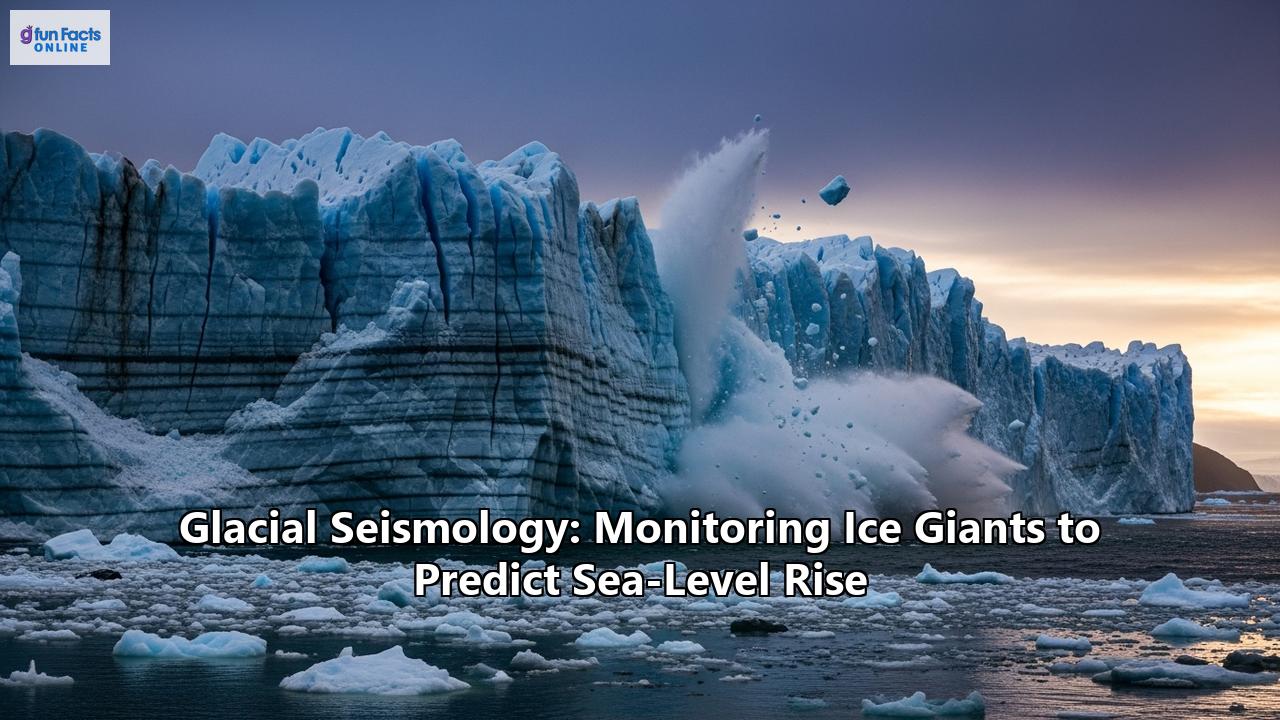
Calving Events: The Roar of a Collapsing GiantPerhaps the most spectacular and consequential of all glacial seismic events are those associated with iceberg calving. When massive chunks of ice break off from the terminus of a tidewater glacier, they release an immense amount of energy, generating powerful, low-frequency seismic waves that can be detected across the globe. These "glacial earthquakes" have magnitudes of up to 5 on the Richter scale and are a direct measure of large-scale ice loss.
The seismic signature of a calving event is complex and can be broken down into several distinct phases. The initial detachment of the iceberg from the glacier front produces a relatively weak, high-frequency signal. The most powerful seismic waves, however, are generated by the subsequent interaction of the iceberg with the water. As a colossal iceberg capsizes and overturns, it scrapes against the fjord floor and the glacier face, and its immense bulk displaces vast quantities of water, creating a long-lasting, low-frequency seismic signal. The interaction of the iceberg with the sea surface, including impacts and cavitation (the collapse of air pockets created by the plunging ice), also contributes significantly to the seismic energy released.
By analyzing the characteristics of these calving-related seismic signals, scientists can not only detect these events in remote and often inaccessible regions but also gain insights into the style and magnitude of the ice loss. For instance, researchers have found a relationship between the duration of a glacial earthquake and the amount of ice shed, offering a way to estimate ice discharge from seismic data alone.
Basal Seismicity: The Grind of a Glacier's UndersideThe interface between a glacier and the rock or sediment beneath it is a region of intense activity, where the immense weight of the ice drives a variety of processes that can generate seismic signals. The study of this basal seismicity provides crucial information about the conditions at the glacier bed, which play a critical role in controlling the speed of ice flow.
One of the most fascinating types of basal seismic events is stick-slip motion. In some glaciers, particularly those flowing over soft, deformable sediments, the base of the glacier can become "stuck" on a "sticky spot" on the bed. Strain builds up in the ice until it is suddenly released in a rapid slip event, similar to the process that causes tectonic earthquakes. These stick-slip events can generate powerful, low-frequency seismic signals that can be detected at great distances. At the Whillans Ice Stream in Antarctica, for example, these events occur with a remarkable regularity, paced by the ocean tides, and release energy equivalent to a magnitude 7 earthquake.
Other forms of basal seismicity include high-frequency icequakes generated by the fracturing of ice as it grinds over bedrock asperities or by the cracking of water-saturated sediments at the bed. The characteristics of these basal seismic signals can help scientists distinguish between a bed that is frozen and "locked" and one that is thawed and "slippery," providing a powerful tool for mapping the basal conditions that control ice flow.
The Tools of the Trade: Listening to the Ice Giants
To capture the faint seismic whispers and powerful roars of the world's glaciers, scientists rely on a sophisticated toolkit of instruments and analytical techniques. Deploying and maintaining this equipment in some of the most remote and hostile environments on Earth is a monumental challenge, but the data it provides is transforming our understanding of these critical components of the climate system.
A Network of Icy Ears: Seismometers in the Polar RegionsThe workhorse of glacial seismology is the seismometer, an instrument that detects and records ground motion. For glacial research, scientists typically use broadband seismometers, which are sensitive to a wide range of frequencies, from the very low-frequency rumbles of glacial earthquakes to the high-frequency pops of crevasse formation.
Deploying these instruments on a moving, melting glacier presents a unique set of challenges. To ensure good coupling with the ice and to protect them from the elements, seismometers are often buried in shallow pits in the snow or firn (partially compacted snow). In some cases, they are placed in shallow boreholes to reach deeper, more stable ice. The electronics must be "cold-rated" to withstand the extreme temperatures of the polar regions, and the entire system must be powered by batteries and solar panels, especially during the long, dark polar winter.
To gain a comprehensive picture of glacial dynamics, scientists often deploy seismometers in arrays, or networks, of multiple instruments. These networks can range from a few stations clustered around a specific feature of interest, such as a moulin or a calving front, to continent-spanning arrays that can monitor an entire ice sheet.
One of the most ambitious of these is the Greenland Ice Sheet Monitoring Network (GLISN). Established through an international collaboration, GLISN consists of 33 seismic and geodetic stations spread across Greenland. This network provides a continuous, real-time stream of data on the seismicity of the Greenland Ice Sheet, allowing scientists to track the increasing frequency of glacial earthquakes and to study the dynamic processes that are driving ice loss in this critical region.
Beyond the Seismometer: Emerging TechnologiesWhile traditional seismometers remain the cornerstone of glacial seismology, researchers are constantly developing and adapting new technologies to improve their ability to listen to the ice. One of the most promising of these is fiber optic sensing. A standard fiber optic cable can be transformed into a dense array of thousands of seismic sensors by sending a laser pulse down the cable and measuring the tiny disturbances in the reflected light caused by ground vibrations. These cables are easier and cheaper to deploy than traditional seismometers and can provide an unprecedented level of detail on the seismic activity of a glacier.
Another area of innovation is the development of smaller, more power-efficient seismometers, some of which are being tested in Antarctica as analogs for future missions to the icy moons of Jupiter and Saturn. These new instruments will make it easier to deploy large seismic networks in remote and logistically challenging areas, further expanding our ability to monitor the world's ice giants.
Decoding the Signals: The Art and Science of Data AnalysisOnce the seismic data has been collected, the next challenge is to interpret it. This requires a sophisticated set of analytical techniques, many of which have been adapted from traditional earthquake seismology.
One of the most powerful of these is moment tensor inversion. This technique analyzes the full waveform of a seismic signal to determine the forces that generated it. For an icequake, this can reveal whether it was caused by a tensile crack opening, a shear fault slipping, or a more complex combination of forces. This information is crucial for understanding the underlying physics of processes like calving and basal slip.
Another important technique is matched-field processing. This method is used to locate the source of a seismic signal with high precision by comparing the observed waveforms at multiple stations with a set of pre-calculated synthetic waveforms for a grid of potential source locations. Matched-field processing is particularly useful for locating the sources of continuous tremor, which can be difficult to pinpoint with traditional methods.
In recent years, scientists have also begun to apply machine learning and artificial intelligence to the vast datasets generated by glacial seismic networks. These techniques can be used to automatically detect and classify different types of seismic events, freeing up scientists from the tedious task of manually analyzing thousands of seismograms. As the volume of seismic data from the polar regions continues to grow, these automated methods will become increasingly important for extracting meaningful information from the noise.
Case Studies from the Cryosphere: What the Ice is Telling Us
The deployment of seismic networks in Greenland and Antarctica has led to a series of groundbreaking discoveries that have fundamentally changed our understanding of how ice sheets behave. By listening to the seismic symphony of these frozen worlds, scientists are uncovering the secrets of some of the most dynamic and important glaciers on the planet.
Jakobshavn Isbræ, Greenland: The Accelerating Roar of a Calving GiantJakobshavn Isbræ is Greenland's largest and fastest-moving glacier, draining about 6.5% of the entire ice sheet. It has been a focus of intense study for decades, as its rapid acceleration and retreat are a major contributor to sea-level rise. Seismic monitoring has provided unprecedented insights into the dramatic calving events that characterize this glacier's behavior.
Scientists have used data from the GLISN network to study the powerful "glacial earthquakes" that are generated when massive icebergs break off from Jakobshavn's terminus. By combining seismic data with time-lapse photography, researchers have been able to deconstruct the complex sequence of events that occurs during a large calving event. They have found that the most powerful seismic signals are not generated by the initial fracture of the ice, but by the overturning of the iceberg as it scrapes against the fjord floor and pushes a tsunami-like wave out to sea.
Seismic studies have also revealed a more subtle, but equally important, form of seismicity at Jakobshavn: long-duration "glacial rumblings." These events, which can last for up to 40 minutes, are thought to be related to the collapse of large ice masses upstream of the calving front, representing a significant and previously unaccounted for form of ice loss. The discovery of these rumblings highlights the power of seismology to reveal hidden processes that are missed by other monitoring techniques.
Pine Island Glacier, Antarctica: Tracking a Catastrophic CrackPine Island Glacier in West Antarctica is another of the world's most rapidly changing glaciers, contributing more to sea-level rise than any other glacier on the continent. In recent years, scientists have been particularly concerned about the formation of a massive rift in the glacier's floating ice shelf, which could lead to a catastrophic collapse. Seismic monitoring has provided a unique, real-time view of this dramatic process.
In a landmark study, scientists used a network of seismometers deployed on the Pine Island Glacier Ice Shelf to track the propagation of this rift. They were able to record the first-ever seismic signal of a large-scale, rapid rift propagation in Antarctica, discovering that a 10-kilometer-long section of the rift opened up at a staggering speed of 35 meters per second—the fastest known ice fracture at this scale.
The seismic data from Pine Island Glacier has also revealed the importance of "flexural gravity waves," a type of seismic wave that is generated by the interaction of the floating ice shelf with the ocean water beneath it. By analyzing these waves, scientists can estimate the size and speed of crevasse opening, providing crucial data for models that predict the future stability of the ice shelf.
Whillans Ice Stream, Antarctica: The Rhythmic Pulse of a Sliding GiantThe Whillans Ice Stream in West Antarctica is a river of ice that flows into the Ross Ice Shelf. Unlike most glaciers, which flow at a relatively steady pace, the Whillans Ice Stream moves in a series of dramatic, twice-daily lurches, a process known as stick-slip motion. These events are so powerful that they generate seismic waves equivalent to a magnitude 7 earthquake, which can be detected by seismometers around the world.
Seismic and GPS data from the Whillans Ice Stream have provided a natural laboratory for studying the physics of earthquakes. Scientists have been able to track the nucleation of these "ice stream earthquakes," finding that they often begin with a period of slow, precursory slip that migrates across the glacier's bed before the main rupture. This discovery has important implications for our understanding of how tectonic earthquakes are initiated.
Seismic studies of the Whillans Ice Stream have also revealed surprising details about the structure of the ice itself. By analyzing how seismic waves are split as they travel through the ice, a phenomenon known as seismic anisotropy, scientists have found that the ice crystals within the glacier are aligned in a direction that is oblique to the current flow direction. This suggests that the ice retains a "memory" of its past flow, a finding that could help to improve models of ice stream dynamics.
The Ross Ice Shelf: A Singing, Vibrating expanseIn a surprising discovery, scientists monitoring the Ross Ice Shelf—the largest ice shelf in Antarctica—found that it is constantly "singing" a haunting, dissonant tune. By deploying a dense network of seismic sensors on the ice shelf, they discovered that winds blowing across the vast, snow-covered expanse cause the surface layers of firn to vibrate, producing a steady hum of seismic energy.
Even more remarkably, the researchers found that the pitch of this seismic hum changes in response to weather conditions. When storms rearrange the snow dunes on the surface or when the air temperature changes, the frequency of the vibrations shifts. This discovery provides a novel way to monitor the conditions on the ice shelf in near real-time, offering an early warning system for the onset of melting, which could be a precursor to ice shelf collapse.
The Road Ahead: Challenges and Future Directions in Glacial Seismology
While glacial seismology has already yielded a wealth of new insights into the behavior of the world's ice giants, the field is still in its infancy and faces a number of significant challenges. Overcoming these hurdles will require new technologies, innovative analytical techniques, and continued international collaboration.
The Challenges of Listening in the ColdOne of the biggest challenges in glacial seismology is the extreme environment in which the research is conducted. Deploying and maintaining sensitive scientific instruments in the polar regions is a logistical nightmare, with extreme cold, high winds, and long periods of darkness creating a hostile working environment. The instruments themselves must be specially designed to withstand these conditions, and the data must often be transmitted in real-time via satellite, which can be expensive and challenging.
Another major challenge is the complexity of the seismic signals themselves. Glaciers are noisy places, and the seismic record is often cluttered with signals from a wide variety of sources, including wind, ocean waves, and human activity. Distinguishing the subtle signals of glacial processes from this background noise can be a difficult task, requiring sophisticated filtering and signal processing techniques.
Furthermore, the heterogeneous and rapidly changing nature of ice can make it difficult to interpret seismic data. The presence of crevasses, water-filled channels, and layers of firn can all scatter and distort seismic waves, complicating the process of locating seismic sources and interpreting their mechanisms.
The Future is Bright: New Technologies and TechniquesDespite these challenges, the future of glacial seismology is bright. Rapid advances in technology and data analysis are opening up new frontiers in our ability to monitor and understand the cryosphere.
The development of fiber optic sensing promises to revolutionize the field by providing a cost-effective way to deploy dense arrays of seismic sensors on glaciers. These "distributed acoustic sensing" (DAS) systems will allow scientists to image glacial processes with an unprecedented level of detail, providing new insights into everything from crevasse formation to subglacial water flow.
The increasing use of machine learning and artificial intelligence will be essential for managing and analyzing the massive datasets that are now being generated by glacial seismic networks. These techniques will automate the process of detecting and classifying seismic events, allowing scientists to build more comprehensive catalogs of glacial seismicity and to identify subtle patterns that might be missed by manual analysis.
The continued expansion of long-term monitoring networks like GLISN will be crucial for understanding the response of ice sheets to climate change over decadal timescales. By providing a continuous, baseline record of glacial seismicity, these networks will allow scientists to detect long-term trends and to identify the tipping points that could lead to rapid and irreversible ice loss.
Finally, the integration of seismic data with other types of observations, such as GPS, satellite imagery, and radar, will provide a more holistic view of glacial dynamics. By combining these different data streams, scientists can build a more complete picture of how glaciers are responding to a warming world, from the surface to the bed.
From Tremors to Predictions: Integrating Seismic Data into Sea-Level Rise Models
The ultimate goal of glacial seismology is not just to understand the intricate workings of glaciers, but to use that knowledge to improve our predictions of future sea-level rise. The vast ice sheets of Greenland and Antarctica hold enough frozen water to raise global sea levels by tens of meters, and even a small increase in the rate of ice loss could have devastating consequences for coastal communities around the world.
Improving the Physics of Ice Sheet ModelsIce sheet models are complex computer simulations that are used to project how glaciers and ice sheets will respond to different climate scenarios. These models are based on the fundamental laws of physics that govern ice flow, but they also contain a number of poorly constrained parameters that describe processes like basal sliding and calving. This is where glacial seismology comes in.
By providing direct observations of these previously hidden processes, seismic data can be used to calibrate and validate ice sheet models, reducing the uncertainty in their projections. For example, data on the frequency and magnitude of calving-related glacial earthquakes can be used to develop and test more realistic "calving laws" in the models, which are a major source of uncertainty in sea-level rise predictions. Similarly, seismic observations of basal slip and tremor can be used to constrain the parameters that describe the friction between a glacier and its bed, a key factor in controlling the speed of ice flow.
A More Accurate Picture of Ice LossIn addition to improving the physics of ice sheet models, glacial seismology can also provide a more direct measure of ice mass loss. By establishing a relationship between the seismic signals generated by calving events and the volume of ice lost, scientists can use seismic data to remotely monitor ice discharge from the world's most remote and inaccessible glaciers.
This is particularly important for tidewater glaciers in Greenland and Antarctica, which are responsible for a significant portion of the current contribution of ice sheets to sea-level rise. By providing a continuous, high-resolution record of calving activity, seismic monitoring can help to fill a critical gap in our ability to track the pulse of the planet's ice sheets.
An Early Warning System for a Changing WorldIn a broader sense, glacial seismology provides an early warning system for the impacts of climate change. The increasing frequency of glacial earthquakes in Greenland is a clear indication that the ice sheet is responding to rising temperatures, and the subtle changes in the seismic hum of the Ross Ice Shelf may be a harbinger of future instability.
By continuing to listen to the silent roar of the world's ice giants, scientists are not only deciphering the complex language of the cryosphere, but also providing the critical information we need to prepare for the profound changes that are coming to our planet's coastlines. The faint tremors emanating from the polar regions are a stark reminder of the immense power of these frozen landscapes and of the urgent need to understand and protect them.
Reference:
- https://www.researchgate.net/figure/Three-component-seismic-data-for-the-seismic-events-at-Jakobshavn-Isbrae-on-21-August_fig6_345442745
- https://www.researchgate.net/publication/309551243_Cryoseismology
- https://durham-repository.worktribe.com/file/1220284/1/Published%20Journal%20Article
- https://eos.org/editors-vox/frontiers-in-cryoseismology
- https://www.researchgate.net/publication/308597998_Cryoseismology
- https://www.bas.ac.uk/data/our-data/publication/influence-of-subglacial-conditions-on-ice-stream-dynamics-seismic-and/
- https://www.jakewalter.net/papers/Walteretal2011_whillans.pdf
- https://www.iris.edu/hq/lrsps/docs/cryopts%20Ekstrom.pdf
- https://www.earthscope.org/news/cracking-ice-seismic-signals-identify-most-rapid-rupture-recorded-on-antarctic-ice-shelf/
- https://www.popularmechanics.com/science/environment/a65542961/fault-line-stirring-earthquake/
- https://www.researchgate.net/figure/Map-of-Whillans-Ice-Plain-and-example-ice-stream-earthquakes-showing-slow-precursory_fig2_349103508
- https://nora.nerc.ac.uk/id/eprint/502341/1/jgrb50012.pdf
- https://www.cambridge.org/core/services/aop-cambridge-core/content/view/9F550E25544491C2D8A41675362612DA/S002214302500019Xa.pdf/evidence_that_seismic_anisotropy_captures_upstream_palaeoice_fabric_implications_on_presentday_deformation_at_whillans_ice_stream_antarctica.pdf
- https://www.sciencedaily.com/releases/2025/08/250805041625.htm
- https://www.cesbio.cnrs.fr/multitemp/pine-island-glacier-rift/
- https://www.researchgate.net/publication/229406067_Dynamics_of_stick-slip_motion_Whillans_Ice_Stream_Antarctica
- https://www.fdsn.org/networks/detail/3Z_2021/
- https://scitechdaily.com/scientists-warn-tintina-fault-could-unleash-major-earthquake/
- https://www.researchgate.net/publication/270594194_Calibrating_an_ice_sheet_model_using_high-dimensional_non-Gaussian_spatial_data
- https://pmc.ncbi.nlm.nih.gov/articles/PMC9285369/
- https://tc.copernicus.org/articles/12/2087/2018/
- https://tc.copernicus.org/articles/17/1513/2023/tc-17-1513-2023.pdf
- https://tc.copernicus.org/articles/17/1513/2023/
- https://courier.unesco.org/en/articles/melting-ice-reveals-past
- https://www.sustainability-times.com/research/86000-hidden-earthquakes-uncovered-beneath-yellowstone-reveals-ai-breakthrough-that-changes-everything-about-volcanic-risk/
- https://neven1.typepad.com/blog/2010/07/animation-7-jakobshavn-isbr%C3%A6.html
- https://www.scienceopen.com/document_file/39234c9c-3399-4cb9-b729-e21b5fb8e169/PubMedCentral/39234c9c-3399-4cb9-b729-e21b5fb8e169.pdf