
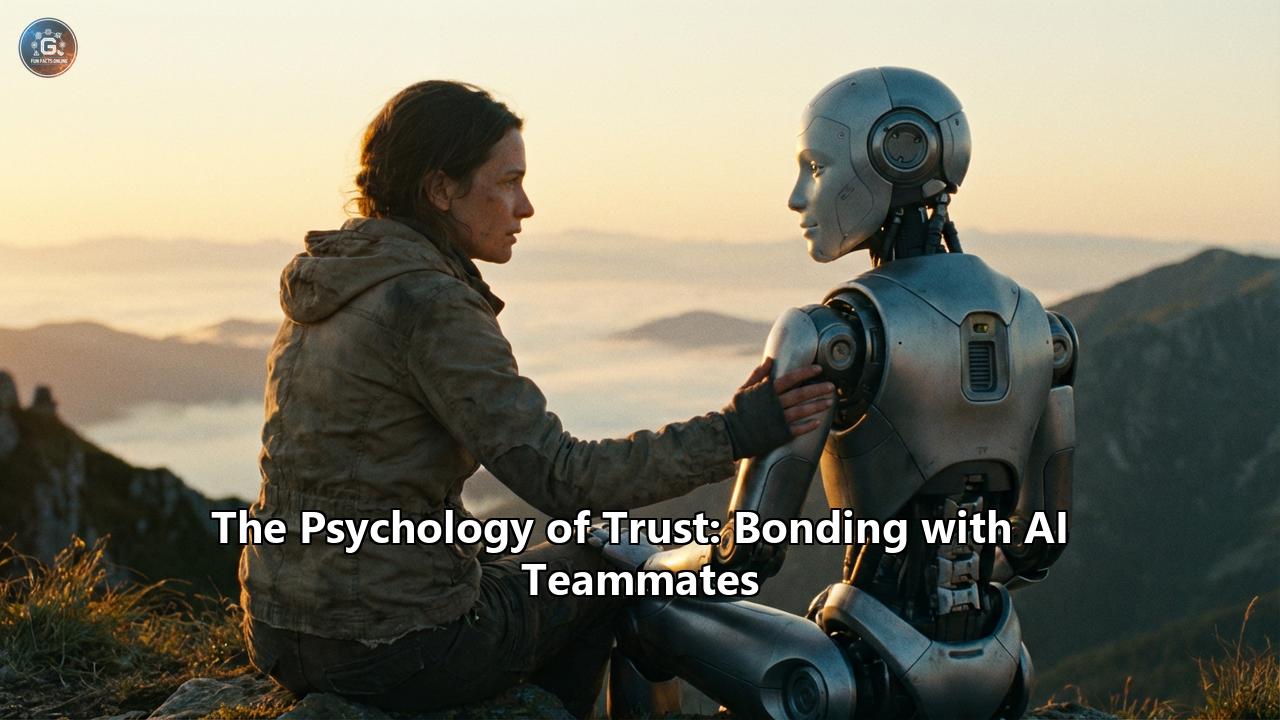
The silent revolution in our workspaces, battlefields, and hospitals isn't just about faster processors or smarter algorithms; it is about a fundamental shift in relationships. For the first time in human history, we are not merely using tools; we are teaming with them.
From the fighter pilot entrusting their life to a "Loyal Wingman" drone, to the radiologist relying on an algorithm to spot a microscopic tumor, the psychology of trust is being rewritten. We are entering an era where our teammates may not have a heartbeat, yet we must bond with them to succeed. This article explores the fascinating, complex, and sometimes perilous psychology of building trust with AI teammates.
The Biological Gap: Why trusting a machine feels "alien"
To understand why bonding with AI is so complex, we must first look at the human brain. For millennia, trust has been a biological survival mechanism. When you look into a colleague's eyes and shake their hand, your brain releases oxytocin, often called the "trust hormone." It quiets the amygdala (the fear center) and fosters a sense of safety and bonding. It is a chemical bridge built on shared vulnerability and empathy.
AI, however, has no biology. It cannot offer a firm handshake or a reassuring glance. Neuroscience research confirms that trust in humans and trust in machines are dissociable processes in the brain. Trusting a human engages the "social brain"—regions linked to theory of mind and empathy. Trusting an AI, conversely, engages the "cognitive control" networks—the same areas you use when deciding if a rickety bridge is safe to cross.
We do not "feel" trust for AI; we "calculate" it. We look for consistency, reliability, and performance. Yet, the human brain is a hacking machine. We constantly try to bridge this biological gap through a psychological quirk known as anthropomorphism.
The "Pinocchio" Effect: Breathing Life into Code
Humans are hardwired to find humanity in everything. We see faces in clouds and give names to our cars. This tendency explodes when we interact with AI. When an AI teammate speaks in a natural voice, uses "I" statements, or offers a polite apology, our brains can't help but project a personality onto the code.
This is the modern evolution of the ELIZA effect—named after a 1960s chatbot that mimicked a psychotherapist. People poured their hearts out to ELIZA, knowing fully well it was a simple script. Today, this effect is supercharged.
- The Name Game: Military pilots often give call signs to their autonomous drones.
- The Caretaker: In nursing homes, patients interacting with robot companions often speak to them as if they are pets or children, forgiving their errors ("He's just tired today") and praising their successes.
This psychological projection is the "glue" that allows the cognitive brain to accept the machine as a partner rather than just a calculator. It transforms a cold tool into a "teammate."
Case Studies from the Frontier of Human-AI Teaming
The theory of trust is interesting, but the practice is where life-and-death decisions are made. Let’s look at three distinct arenas where this bond is being tested.
1. The Battlefield: The "Loyal Wingman"
In modern aerial warfare, the concept of the "Loyal Wingman" is redefining the pilot's role. A human pilot in an advanced fighter jet flies alongside several autonomous drones—unmanned aircraft that can scout, jam radar, or even strike targets.
For the human pilot, the cognitive load is immense. They cannot "fly" the drones with a joystick; they must trust the drones to fly themselves.
- The Trust Crisis: If a drone swerves unexpectedly, does the pilot panic and take control (micromanagement), or do they trust that the drone saw a threat the human missed?
- The Solution: Trust here is built on transparency. The AI must not just act; it must communicate its intent. "I am breaking formation to avoid a radar lock" is a message that builds trust. Silence breeds suspicion.
2. The Hospital: The "Second Pair of Eyes"
In radiology, AI is becoming a standard partner. Algorithms scan X-rays and MRIs, flagging potential abnormalities for the doctor to review.
- The Challenge: A phenomenon known as "Algorithm Aversion" often plagues these teams. If an AI makes a single glaring error—marking a collarbone as a fracture, for example—the radiologist may lose faith entirely, ignoring the AI even when it is correct.
- The Success Story: At institutions like Massachusetts General Hospital, trust is built through "human-in-the-loop" systems. The AI doesn't dictate; it suggests. When an AI highlights a subtle nodule a tired doctor missed at 2:00 AM, and the doctor verifies it, a bond of professional respect is formed. The AI becomes a vigilant partner that never sleeps, covering the human's blind spots.
3. The Arena: OpenAI Five and "Team Spirit"
Perhaps the most surprising example comes from the world of competitive video games. OpenAI built a team of five neural networks (OpenAI Five) to play the complex strategy game Dota 2.
- The "Team Spirit" Parameter: To make the bots work together, researchers had to code a hyperparameter literally called "team spirit." It adjusted how much a bot cared about its own survival versus the team's victory.
- The Human Interaction: When human professionals played alongside these bots, they reported a strange sensation: feeling supported. The bots would instantly sacrifice themselves to save the human player, or offer resources without being asked. The human players described the bots not as tools, but as "selfless" teammates. It was a glimpse into a future where AI partners might be more chemically "loyal" than any human.
The Dark Side: When Trust Goes Wrong
Trust is a double-edged sword. Just as we can under-trust (aversion), we can also over-trust.
- Automation Bias: This is the "sleeping at the wheel" phenomenon. When an AI system performs flawlessly for 99 days, on the 100th day, the human stops checking. We see this in drivers who over-rely on autopilot features, or office workers who blindly accept ChatGPT's summary of a meeting without verifying the facts.
- The "Black Box" Problem: Trust without understanding is dangerous. If we don't know why an AI made a decision, we cannot know when it is hallucinating. This is why "Explainable AI" (XAI) is the holy grail of psychology in tech. An AI that says "I recommend this loan approval because of the applicant's debt-to-income ratio" is a trustworthy teammate. An AI that says "Approved" (with no reason) is a magical oracle that will eventually lead you off a cliff.
Blueprints for Bonding: How to Build a Healthy Human-AI Team
If you are a manager, a developer, or a user looking to build a successful relationship with an AI, the psychology points to three actionable pillars:
- Calibrated Trust: The goal is not "maximum trust," but "calibrated trust." You should trust the AI exactly as much as its performance warrants—no more, no less. This requires constant feedback loops where the AI reports its own confidence levels ("I am only 60% sure this is a cat").
- Vulnerability Loops: In human teams, admitting mistakes builds trust. AI should be designed to do the same. An AI that says, "I am having trouble interpreting this data, can you help?" triggers a helpful, collaborative response in humans, rather than frustration.
- Shared Mental Models: The human and the AI need to see the world the same way. In the military, this means the drone and the pilot must agree on what "threat" means. In business, you and your AI analyst must agree on what "profit" implies. Training with the AI (not just training on it) aligns these mental models.
The Future: Emotional AI and the "Her" Scenario
We are on the cusp of a new frontier: Emotional AI. Systems are being developed that can detect irritation in your voice or fatigue in your typing patterns.
- Imagine an AI teammate that says, "You sound stressed. I'll handle the data entry for the next hour; you focus on the creative strategy."
- This capability will deepen the bond significantly, moving us from "cognitive trust" (it works) to "affective trust" (it cares).
However, this brings us back to the biological gap. The AI does not actually "care"—it is simulating care. Will it matter? If the simulation is perfect, if the support feels real, and if the team succeeds, perhaps the psychology of trust will evolve. We may find that in the cold logic of machines, we discover a new kind of warmth—a partnership that frees us to be more human, supported by a teammate that is perfectly, reliably, machine.
Reference:
- https://pmc.ncbi.nlm.nih.gov/articles/PMC10725778/
- https://elevatedmarketing.solutions/the-one-thing-ai-will-never-steal-human-trust/
- https://automatorslab.ai/blog/ai-news/us-airforce-ai-loyal-wingman-program/
- https://www.defensenews.com/air/2022/02/13/how-autonomous-wingmen-will-help-fighter-pilots-in-the-next-war/
- https://en.wikipedia.org/wiki/Manned-unmanned_teaming
- https://catalyit.com/techtips/how-to-build-team-trust-in-ai-a-step-by-step-guide
- https://aiforhealthtech.com/how-ai-transforming-radiology-mgh-case-study/
- https://www.salesforce.com/blog/build-trust-engage-users-artificial-intelligence/?bc=HL
- https://www.analyticsvidhya.com/blog/2018/06/openai-five-a-team-of-5-algorithms-is-beating-human-opponents-in-a-popular-game/
- https://www.weforum.org/stories/2018/07/five-ai-algorithms-worked-together-to-beat-humans-at-a-strategy-game/
- https://en.wikipedia.org/wiki/OpenAI_Five
- https://www.youtube.com/watch?v=eHipy_j29Xw
- https://openai.com/index/openai-five-defeats-dota-2-world-champions/