
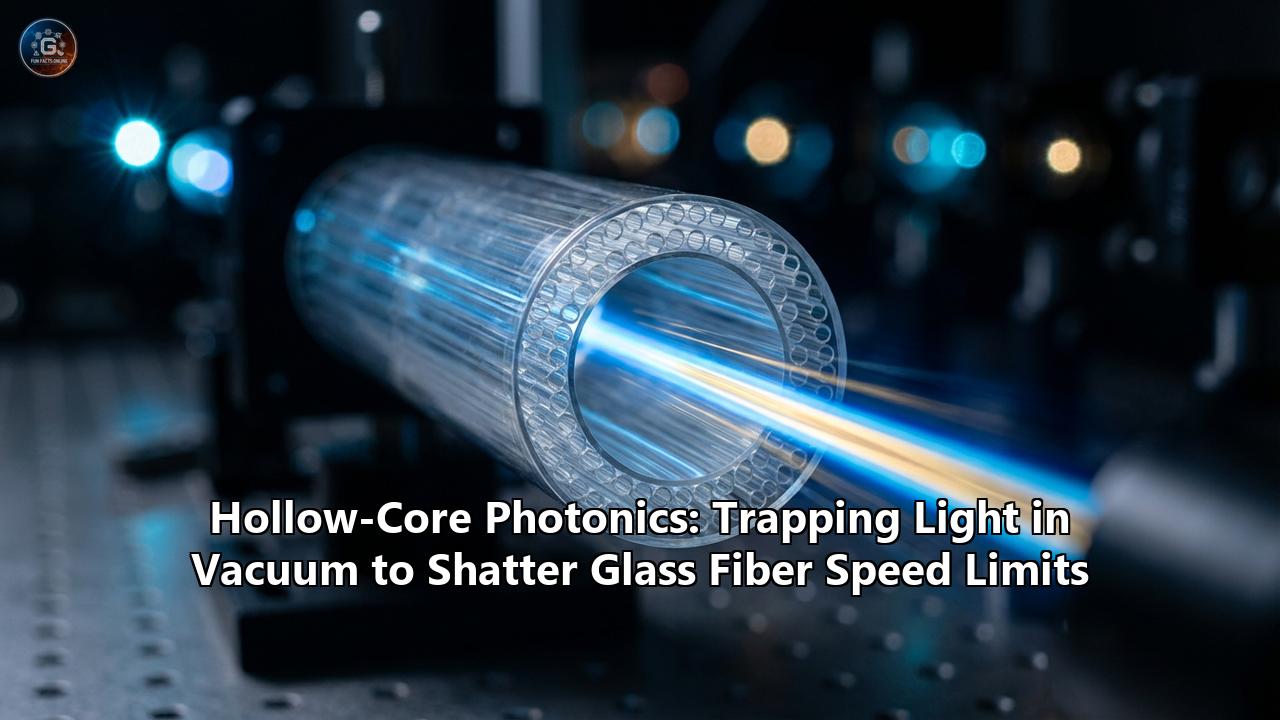
In the silent, subterranean world of global telecommunications, a revolution is brewing—one that consists of nothing. For fifty years, the backbone of our digital civilization has been built on strands of ultra-pure glass, guiding pulses of light across oceans and continents. This technology, based on Total Internal Reflection (TIR), has been a miracle of engineering, enabling the internet as we know it. But it has a flaw, a fundamental physical limit that no amount of engineering can bypass: inside solid glass, light slows down.
For decades, we accepted this cosmic speed limit. But now, a new paradigm has emerged, one that promises to unshackle light from its silica prison. It is called Hollow-Core Photonics, and it involves a counter-intuitive feat of engineering—trapping light not in a solid, but in a vacuum, guiding it through microscopic tunnels of nothingness to achieve speeds 47% faster than standard fiber.
This is not science fiction. It is a technology currently being deployed beneath the streets of London and Chicago, tested by giants like Microsoft and Comcast, and raced for by high-frequency traders for whom a nanosecond is worth millions. This is the story of how we learned to trap light in a vacuum, and why it is about to change everything from Artificial Intelligence to the Quantum Internet.
Part I: The Glass Prison and the Speed of Light
To understand the magnitude of the hollow-core breakthrough, we must first understand the "glass prison" we currently inhabit.
The Refractive Index Problem
In a vacuum, light travels at $c$, approximately 299,792,458 meters per second. This is the universal speed limit. However, when light enters a medium like water or glass, it interacts with the atoms in that material. It is absorbed and re-emitted, a process that effectively slows it down. This slowing is measured by the Refractive Index ($n$).
Standard telecommunications fiber is made of fused silica (silica glass), which has a refractive index of approximately 1.45.
$$ v = c / n $$
$$ v = 299,792,458 / 1.45 \approx 206,753,419 \text{ m/s} $$
This means that in every fiber optic cable on Earth—from the patch cord at your desk to the massive trans-Atlantic cables—light is traveling at roughly 69% of its potential speed. For decades, this latency was negligible. Who cares if an email arrives in 100 milliseconds or 150 milliseconds?
But as our hunger for real-time data exploded, this 31% "tax" on speed became a bottleneck. In High-Frequency Trading (HFT), where algorithms battle for queue position in microseconds, the delay of glass is an eternity. In the massive parallel computing clusters used to train AI models like GPT-4, latency between Graphical Processing Units (GPUs) limits how large a cluster can grow.
The solution seems obvious: remove the glass. If we could guide light through air (which has a refractive index of ~1.0003) or a vacuum ($n=1$), we could recover that lost speed. But light, by its nature, wants to spread out. How do you force a beam of light to stay confined in a hollow tube without leaking away?
Part II: The Physics of "Nothing"
The journey to hollow-core fiber (HCF) required abandoning the principle that had defined fiber optics since Charles Kao won the Nobel Prize for it. Standard fiber uses Total Internal Reflection (TIR). A core of high-refractive-index glass is surrounded by a cladding of lower-refractive-index glass. When light tries to escape the core, it hits the boundary at a shallow angle and bounces back in, like a stone skipping on water.
But you cannot have a material with a refractive index lower than 1.0 (vacuum). Therefore, you cannot use TIR to guide light inside a vacuum core because there is no solid cladding material with a lower index to bounce it off. The laws of physics seemed to forbid it.
The Photonic Crystal Revolution
In the 1990s, Philip Russell and his team at the University of Southampton proposed a radical new idea: Photonic Bandgaps. Just as a semiconductor crystal has "bandgaps" where electrons cannot exist, a "photonic crystal"—a material with a periodic structure of microscopic air holes—could prohibit light from existing in the cladding. If the cladding forbids light, and the core is a hollow defect in that crystal, the light has nowhere to go but down the hollow core.
This birthed the Photonic Bandgap Fiber (PBG). These fibers looked like honeycombs under a microscope, with hundreds of tiny air holes surrounding a central hollow core. They worked, but they had issues. They were "lossy" (light scattered easily), they had narrow bandwidths (acting like a filter that only let certain colors through), and they were incredibly difficult to make.
The "Soap Bubble" Breakthrough: Anti-Resonance
The real game-changer came with a shift from "bandgaps" to Anti-Resonance. Imagine a soap bubble floating in the air. When light hits the thin film of the bubble, some reflects off the outer surface, and some reflects off the inner surface. At specific thicknesses, these reflections interfere constructively or destructively.
Researchers, specifically the team led by Francesco Poletti at Southampton, realized they could surround a hollow core not with a complex honeycomb, but with a simple ring of thin glass tubes. If the glass walls of these tubes are the exact right thickness, they act as Anti-Resonant Reflecting Optical Waveguides (ARROW).
When light tries to escape the hollow core and hit the glass wall, the wall acts like a highly reflective mirror due to destructive interference in the glass membrane. It pushes the light back into the air core. This design is called Nested Anti-Resonant Nodeless Fiber (NANF).
Why NANF Changed the World:- Broad Spectrum: Unlike bandgap fibers, NANFs reflect a massive range of wavelengths. They can carry the entire C, L, and S bands of telecommunications simultaneously.
- Ultra-Low Loss: Because the light bounces off the air-glass boundary without actually traveling inside the glass, absorption is minimized. In solid fiber, the light travels through the glass. In NANF, light travels through the air and only "touches" the glass walls occasionally.
- Low Non-Linearity: In solid glass, intense laser pulses cause the glass to distort the signal (non-linear effects). In air, these effects are 1,000x weaker. You can pump massive amounts of power into a hollow core without the signal garbling itself.
Part III: The Engineering Marvel – How It’s Made
The manufacturing of NANF is a feat of extreme precision, often compared to "blowing a glass flute longer than the Burj Khalifa."
The Stack-and-Draw Technique
It starts with a preform. Engineers hand-assemble a bundle of glass capillaries (tubes) inside a larger glass tube. This bundle is the macroscopic version of the fiber, perhaps 2-3 centimeters wide. The arrangement is critical: typically, six smaller tubes are arranged in a ring inside the outer tube, and often, smaller tubes are nested inside those (hence "Nested").
This preform is placed at the top of a fiber draw tower—a multi-story vertical factory. A furnace melts the bottom of the preform, and gravity pulls a thin thread of glass downward.
The Pressure Control Challenge
Here lies the magic. If you just pulled the glass, the holes would collapse under surface tension. Engineers must pressurize the inside of the hollow tubes with inert gas while pulling. They must independently control the pressure in the central core, the cladding tubes, and the nesting tubes.
By balancing the downward pull speed, the furnace temperature, and the internal gas pressures, the 3cm preform is stretched into a hair-thin fiber (125 microns wide) while maintaining the perfect internal geometry. The glass membranes in the final fiber are often less than 1 micron thick—thinner than a red blood cell—and must remain uniform over kilometers of length.
Recent breakthroughs by companies like Lumenisity (now part of Microsoft) have achieved lengths of over 10km with record-low loss, proving that this isn't just a lab curiosity—it's scalable manufacturing.
Part IV: The Killer Application – High-Frequency Trading (HFT)
While scientists were perfecting the physics, the financial world was hunting for speed. In the HFT ecosystem, the "tick-to-trade" time—the time it takes to receive a market price update and execute a trade—is the single most important metric.
The Chicago-New Jersey Corridor
The most famous route in trading is the path between the futures markets in Chicago (Aurora, IL) and the equity markets in New Jersey (Secaucus/Carteret/Mahwah). The straight-line distance is roughly 730 miles.
- Light in Vacuum (Theoretical Minimum): ~3.9 milliseconds (one way).
- Solid Fiber (Refractive Index 1.45): ~5.7 - 6.0 milliseconds (straight line, not accounting for cable routing).
- Microwave (Air, Index ~1.0003): ~4.0 - 4.1 milliseconds.
For years, traders abandoned fiber for microwave towers to get closer to the speed of light in air. But microwaves have low bandwidth (megabits, not terabits) and fade in the rain. Hollow-core fiber offers the speed of microwave with the bandwidth and reliability of fiber.
The "Value of a Millisecond"
In 2022 and 2023, euNetworks deployed the first commercial hollow-core cables in London, connecting the London Stock Exchange data center to Interxion.
- The Gain: A 30% reduction in latency.
- The Math: Light in HCF saves approximately 1.54 microseconds per kilometer compared to solid fiber. Over a short 7km metro link, that’s ~10 microseconds.
Ten microseconds sounds trivial. But in HFT, where order queues are First-In-First-Out (FIFO), arriving 1 microsecond ahead of a competitor determines whether you buy a stock at \$100.00 or \$100.01. That penny difference, multiplied by millions of shares, is an empire.
This "race to zero" has driven the early adoption. Financial firms are paying premiums of 50x or more for dark hollow-core fiber strands because the ROI is immediate.
Part V: The AI Revolution – Why Microsoft Bought the Technology
While traders want speed for profit, the Tech Giants want speed for intelligence. In late 2022, Microsoft shocked the optical industry by acquiring Lumenisity, the undisputed leader in NANF technology. Why? Artificial Intelligence.
The Data Center Radius Problem
Training massive Large Language Models (LLMs) requires thousands of GPUs (like NVIDIA H100s) working in unison. They must constantly exchange parameters (weights and biases). If one GPU has to wait for data from another, the entire cluster stalls. This is the "tail latency" problem.
To keep latency low, data centers today pack GPUs into tight clusters. But you can only pack so much power and heat into one building before you melt the grid. You need to spread the cluster across multiple buildings or "Availability Zones."
The Hollow-Core Unlock:Because HCF moves light 50% faster, it effectively expands the synchronous radius of a data center.
- Solid Fiber Scenario: If your maximum allowable latency for synchronous training is 10 microseconds, your GPUs must be within ~2 km of each other.
- Hollow-Core Scenario: With 50% faster light, that same 10-microsecond budget allows you to place GPUs ~3 km apart.
This increases the area of the circle ($A = \pi r^2$) by a factor of 2.25x.
Microsoft can now build data center campuses that are spatially larger—easier to cool, easier to power—while the AI models "feel" like they are all in the same room. For a company planning to deploy millions of GPUs, this geographical flexibility is worth billions in infrastructure savings.
Part VI: 5G, 6G, and The Green Network
Beyond finance and AI, hollow-core photonics solves a looming crisis in general telecommunications: Energy Density.
Eliminating the Repeater
Solid core fibers have a non-linear limit. If you pump too much laser power into glass, the glass interacts with the light (Kerr effect), creating noise that destroys the signal. This limits how much data you can send before you need a "repeater" or amplifier to boost the signal.
Hollow-core fibers have almost zero non-linearity. You can theoretically pump 100x or 1000x more power into an air core than a glass core.
- High Power Launch: If you can launch a signal with 100x more power, it can travel significantly further before it fades to the noise floor.
- Result: You need fewer electronic repeaters and amplifiers along the ocean floor or across a continent.
Repeaters are expensive, they break, and they consume electricity. A hollow-core network could be a "passive" network over much longer distances, drastically reducing the carbon footprint of the internet.
6G and Time Synchronization
Future 6G networks rely on "Coordinated Multipoint" (CoMP), where multiple cell towers talk to your phone simultaneously to boost speed. This requires the towers to be perfectly synchronized in time. The ultra-stable, low-latency nature of hollow-core fiber makes it the ideal "sync cable" for the wireless networks of the 2030s.
Part VII: Remaining Challenges – The Last Mile
If HCF is so perfect, why isn't it everywhere?
- Loss (Attenuation):
Solid Fiber: ~0.14 dB/km.
Hollow Core: Historical best was >1 dB/km.
Current State: The "Double Nested" designs have recently hit 0.174 dB/km in the C-band and are actually better than solid fiber in other bands (O-band). We have effectively solved the loss problem in the lab, but consistent mass production is still ramping up.
- Splicing:
You cannot just melt two hollow tubes together; the holes would collapse. Splicing HCF to standard solid fiber requires complex "mode field adapters" and careful thermal management to avoid sealing the hole shut.
- Cost:
* Currently, HCF is a boutique product. It costs significantly more per meter than the commoditized solid fiber. However, like solar panels or SSDs, this price will collapse as Microsoft and others drive volume manufacturing.
Conclusion: The End of the Glass Age
We are witnessing a rare moment in hardware history: a fundamental substitution of the medium of transmission. For 5,000 years, we used copper wires. For 50 years, we used solid glass. Now, we are moving to vacuum.
Hollow-core photonics is not just an incremental upgrade; it is a step-change. It brings the speed of light in vacuum—the fundamental speed limit of the universe—down to the physical layer of our internet.
- For the trader, it is profit.
- For the AI engineer, it is a brain that spans miles.
- For the gamer, it is the end of lag.
- For humanity, it is the shattering of the glass ceiling that has capped our communication speeds for half a century.
The future is hollow, and it is traveling at 299,792,458 meters per second.
Reference:
- https://www.reddit.com/r/FuturesTrading/comments/1i0bvte/high_frequency_trading_question_how_high_is_high/
- https://relativitynetworks.ai/our-technology/
- https://www.theregister.com/2013/02/27/microwave_versus_fibre/
- https://fondexx.pro/blog/milliseconds-market-money-making-high-frequency-trading
- https://www.theregister.com/2025/09/01/hollowcore_optical_fiber_research/
- https://www.techradar.com/pro/a-potential-revolution-microsoft-backs-researchers-working-on-potentially-the-fastest-fiber-optics-yet
- https://www.cremieux.xyz/p/high-frequency-trading-is-good
- https://adtek-fiber.com/hollow-core-fiber-a-new-paradigm-for-ultra-low-loss-datacenter-links/
- https://eunetworks.com/network/network-developments/hollowcore-fibre-deployment-2/
- https://techstrong.it/featured/microsofts-hollow-core-fiber-offers-network-breakthrough/
- https://news.ycombinator.com/item?id=39220575
- https://www.analysysmason.com/contentassets/14c0d9a2965d431fb448a27d36a2dfca/analysys_mason_hollow_core_fibre_sep2022_rdfi0.pdf
- https://www.networkworld.com/article/4049666/microsofts-hollow-core-fiber-delivers-the-lowest-signal-loss-ever.html
- https://www.prysmian.com/en/insight/nexst/digital-solutions/hollow-core-fibre-powering-the-future-of-ai-ready-data-centres
- https://www.cordacord.com/news_view.php?id=20241121043014
- https://www.computerworld.com/article/1541026/microwave-vies-with-fiber-for-high-frequency-trading.html
- https://www.cambridgemc.com/hollow-core-fibre-the-route-to-a-faster-future
- https://www.ainvest.com/news/prysmian-strategic-bet-hollow-core-fiber-game-changer-ai-driven-data-centers-2507/
- https://www.binance.com/en/square/post/24177861174553