
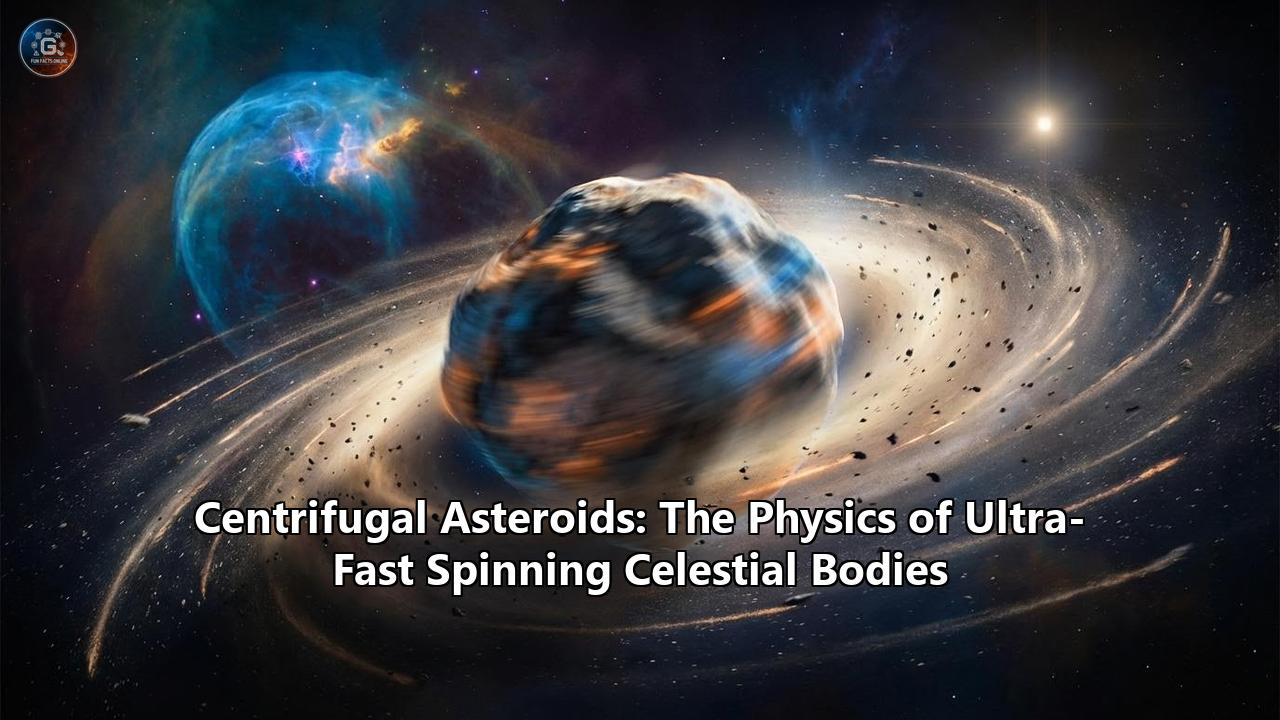
Imagine a mountain floating in the vacuum of space, spinning so violently that a rock placed on its equator wouldn't stay on the ground—it would "fall" upwards, flung outward into the cosmic void. This is not a concept pulled from the pages of science fiction. It is the bizarre, high-stakes physical reality of centrifugal asteroids, a class of ultra-fast spinning celestial bodies that test the absolute limits of structural physics.
For decades, our understanding of asteroids was relatively static. We pictured them as dead, inert craters floating aimlessly through the dark. However, modern astrophysics has revealed that asteroids are dynamic, evolving systems shaped by invisible forces. They are caught in a constant battle between the gravitational pull trying to hold them together and the immense centrifugal forces threatening to tear them apart. Recently, groundbreaking discoveries have shattered our previous assumptions about how fast these bodies can spin and what they must be made of to survive such extreme rotational violence.
To truly understand these enigmatic objects, we must dive into the mechanics of the cosmic merry-go-round, exploring the subtle power of sunlight, the hidden strength of microscopic forces, and the spectacular ways in which asteroids give birth to moons.
The Physics of the Spin and the 2.2-Hour Barrier
If you stand on the equator of the Earth, you are rotating at roughly 1,000 miles per hour. Yet, you do not fly off into space. This is because Earth's immense mass generates a gravitational pull that vastly overpowers the outward centrifugal force caused by its rotation. But what happens when you shrink the world down to the size of a city, or a football field?
Asteroids possess very little mass, and consequently, incredibly weak gravity. For the vast majority of asteroids larger than 150 meters across, there is a hard, mathematical limit to how fast they can rotate before the centrifugal force at their equator exceeds their gravitational pull. This threshold is known to planetary scientists as the "spin barrier," and it sits at approximately one rotation every 2.2 hours.
Why 2.2 hours? The answer lies in the dominant architecture of asteroids. Most space rocks larger than a few hundred meters are not solid monoliths; they are "rubble piles". A rubble pile asteroid is essentially a floating cosmic gravel pit—a loose collection of boulders, pebbles, and fine dust held together entirely by weak mutual gravity. They are the aggregated debris of ancient collisions. Because they lack internal structural integrity, spinning a rubble pile faster than the 2.2-hour limit results in a catastrophic structural failure. The asteroid will literally begin to shed its mass, flinging boulders and regolith from its equator into deep space.
If you were to plot the rotation rates of thousands of known asteroids against their sizes, you would see a massive clustering right at the 2.2-hour mark, acting like an invisible brick wall. But what is driving these asteroids to spin up to this barrier in the first place? In the vacuum of space, where there is no wind and no obvious motor, how does a mountain of floating rubble accelerate to such dizzying speeds?
The answer is sunlight.
The YORP Effect: Sunlight as a Cosmic Engine
While it is easy to think of light purely as illumination, photons carry momentum. When sunlight strikes the surface of an asteroid, it warms the rock. Because space is unimaginably cold, the asteroid must eventually radiate this absorbed solar energy back into space as thermal infrared radiation.
If an asteroid were a perfect, smooth sphere, this thermal radiation would be emitted evenly in all directions, canceling itself out. But asteroids are chaotic, irregular, and heavily cratered. As the asteroid rotates, the afternoon side of the rock—having just baked in the sun—is significantly hotter than the morning side. The thermal radiation pushes away from the asteroid's surface unevenly. Over the course of a single day, this microscopic push is entirely negligible. But asteroids have been orbiting the sun for billions of years.
This phenomenon is known as the Yarkovsky–O'Keefe–Radzievskii–Paddack effect, or simply the YORP effect. Over millions of years, this asymmetric thermal exhaust acts like a set of tiny, invisible thrusters attached to the asteroid's surface. Depending on the specific shape of the asteroid, the YORP effect can either gradually slow its rotation down until it tumbles chaotically, or it can continuously spin it up, accelerating the body toward the dreaded 2.2-hour spin barrier.
The YORP effect is not merely theoretical; it has been observed in real-time. By monitoring the near-Earth asteroid (54509) 2000 PH5 (later named Apollo) over several years, astronomers detected its rotation period steadily decreasing by fractions of a second per year—a direct observation of sunlight turning a multi-million-ton rock like a top.
Pushing the Limits: Cohesion in the Void
When a rubble pile asteroid is spun up by the YORP effect and approaches the 2.2-hour barrier, strange things begin to happen to its morphology. The loose material behaves somewhat like a fluid. As centrifugal forces reduce the effective gravity at the equator to near zero, landslides are triggered across the asteroid's surface. Boulders and dust migrate from the poles down to the equator, causing the asteroid to bulge outward. This is why extensively studied asteroids like Bennu and Ryugu look like massive cosmic spinning tops or diamonds; they have been sculpted by centrifugal forces driving material to their equators.
Yet, scientists have noticed something peculiar. Some small rubble pile asteroids manage to spin slightly faster than the 2.2-hour barrier would strictly allow based purely on gravity. If gravity isn't holding them together, what is?
The secret lies in the microscopic dust. The surfaces of these asteroids are covered in fine regolith—pulverized rock created by eons of micrometeorite impacts. In the ultra-high vacuum and low gravity of space, incredibly weak quantum mechanical forces known as Van der Waals forces come into play. On Earth, these forces are easily overpowered by gravity and atmospheric pressure. But on an asteroid, the fine grains of dust cling to one another and to larger boulders, acting like a weak "cosmic cement".
This cohesive strength is minuscule—roughly equivalent to the pressure of a few sheets of paper resting on your hand. However, in the microgravity environment of an asteroid, this cohesive dust provides just enough structural integrity to prevent the rubble pile from immediately flying apart, allowing it to edge slightly past the theoretical spin limit. But even Van der Waals forces have their breaking point.
Mass Shedding: How Asteroids Give Birth to Moons
When the YORP effect relentlessly pushes a rubble pile past its absolute limit of gravity and cohesive strength, the asteroid does not simply explode. Instead, it undergoes a graceful, terrifying process known as mass shedding.
As the equator spins too fast, the rocks and regolith resting there achieve orbital velocity. They gently lift off the surface, floating into space to form a ring of debris around the parent asteroid. Over time, this ring of shed material coalesces under its own weak gravity to form a secondary body—a moonlet.
This process of centrifugal mass shedding is believed to be the primary mechanism for the creation of binary asteroid systems, which make up roughly 15% of the near-Earth asteroid population. We have seen the dramatic aftermath of this process up close. In 2022, NASA's DART (Double Asteroid Redirection Test) mission deliberately crashed a spacecraft into Dimorphos, the small moonlet orbiting the larger asteroid Didymos. Analysis of the high-resolution images beamed back moments before impact revealed that Dimorphos was constructed from the exact same boulders and material as Didymos's equator. Didymos had been spun up by the YORP effect until it shed mass, literally giving birth to Dimorphos.
The Monoliths: Defying the Spin Barrier
While rubble piles are strictly bound by the spin barrier, there is an exception to the rule. If an asteroid is not a loose collection of rubble, but rather a single, solid piece of rock or metal, its internal tensile strength can withstand immense centrifugal forces. These bodies are known as monoliths, and they can spin at mind-bending speeds.
For years, it was assumed that monolithic asteroids larger than a few hundred meters were incredibly rare. Space is a violent place, and over billions of years, almost all large asteroids have been fractured and shattered by collisions, turning them into rubble piles. But in early 2026, the scientific community was stunned by an unprecedented data release from the newly operational Vera C. Rubin Observatory in Chile.
Equipped with the largest digital camera ever built, the Rubin Observatory peered into the main asteroid belt between Mars and Jupiter and identified thousands of previously unknown asteroids in just its first few nights of observation. Among these were 19 "super-fast" and "ultra-fast" rotators that completely defied the expected norms.
The absolute champion of these discoveries was an asteroid designated 2025 MN45. This gargantuan rock measures 710 meters (over 2,300 feet) in diameter—more than twice the length of the Eiffel Tower. Yet, despite its massive size, it completes a full rotation in an astonishing 1.88 minutes (just 112 seconds).
To put this into perspective, the equator of 2025 MN45 is moving at such a high velocity that the outward centrifugal force is immense. For an object of this size to spin that fast without disintegrating into a cloud of shrapnel, it cannot be a rubble pile. It must possess a cohesive strength comparable to solid, flawless rock. The discovery of 2025 MN45, along with other speed demons like the 1.9-minute rotator 2025 MJ71, proved that massive, intact monoliths exist in far greater numbers than previously believed.
Even smaller objects can spin at rates that defy comprehension. During a separate near-Earth survey, astronomers utilizing the Two-meter Twin Telescope in Spain identified an asteroid known as 2025 KS1. While much smaller in diameter, 2025 KS1 completes a full 360-degree rotation every 8 seconds.
Where do these monolithic speed demons come from? Planetary geologists theorize that they are the dense, internal "hearts" of much larger parent bodies. In the early days of the solar system, large protoplanets formed solid cores under immense pressure and heat. When these parent bodies were ultimately destroyed by cataclysmic impacts, their shattered, ultra-dense cores were liberated into space. Stripped of their outer layers, these solid rock and metal fragments can be spun up by the YORP effect for millions of years, safely accelerating to blistering speeds that would instantly vaporize a rubble pile.
The Implications for Planetary Defense
Understanding whether an asteroid is a slow-spinning rubble pile or an ultra-fast spinning monolith is not just an academic exercise—it is a matter of planetary survival. The internal structure and rotational physics of an asteroid dictate exactly how we must respond if one is ever found on a collision course with Earth.
If a rubble pile is detected on an impact trajectory, deflecting it requires extreme caution. Striking a loosely bound, fast-spinning rubble pile with a kinetic impactor or a nuclear device might not divert the asteroid as a single unit. Instead, the impact could shatter the weak cohesive bonds holding it together, turning a single incoming "cannonball" into a devastating shotgun blast of radioactive, city-killing boulders.
Conversely, an ultra-fast spinning monolith like 2025 MN45 presents a different nightmare. Because it is a solid piece of high-strength rock, it is highly resilient to fragmentation. A kinetic impactor would efficiently transfer its momentum to the rock, theoretically making it easier to push off course. However, the extreme rotation means that any spacecraft attempting to rendezvous with it, land on it, or attach a "gravity tractor" would be dealing with a wildly hostile, rapidly moving surface where a simple miscalculation could result in the spacecraft being swatted away by the asteroid's equator.
Furthermore, the YORP effect itself plays a massive role in predicting asteroid trajectories. Because the YORP effect alters how an asteroid spins, it subsequently alters the Yarkovsky effect—a related phenomenon where thermal radiation gently pushes the asteroid along its orbital path, changing its trajectory over time. If we do not precisely map the spin rate, shape, and thermal properties of near-Earth asteroids, our predictions of their future orbits could be off by millions of miles over a century. We could completely miss predicting a direct impact.
The Future of Asteroid Mining: Harnessing the Centrifuge
Beyond the realm of planetary defense, centrifugal asteroids present a fascinating frontier for the future of space exploration and resource extraction. The burgeoning field of asteroid mining views near-Earth objects as deep-space gas stations and material reserves, rich in water-ice, platinum-group metals, and silicates.
Fast-spinning rubble piles might be the most lucrative targets of all. Because the centrifugal force at their equators nearly cancels out their gravity, moving material off the surface requires virtually zero energy. In theory, a mining spacecraft would not need to drill deeply or use heavy equipment to launch harvested materials back to a processing facility. The asteroid is already functioning as a natural centrifuge. By simply placing a capture mechanism near the equator and gently disturbing the surface, miners could allow the asteroid's own rotational energy to fling loose, pre-pulverized regolith directly into their cargo bays.
Alternatively, the shedding mechanism that created Dimorphos could be artificially triggered. By using reflective foils or directed lasers to artificially enhance the YORP effect, future engineers could intentionally spin up a rubble pile asteroid until it crosses the 2.2-hour barrier, forcing it to safely shed its outer layers of material for easy collection.
A Clockwork Solar System
The discovery of the physics governing ultra-fast spinning celestial bodies has fundamentally rewritten the narrative of our solar system. Asteroids are not stagnant rocks; they are active, evolving mechanisms. They are shaped by the gentle, persistent push of ancient sunlight. They are bound together by quantum mechanical forces. They spin, they bulge, they tear themselves apart, and in their destruction, they give birth to new moons.
As next-generation instruments like the Vera C. Rubin Observatory continue to scan the heavens, we are guaranteed to find even more extreme outliers—asteroids spinning faster, surviving immense stresses, and challenging our fundamental understanding of material physics. Every flash of light reflecting off these cosmic tops serves as a reminder of the unseen forces dictating the dance of the cosmos. In the silent, frictionless void of space, the merry-go-round never stops. It only spins faster.
Reference:
- https://skyandtelescope.org/astronomy-news/near-earth-asteroids-spin-faster-than-we-thought/
- https://www.sciencealert.com/record-breaking-asteroid-spins-so-fast-it-should-tear-itself-apart
- https://academic.oup.com/mnras/article/430/2/1376/2892574
- https://news.stanford.edu/stories/2026/01/rubin-observatory-lsst-research-record-breaking-asteroid
- https://www.sciencenews.org/article/rubin-fastest-spinning-asteroid
- https://sciences.ucf.edu/class/wp-content/uploads/sites/23/2018/02/MAPS_cohesion.pdf
- https://gizmodo.com/astronomers-discover-unusual-asteroid-spinning-faster-than-anything-its-size-2000707371
- https://pmc.ncbi.nlm.nih.gov/articles/PMC11289111/
- https://www.researchgate.net/publication/248577525_On_YORP-induced_spin_deformations_of_asteroids
- https://www.researchgate.net/publication/6460329_Direct_Detection_of_the_Asteroidal_YORP_Effect
- https://par.nsf.gov/biblio/10475049-strength-fine-coarse-mixtures-rubble-pile-asteroids
- https://www.discovermagazine.com/fastest-spinning-asteroid-ever-found-spotted-by-vera-c-rubin-observatory-48532
- https://www.sci.news/astronomy/record-setting-asteroid-vera-rubin-observatory-14472.html
- https://www.independent.co.uk/space/asteroid-record-breaking-earth-hit-b2896361.html
- https://www.livescience.com/space/astronomy/vera-c-rubin-observatory-discovers-enormous-record-breaking-asteroid-in-first-7-nights-of-observations