
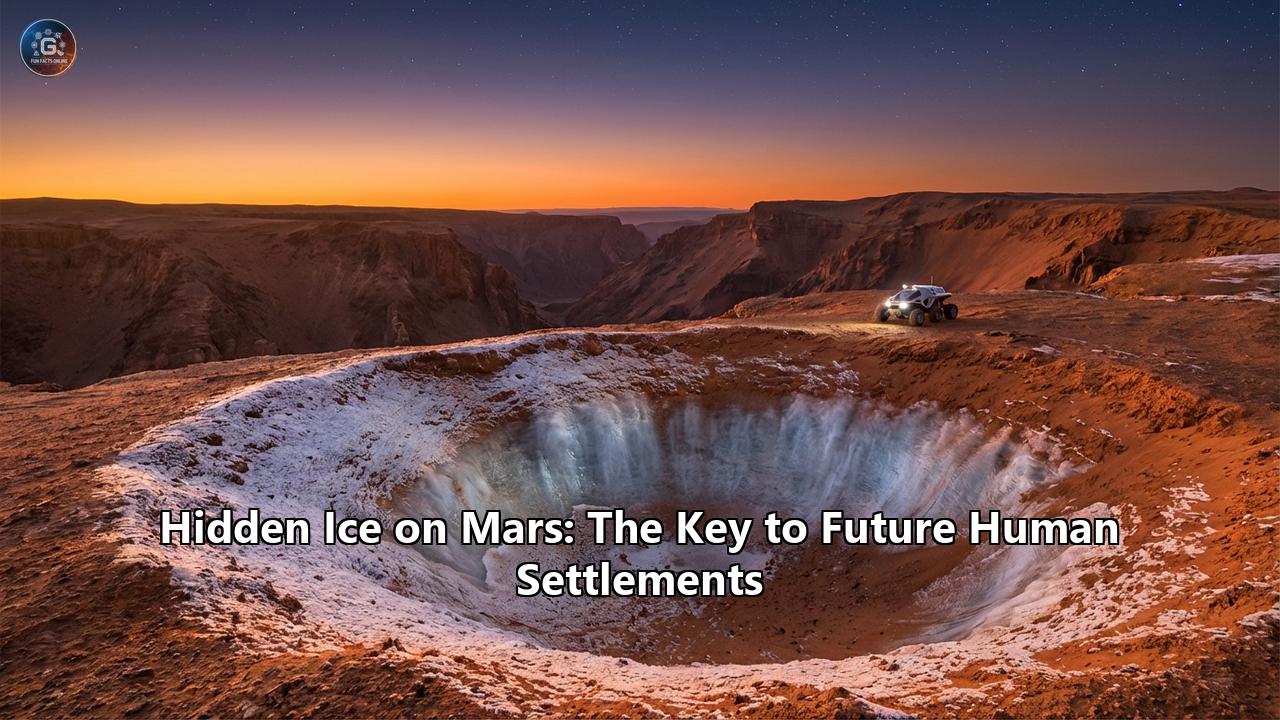
The Red Planet is not as dead as it looks. For centuries, astronomers gazed at Mars and saw a desolate, rusty wasteland—a global desert where dust storms raged and liquid water was a phantom memory from billions of years ago. But that image is shattering. Beneath the ruddy regolith, Mars is hiding a secret that changes everything: ice. Not just frost at the poles, but vast, continent-sized glaciers buried under equatorial dust; ancient, fossilized oceans trapped in rock; and pure, massive slabs of frozen water just meters below the surface.
This is not merely a scientific curiosity; it is the single most important factor for the future of humanity in space. We are no longer looking at Mars as a place to visit, but as a place to live. And to live, we need water. The recent discoveries of massive subsurface ice deposits—particularly near the equator in the Medusae Fossae Formation and the dramatic Noctis Labyrinthus—have rewritten the playbook for colonization. We no longer need to haul our own water across the cosmic void. It is already there, waiting for us.
This comprehensive guide explores the revolution in our understanding of Martian ice. We will journey deep into the geology of these hidden glaciers, explore the cutting-edge technologies being designed to mine them, visualize the ice-houses that will shelter future astronauts, and grapple with the legal and ethical storms that will arise when the first drill pierces the Martian crust.
Part I: The New Geography of Mars – An Ice World in Disguise
To understand the magnitude of recent discoveries, we must first unlearn the "Dry Mars" dogma of the 20th century. While the Viking landers of the 1970s showed us a bone-dry surface, the orbiters of the 21st century—equipped with radar eyes that can see deep underground—have revealed a planet that is surprisingly wet, provided you know where to look.
The Equator’s Frozen Secret: Medusae Fossae Formation
For decades, mission planners faced a cruel dilemma. They wanted to land human crews near the Martian equator because that’s where the sunlight is strongest (essential for solar power) and the temperatures are mildest. However, they believed all the accessible water ice was locked away at the freezing, dark poles. It seemed we had to choose between power and water.
That changed with the startling data from the European Space Agency’s (ESA) Mars Express orbiter. Its MARSIS radar instrument probed the Medusae Fossae Formation (MFF), a mysterious, wind-sculpted region of soft rock extending for 5,000 kilometers along the equator. Scientists had long debated what the MFF was made of. Was it volcanic ash? Porous dust?
The latest analysis, released in early 2024, delivered the verdict: it is ice. Massive amounts of it. The radar signals indicated a material that was low in density and transparent to radio waves—a signature that matches water ice perfectly. The deposits are colossal, stretching up to 3.7 kilometers (2.3 miles) deep. If this ice were melted, it would cover the entire planet of Mars in a global ocean between 1.5 and 2.7 meters deep. This is the largest deposit of water ever found near the Martian equator.
This discovery is a strategic game-changer. It means future astronauts could potentially land in the tropical latitudes of Mars, set up vast solar arrays for power, and still have access to essentially infinite water reserves beneath their feet. The catch? It is buried under hundreds of meters of dry dust and ash. But its existence proves that the equator is not the dry trap we once feared.
The Smoking Gun: Noctis Labyrinthus and the Buried Glacier
While Medusae Fossae offers deep reservoirs, a more accessible treasure was found in the labyrinthine canyons of Noctis Labyrinthus, just west of the colossal Valles Marineris canyon system. In 2024, scientists announced the discovery of a "relict glacier"—a massive sheet of ice that had been preserved just beneath the surface, protected by a blanket of volcanic salts.
This discovery was serendipitous. Researchers were studying a newly identified volcano in the region (provisionally named "Noctis Volcano") when they spotted strange geological features: "rootless cones" caused by steam explosions and light-toned sulfate deposits. These sulfates are significant because they form when volcanic ash interacts with ice. The salt crust effectively fossilized the glacier, preventing it from sublimating (turning from solid to gas) into the thin Martian atmosphere.
Unlike the deep MFF deposits, this glacier might be accessible with shallow drilling. It sits in a region of chaotic terrain where the crust has fractured, potentially offering "skylights" or easy access points to the ice below. For a human settlement, this is the holy grail: a location with interesting geology, volcanic heat sources (potentially indicating geothermal energy), and shallow, harvestable ice.
The Northern Plains: Utopia and Amazonis
Further north, the evidence for ice becomes even more direct. In regions like Utopia Planitia and Amazonis Planitia, NASA’s Mars Reconnaissance Orbiter (MRO) has used its Shallow Radar (SHARAD) to map ice sheets that are the size of New Mexico and hold as much water as Lake Superior.
Here, the ice is not kilometers deep; it is practically scratching the surface. In some areas, erosion has created "scarps"—steep cliffs that have sliced through the terrain to reveal the cross-section of the ground. These scarps show banded layers of pure blue ice, some over 100 meters thick, beginning just a meter or two below the red dust.
These scarps are essentially "road cuts" made by nature. They allow us to see the resource without drilling a single hole. For a first-generation colony, these northern mid-latitude sites offer the path of least resistance. You wouldn't need heavy industrial drills; you could practically excavate the ice with a backhoe.
Part II: The Science of Seeing the Invisible
How do we know this ice is there if we haven't touched it? The story of Martian ice is a triumph of remote sensing physics. It relies on the interplay between electromagnetic waves and matter.
Radar Sounding (MARSIS and SHARAD):Ground-penetrating radar is our primary tool. Instruments like MARSIS (on Mars Express) and SHARAD (on MRO) beam radio waves down to the planet. These waves pass easily through dry dust and rock but reflect sharply when they hit a boundary between different materials—like the transition from rock to ice, or ice to liquid water.
By measuring the time delay of the reflection, scientists can calculate the depth. By analyzing the strength of the reflection (the dielectric constant), they can determine the material. Rock absorbs radar energy differently than ice. The signals returning from Medusae Fossae and the polar caps are distinctively "transparent," meaning the radio waves pass through them with little attenuation, a classic signature of pure water ice.
Neutron Spectroscopy (FREND):While radar sees deep, neutron detectors taste the surface. The ExoMars Trace Gas Orbiter (TGO) carries an instrument called FREND (Fine Resolution Epithermal Neutron Detector). It detects neutrons that are knocked loose from the Martian soil by cosmic rays.
Here is the physics trick: Hydrogen atoms are excellent at stopping neutrons. Since water ($H_2O$) is rich in hydrogen, "wet" soil absorbs more neutrons than dry soil. FREND creates a map of "neutron suppression." Dark spots on this map—where fewer neutrons bounce back to space—indicate areas where hydrogen is abundant in the top meter of soil. This instrument recently revealed that the massive Valles Marineris canyon system is packed with near-surface hydrogen, likely in the form of chemically bound water or ice, covering an area the size of the Netherlands.
Visual Confirmation (HiRISE):Sometimes, you just need a good camera. The HiRISE camera on the MRO is a spy satellite for Mars, capable of resolving objects as small as a coffee table. It has captured images of fresh impact craters where meteoroids have punched through the dust, exposing bright, white material underneath. Over the course of weeks, this white material fades, sublimating away into the atmosphere—visual proof that it was water ice, not stable rock.
Part III: Engineering the Extraction – From Rodwells to RedWater
Finding the ice is step one. Getting it out of the ground in a -60°C vacuum is a monumental engineering challenge. You cannot simply chip away at it with a pickaxe; the ice on Mars is as hard as granite due to the cryogenic temperatures. Furthermore, if you expose it to the air, it won't melt into a puddle; it will flash-boil into vapor (sublimate) and vanish.
Engineers at NASA and private companies like Honeybee Robotics are developing specialized technologies to solve this, borrowing techniques from Antarctica and the oil and gas industry.
The Rodwell Solution
The Rodriguez Well, or "Rodwell," is a technology developed by the U.S. Army in the 1960s to provide water for Camp Century in Greenland. The concept is elegant in its simplicity. Instead of mining solid ice, you melt a cavity underground.
- Drill: You drill a shaft down into the ice sheet.
- Heat: You pump hot water or steam down the pipe.
- Melt: The heat melts the surrounding ice, creating a pool of water deep beneath the surface, protected from the freezing air above.
- Pump: You pump the liquid water up to the surface, reheat a portion of it, and send it back down to melt more ice, creating a self-sustaining cycle.
On Mars, a Rodwell is ideal because the "well" stays underground. The liquid water is never exposed to the low-pressure atmosphere, so it doesn't sublime. The overlying dust layer acts as an insulating lid, keeping the heat in.
Project RedWater
Adapting the Rodwell to Mars requires miniaturization and autonomy. Enter RedWater, a system designed by Honeybee Robotics. RedWater replaces the massive drill rigs of Earth with a Coiled Tubing system.
Imagine a drill pipe that is flexible, like a garden hose made of steel, wound onto a large spool. This allows a compact lander to deploy a drill capable of reaching 25 meters or deeper without needing a tower crane to assemble rigid pipe sections.
RedWater drills through the abrasive "overburden" (the dry soil on top) using pneumatic force (gas jets) to clear cuttings. Once it hits the ice, it switches modes, circulating hot water to melt a bulbous cavity. It is a dual-use probe: a drill to get there, and a well to harvest.
Optical Mining
For surface ice or shallow deposits, some visionaries propose Optical Mining. This involves using mirrors or inflatable lenses to focus sunlight onto the icy ground. The concentrated solar energy heats the regolith, causing the ice within it to sublime. The resulting water vapor is captured under a tent or dome, funneled into "cold traps," and condensed back into liquid or solid blocks. This method has the advantage of having no moving parts—just lightweight mirrors and thermodynamics.
Part IV: ISRU – The Industrial Revolution on Mars
In-Situ Resource Utilization (ISRU) is the acronym that makes Mars colonization possible. It basically means "living off the land." Water ice is the feedstock for the three pillars of survival: Air, Water, and Fire (Fuel).
1. The Breath of Life (Oxygen):Water is $H_2O$. By running an electrical current through it (electrolysis), we split it into Hydrogen ($H_2$) and Oxygen ($O_2$).
$$ 2H_2O \rightarrow 2H_2 + O_2 $$
The oxygen goes into the habitat’s life support system. The hydrogen is saved for the next step.
2. The Rocket Fuel (Methane):You cannot bring enough fuel from Earth to fly home from Mars; the rocket would be too heavy to launch. You have to make your return gas station on Mars. This is done using the Sabatier Process, a chemical reaction discovered in the 1910s.
We take the Hydrogen ($H_2$) from the water electrolysis and mix it with Carbon Dioxide ($CO_2$) sucked from the Martian atmosphere.
$$ CO_2 + 4H_2 \rightarrow CH_4 + 2H_2O $$
The result is Methane ($CH_4$)—the most efficient rocket fuel for deep space—and water ($H_2O$), which is recycled back into the system.
SpaceX’s Starship is designed specifically to run on Methalox (Methane + Oxygen) for this exact reason. Every Starship that lands on Mars will be a chemical plant, thirsty for hundreds of tons of ice to refuel for the journey back to Earth.
3. Agriculture:Martian soil contains perchlorates—toxic salts that are hazardous to humans. However, if we wash the soil with our harvested water, we can flush out these toxins. We can then use the water for hydroponics and aeroponics, turning the ice into tomatoes, lettuce, and potatoes. The water becomes the blood of the colony's ecosystem.
Part V: Ice as Architecture – Living Inside the Glacier
When we think of Mars habitats, we usually picture metal tin cans or stone igloos covered in dirt. But architects and engineers are proposing a radical alternative: buildings made of ice.
The Radiation Problem:Mars has no magnetic field and a thin atmosphere, leaving the surface exposed to Galactic Cosmic Rays (GCRs) and Solar Particle Events (SPEs). These high-energy particles tear through DNA, increasing cancer risk and causing acute radiation sickness. To be safe, astronauts need shielding equivalent to about 3 meters of concrete.
Hauling 3 meters of concrete to Mars is impossible. But water is an even better radiation shield than concrete. Hydrogen atoms are unparalleled at blocking GCRs because they break up the heavy particles effectively.
The Mars Ice House:This concept, a winner of NASA’s 3D-Printed Habitat Challenge, proposes a translucent habitat. Instead of living in a dark, buried bunker, astronauts would live inside a pressure vessel surrounded by a thick, 3D-printed shell of ice.
- Light: Ice blocks radiation but lets in visible light. Astronauts could enjoy natural circadian rhythms and views of the Martian landscape without being irradiated.
- Construction: Robots would harvest subsurface ice, melt it, and "print" it layer by layer around the habitat, where it would freeze instantly in the cold Martian air.
- Psychology: The psychological benefit of natural light and a visual connection to the outside world cannot be overstated for long-duration missions. The "Ice Home" converts the enemy (the cold environment) into the protector.
Part VI: The Search for Life – Astrobiology in the Ice
The discovery of ice is not just about human survival; it is about the question: "Are we alone?"
On Earth, wherever we find water, we find life. Microbes thrive in the veins of liquid water deep inside Antarctic glaciers and in the subglacial lakes of the Arctic.
The Habitable Zone in the Ice:Dusty ice on Mars creates a fascinating micro-environment. When sunlight hits dust grains trapped inside the ice, the dust heats up, melting a tiny pocket of water around it—even if the air temperature is far below freezing. This is called the "solid-state greenhouse effect."
These cryoconite holes could be safe havens for Martian microbial life. They are protected from UV radiation by the ice layers above but have access to liquid water and energy.
Drilling into the Medusae Fossae or Noctis glaciers carries a profound responsibility. We might be drilling into an alien ecosystem.
Planetary Protection and COSPAR:This brings us to the concept of Planetary Protection. The Committee on Space Research (COSPAR) sets international guidelines to prevent "forward contamination" (infecting Mars with Earth bugs) and "backward contamination" (bringing Mars bugs to Earth).
Regions with accessible water ice are classified as "Special Regions." These are areas where terrestrial microbes could potentially replicate. Under current strict rules, we are technically forbidden from sending dirty human explorers (who are walking bags of bacteria) into these zones.
This creates a tension: The places we need to go for resources (ice) are the exact places we are banned from going to protect science. Resolving this will require new technologies for sterilization and perhaps a philosophical shift in how we weigh the value of colonization against the value of pristine preservation.
Part VII: Legal Frontiers – Who Owns the Ice?
When a SpaceX Starship or a NASA Artemis lander starts pumping water from the ground, they are extracting a resource. On Earth, we have laws for this. In space, it is the Wild West.
The Outer Space Treaty (OST) of 1967:The "Magna Carta" of space law states that "outer space... is not subject to national appropriation by claim of sovereignty." No country can plant a flag and claim the ice fields of Utopia Planitia as their territory.
The Artemis Accords & US Law:However, the US Commercial Space Launch Competitiveness Act (2015) and the Artemis Accords argue for a distinction. They say that while you cannot own the land, you can own the resources you extract. It’s like fishing in international waters: you don’t own the ocean, but you own the fish you catch.
Not everyone agrees. Russia and China have viewed these interpretations with skepticism. As ice becomes the "oil of the solar system"—the commodity that powers transport and life—conflicts could arise. If one base secures the prime "rootless cone" access point at Noctis Labyrinthus, do they have a monopoly? What if their drilling destabilizes the glacier for a scientific neighbor?
We will likely see the emergence of "Safety Zones" (as proposed in the Artemis Accords) around mining operations, which could effectively become de facto property claims. The ice of Mars will force humanity to write the first constitution for an interplanetary civilization.
Conclusion: The Key to the Golden Age
The discovery of hidden ice on Mars is the turning point in our relationship with the Red Planet. It transforms Mars from a scenic backdrop into a destination with logistics support. The sheer volume of water—from the deep reservoirs of Medusae Fossae to the accessible glaciers of Noctis and the vast sheets of the northern plains—ensures that we will not die of thirst.
We have the map. We have the technology (RedWater, Sabatier reactors). We have the architectural vision (Ice Houses). The challenges that remain are engineering and political, not fundamental physics.
Generations from now, when Martian children look out through the translucent ice walls of their chaotic terrain homes, watching the sun set over the rim of Valles Marineris, they will not see a dry, dead world. They will see a world that gave them the water of life—a world that was waiting for them all along, wrapped in a blanket of dust, holding its breath for the return of liquid water.
The ice is the key. And the door is about to open.
Deep Dive: Specific Regions of Interest
1. Medusae Fossae Formation (MFF): The Equatorial Giant
- Location: Straddling the equator, stretching approx. 5,000 km.
- Discovery: Mars Express (ESA) radar data re-analysis in 2024.
- Volume: 2.5 to 3.7 km thick. Enough water to fill the Red Sea.
- Implication: This is the largest single reservoir of water near the equator. However, it is a "deep" resource. The ice is likely capped by 300-600 meters of dry ash. Accessing it is not a matter of scratching the dirt; it requires industrial deep-boring technology. It is a resource for a mature "Second Generation" colony, not the first landing party.
2. Noctis Labyrinthus: The Geothermal Goldmine
- Location: West of Valles Marineris.
- Discovery: Identified in 2023-2024 alongside the "Noctis Volcano."
- Feature: A "relict glacier" covered in sulfate salts.
- Advantage: This site combines water with heat. The recent volcanic activity suggests the thermal gradient here might be higher than elsewhere. Warm rock means less energy is needed to melt the ice. It also offers the most spectacular scenery in the solar system—a labyrinth of canyons and mesas—which, while not a survival need, is a massive morale booster for human settlers.
3. Utopia Planitia: The Parking Lot
- Location: Northern Mid-Latitudes (40-50° N).
- Discovery: SHARAD radar data (MRO).
- Feature: Extensive, flat ice sheets just 1-10 meters below the surface.
- Advantage: "Parking lot" terrain. It is flat, safe for landing, and the ice is easy to reach. This is the likely site for early SpaceX Starship missions. It is less geologically dramatic than Noctis, but safety and accessibility are king for initial missions.
Technological Spotlight: How to Build an Igloo on Mars
The Mars Ice House project highlights the synergy between ISRU and habitat design.
- The Shell: A double-walled torus (donut shape) made of ETFE membrane.
- The Fill: Robots extract water from the surroundings and inject it into the gap between the membranes.
- The Insulation: A layer of Carbon Dioxide ($CO_2$) gas—harvested from the air—is used to insulate the water layer from the interior living space, preventing the astronauts from freezing.
- The Effect: The water layer absorbs the dangerous ionizing radiation but transmits the safe visible light. The habitat glows with a soft, blue daylight, solving the problem of claustrophobia in space.
The Timeline of Martian Water
- 2002: Mars Odyssey detects hydrogen signatures suggesting subsurface ice.
- 2008: NASA's Phoenix lander digs a trench and physically touches white ice, which sublimates days later.
- 2018: Discovery of potential subglacial liquid water lakes at the South Pole (still debated).
- 2024: Confirmation of massive equatorial ice in Medusae Fossae and the Noctis glacier.
- 2030s (Projected): First robotic ISRU demonstration missions (drilling and melting water).
- 2040s (Projected): Human missions utilizing ISRU for return propellant.
The ice of Mars is the bridge between Earth and the stars. Without it, Mars is a visit. With it, Mars is a home.
Reference:
- https://spacearchitect.org/portfolio-item/mars-ice-house/
- https://ntrs.nasa.gov/api/citations/20205011353/downloads/Rodwell%20Experiment%20Final%20Report%20TP-20205011353.pdf
- https://digitalcommons.mtu.edu/michigantech-p/15790/
- https://arc.aiaa.org/doi/10.2514/6.2025-4104
- https://www.hou.usra.edu/meetings/ninthmars2019/pdf/6333.pdf
- https://www.nasa.gov/wp-content/uploads/2015/06/mars_ice_drilling_assessment_v6_for_public_release.pdf?emrc=061049
- https://cms-lawnow.com/en/ealerts/2025/07/space-mining-breach-of-international-law-in-space
- http://www.marsicehouse.com/habitat
- https://worldarchitecture.org/architecture-news/cgvmc/first-habitat-on-mars-made-of-translucent-ice-to-protect-astronauts-from-harsh-martian-environment.html
- https://ttu-ir.tdl.org/items/1d12fc5d-ef85-44fe-a1e6-0499869f42a5
- https://inhabitat.com/nasa-crowns-the-3d-printed-space-igloo-as-the-most-livable-habitat-for-mars/
- https://cosparhq.cnes.fr/assets/uploads/2021/01/Research_Outreach_PPP_2020.pdf
- https://cosparhq.cnes.fr/assets/uploads/2021/07/PPPolicy_2021_3-June.pdf
- https://pubmed.ncbi.nlm.nih.gov/36682826/
- https://scholarlycommons.law.case.edu/cgi/viewcontent.cgi?article=2546&context=jil
- https://cloudsao.com/MARS-ICE-HOME
- http://bigidea.nianet.org/wp-content/uploads/2018/07/IceDome-ConOps-2017-12-21v-reduced.pdf