
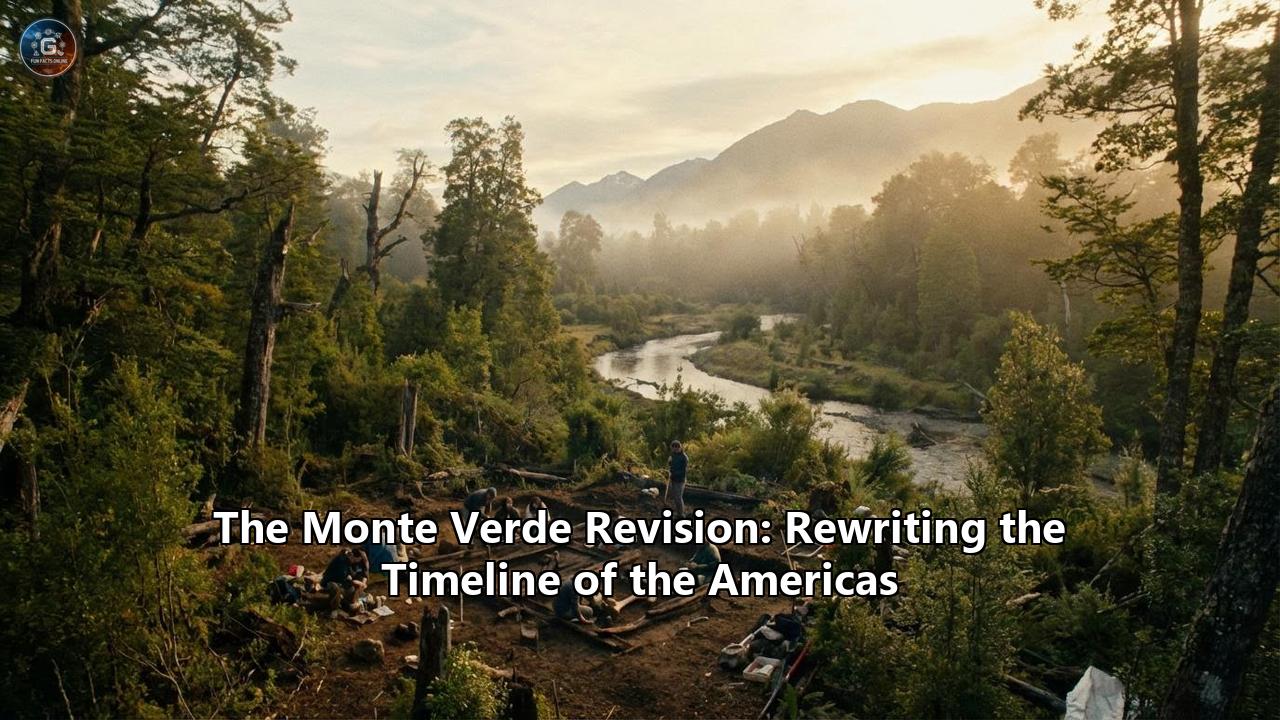
The history of the Americas is not written in ink; it is written in stone, bone, and, occasionally, in the oxygen-starved mud of a prehistoric peat bog. For decades, the story of how the first human beings arrived in the Western Hemisphere was a neat, universally accepted narrative. It was a tale of intrepid ice-age hunters crossing a frozen land bridge from Asia, pursuing towering mammoths through a narrow corridor of ice into a virgin continent. But then, an unlikely discovery at the bottom of the world—in a damp creek bed in southern Chile—threw a wrench into the machinery of archaeological dogma.
The site was called Monte Verde. For over forty years, it stood as the great anomaly, the ultimate paradigm-shifter that forced humanity to rewrite the timeline of its own global expansion. It told us that humans were in the Americas thousands of years earlier than we thought, and that they likely arrived not by trekking through an icy valley, but by sailing down the Pacific coast.
Yet, in the world of archaeology, the earth rarely settles for long. In March 2026, a seismic new study published in the journal Science introduced a shocking twist, suggesting that the site that rewrote history might itself have been misread. As modern researchers clash over radiocarbon dates, volcanic ash layers, and the fluid dynamics of ancient streams, the saga of Monte Verde has evolved into one of the most thrilling scientific debates of the 21st century. To understand the gravity of this debate, one must first understand the towering orthodoxy that Monte Verde originally overthrew.
The Clovis First Orthodoxy: An Ice-Age Dogma
To appreciate the shockwaves Monte Verde sent through the scientific community, one must look back to the early 20th century, specifically to the dusty plains of New Mexico. In the 1930s, near the town of Clovis, archaeologists unearthed elegantly crafted, fluted stone spear points mingled with the massive ribs of extinct Pleistocene megafauna. These "Clovis points" became the hallmark of what was believed to be the first and oldest culture in the Americas.
The resulting narrative, known as the "Clovis First" paradigm, was remarkably elegant. During the Last Glacial Maximum, massive amounts of the Earth’s water were locked up in towering ice sheets, causing global sea levels to plummet. This exposed a vast expanse of land known as Beringia, connecting modern-day Siberia to Alaska. According to the Clovis First model, around 13,500 years ago, small bands of Asian hunter-gatherers tracked herds of game across this land bridge.
At the time, North America was smothered by two colossal glaciers: the Laurentide in the east and the Cordilleran in the west. However, as the planet began to warm, a narrow, unglaciated pathway opened between them. Through this "ice-free corridor," the Clovis people supposedly marched southward, exploding into a pristine continent teeming with naive megafauna, and rapidly populating the Americas from north to south.
For more than half a century, this timeline was treated not as a hypothesis, but as an incontrovertible fact. The "Clovis First" model became an impregnable fortress. Any archaeologist who claimed to find human artifacts dating older than 13,500 years ago was subjected to intense, often hostile scrutiny. The professional community developed an informal but formidable "Clovis Police"—experts who would systematically dismantle any pre-Clovis claims, usually citing contaminated radiocarbon samples, natural rock formations mistaken for tools, or disturbed soil layers.
Then came a young, untested archaeologist and a muddy creek in Chile.
A Mastodon Tooth in the Mud
In late 1975, a veterinary student was wandering the heavily eroded banks of Chinchihuapi Creek in the Los Lagos Region of southern Chile, roughly 36 miles from the Pacific coast. He stumbled upon an odd, massive bone protruding from the soil. It was later identified as a mastodon tooth. Word of the strange find eventually reached Tom Dillehay, a 27-year-old American anthropological archaeologist who was then teaching at the Universidad Austral de Chile.
When Dillehay visited the site in 1976 and began excavations a year later, he quickly realized that Monte Verde was no ordinary dig. Most archaeological sites from the Pleistocene epoch yield only lithics (stone tools) and the hardest of animal bones, as the relentless grind of time, weather, and microbes destroys everything else. But Monte Verde was different. Shortly after the site was abandoned by its prehistoric inhabitants, the water table rose, drowning the camp in a peat bog. This created an anaerobic (oxygen-free) environment that perfectly preserved organic materials that would normally rot away within a decade.
The preservation was nothing short of miraculous. As Dillehay and his interdisciplinary team peeled back the peat, they found a frozen moment in time. They uncovered the wooden foundations of twenty-four tent-like huts, still draped with fragments of animal hides. They found wooden stakes and knots of cordage made from local reeds. There were chunks of mastodon meat that still contained preserved DNA, a variety of medicinal plants—including chewed cud of seaweed—and stone tools. Most breathtaking of all, they found a single, perfectly preserved footprint of a young child pressed into the ancient clay.
The artifacts told the story of a highly adapted, semi-sedentary community. These were not the frantic, hyper-mobile mammoth hunters of the Clovis myth; they were foragers who intimately knew their landscape, utilizing coastal resources, rainforest tubers, and local game. But it was the radiocarbon dating of the wooden artifacts and charcoal that would drop a bomb on the archaeological establishment.
The dates clustered around 14,500 years before present (BP).
The Mathematical Impossibility and the Kelp Highway
When Dillehay published his findings, the Clovis First establishment balked. The dates were simply impossible under the accepted paradigm. Clovis culture in North America was strictly dated to roughly 13,000 to 13,500 years ago. Monte Verde, located a staggering 10,000 miles south of the Bering Land Bridge, was dating to 14,500 years ago.
If the first humans walked across Beringia and waited for the ice-free corridor to open 13,500 years ago, how could a well-established community be thriving at the very bottom of South America a full millennium earlier? It was a geographical and mathematical impossibility.
The rejection of Dillehay’s work was immediate and fierce. Critics claimed the dates were wrong, the stratigraphy was misunderstood, or the carbon samples were contaminated by natural bitumen. But Dillehay, demonstrating a staggering level of scientific rigor, spent the next two decades meticulously documenting the site. He amassed data from over 80 specialists across various disciplines—botanists, geologists, geneticists, and paleontologists—resulting in what one prominent archaeologist later called "analytical overkill".
Finally, in 1997, a blue-ribbon panel of the world’s most skeptical archaeologists, including fierce Clovis First defenders, traveled to Chile to inspect Monte Verde in person. They examined the trenches, the stratigraphy, and the pristine artifacts. In the end, the skeptics surrendered. The panel universally agreed: Monte Verde was real, the stratigraphy was sound, and the date of 14,500 BP was accurate.
The Clovis barrier had officially been broken.
The acceptance of Monte Verde triggered a profound paradigm shift. If people were in Chile 14,500 years ago, they could not have used the ice-free corridor, which geological evidence showed was completely blocked by towering glaciers at that time. This realization breathed life into a radical new idea: the Coastal Migration Theory, or the "Kelp Highway" hypothesis.
Researchers began to postulate that the first Americans did not arrive on foot, but by boat. They envisioned maritime cultures skirting the edge of the Pacific coastline, moving rapidly down the western seaboard from Beringia to South America, sustained by the rich, continuous ecosystem of kelp forests that provided fish, marine mammals, and edible seaweed. Monte Verde, with its stash of ocean seaweed found 36 miles inland, perfectly supported this coastal connection. For the next thirty years, the story of the Americas was fundamentally centered around the truth of Monte Verde.
The 2026 Seismic Shift: A Paradigm Under Fire
For three decades, Monte Verde rested comfortably in the textbooks as the definitive anchor of the pre-Clovis world. But science is a perpetual engine of re-evaluation. On March 19, 2026, the journal Science published a bombshell paper that threatened to upend the timeline of the Americas once again.
The paper was spearheaded by Todd Surovell, an archaeologist at the University of Wyoming, and Claudio Latorre Hidalgo, a Chilean paleoecologist. For years, Surovell had harbored a lingering skepticism about Monte Verde. It was, in his words, a massive "outlier" that never quite fit cleanly into the broader archaeological record. When the exclusive excavation permits held by Dillehay’s team briefly expired, Surovell and an independent international team seized the window in early 2022 to conduct the first independent geological survey of the Chinchihuapi Creek valley in 50 years.
What they found, they claimed, was a monumental misreading of the site’s geology.
To date an archaeological site, one does not date the stone tools themselves (as stone cannot be radiocarbon dated); rather, one dates the organic material—like wood, charcoal, or bone—found in the same stratigraphic layer. Dillehay’s original dating relied heavily on the organic material found directly alongside the artifacts. However, Surovell’s team utilized new stratigraphic profiling and dating techniques on the valley’s continuous landforms, both upstream and downstream from the original dig site.
The new team mapped out a distinct geological sequence. They identified an older, deeper layer of earth containing glacial outwash and ancient organic materials (dubbed SU1) which dated from 9,700 to 23,000 years ago. Above this layer was an erosional boundary, topped by a younger layer of sediment (SU2) which contained the Monte Verde artifacts.
Crucially, Surovell’s team identified a distinct layer of volcanic ash—known as the Lepué Tephra, which has a definitive regional age of 11,000 years—situated stratigraphically below the Monte Verde artifact layer. In the rules of geology, if an 11,000-year-old layer of ash sits beneath an artifact, the artifact must be younger than 11,000 years.
How, then, did Dillehay’s team get dates of 14,500 years ago?
Surovell proposed a fascinating, naturally deceptive mechanism: stream erosion. Imagine the ancient Chinchihuapi Creek meandering through the valley. Over time, the stream undercut its own banks, carving into the ancient, 14,500-year-old Pleistocene peat (SU1). As the banks collapsed, ancient wood and organics washed into the creek and were redeposited downstream, settling comfortably into the younger, Holocene-era mud (SU2). Thousands of years later, a group of human hunter-gatherers camped on this younger mud, leaving their stone tools, butchered bones, and footprints behind.
When archaeologists excavated the site in the 1970s, they found the human tools sitting side-by-side with the 14,500-year-old wood. Surovell argues that the wood is indeed 14,500 years old, but the human occupation is not. Based on their massive suite of new radiocarbon and optically stimulated luminescence (OSL) dates, Surovell’s team concluded that the human settlement at Monte Verde actually occurred during the Middle Holocene, making the site only 4,200 to 8,200 years old.
"The so-called 14,500-year-old archaeological component that was supposed to forever change our understanding of the colonization of the Americas actually comes from a landform that's at best 8,000 years old," Surovell bluntly stated. If valid, this chronological revision removes Monte Verde as the foundational pillar of the pre-Clovis coastal migration theory.
The Counter-Attack: A Discipline Divided
The publication of the 2026 paper immediately set the archaeological world ablaze. For many, Surovell’s hypothesis provided an elegant solution to the Monte Verde anomaly. It explained why the site was so staggeringly older than almost anything else found at the time, and it offered a sobering reminder of how tricky geoarchaeology can be.
But Tom Dillehay, the veteran architect of the Monte Verde discovery, did not take the challenge quietly. Defending half a century of rigorous, peer-reviewed work, Dillehay fiercely rejected the new findings, characterizing them as deeply flawed and fundamentally detached from the reality of the actual excavation site.
"Do you really think that 50 years of research at a place by more than 80 specialists from many different disciplines from around the world made such a big mistake?" Dillehay countered in response to the publication.
Dillehay's defense centers on the destructive nature of archaeology itself. When an archaeological site is excavated, it is systematically dismantled. The exact trenches and stratigraphic matrices that Dillehay dug in the 1970s and 1980s no longer exist; they were destroyed in the process of discovery, and the surrounding area has since been heavily altered by decades of flooding and erosion. Dillehay argues that Surovell’s team did not date the site itself, but rather a completely different geological context nearby, mistakenly projecting those downstream stratigraphies onto a site they never actually saw intact.
"There is no 11,000-year-old ash layer underneath the Monte Verde II site," Dillehay firmly asserted. "They are studying a different context in the area and are projecting that into the site from elsewhere... They saw what they wanted to see, and came to the site with predetermined conclusions."
The standoff highlights one of the most frustrating and beautiful aspects of archaeological science. It is a discipline where the primary evidence is inherently finite and largely destroyed upon observation. Surovell acknowledges this limitation, noting that "Once I dig a portion of a site, someone can't go back and dig exactly what I did". Yet, to Surovell and his supporters, the continuous landforms of the valley provide a macro-level geological truth that supersedes the micro-level anomalies of a single, long-gone trench.
The Broader Landscape: Does Clovis Reclaim the Crown?
If Monte Verde is indeed "only" 8,000 years old, what does this mean for the timeline of the Americas? Does the Clovis First orthodoxy rise from the grave to reclaim its crown? Does the Beringia ice-free corridor once again become the sole gateway to the New World?
The short answer is: No.
While Monte Verde was the catalyst that shattered the Clovis barrier, the decades since 1997 have seen a proliferation of pre-Clovis discoveries that do not rely on the mud of southern Chile. The scientific gates were opened, allowing researchers to seriously investigate older sites without fear of career-ending backlash from the "Clovis Police."
Today, the pre-Clovis landscape is populated by numerous compelling sites. At the Gault Site in Texas, researchers have found projectile points dating older than Clovis. At the Page-Ladson site in Florida, butchered mastodon tusks have been found deep underwater in a sinkhole dating to 14,550 years ago. Even Dillehay himself has excavated the Huaca Prieta site in northern Peru, finding human occupation dating between 13,300 and 14,200 years ago—which remains robustly defended.
Perhaps most stunning of all are the fossilized human footprints discovered at White Sands National Park in New Mexico. Multiple lines of evidence, published in Science just a few years prior to the Monte Verde challenge, date these footprints to between 21,000 and 23,000 years ago—placing humans in North America during the absolute peak of the Last Glacial Maximum.
Therefore, even if Surovell’s 2026 chronological revision of Monte Verde holds up to future scrutiny, the paradigm it helped birth survives it. The coastal migration theory, the Kelp Highway, and the pre-Clovis peopling of the Americas are now supported by a diverse web of evidence spanning two continents. Monte Verde may lose its status as the anchor of the pre-Clovis world, but its legacy as the site that forced archaeology to open its eyes remains untouched.
Conclusion: The Living Mystery of Human Origins
The story of Monte Verde—from its serendipitous discovery in 1975, through its decades as a controversial outcast, its triumphant vindication in 1997, and its sudden existential challenge in 2026—serves as a masterclass in the scientific method. It is a testament to the fact that science is not a rigid set of facts to be memorized, but an ongoing, passionate argument.
"Regardless of which interpretation of Monte Verde is correct, this back-and-forth reinvestigation of results is what healthy scientific progress looks like," notes Surovell.
As the debate rages on, the mud of Chinchihuapi Creek continues to guard its ultimate truths. Whether the hunter-gatherers of Monte Verde sat around their hearths 14,500 years ago beneath the shadow of glaciers, or 8,000 years ago in the warming dawn of the Holocene, their legacy is indelible. They remind us that the human story is vastly more complex, incredibly older, and infinitely more resilient than our boldest theories have ever dared to guess. The timeline of the Americas remains a thrilling, living document, forever waiting for the next strike of a trowel to rewrite it once more.
Reference:
- https://en.wikipedia.org/wiki/Monte_Verde
- https://www.sciencenews.org/article/first-people-south-america-clovis
- https://gizmodo.com/new-research-challenges-one-of-archaeologys-most-important-discoveries-2000735599
- https://www.archaeologychannel.org/video-guide/video-interviews/2353-monte-verde-site-interview
- https://www.researchgate.net/publication/241524991_Geological_perspectives_on_the_Monte_Verde_archeological_site_in_Chile_and_pre-Clovis_coastal_migration_in_the_Americas
- https://www.malaymail.com/news/life/2026/03/21/when-did-humans-arrive-in-the-americas-new-findings-cast-doubt-on-timeline-of-first-settlers/213347
- https://hakaimagazine.com/features/encounters-with-the-maverick-archaeologist-of-the-americas/
- https://www.academicjobs.com/research-publication-news/monte-verde-age-challenge-or-early-americas-migration-or-academicjobs-10135
- https://www.nationalgeographic.com/history/article/monte-verde-redated
- https://www.theguardian.com/science/2026/mar/19/archaeological-site-in-chile-upends-theory-of-how-humans-populated-the-americas-again
- https://www.livescience.com/archaeology/americas/monte-verde-one-of-the-earliest-indigenous-sites-in-south-america-is-much-younger-than-thought-study-claims-but-others-call-it-egregiously-poor-geological-work
- https://www.labrujulaverde.com/en/2026/03/timeline-of-the-first-humans-in-america-is-completely-wrong-according-to-new-dating-of-monte-verde-site/