
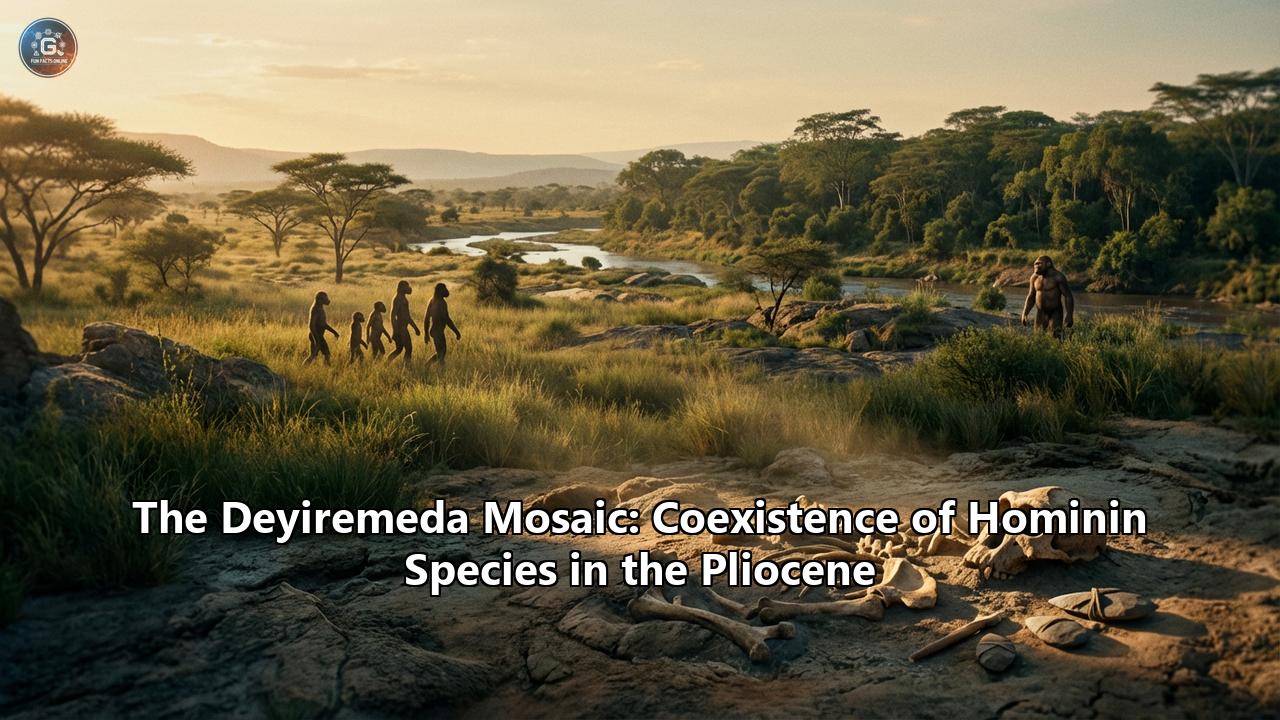
The story of human origins has long been dominated by a single, iconic figure: Australopithecus afarensis, best known to the world as "Lucy." For decades, the prevailing narrative suggested that Lucy’s species walked the East African rift largely alone between 3.0 and 4.0 million years ago—a lonely ancestor on a linear march toward humanity.
That narrative has now been irrevocably shattered.
With the groundbreaking findings released in late 2025, confirming the taxonomic assignment of the enigmatic "Burtele foot," we now possess the final piece of a puzzle that has perplexed paleoanthropologists for over a decade. We can now say with certainty that the Pliocene was not the domain of a single lonely ancestor, but a crowded, experimental stage where multiple hominin species danced an intricate evolutionary tango.
At the center of this revolution is Australopithecus deyiremeda. Once a "ghost" known only by jaws and teeth, this species has now stepped fully into the light, revealing a creature that lived, walked, and ate alongside Lucy, yet did so in a completely different way.
This is the comprehensive story of the Deyiremeda Mosaic—a window into a time when Earth experimented with different ways to be human.
Part I: The Ghost in the Machine (2015–2025)
To understand the magnitude of the recent breakthroughs, we must look back to the arid scrublands of the Afar region in Ethiopia, specifically the Woranso-Mille study area. This region, a geological layer cake of time, lies just 50 kilometers north of Hadar, where Lucy was found.
The Initial Discovery
In 2015, a team led by Dr. Yohannes Haile-Selassie made a startling announcement. They had recovered fossilized jaws and teeth dating back 3.3 to 3.5 million years. On the surface, they looked like Australopithecus, but the details were "wrong" for Lucy’s species. The cheekbones were positioned further forward, the lower jaw was more robust, and the enamel on the teeth was surprisingly thick.
They named it Australopithecus deyiremeda. The name itself is a nod to its significance: in the local Afar language, deyi means "close" and remeda means "relative." A close relative, but a stranger nonetheless.
The Mystery of the Burtele Foot
Three years prior to the naming of the species, in 2012, the same team had published a paper on a bizarre partial foot found in the Burtele locality of the same region. This foot (specimen BRT-VP-2/73) was a shock to the scientific system.
While Lucy possessed a foot adapted for committed terrestrial bipedalism—with an inline big toe (hallux) capable of pushing off the ground—the Burtele foot possessed a divergent, opposable big toe. It looked less like a human foot and more like that of an ancient Ardipithecus or even a chimpanzee, yet it possessed other features of bipedal weight-bearing.
For over a decade, the "Burtele Foot" and the "Deyiremeda Jaws" existed in scientific limbo. Were they parts of the same animal? Or did the Afar region host three different species (Lucy, Deyiremeda, and the owner of the foot)?
The 2025 Resolution
The ambiguity ended in November 2025. A landmark study published in Nature finally linked the post-cranial remains of the foot to the dental remains of A. deyiremeda through the discovery of new intermediate fossils and precise stratigraphic correlation.
We now know: Australopithecus deyiremeda was the owner of that opposable toe. This confirmation has forced a total rewrite of Pliocene locomotor evolution. It proves that 3.4 million years ago, two hominins walked the same landscape using two completely different biomechanical strategies.
Part II: Anatomy of a Mosaic
Australopithecus deyiremeda is described as a "mosaic" because it combines features that seemingly shouldn't belong together—traits from the distant past mixed with features that foreshadow the future genus Homo.The Face and Jaws
If you were to stare into the face of A. deyiremeda, it would look distinctively different from Lucy.
- Forward-Facing Cheekbones: The zygomatics are positioned anteriorly. In modern humans and later "robust" australopiths, this architecture helps dissipate the massive forces generated by chewing tough foods.
- Robust Mandible: The lower jaw is heavily built, thicker and sturdier than that of A. afarensis.
- Small Anterior Teeth: Unusually, the incisors and canines are relatively small. This stands in contrast to the larger front teeth of A. afarensis, suggesting A. deyiremeda did not use its front teeth as tools for stripping or gripping as intensively.
The Paradoxical Foot
The most fascinating anatomical feature is the foot. Evolution was previously thought to be a one-way street toward the modern human foot. A. deyiremeda proves it was a branching path.
- The Grasping Hallux: The big toe could splay outward, allowing the foot to grasp tree branches effectively. This indicates that A. deyiremeda was far more arboreal (tree-dwelling) than Lucy.
- Bipedal Adaptation: Despite the grasping toe, the rest of the foot shows stiffness and arch development consistent with walking on two legs. However, the gait would have been different—lacking the "toe-off" propulsion of modern humans. They likely walked with a "flat-footed" or lateral-push gait.
Part III: The Landscape of the Middle Pliocene
To visualize the world of A. deyiremeda, erase the image of the infinite open savannah often depicted in documentaries. The Afar region 3.4 million years ago was a mosaic environment—a complex patchwork of ecosystems.
The "Mosaic" Ecosystem
- Riverine Forests: Along the banks of the ancient rivers, dense gallery forests provided shade, fruit, and safety from predators. This was the likely stronghold of A. deyiremeda.
- Woodlands and Scrub: Beyond the riverbanks lay open woodlands, filled with acacia-like trees and shrubs.
- Open Grasslands: Patches of C4-dominated grasslands were expanding, driven by global cooling and drying trends.
The Fauna (The Neighbors)
A. deyiremeda was just one actor on a crowded stage.- The Rival: Australopithecus afarensis (Lucy). They were physically close—fossils of both species have been found just 35 kilometers apart.
- The Grazing Monkey: Theropithecus oswaldi, a giant relative of the modern gelada baboon, was a dominant figure. Unlike the omnivorous hominins, this primate was a specialized grazer, sitting in the meadows consuming vast quantities of grass.
- The Pigs and Proboscideans: The giant forest pig Notochoerus euilus and ancestors of modern elephants roamed the woodlands. Their teeth, recovered from the same strata, help reconstruct the available vegetation.
- The Predators: This was a dangerous world. The sabertooth cats (Dinofelis and Homotherium) and the hyena-like Chasmaporthetes prowled the mosaic, making the trees a necessary refuge for the small-bodied hominins.
Part IV: The Mechanics of Coexistence
The most pressing question for ecologists is: How did two intelligent, bipedal primates live in the same place at the same time without driving each other to extinction? The answer lies in Niche Partitioning.
The Competitive Exclusion Principle states that two species cannot occupy the exact same niche; one will inevitably outcompete the other. Therefore, A. deyiremeda and A. afarensis must have been doing something different.
1. The Dietary Partition
Recent stable carbon isotope analyses (updated 2025) have provided the smoking gun.
- Lucy’s Diet (A. afarensis): Lucy was a generalist. Her chemical signature shows a mix of C3 (forest plants) and significant amounts of C4 (grasses/sedges). She was the "jack-of-all-trades," capable of foraging on the forest floor or grazing in the open.
- Deyiremeda’s Diet (A. deyiremeda): The isotope data for A. deyiremeda is distinct. It shows a strong preference for C3 foods. This species was a specialist, relying on the fruits, nuts, leaves, and tubers found in the wooded and riverine areas. It largely ignored the expanding savannah grasses.
This dietary divergence allowed them to dine at the same restaurant but order from different menus. When the dry season hit and fruit became scarce, Lucy could turn to roots and grasses in the open, while A. deyiremeda likely relied on harder, tougher forest foods (nuts, bark, tubers), utilizing its robust jaws to process them.
2. The Vertical Partition
The locomotor differences reinforced this separation.
- A. afarensis was a committed terrestrial biped. While capable of climbing, it was efficient at walking long distances across open ground to find widely dispersed resources.
- A. deyiremeda, with its grasping toe, was likely the "arboreal specialist." It could navigate the canopy with an agility Lucy lacked, accessing resources high in the trees and using the vertical space to avoid predators (and perhaps avoid Lucy).
Part V: The Toolmaker Question & The Lomekwi Connection
Perhaps the most tantalizing aspect of the A. deyiremeda story is its potential link to technology.
In 2015, archaeologists discovered stone tools at Lomekwi 3 in Kenya, dated to 3.3 million years ago. These tools predated the genus Homo by half a million years. They were large, clunky, and created using a "passive hammer" technique (bashing a stone against a stationary anvil).
Who made them?
For years, the prime suspect was Kenyanthropus platyops, a flat-faced hominin found nearby in Kenya. However, the anatomy of A. deyiremeda—specifically the robust jaw and the timing of its existence—has led leading anthropologists like Fred Spoor to suggest a connection.
A. deyiremeda shares several facial similarities with Kenyanthropus. Some researchers now hypothesize that these two might be regional variants of the same clade—a group of "flat-faced" hominins distinct from the afarensis lineage.
If A. deyiremeda (or its close kin) was the Lomekwian toolmaker, it implies that the cognitive leap to stone tool use was not sparked by the open savannah (as long believed) but began in the woodlands, perhaps to crack nuts or process the tough C3 vegetation that formed their diet.
Part VI: Rewriting the Family Tree
The discovery and confirmation of Australopithecus deyiremeda is the final nail in the coffin of the "Linear Evolution" model.
The Old View:- A. anamensis → A. afarensis → A. africanus → Homo
(A single lineage changing over time).
The New View (The Bushy Tree):The Middle Pliocene was a period of rampant speciation. We now see a diversity of forms:
- The Generalist: Australopithecus afarensis (Ethiopia/Tanzania) - The survivor, adaptable and widespread.
- The Forest Specialist: Australopithecus deyiremeda (Ethiopia) - The climber with the powerful jaw.
- The Western Stranger: Australopithecus bahrelghazali (Chad) - Evidence that hominins had spread far west into Central Africa.
- The Flat-Faced Enigma: Kenyanthropus platyops (Kenya) - The potential toolmaker with a distinct facial structure.
This diversity mirrors what we see in other successful mammal groups. Just as there are multiple species of antelope or pigs on the savannah, there were multiple ways to be a hominin. Evolution threw several strategies at the wall to see what would stick.
Why did Lucy survive?
If A. deyiremeda was so specialized, why does it seem to disappear from the fossil record while the afarensis lineage likely continued (eventually leading to Homo)?
The answer may lie in the changing climate. As the Pliocene cooled and the forests shrank, the specialized "woodland/arboreal" niche of A. deyiremeda likely contracted. Lucy’s "good enough" bipedalism and ability to eat grass-based foods may have been the key adaptation that allowed her lineage to endure the drying world.
Conclusion: The Mosaic of Us
The Australopithecus deyiremeda mosaic teaches us a humbling lesson. We are not the inevitable result of a straight line of progress. We are the survivors of a diverse and competitive family reunion.
3.4 million years ago, a human ancestor looked across the Afar river valley. It stood on a foot with a grasping toe, chewed a tough tuber with a heavy jaw, and perhaps watched a group of A. afarensis walking in the distance. They were neighbors, rivals, and cousins, living two very different lives on the same Earth.
The "Burtele Foot" is no longer an anomaly; it is a testament to the rich, experimental nature of evolution. In the Pliocene, there were many ways to be human. A. deyiremeda was one of them—a fascinating variation on the theme of us.
Further Reading & References
- Haile-Selassie, Y. et al. (2015). New species from Ethiopia further expands Middle Pliocene hominin diversity. Nature.
- Haile-Selassie, Y., et al. (2025). Taxonomy and Locomotor Adaptation of the Burtele Foot. Nature.
- Spoor, F. (2015). Palaeoanthropology: The middle Pliocene gets crowded. Nature.
- Harmand, S. et al. (2015). 3.3-million-year-old stone tools from Lomekwi 3, West Turkana, Kenya. Nature.
Reference:
- https://nutcrackerman.com/2015/05/25/the-lomekwian-technology/
- https://www.eurekalert.org/news-releases/850680
- https://pmc.ncbi.nlm.nih.gov/articles/PMC4920290/
- https://en.wikipedia.org/wiki/Lomekwi
- https://www.researchgate.net/publication/259635255_Mid-Pliocene_Carnivora_from_the_Woranso-Mille_Area_Afar_Region_Ethiopia
- https://pmc.ncbi.nlm.nih.gov/articles/PMC11166571/
- https://pmc.ncbi.nlm.nih.gov/articles/PMC8994497/
- https://www.researchgate.net/publication/282980219_Pliocene_hominin_biogeography_and_ecology
- https://en.wikipedia.org/wiki/Australopithecus_deyiremeda
- https://becominghuman.org/pathways-to-discovery/the-fossil-record/archaeology-tools-and-artifacts/lithics-lomekwi-and-dikika/
- https://scispace.com/pdf/diet-of-theropithecus-from-4-to-1-ma-in-kenya-7xjht9bf3k.pdf
- https://milnepublishing.geneseo.edu/the-history-of-our-tribe-hominini/part/part-iii-pliocene-epoch/
- https://www.cambridge.org/core/books/abs/african-paleoecology-and-human-evolution/hadar-formation-afar-regional-state-ethiopia-geology-fauna-and-paleoenvironmental-reconstructions/941588584869FDEA5240D1062159A8E3
- https://pmc.ncbi.nlm.nih.gov/articles/PMC4988594/