
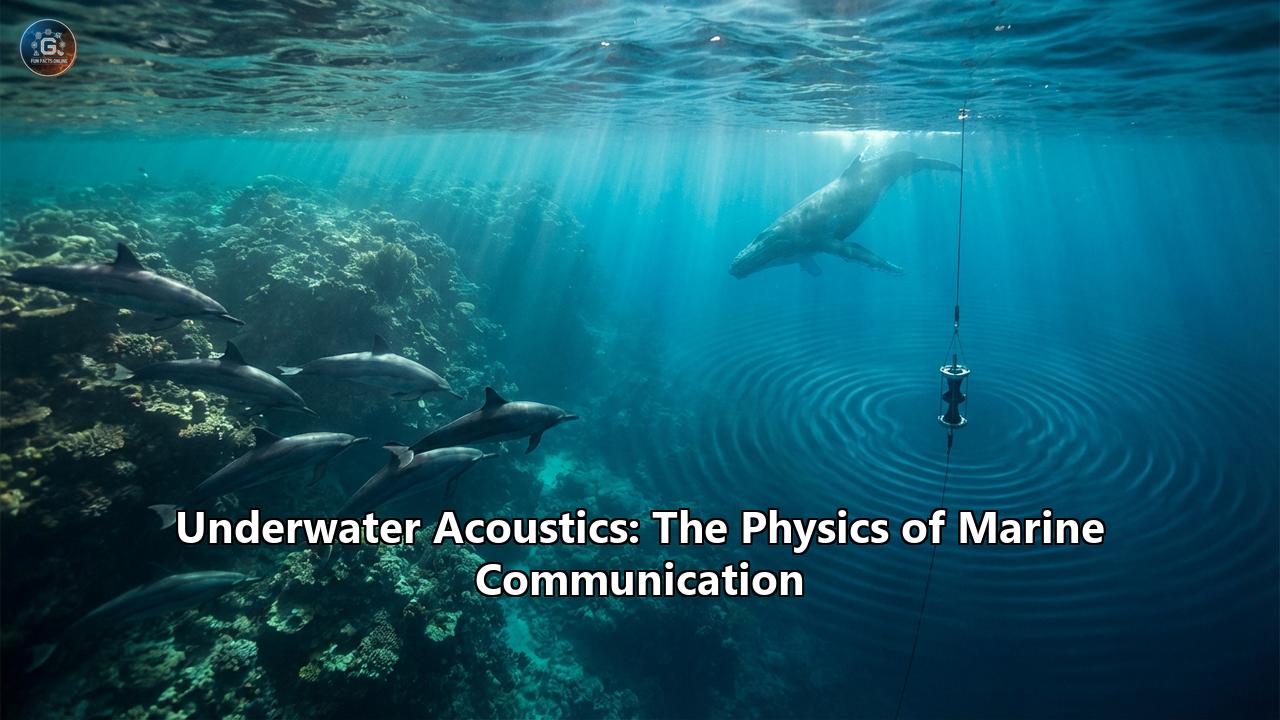
For decades, popular culture depicted the ocean as a serene, silent abyss. In 1953, the legendary oceanographer Jacques Cousteau even titled his seminal documentary The Silent World. But as technology has allowed us to plunge our instruments deeper into the pelagic depths, we have discovered that Cousteau’s title was a profound misnomer. The ocean is not silent; it is a booming, clicking, singing, and roaring symphony of physics and biology.
In the aquatic realm, where sunlight is rapidly absorbed and absolute darkness reigns below a few hundred meters, vision is a luxury. Sound, however, is an omnipresent force. It is the primary medium of communication, navigation, and survival for countless marine species. Understanding underwater acoustics—the physics of how sound behaves in water—is not merely an academic exercise. It is the key to decoding the complex languages of whales, the foundation of modern naval and exploratory technology, and the crucial battleground for one of the most pressing environmental crises of the Anthropocene: marine noise pollution.
To truly appreciate the intricate web of life and technology beneath the waves, we must first understand the fundamental physics that govern this liquid concert hall.
The Physics of Sound in Water: A Liquid Concert Hall
Sound is a mechanical wave, an oscillation of pressure transmitted through a solid, liquid, or gas. In the air around us, sound travels at a relatively leisurely pace of about 340 meters per second. But plunge into the ocean, and the rules of physics shift dramatically. Water is roughly 800 times denser than air and significantly less compressible. Because sound waves are essentially chains of molecules bumping into one another, this higher density and incompressibility allow acoustic energy to transfer with remarkable efficiency.
In the ocean, sound travels at an average speed of 1,500 meters per second—nearly four and a half times faster than it does in the air. However, this speed is not a universal constant. It is a highly dynamic variable dictated by three primary oceanographic properties: temperature, pressure, and salinity.
Temperature is the most dominant factor in the upper layers of the ocean. As water temperature increases, the molecules become more energetic and interact more rapidly, facilitating faster sound transmission. Conversely, as you descend through the water column and the water cools, the speed of sound decreases. Pressure increases linearly with depth. At extreme depths, where the temperature stabilizes to near freezing, the crushing pressure of the water column takes over as the dominant factor. The immense pressure compresses the water molecules closer together, increasing the fluid's stiffness and causing the speed of sound to rise once more. Salinity, while less variable than temperature and pressure in the open ocean, also plays a role. Higher salt content increases the density of the water, which in turn slightly increases the speed of sound.The interplay of these three factors creates a complex, three-dimensional acoustic environment where sound waves do not simply travel in straight lines. Instead, they are constantly bent, or refracted. According to Snell’s Law of refraction, waves will always bend toward the region where they travel the slowest. This simple physical principle is responsible for one of the most extraordinary phenomena on Earth.
The SOFAR Channel: The Ocean’s Secret Acoustic Highway
In 1944, at the height of World War II, scientists Maurice Ewing and J. Lamar Worzel were conducting classified research for the U.S. Navy. They hypothesized the existence of a deep acoustic waveguide and decided to test it. Dropping four-pound dynamite charges into the ocean at specific depths, they listened using underwater microphones (hydrophones) dropped from a ship over 900 miles away. To their astonishment, the explosive sounds were received with stunning clarity. They had proven the existence of the Deep Sound Channel, now widely known as the SOFAR (Sound Fixing and Ranging) channel.
The SOFAR channel is a horizontal layer of water in the ocean where the speed of sound reaches its absolute minimum. In mid-latitudes, this channel typically sits at a depth of about 800 to 1,000 meters. Above this axis, the water is warmer, making sound travel faster. Below this axis, the immense pressure makes sound travel faster. Because sound waves are always refracted toward the region of minimum speed, any sound generated within this channel is continuously bent back toward the center.
The sound waves oscillate up and down, trapped in a horizontal pipeline, never interacting with the energy-scattering surface of the ocean or the absorptive sediment of the seafloor. Because the low-frequency sounds within this channel suffer almost no energy loss from scattering, they can travel staggering distances. A sound generated in the SOFAR channel off the coast of Australia can be detected by hydrophones off the coast of Bermuda, traveling thousands of miles across entire ocean basins.
The discovery of the SOFAR channel revolutionized oceanography and naval warfare. Before the advent of GPS, the Navy used the SOFAR channel to track the locations of downed pilots who would drop a small explosive charge that sank to the channel axis and detonated, allowing coastal listening stations to triangulate their coordinates. During the Cold War, the U.S. Navy deployed SOSUS (Sound Surveillance System), a vast, classified network of seafloor hydrophones designed to exploit the SOFAR channel to track Soviet submarines.
But humans were not the first to discover this acoustic highway. Evolution beat us to it by millions of years.
Biological Acoustics: How Marine Life Communicates
Long before submarines prowled the depths, the ocean was already filled with the complex chatter of marine life. Because light attenuates so rapidly in water—leaving the deep ocean in perpetual darkness—marine animals evolved to rely heavily on acoustics for survival. They use sound to navigate, hunt, avoid predators, attract mates, and maintain social structures across vast expanses of water.
Cetaceans: The Masters of Sound
The true masters of underwater acoustics are the cetaceans—whales, dolphins, and porpoises. They are broadly divided into two suborders, each possessing uniquely adapted acoustic mechanisms: the Odontocetes (toothed whales) and the Mysticetes (baleen whales).
Odontocetes, such as bottlenose dolphins, sperm whales, and killer whales, are the ocean's premier echolocators. They produce high-frequency clicks, squeaks, and whistles using a specialized organ in their nasal passage called the "phonic lips." As air is pushed through these lips, they snap shut, creating high-frequency acoustic pulses. These sound waves are then focused and projected forward by the "melon," a large, fatty, lens-shaped organ in their foreheads.When these high-frequency clicks strike an object—a schooling fish, a squid, or a jagged reef—the echoes bounce back to the animal. Odontocetes do not hear these echoes through external ears. Instead, the sound vibrations are received by a hollow, fat-filled cavity in their lower jaw, which conducts the sound directly to their inner ear. This biological SONAR is so incredibly precise that a blindfolded dolphin can differentiate between a golf ball and a ping-pong ball based solely on the acoustic return.
Mysticetes, the baleen whales like the blue whale, fin whale, and humpback whale, operate on an entirely different acoustic spectrum. They produce low-frequency moans, groans, and complex songs using massive laryngeal sacs. Because low-frequency sounds suffer from far less acoustic attenuation (energy loss) than high-frequency sounds, the calls of baleen whales are designed for long-distance communication.Marine biologists now believe that species like the fin whale and humpback whale deliberately dive into the SOFAR channel to sing. By broadcasting their low-frequency, booming voices into this acoustic waveguide, a whale in the Caribbean can potentially communicate with another whale off the coast of Newfoundland. The haunting, complex songs of humpback whales—which can last for hours and evolve structurally over years—serve as a cultural transmission among populations across entire ocean basins.
Pinnipeds, Fish, and Invertebrates
While whales take the spotlight, the rest of the ocean is equally vocal. Pinnipeds (seals, sea lions, and walruses) possess amphibious hearing and vocal tracts, allowing them to communicate both on ice and underwater. The Weddell seal, for example, produces an otherworldly, sci-fi-like descending trill beneath the Antarctic ice to defend its territory.
Even fish, which lack vocal cords, are remarkably noisy. Many fish species produce sound by "drumming" on their swim bladders—gas-filled organs used for buoyancy—using highly specialized, rapid-twitch sonic muscles. The resulting thumps, croaks, and purrs are vital for spawning aggregations.
Perhaps the most astonishing sound producer relative to its size is the snapping shrimp. These tiny crustaceans possess an oversized claw that, when snapped shut, shoots a jet of water at such high velocity that it creates a localized drop in pressure. This causes the water to vaporize, forming a cavitation bubble. When the surrounding water pressure collapses the bubble, it produces a shockwave that emits a loud "pop," a flash of light (sonoluminescence), and temperatures briefly rivaling the surface of the sun. When millions of snapping shrimp snap simultaneously, they create a continuous, deafening crackle that sounds like frying bacon, which can actually interfere with military SONAR readings.
Human Technology: Eavesdropping and Echoing
Inspired by the physical laws of the ocean and the biological marvels within it, human engineering has sought to conquer the aquatic environment through acoustic technology. Radio waves and optical signals (like lasers or Wi-Fi) are practically useless for long-distance underwater communication. Electromagnetic waves are rapidly absorbed by the conductive saltwater, and optical light scatters violently against marine particles. Sound, therefore, remains our only reliable tether to the deep.
The Evolution of SONAR
The sinking of the RMS Titanic in 1912 spurred the first serious pursuit of underwater acoustics to detect icebergs, leading to the development of SONAR (Sound Navigation and Ranging). By World War I and II, SONAR became critical for submarine detection.
There are two primary types of SONAR. Passive SONAR involves purely listening. Submarines and surface ships trail arrays of highly sensitive hydrophones to detect the acoustic signatures of other vessels' propellers or onboard machinery. Active SONAR, on the other hand, acts like the echolocation of a dolphin. A ship emits a powerful "ping" of sound and waits for the echo to bounce off a solid object. While active SONAR provides precise distance and bearing data, it also instantly reveals the searching ship's position—and as we will explore later, it carries devastating ecological consequences.
Modern Underwater Communication and IoT
Today, underwater acoustic networks are undergoing a renaissance. The push to map the seafloor, monitor deep-sea infrastructure, and study climate change has birthed the "Internet of Underwater Things" (IoUT). Autonomous Underwater Vehicles (AUVs) acting as swarms now communicate with one another using acoustic modems to survey vast tracts of the ocean floor.
However, communicating underwater is a tremendous engineering challenge. Because the speed of sound is relatively slow compared to the speed of light, underwater data transmission suffers from extreme latency. Furthermore, the ocean is a "multipath" environment; a signal sent from a drone to a surface ship doesn't just travel in a straight line. It bounces off the surface, the sea floor, and thermal layers, arriving at the receiver as a chaotic, overlapping jumble of echoes. Modern signal processing, leveraging artificial intelligence and machine learning, is required to untangle these acoustic signals, filtering out background noise to achieve reliable data transmission.
Acoustic Thermometry: Measuring Climate Change
One of the most profound scientific applications of underwater acoustics is Acoustic Thermometry of Ocean Climate (ATOC). Because the speed of sound is intrinsically tied to the temperature of the water, scientists can measure the precise time it takes for a sound pulse to travel thousands of miles across an ocean basin. By measuring these transit times over decades, researchers can calculate the average temperature of the entire ocean with far greater accuracy than spot-measurements from ships. The data gathered from these acoustic transits provides irrefutable evidence of the rapid warming of our oceans due to anthropogenic climate change.
The Anthropocene Ocean: When Noise Becomes Pollution
While acoustic technology has allowed humans to understand the ocean, our industrialization of the sea has created a largely invisible, yet catastrophic, environmental crisis. We are deafening the ocean.
According to research from Ocean Conservation Research, the sea is an estimated ten times louder today than it was just fifty years ago. This dramatic shift in the ocean's acoustic landscape—dubbed the "Soundscape of the Anthropocene"—is fundamentally altering marine ecosystems. For marine animals that rely on sound for everything, human-generated (anthropogenic) noise acts like an impenetrable, blinding fog.
The Sources of the Cacophony
The primary culprit of chronic underwater noise is the global shipping industry. Approximately 90% of global trade is transported by sea. The relentless, low-frequency drone of commercial ship propellers—caused primarily by cavitation, where millions of microscopic bubbles collapse around the spinning blades—overlaps perfectly with the frequencies used by baleen whales.
For acute, explosive noise, the oil and gas industry leads the charge. To search for fossil fuels beneath the seabed, companies use seismic airgun arrays. These arrays are towed behind ships and blast highly pressurized air into the water every 10 to 15 seconds, 24 hours a day, for weeks or months on end. These shockwaves penetrate miles into the Earth's crust, and the echoes are analyzed to find oil deposits. The blasts are so powerful that they are one of the loudest human-made sounds in the ocean, capable of being detected across entire ocean basins.
Military active SONAR and the pile-driving associated with offshore wind farm construction add to this traumatic acoustic landscape.
The Biological Toll of Acoustic Bleaching
The biological consequences of noise pollution are devastating and manifold. Scientists refer to the overarching effect as "acoustic bleaching"—a phenomenon where the natural soundscape is entirely masked by mechanical noise.
- Masking: Just as it is difficult to hold a conversation at a loud rock concert, marine animals struggle to hear one another over the din of shipping lanes. A mother right whale and her calf can become separated if they cannot hear their contact calls. Predators cannot hear their prey, and prey cannot hear approaching predators.
- Behavioral Disruption: Faced with deafening noise, many marine species simply flee. Acoustic surveys have shown that minke whales will abandon feeding grounds up to 40 kilometers away from pile-driving sites. By shrinking their viable habitats, animals are forced into unfamiliar waters where food is scarce and breeding is difficult.
- Physiological Stress and Injury: Chronic noise exposure drastically increases the stress hormone (cortisol) levels in marine animals, suppressing their immune systems and lowering reproductive success.
- Mass Strandings: The most dramatic and tragic impact of noise pollution is linked to naval active SONAR exercises. Deep-diving species, particularly Cuvier's and Blainville's beaked whales, are highly sensitive to mid-frequency SONAR. The acoustic shock induces a panic response, causing these deep-dwellers to ascend to the surface too rapidly. Similar to human scuba divers, the whales suffer from decompression sickness (the bends), leading to severe internal hemorrhaging and mass beach strandings.
Restoring the Harmony: Mitigation and The Future
Unlike chemical pollutants or microplastics, which will take centuries to remove from the marine environment, noise pollution has a unique and deeply encouraging characteristic: the moment you turn off the source, the pollution vanishes entirely.
The global lockdown induced by the COVID-19 pandemic in early 2020 provided an unprecedented natural experiment. As global shipping slowed and cruise ships docked, ocean noise dropped by up to 20%. Marine scientists recording the ocean's soundscape documented a near-instantaneous rebound; whales returned to historic feeding grounds, and the complexity of their vocalizations increased. It was a profound proof of concept that recovery is possible.
Today, researchers, naval engineers, and environmental agencies are developing a suite of solutions to mitigate the human roar:
- Quiet Ship Technology: Naval architects are designing new propellers that reduce cavitation and altering hull shapes to glide more silently through the water. The Vancouver Fraser Port Authority recently implemented a program that incentivizes cargo ships to slow down as they traverse the Haro Strait, a simple operational change that drastically reduces noise output and protects the endangered Southern Resident Killer Whales.
- Bubble Curtains: To mitigate the extreme noise of pile driving during offshore wind turbine construction, engineers deploy "bubble curtains." By pumping air through a perforated hose surrounding the construction site, they create a dense wall of bubbles. Because sound travels poorly through the air-water interface of the bubbles, this curtain can absorb and dampen up to 90% of the acoustic energy before it radiates into the open ocean.
- Regulation and Policy: The International Maritime Organization (IMO), a United Nations agency, has actively recognized the threat. In 2024, the IMO issued revised guidelines for the reduction of underwater radiated noise from shipping, and they are currently conducting comprehensive studies through 2028 to establish hard baseline targets for emission reductions to protect marine life.
- AI and Acoustic Monitoring: Advancements in artificial intelligence are revolutionizing how we monitor the ocean. AI-driven acoustic networks are now deployed in busy shipping lanes. When hydrophones detect the acoustic signature of an endangered whale, the AI instantly alerts nearby ships via satellite, requesting them to slow down or alter course to prevent ship strikes and reduce noise.
Conclusion: The Stewardship of the Acoustic Ocean
The physics of underwater acoustics reveals an ocean that is intimately interconnected by sound. The very physical properties of seawater—its density, pressure, and thermal layers—have crafted a realm where acoustic energy can traverse the globe. It is a world where microscopic shrimp generate the heat of the sun with a snap, where dolphins see with their ears, and where the low, haunting moans of the great whales ride the SOFAR channel across the abyss.
Humanity's technological mastery of underwater acoustics has unlocked the secrets of the deep, allowing us to map the invisible contours of the sea floor and track the warming of our planet. Yet, our reliance on the industrialization of the ocean threatens to silence the very biological symphony we are only just beginning to understand.
We stand at a pivotal crossroads. By integrating advanced engineering with ecological stewardship—quieting our engines, regulating our acoustic footprint, and listening carefully to the data our hydrophones provide—we have the power to restore the balance. The ocean is not a silent world, and it is up to us to ensure that the ancient, beautiful chorus of marine life continues to sing into the deep.
Reference:
- https://coexploration.org/bbsr/classroombats/html/sofar.html
- https://www.whoi.edu/oceanus/feature/communicating-under-sea-ice/
- https://en.wikipedia.org/wiki/SOFAR_channel
- https://rvbangarang.wordpress.com/wp-content/uploads/2014/01/sofar_channel.pdf
- https://dosits.org/science/movement/sofar-channel/sound-travel-in-the-sofar-channel/
- https://time.com/5936110/underwater-noise-pollution-report/
- https://www.mdpi.com/2077-1312/13/8/1505
- https://www.researchgate.net/publication/390947770_Underwater_communication_technologies_a_review
- https://sinay.ai/en/the-role-of-underwater-acoustics-monitoring-in-marine-conservation-and-operations/
- https://www.acs-sfbay.org/blog/2018/11/4/impacts-of-anthropogenic-sound-on-marine-life
- https://www.eopugetsound.org/articles/impacts-anthropogenic-noise-marine-life-publication-patterns-new-discoveries-and-future
- https://www.universiteitleiden.nl/en/news/2021/02/noise-pollution-affects-marine-life-worldwide
- https://afloat.ie/marine-environment/marine-wildlife/item/70210-un-agency-to-study-underwater-noise-impact-on-marine-life