
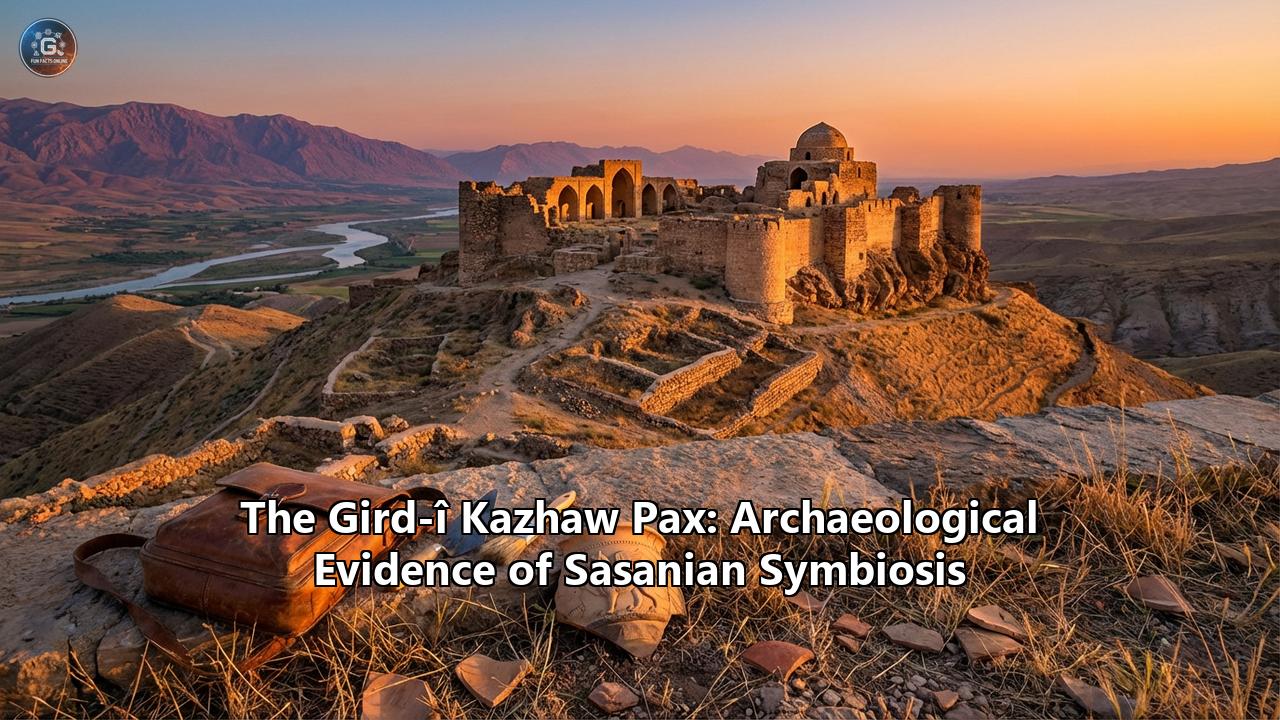
In the rolling foothills of the Zagros Mountains, where the fertile soils of the Shahrizor Plain meet the rising peaks of Kurdistan, a quiet revolution is taking place in our understanding of the ancient world. For centuries, the narrative of late antiquity in the Near East has been dominated by the clash of empires—Rome versus Persia—and the clash of faiths—Christianity versus Zoroastrianism. History books have long been filled with accounts of Sasanian persecutions, martyrologies, and the rigid hierarchy of a state religion that brooked no rivals. But the spade of the archaeologist has a way of complicating the simple stories told by court chroniclers.
Recent excavations at a site known as Gird-î Kazhaw have unearthed evidence that challenges these long-held assumptions. Here, in a rural hinterland far from the capital of Ctesiphon, a Sasanian military fortress and a Christian monastic complex stood not just in proximity, but in an apparent state of enduring, peaceful symbiosis. This phenomenon, which we might call the "Gird-î Kazhaw Pax," offers a rare and intimate glimpse into the reality of daily life in the Sasanian Empire. It suggests that away from the high politics of the imperial court, Christians and Zoroastrians forged a cooperative existence, bound together by the necessities of the frontier and a shared local economy.
The discovery of Gird-î Kazhaw is not merely the finding of another ruin; it is the recovery of a lost social contract. It forces us to reimagine the Sasanian landscape not as a checkerboard of conflict, but as a complex tapestry of coexistence. This article will explore the archaeological findings at Gird-î Kazhaw in depth, placing them within the broader context of the Sasanian world to understand how this "Pax" functioned, why it matters, and what it tells us about the resilience of human communities in the face of imperial ideology.
Part I: The Landscape of the ShahrizorTo understand Gird-î Kazhaw, one must first understand the stage upon which it sits. The Shahrizor Plain is a vast, intermontane valley in the Sulaymaniyah Governorate of Iraqi Kurdistan. Historically, this region has always been a corridor—a vital artery connecting the Mesopotamian lowlands to the Iranian plateau. It is a land of transit, where trade caravans, armies, and ideas have flowed for millennia.
The Strategic GatewayIn the Sasanian period (224–651 CE), the Shahrizor was not a sleepy backwater but a strategic frontier zone. It guarded the passes into the Zagros, acting as a buffer against mountain tribes and a marshaling area for campaigns toward the north and west. The region was dotted with settlements, relying on the abundant rainfall and the springs that fed the tributaries of the Diyala River.
The Site of Gird-î KazhawLocated near the modern village of Bestansur, Gird-î Kazhaw is distinct in its topography. It is not a single tell, but a complex composed of two distinct mounds, referred to by archaeologists as Mound A and Mound B.
- Mound A: The northern mound is lower, oval-shaped, and covers a larger surface area. It rises only 2 to 3 meters above the surrounding plain but hides substantial architectural remains beneath its surface.
- Mound B: To the south lies a steeper, more imposing conical mound, rising nearly 10 meters high. This high ground offers a commanding view of the surrounding plain, making it a natural location for surveillance and defense.
Between these two mounds lies a depression, a physical separation that would, in the hands of the ancient inhabitants, become a symbolic bridge between two very different worlds. The site was investigated by a joint German-Kurdish team from Goethe University Frankfurt and the University of Erlangen-Nuremberg, led by archaeologists like Dirk Wicke and Alexander Tamm. Their work, beginning in roughly 2015 and continuing through recent years, has peeled back the layers of history to reveal a surprising hiatus.
The Hiatus and the RebirthExcavations revealed that Gird-î Kazhaw was occupied in the Bronze Age, then abandoned for nearly two millennia. It lay silent, a ruin of a forgotten era, until the late 5th century CE. It was then, likely under the reign of the Sasanian King Kavadh I (r. 488–531 CE), that the site was suddenly and purposefully resettled. This was not an organic growth of a village, but a planned imperial intervention. The empire had returned to the Shahrizor, and it brought with it soldiers, administrators, and, as we now know, a community of Christians.
Part II: The Fortress of the Fire (Mound B)The high mound, Mound B, was the anchor of the Sasanian presence. Here, excavations uncovered a fortification that leaves no doubt about the military nature of the settlement.
Architecture of AuthorityThe fortress was built to impress and to defend. Archaeologists exposed a massive perimeter wall, preserved in places to a height of nearly four meters. Constructed of mudbrick on stone foundations—a hallmark of Sasanian military architecture—the wall encircled the summit of the mound. The layout suggests a garrison post, a "hinterland fortress" designed to secure the local road networks and, crucially, the freshwater spring near Bestansur.
Inside the walls, the team found evidence of a garrison's life: storage jars for grain, weaponry, and administrative seals. This was a state-sponsored installation. The soldiers stationed here were the representatives of the King of Kings (Šāhanšāh). In the Sasanian worldview, the king was the divinely appointed guardian of order (asha) against chaos (druj). The presence of this fortress was a physical manifestation of that order.
The Zoroastrian ContextWhile no fire temple was explicitly found inside the small excavated portion of the fortress, the military administration of the Sasanian Empire was inextricably linked to Zoroastrianism. The soldiers and commanders would have observed the rituals of the Good Religion. Their presence on Mound B was an assertion of the state religion's dominance over the landscape. Defending the empire was a religious duty; the fortress was a bulwark not just against physical enemies, but against spiritual disorder.
The dating of this fortress to the time of Kavadh I is significant. Kavadh’s reign was a time of immense turmoil and reorganization. He faced the Mazdakite social movement, wars with the Hephthalites in the east, and the Romans in the west. The construction of Gird-î Kazhaw was likely part of a broader program to consolidate control over the Zagros frontiers, ensuring that the empire's internal lines of communication remained secure during these turbulent decades.
Part III: The Sanctuary of the Cross (Mound A)If Mound B represented the sword of the state, Mound A revealed the soul of the local community. Across the shallow depression, less than a stone’s throw away from the fortress walls, archaeologists uncovered a large, high-status building that defied initial expectations.
The Pillared HallIn the center of Mound A, the spade hit stone pillars. These were not the rough constructions of a peasant village. They were square pillars made of rubble stone, carefully coated in white gypsum plaster. This technique is characteristic of Sasanian monumental architecture, but the plan of the building was distinct.
It was a three-aisled hall, a basilica in form if not strictly in canon. The central nave was flanked by side aisles separated by these imposing pillars. To the east, the building terminated in a sanctuary area. The layout, the orientation, and the associated finds pointed to one conclusion: this was a Christian church.
A Monastic Complex?Geophysical surveys (magnetometry) of the area surrounding the church revealed a honeycomb of walls and courtyards. This was not an isolated chapel. The density and layout of the structures suggest a monastic complex or a large estate associated with the church. There were refectories, cells for monks or clergy, and workshops.
The pottery recovered from the floor levels confirmed the dating: Late Sasanian. This church was built and used at the exact same time the fortress on Mound B was active. It was not a ruin squatted in by Christians after the soldiers left; it was a contemporary, functioning institution.
The Absence of FearThe most striking feature of the church on Mound A is its visibility. It was not hidden in a cave or disguised as a house. It was a large, whitewashed structure, likely visible from miles away in the plain. More importantly, it was fully visible from the ramparts of the Sasanian fortress on Mound B.
A sentry standing on the fortress wall could have looked down and watched the Christian monks processing into their church. He could have heard the chanting of the liturgy. There were no high walls separating the two mounds, no evidence of defensive barriers built by the monks to protect themselves from the garrison. The church was built with an openness that implies a total lack of fear. This architectural confidence is the primary physical evidence for the "Gird-î Kazhaw Pax."
Part IV: The Anatomy of SymbiosisHow do we explain this coexistence? The traditional historical narrative emphasizes the sporadic persecution of Christians in the Sasanian Empire, particularly during times of war with Christian Rome. Why, then, do we find a church and a fortress sitting side-by-side in the Zagros hinterland?
1. The Economic NecessityThe answer likely lies in the practicalities of rural life. A fortress requires supplies. It needs grain, meat, wine, oil, pottery, and textiles. Soldiers cannot farm and fight at the same time. The settlement on Mound A—anchored by the church—likely provided the logistical support for the garrison on Mound B.
Monasteries in late antiquity were major economic engines. They organized agriculture, managed herds, and facilitated craft production. It is highly probable that the Sasanian administration encouraged the settlement of this Christian community. In a "quid pro quo" arrangement, the monks and the lay community around them provided the surplus food and labor necessary to sustain the fortress. In exchange, the fortress provided security—protection from bandits, mountain raiders, and the chaotic instability of the frontier.
2. The "Nestorian" FactorThe specific "brand" of Christianity practiced at Gird-î Kazhaw is crucial. By the 5th century, the Church of the East (often called "Nestorian," though the term is historically problematic) had distinguished itself from the Christianity of the Roman Empire. In 410 CE, at the Synod of Isaac, the Church of the East organized itself as a distinct entity under Sasanian patronage.
The Sasanian kings, while Zoroastrian, often viewed the Church of the East as a loyal minority. Because these Christians were considered heretics by the Roman Emperor, they were politically safe for the Persian King. They were "our" Christians, distinct from "their" (Roman) Christians. The community at Gird-î Kazhaw likely belonged to this tradition. To the commander of the fortress, they were not Roman fifth columnists; they were productive subjects of the King of Kings.
3. Local Elites and Social TiesThe "Pax" also suggests a web of local social ties. The soldiers in the fortress were likely not all Persians from the central province of Fars. Many may have been recruited from the local Zagros population, some of whom might have been Christian or had Christian kin. The strict religious boundaries found in theological texts often dissolved in the melting pot of the frontier. A soldier might offer a sacrifice at a fire altar in the morning and buy bread from a Christian baker in the afternoon.
The excavation found no evidence of destruction layers in the church that would correspond to a Sasanian raid. There were no signs of iconoclasm or violent desecration during the period of overlap. The decline of the site appears to have been gradual or linked to the later Islamic conquest, not the result of internal Sasanian religious strife.
Part V: The Significance of the Gird-î Kazhaw PaxThe discovery at Gird-î Kazhaw forces a recalibration of Sasanian history in three key areas.
Revising the Persecution NarrativeWhile Sasanian kings like Shapur II are infamous for their "Great Persecution," the archaeological record at Gird-î Kazhaw supports the view that these persecutions were often specific, political, and episodic, rather than total and constant. For the vast majority of the Sasanian era, particularly in the 5th and 6th centuries, tolerance was the norm. The empire functioned as a multi-religious confederation where loyalty to the state mattered more than the god one worshipped.
Center vs. PeripheryGird-î Kazhaw highlights the agency of the rural periphery. In the capital cities, religious leaders (the Zoroastrian Mowbeds) might rail against other faiths. But in the Shahrizor Plain, pragmatism ruled. The "Pax" was a local achievement, a modus vivendi crafted by people who had to live together. It demonstrates that the actual governance of the empire was flexible and adaptive.
The Role of the Church in Imperial InfrastructureThe site suggests that the Sasanian state may have actively utilized Christian institutions as tools of colonization. Resettling the Shahrizor after a 2000-year hiatus required a reliable population. Who better than a monastic community, known for its discipline and agricultural prowess? This implies a level of state-church cooperation that is rarely acknowledged—the Christian monastery as a vehicle for Zoroastrian imperial expansion.
Part VI: The Twilight of the PaxThe story of Gird-î Kazhaw does not end with the Sasanians. The excavations on Mound B revealed that long after the fortress walls crumbled, the site took on a new sanctity. In the upper layers, cutting into the ruins of the Sasanian fortification, archaeologists found an Islamic cemetery.
The transition was respectful. The graves were oriented towards Mecca, but they utilized the high ground that had once been the seat of military power. This layering of history—Bronze Age village, Sasanian fortress/church complex, Islamic cemetery—encapsulates the continuity of the region. The "Pax" of the Sasanian era set the stage for the Islamization of the region, a process that, in the Kurdish mountains, was often gradual and complex.
ConclusionThe "Gird-î Kazhaw Pax" is more than just a clever name for an archaeological anomaly. It is a testament to the capacity of human communities to build bridges over the divides of dogma. On these two mounds in the Kurdish plain, a Sasanian commander and a Christian abbot once looked across the narrow depression separating them and saw not an enemy, but a neighbor.
The stones of the fortress and the pillars of the church, now exposed to the sunlight after fifteen centuries, stand as silent witnesses to this symbiosis. They remind us that the history of the Middle East is not solely a history of conflict. It is also a history of accommodation, of the quiet, unrecorded compromises that allow life to flourish on the frontier. As excavations continue and the Shahrizor yields more of its secrets, Gird-î Kazhaw will undoubtedly remain a cornerstone in our effort to understand the complex, multicultural reality of the Sasanian Empire. It is a beacon of the past, illuminating a time when the sword and the cross found a way to share the same horizon.
Reference:
- https://www.labrujulaverde.com/en/2025/12/an-architectural-complex-next-to-a-sasanian-fortification-confirms-the-peaceful-coexistence-of-christians-and-zoroastrians-in-northern-iraq-in-the-5th-century-ad/
- https://arkeonews.net/1500-year-old-church-like-structure-offers-new-insight-into-christian-zoroastrian-relations-in-northern-iraq/
- https://slemani-antiquities.com/detail?id=51
- https://www.ca.phil.fau.de/projekte/forschungsprojekte/sasanian-era-rural-communities_iraqi-kurdistan/kazhaw/
- https://www.orient-gesellschaft.de/repositorium/MDOG/MDOG_150_Tamm_et_al.pdf
- https://www.researchgate.net/publication/329222654_Ausgrabungen_in_Gird-i_Kazhaw_Iraqi-Kurdistan_2015-2017_Magnetometer-Prospektion_des_Gird-i_Kazhaw
- https://www.tasteiran.net/stories/9034/sassanian-archaeological-landscape
- https://www.ca.phil.fau.de/projekte/forschungsprojekte/sasanian-era-rural-communities_iraqi-kurdistan/literatur/