
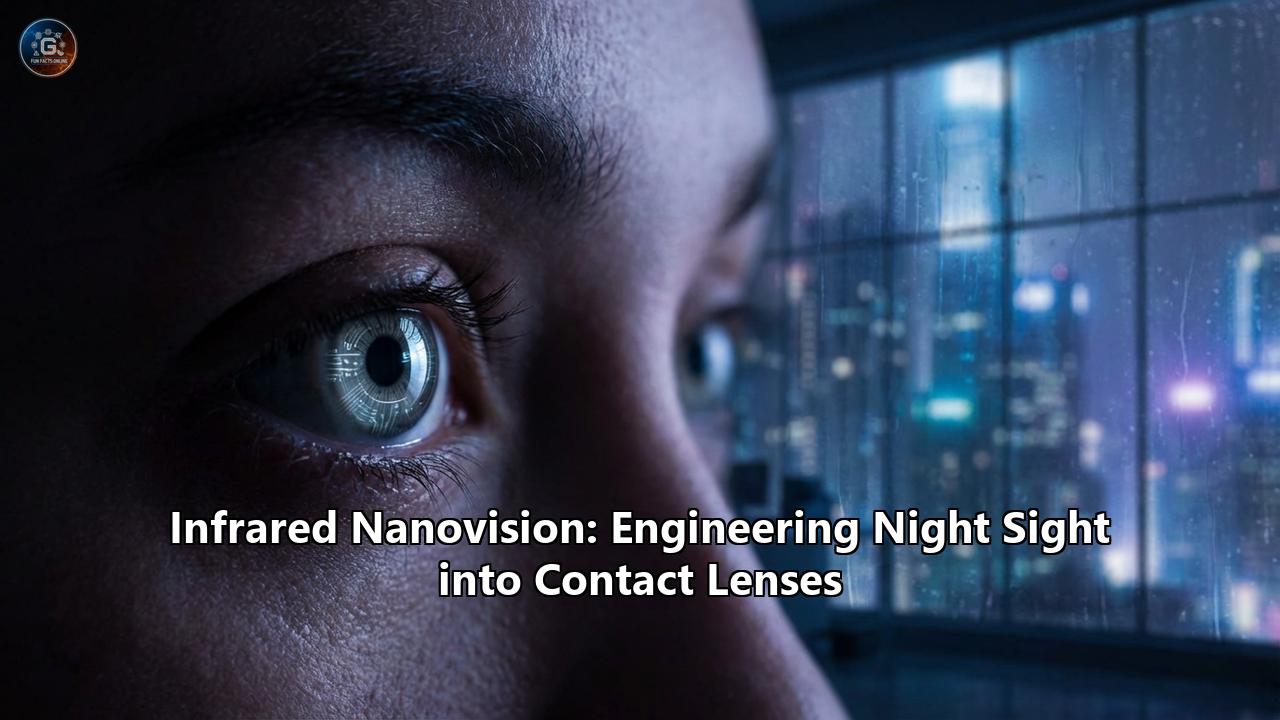
The human eye is a marvel of biological engineering, yet for all its complexity, it is surprisingly limited. We perceive only a tiny sliver of the electromagnetic spectrum—the "visible light" band that paints our world in rainbows. Beyond the red edge of that rainbow lies a vast, invisible ocean of information: infrared radiation. For decades, accessing this hidden world required heavy, battery-draining equipment strapped to helmets or held in hand.
But the days of clunky green-tinted goggles are numbered.
A quiet revolution is taking place in nanophotonics labs from Michigan to Hefei. By marrying the atomic-scale precision of graphene with the unique properties of upconversion nanoparticles, engineers are effectively upgrading the human operating system. We are entering the era of Infrared Nanovision—a technology that shrinks night sight capability down to a transparent layer lighter than a feather and thinner than a strand of DNA, sitting comfortably on the surface of your eye.
The Invisible World: Why We Want to See It
Before understanding how we are engineering this technology, we must understand what we are missing. Infrared (IR) light surrounds us constantly. It is the thermal signature of a warm body in a cold forest; it is the piercing beam of a TV remote; it is the energy radiating from a cooling car engine.
Evolution gave snakes like pit vipers the ability to sense this radiation to hunt in the dark. Humans, however, were left in the dark. Bridging this gap has traditionally relied on two methods:
- Thermal Imaging: Detects heat (long-wave IR) but requires cryogenic cooling to reduce noise.
- Image Intensification: Amplifies tiny amounts of visible light (stararlight/moonlight) but fails in total darkness.
The new generation of contact lenses bypasses these limitations entirely. Instead of capturing an image on a sensor and displaying it on a screen, these lenses remix the light itself, converting invisible infrared photons into visible ones before they even hit your retina.
The Two Paths to Super-Vision
Current research is spearheaded by two distinct but converging technological philosophies: the Graphene Electrical Interface and the Nanoparticle Upconverter.
1. The Graphene Sandwich: University of Michigan
Early breakthroughs at the University of Michigan utilized graphene, a "wonder material" consisting of a single layer of carbon atoms. Graphene is incredibly strong and conductive, but on its own, it’s almost transparent, absorbing only about 2.3% of light. This makes it a poor light sensor in its raw form.
To overcome this, researchers engineered a "graphene sandwich." They placed an insulating barrier between two sheets of graphene. When light hits the top layer, it frees electrons, creating "holes" (positive charges). These quantum effects are then amplified by the bottom layer, turning a weak optical signal into a strong electrical one.
The Result: A sensor smaller than a pinky nail that can detect the full infrared spectrum without bulky cooling systems. While this approach primarily feeds data to external devices (like an overlaid display or a smartphone), the ultimate goal is integration into a "smart lens" that acts as a transparent heads-up display (HUD).2. The Upconversion Breakthrough: Direct Retinal Projection
The more recent and perhaps more "sci-fi" approach—pioneered by researchers at the University of Science and Technology of China (USTC) and UMass Chan Medical School—skips electronics entirely.
They utilize upconversion nanoparticles. Imagine these nanoparticles as tiny light antennas. In normal physics, light loses energy as it travels or bounces (down-conversion). But these particles are engineered to do the opposite. They absorb multiple low-energy infrared photons and combine their energy to spit out a single high-energy visible photon.
How it works in a lens:- Absorption: The lens is embedded with nanoparticles made of sodium gadolinium fluoride, doped with elements like erbium and ytterbium.
- Conversion: When infrared light hits the lens, these particles "catch" the wavelengths between 800 and 1600 nanometers (Near-Infrared).
- Emission: The particles instantly re-emit this energy as green, red, or blue visible light.
The wearer looks at an infrared source, and their eye perceives it as a glowing green image. Because the lens is transparent, they can still see normal visible light simultaneously. It is an augmented reality overlay powered by the laws of physics, not a battery.
Engineering the Lens: From Lab to Eye
Creating the material is one thing; putting it on a human eyeball is another. The engineering challenges here are immense, focusing on biocompatibility and clarity.
The Polymer MatrixYou cannot simply dust nanoparticles into an eye. To ensure safety, engineers encapsulate these crystals within a highly breathable, FDA-approved polymer—the same hydrogels used in standard corrective contact lenses. This "sandwiching" technique ensures the active sensing layer never directly touches the cornea, preventing irritation or toxicity.
The "Blur" ProblemOne of the early hurdles was image clarity. If you place a screen directly on your cornea, you can't focus on it—it’s too close. However, because these upconversion lenses aren't "screens" but rather light converters, the light they emit passes through the eye's natural lens and focuses onto the retina just like normal light. Early prototypes gave a slightly "watery" or blurry view of the IR sources, but refinement in particle density is rapidly sharpening the resolution.
Applications: Beyond Military Night Vision
While the phrase "night vision" conjures images of special forces, the utility of infrared contact lenses extends far deeper into civilian and medical life.
1. Medical Diagnostics
Veins and blood vessels are highly visible under infrared light. A doctor wearing these lenses could look at a patient's arm and see the vasculature glowing beneath the skin, making blood draws and IV insertions safer and faster. Furthermore, certain tumors and inflamed tissues have different heat signatures; a surgeon could potentially identify the margins of a tumor in real-time without looking away at a monitor.
2. Search and Rescue
Smoke, fog, and dust scatter visible light, blinding rescue workers. Infrared light, however, has longer wavelengths that penetrate these obscurants much better. A firefighter wearing IR lenses could potentially see the glowing thermal signature of an unconscious person on the floor of a smoke-filled room, hands-free and unencumbered by heavy gear.
3. Security and Encryption
We could enter an era of "invisible signage." Security codes, authentication patterns, or silent alarms could be projected in infrared on walls or screens. To the naked eye, the wall looks blank. To the lens wearer, the message is clear. This has massive implications for anti-counterfeiting measures on currency and high-value goods.
4. Color Blindness Correction
Interestingly, the same technology used to shift IR light to green can be tweaked to shift other wavelengths. Researchers are exploring how upconversion particles could help the color blind by shifting "invisible" shades (to them) into parts of the spectrum they can perceive, effectively restoring a form of full-color vision.
The Experience: What is it Like?
Test subjects in early trials described a surreal experience. In a lit room, vision is normal. But switch off the lights, and the darkness isn't absolute. Infrared sources—like the pilot light on a stove, the IR sensor on a TV, or even a specialized IR flashlight—appear as luminous green or blue beacons.
Perhaps the most uncanny aspect is the ability to see through eyelids. Infrared light passes through human skin and tissue much better than visible light. In tests, subjects with their eyes closed could still detect bright infrared flashes, sensing the direction of the light source even while "blind."
The Road Ahead: Challenges and Timeline
Despite the excitement, we aren't quite ready to buy these at the pharmacy.
- Sensitivity: Current nanoparticle lenses need moderately bright IR light to work. They aren't yet sensitive enough to passively detect the low-level thermal body heat of a person standing in a pitch-black field (true thermal vision). Boosting the "quantum efficiency" of the particles is the primary engineering focus right now.
- Powering the Graphene: For the graphene-based electrical versions, finding a way to power the lens wirelessly without heating up the eye is a critical hurdle.
- Privacy: If anyone can wear undetectable night-vision cameras or sensors, privacy in low-light public spaces becomes a complex issue.
Conclusion
We are witnessing the end of human biological limitation. Infrared nanovision is more than just a gadget; it is the first step toward transhumanist ocular enhancement. By engineering night sight into the humble contact lens, we are not just looking at the dark; we are looking through it. As costs fall and sensitivity rises, the phrase "afraid of the dark" may soon become a relic of the past, forgotten by a generation that can see the world in all its invisible glory.
Reference:
- https://unionrayo.com/en/future-contact-lenses-infrared-light-human-sight/
- https://timesofindia.indiatimes.com/science/new-contact-lenses-let-humans-see-in-the-dark-even-with-eyes-closed/articleshow/121420242.cms
- https://www.cbsnews.com/news/graphene-contact-lenses-could-let-give-you-infrared-vision/
- https://newatlas.com/infrared-light-detector-graphene-contact-lens/31603/
- https://singularityhub.com/2014/03/29/contact-lenses-with-infrared-vision-ultra-thin-graphene-opens-up-the-possibilities/
- https://www.extremetech.com/extreme/178593-graphene-smart-contact-lenses-could-give-you-thermal-infrared-and-uv-vision
- https://www.youtube.com/watch?v=zG_SerHs7ao
- https://www.mic.com/articles/86081/night-vision-contact-lenses-may-soon-be-possible-this-is-how-they-ll-work
- https://www.iflscience.com/graphene-light-detector-could-lead-heat-vision-contact-lenses-24039
- https://www.dezeen.com/2014/03/18/graphene-sensors-could-create-night-vision-contact-lenses/
- https://www.youtube.com/watch?v=89EvH15T0Co
- https://www.theguardian.com/science/2025/may/22/infrared-contact-lenses-super-vision
- https://theanalyticalscientist.com/issues/2025/articles/may/spectroscopy-roundup-infrared-contact-lenses-enable-night-vision/
- https://www.thebrighterside.news/post/futuristic-infrared-contact-lenses-give-wearers-night-vision-superpowers/
- https://www.independent.co.uk/news/science/night-vision-contact-lens-infrared-b2757495.html
- https://www.bbntimes.com/science/battery-free-night-vision-contact-lenses-a-breakthrough-in-wearable-technology
- https://optics.org/news/16/5/39
- https://www.livescience.com/technology/super-vision-contact-lenses-let-wearers-see-in-the-dark-even-with-their-eyes-closed
- https://www.scimex.org/newsfeed/new-contact-lenses-could-let-us-see-in-the-dark-even-with-our-eyes-closed