
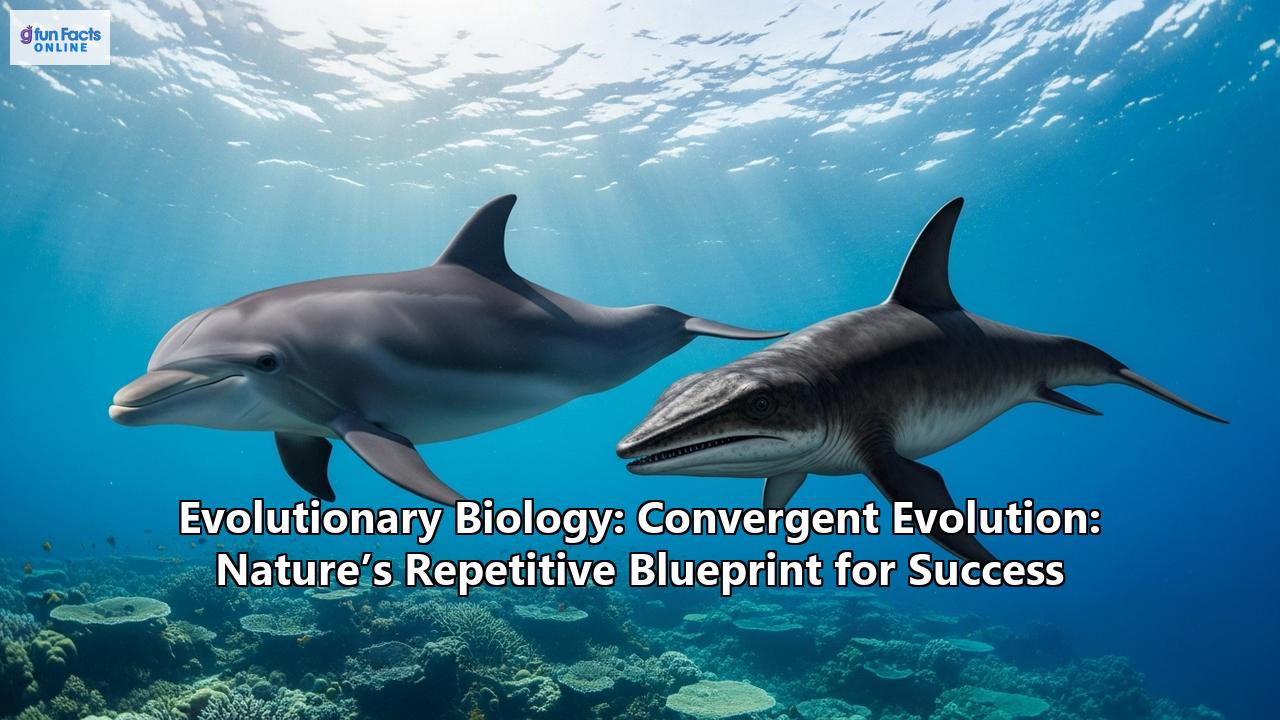
An iconic principle of evolutionary biology is that of common descent, where related species inherit traits from a shared ancestor, gradually diverging over millions of years to create the vast tree of life. Yet, nature is also filled with a seemingly contradictory phenomenon, a testament to its ingenuity and predictability. This is convergent evolution, a process where unrelated organisms independently evolve similar traits as they adapt to similar challenges or ecological niches. It’s as if nature possesses a blueprint for success, a set of optimal designs that are so effective they are repeatedly deployed across the globe and throughout the eons.
From the streamlined bodies of sharks and dolphins to the camera-like eyes of humans and octopuses, convergent evolution demonstrates that the paths of life, though starting from vastly different points, can often arrive at the same destination. This article delves into the fascinating world of convergent evolution, exploring its mechanisms, its genetic underpinnings, and a gallery of its most striking examples. We will journey through the depths of the oceans, soar into the skies, and peer into the very code of life to understand how and why evolution sometimes repeats itself, providing us with a deeper appreciation for the power of natural selection and the constraints that shape the diversity of life on Earth.
The What and Why of Convergence: A Tale of Two Paths
At its core, convergent evolution is the independent evolution of similar features in species of different lineages. These similar features, known as analogous structures, have a similar form or function but were not present in the last common ancestor of those groups. This stands in stark contrast to homologous structures, which are features shared by related species because they have been inherited from a common ancestor. For example, the wing of a bat and the arm of a human are homologous structures; they share a similar bone structure inherited from a common mammalian ancestor. However, the wing of a bat and the wing of an insect are analogous structures. Both are used for flight, but they evolved independently and have vastly different structural origins.
This distinction is crucial. While divergent evolution describes how species with a common ancestor become more different over time, often due to adapting to different environments, convergent evolution is about unrelated species becoming more similar. Think of it as two separate rivers carving their way through a landscape; though their sources are far apart, they might both eventually form a similar-looking canyon if they encounter the same type of rock and erosional forces.
So, what drives this remarkable phenomenon? The primary engine is natural selection. Similar environments pose similar challenges, and organisms that develop advantageous traits to meet these challenges are more likely to survive, reproduce, and pass on those traits. Whether it’s the need to move efficiently through water, see clearly in dim light, or access a specific food source, the laws of physics and the demands of ecology create a limited set of effective solutions.
A classic example is the fusiform body shape—a tapered, torpedo-like form—seen in a wide range of aquatic animals. Fish like sharks, marine mammals like dolphins, and even extinct marine reptiles like the ichthyosaurs all evolved this streamlined shape independently. This shape minimizes drag, allowing for fast and efficient movement through water, a universal challenge for any active aquatic predator. These species are known as "ecological equivalents," organisms that fill similar roles in different ecosystems, often separated by vast geographical distances or even millions of years.
The Genetic Blueprint: How Convergence is Coded
For centuries, convergent evolution was observed as a fascinating pattern in the anatomy and behavior of organisms. However, the advent of genomics has opened up a new frontier, allowing us to understand convergence at its most fundamental level: the DNA. The story of how different species arrive at similar solutions is often written in their genes, and the narratives are surprisingly diverse.
Sometimes, phenotypic convergence arises from entirely different genetic and developmental pathways. In other cases, and this is where the story gets particularly intriguing, similar phenotypes evolve through remarkably similar genetic changes. This can happen in several ways:
- Parallel Evolution: This occurs when independent species evolve the same trait by acquiring similar or identical mutations in the same genes. It’s as if two different software engineers, working independently, fix a bug by writing the exact same line of code. This suggests that for certain adaptations, the number of effective genetic solutions is highly constrained.
- Collateral Evolution: This is when convergence results from the independent evolution of alleles that were already present in a shared ancestral population. In this scenario, different lineages inherit a common pool of genetic variation, and natural selection then favors the same pre-existing alleles in each lineage as they face similar environmental pressures.
- Deep Homology: Perhaps the most astonishing mechanism is what scientists call "deep homology." This is a situation where analogous structures—those that evolved independently—arise from the activity of homologous genes. These are ancient, highly conserved "master control" genes that have been passed down from a very distant common ancestor and are involved in fundamental developmental processes. The repeated co-option of these ancestral genetic toolkits for similar purposes in different lineages is a profound testament to the deep unity of life.
These molecular mechanisms reveal that the "predictability" of evolution goes far beyond just the final physical form. The path of evolution is not entirely random; it is constrained by the available genetic material, the pleiotropic effects of mutations (where one gene affects multiple traits), and the fundamental principles of biochemistry and development. Modern genomics allows us to peer into the evolutionary history of different species and see these constraints in action, revealing the intricate dance between chance mutation and deterministic selection that gives rise to convergence.
A Gallery of Convergence: Nature's Greatest Hits
The examples of convergent evolution are as diverse as life itself, spanning across kingdoms and continents. They serve as powerful, independent experiments that demonstrate the efficacy of natural selection.
In the Water: The Streamlined Swimmers and Electric Marvels
As mentioned earlier, the fusiform body shape is a hallmark of aquatic convergence. Sharks (cartilaginous fish) and dolphins (mammals) are a prime example. Despite their last common ancestor living hundreds of millions of years ago, they both possess streamlined bodies, dorsal fins, pectoral fins, and powerful tails for propulsion. These similarities are not due to shared ancestry but are adaptations to the same high-speed, predatory lifestyle in a marine environment.
Another stunning example of aquatic convergence is the evolution of electric organs in fish. This extraordinary trait has evolved independently at least six times in different fish lineages living in the murky waters of Africa and South America. These organs, which are derived from modified muscle or nerve cells, can generate electric fields for navigation, communication, and in some cases, stunning prey or deterring predators. Genomic studies have revealed that despite the millions of years of separate evolution, these different lineages have co-opted many of the same genetic and developmental pathways to turn muscle into an electric organ. They often achieve this by suppressing the expression of genes that are typically involved in muscle contraction and amplifying the expression of genes that control the flow of ions across cell membranes, effectively turning a muscle cell into a biological battery. For instance, different electric fish lineages show convergent substitutions in the scn4aa gene, a voltage-gated sodium channel crucial for electrical activity.
Taking to the Skies: The Convergent Evolution of Flight
The ability to fly has been one of evolution's most successful inventions, and it has been independently achieved at least four times in the history of life: in insects, pterosaurs (extinct flying reptiles), birds, and bats. In each case, a limb was modified into a wing, but the specific architecture of that wing is unique to each group, highlighting their separate evolutionary journeys.
- Insect wings are outgrowths of the exoskeleton.
- Pterosaur wings were supported by a single, elongated fourth finger.
- Bird wings are composed of feathers attached to a fused hand and arm bones, with the second digit being the most prominent.
- Bat wings consist of a membrane of skin stretched between four elongated fingers and the side of the body.
This is a classic case of homologous forelimbs (in the vertebrates) being adapted into analogous wings. The underlying bone structure is inherited from a common tetrapod ancestor, but the modification into a flight-capable airfoil occurred independently in each lineage, driven by the immense ecological opportunities available to creatures that could conquer the air.
A Window to the Soul: The Camera Eye
One of the most profound examples of convergent evolution is the camera-type eye, a sophisticated organ capable of forming detailed images. This type of eye has evolved independently in lineages as disparate as vertebrates (like us), cephalopods (like octopuses and squid), and even some jellyfish. The last common ancestor of these groups had at most a simple light-sensitive spot.
The similarity in overall design is striking: a light-tight chamber, a lens to focus light, an iris to control the amount of light entering, and a retina to detect the image. However, a closer look reveals key differences that betray their separate origins. The most famous of these is the "wiring" of the retina. In vertebrates, the nerve fibers pass in front of the photoreceptor cells, creating a blind spot where the nerves bundle together and exit the eye. In cephalopods, the nerve fibers are located behind the photoreceptors, resulting in a more "sensibly" designed eye without a blind spot.
The story of the eye also brings us to the concept of deep homology. The development of eyes across a vast array of animals, from flies to humans to squid, is controlled by a master regulatory gene known as Pax6 (or its homolog, eyeless, in flies). This gene is so fundamental that the squid Pax-6 gene can be inserted into a fruit fly and trigger the development of an ectopic (out of place) fly eye. This indicates that the last common ancestor of all these creatures likely had a simple photoreceptive organ controlled by an early version of Pax6. Over time, this ancestral genetic toolkit was independently elaborated upon in different lineages to construct complex, yet analogous, camera eyes. Cephalopods, for example, did not duplicate the Pax-6 gene but evolved different splicing variants to help build their eyes, a different path from that taken by insects or vertebrates.
The Continental Counterparts: Marsupials and Placentals
Australia’s geographic isolation for over 100 million years created a massive natural experiment in evolution. While placental mammals radiated across the other continents, marsupials became the dominant mammals "down under." The result is a stunning showcase of convergent evolution. For nearly every type of placental mammal in North America or Eurasia, there is a remarkably similar marsupial counterpart in Australia that fills a parallel ecological niche.
- The marsupial mole, with its powerful claws and reduced eyes, is strikingly similar to the placental mole of the Northern Hemisphere.
- The gliding sugar glider (a marsupial) shares its nocturnal, tree-dwelling lifestyle and skin flaps (patagium) with the flying squirrel (a placental rodent).
- The extinct thylacine, or Tasmanian wolf, was a dog-like predator that bore an uncanny resemblance to placental canids like wolves.
- There are marsupial mice, anteaters (numbats), and cat-like predators (quolls), all of which have placental look-alikes.
These pairs of animals evolved their similar body plans, feeding habits, and modes of locomotion independently, driven by the similar selective pressures of their respective environments. They are a powerful illustration of how evolution can produce predictable outcomes when faced with similar ecological opportunities.
Plant Power: The Independent Invention of C4 Photosynthesis
Convergent evolution is not limited to the animal kingdom. Plants provide some of the most compelling examples, particularly in their biochemical pathways. C4 photosynthesis is a complex series of metabolic and anatomical modifications that allow plants to concentrate CO2 within their leaves, making photosynthesis more efficient in hot, dry, and low-CO2 environments. This "turbocharged" version of photosynthesis has evolved independently more than 62 times in 19 different families of flowering plants.
This is a remarkable feat of convergence because it requires a coordinated suite of changes, including alterations in leaf anatomy (the development of "Kranz anatomy"), the recruitment of new enzymes, and the cell-specific expression of numerous genes. Genomic studies have shown that in many cases, C4 plants have co-opted the same ancestral genes for their new roles. For example, the key enzyme PEP carboxylase (PEPC), which is responsible for the initial fixation of CO2 in C4 plants, has evolved through parallel amino acid changes in different grass lineages. These repeated, independent recruitments and modifications of the same genetic toolkit underscore how developmental and genetic predispositions can channel evolution down similar paths.
The Art of Deception: Convergent Mimicry
Mimicry, where one species evolves to resemble another, is a powerful evolutionary strategy often driven by predation. In Müllerian mimicry, two or more well-defended (e.g., poisonous) species evolve to resemble each other. This creates a shared, stronger warning signal for predators, who learn to avoid that pattern more quickly. A striking example of this is found in Heliconius butterflies of the neotropics. Different species, like Heliconius melpomene and Heliconius erato, have convergently evolved the same vibrant wing patterns in the same geographic locations.
Genetic studies have revealed an astonishing level of molecular convergence. The major genes controlling these mimetic color patterns are located in the same homologous regions of the genome in both species. This suggests that despite diverging millions of years ago, the evolutionary path to these similar wing patterns was constrained to the same genetic loci. In some cases, the same "supergene" (a cluster of tightly-linked genes) or even single genes like doublesex can control these complex patterns, with different versions of the gene producing dramatically different appearances.
The Social Blueprint: Convergent Eusociality
Evolutionary convergence can also shape complex behaviors and social structures. Eusociality—the highest level of social organization, characterized by cooperative brood care, overlapping generations, and a division of labor into reproductive and non-reproductive castes (e.g., queens and workers)—has evolved independently at least 11 times in insects. Bees, ants, wasps, and termites have all independently converged on this colonial lifestyle.
While the specific paths to eusociality differ, researchers are finding evidence for a "genetic toolkit" for social behavior. Studies comparing the genomes of various social insects have found that similar sets of genes, particularly those involved in signal transduction, gland development (for producing pheromones), and metabolism, show signs of accelerated evolution across these independent lineages. This suggests that building a complex society, with its intricate communication and division of labor, may rely on modifying a common set of ancestral genes related to physiology and communication.
A Repetitive Blueprint for Success
Convergent evolution is far more than an evolutionary curiosity. It provides some of the most compelling evidence for the power of natural selection. The fact that different lineages, starting with different raw materials, can be molded by similar environmental pressures to arrive at the same functional solutions is a powerful demonstration that evolution is not entirely a game of chance. It is a predictable process governed by universal principles of physics, chemistry, and ecology.
Furthermore, the study of convergence, especially at the genetic level, allows us to understand the constraints that channel evolution. It reveals that the number of viable solutions to life’s challenges is not infinite. The legacy of an organism's genetic and developmental history—the "deep homology" of its ancestral toolkit—plays a crucial role in determining which evolutionary paths are open and which are closed.
From the silent, electric world of a mormyrid fish to the high-frequency clicks of a dolphin, from the shared warning colors of butterflies to the parallel worlds of marsupials and placentals, nature’s repetitive blueprint for success is all around us. It is a constant reminder that life, in all its staggering diversity, is also a story of shared solutions, of common answers to common problems, written again and again across the vast and intricate tapestry of evolution.
Reference:
- https://pmc.ncbi.nlm.nih.gov/articles/PMC5541775/
- https://pmc.ncbi.nlm.nih.gov/articles/PMC7952227/
- https://academic.oup.com/gbe/article/16/8/evae163/7721785
- https://pubmed.ncbi.nlm.nih.gov/18791259/
- https://www-tc.pbs.org/wgbh/evolution/library/01/4/pdf/l_014_02.pdf
- https://www.quantamagazine.org/electric-fish-genomes-reveal-how-evolution-repeats-itself-20220822/
- https://www.vedantu.com/question-answer/australian-marsupials-and-placental-mammals-are-class-12-biology-cbse-6075e641a265f32808d66450
- https://www.pnas.org/doi/10.1073/pnas.1103457108
- https://ohiostate.elsevierpure.com/en/publications/genomic-basis-for-the-convergent-evolution-of-electric-organs
- https://news.utexas.edu/2006/03/02/convergent-evolution-of-molecules-in-electric-fish/
- https://pmc.ncbi.nlm.nih.gov/articles/PMC2581958/
- https://pmc.ncbi.nlm.nih.gov/articles/PMC20103/
- https://pubmed.ncbi.nlm.nih.gov/10461206/
- https://www.researchgate.net/publication/260525381_Cephalopod_eye_evolution_was_modulated_by_the_acquisition_of_Pax-6_splicing_variants
- https://www.pbslearningmedia.org/resource/tdc02.sci.life.evo.convergence/convergence-marsupials-and-placentals/
- https://www.pbs.org/wgbh/evolution/library/01/4/l_014_02.html
- https://www.scienceworld.ca/stories/placental-mammals-and-their-marsupial-counterparts/
- https://www.frontiersin.org/journals/plant-science/articles/10.3389/fpls.2021.774818/full
- https://www.c4phylomics.org/photosynthesis/evolution
- https://pmc.ncbi.nlm.nih.gov/articles/PMC8784020/
- https://www.researchgate.net/publication/23255453_Convergent_Evolution_in_the_Genetic_Basis_of_Mullerian_Mimicry_in_Heliconius_Butterflies
- https://www.uchicagomedicine.org/forefront/research-and-discoveries-articles/how-a-flipped-gene-helped-butterflies-evolve-mimicry
- https://manifold.umn.edu/read/social-insects-and-evolutionary-convergence/section/35ce5cd9-a014-4e03-9716-a875c3109e1a
- https://pmc.ncbi.nlm.nih.gov/articles/PMC3131825/
- https://www.researchgate.net/publication/326302922_Insects_with_similar_social_complexity_show_convergent_patterns_of_adaptive_molecular_evolution
- https://www.annualreviews.org/doi/10.1146/annurev-genet-120116-024515