
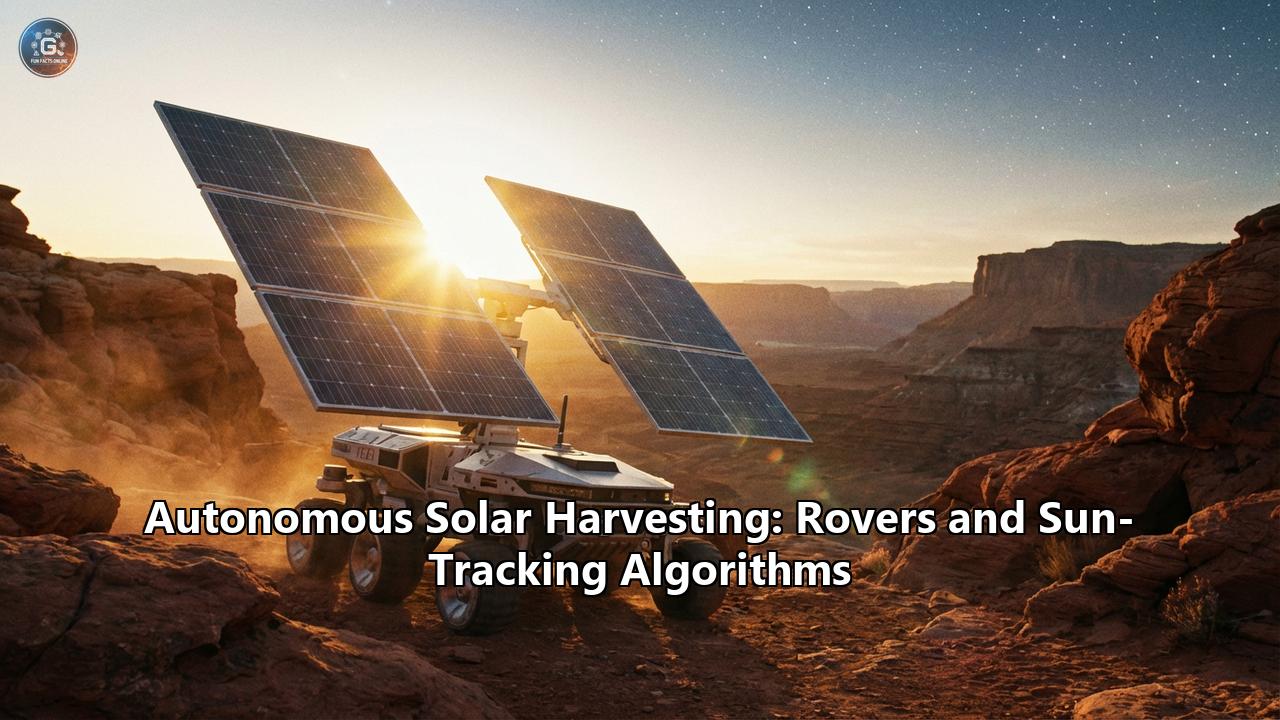
The Red Planet is a graveyard of batteries. From the earliest Soviet probes to the latest technological marvels sent by NASA and the ESA, the history of mobile robotics is fundamentally a history of energy management. In the vacuum of space, on the dusty plains of Mars, or floating in the vast, crushing pressure of Earth’s oceans, a robot is only as capable as its power budget. For decades, this budget was a fixed savings account: a primary battery with a finite chemical lifespan. When the electrons ran out, the mission ended. The transition to rechargeable systems extended this lifespan, but the robot remained tethered—if not by a physical cord, then by the need to return to a charging station or the inevitability of a degrading power source.
True autonomy, the kind that allows a machine to traverse a continent or monitor a forest for a decade, requires a shift from energy storage to energy harvesting. This is the domain of autonomous solar harvesting: a complex intersection of photovoltaic physics, mechanical engineering, and advanced algorithmic intelligence. It is not merely about slapping a solar panel on a robot’s back; it is about teaching the machine to understand the sun. It involves "sun-seeking" behaviors where the robot treats light as a resource to be hunted, navigational algorithms that weigh the metabolic cost of movement against the caloric gain of insolation, and hardware that actively twists and turns to catch every available photon.
This article explores the comprehensive landscape of autonomous solar harvesting. We will dissect the history of solar-powered rovers, the physics of modern photovoltaics, the mechanical intricacies of sun-tracking hardware, and, most crucially, the sophisticated algorithms—from astronomical predictions to AI-driven energy maps—that enable robots to follow the light.
Part I: The Historical Crucible – Solar Rovers on Mars
To understand the state of the art on Earth, we must first look to Mars. The Red Planet has been the ultimate proving ground for autonomous solar technology. Unlike Earth, where a cloudy day is an inconvenience, on Mars, a dust storm can be a death sentence.
Sojourner: The Proof of Concept
When the Mars Pathfinder mission landed in Ares Vallis on July 4, 1997, it unleashed a microwave-sized rover named Sojourner. By modern standards, Sojourner was primitive, but its energy architecture was revolutionary. It carried a 0.2-square-meter solar array capable of generating about 16 watts of power at peak noon—roughly enough to power a standard LED lightbulb.
Sojourner’s reliance on solar power was a calculated risk. The rover carried non-rechargeable lithium-thionyl chloride batteries, but these were intended primarily to keep the electronics warm during the frigid Martian nights. For mobility and computation, Sojourner lived hand-to-mouth, consuming solar energy as it was generated. This constraint dictated its operations: the rover was diurnal, waking up with the sun and shutting down at dusk. This "commuter" lifestyle is the baseline for solar autonomy. The central lesson from Sojourner was that solar power is viable, but without intelligent management, the robot is a slave to the planetary rotation.
Spirit and Opportunity: The Golden Age
The Mars Exploration Rovers (MER), Spirit and Opportunity, launched in 2003, represent the apotheosis of solar-powered robotics. Designed for a 90-day mission, they lasted for 6 years and 14 years, respectively. This miracle of longevity was not due to magic, but to the over-engineering of their solar harvesting systems and the serendipity of Martian weather.
The MER rovers utilized triple-junction gallium arsenide (GaAs) solar cells. Unlike standard silicon cells found on residential rooftops, which use a single layer of material to absorb light, triple-junction cells use three distinct layers—typically Indium Gallium Phosphide (InGaP), Gallium Arsenide (GaAs), and Germanium (Ge). Each layer is tuned to absorb a different wavelength of the solar spectrum. The top layer catches high-energy blue and UV light, allowing lower-energy red and infrared light to pass through to the layers beneath. This "stacking" allows the cells to achieve efficiencies nearing 30%, compared to the 15-20% of standard silicon.
However, the defining story of the MER mission was the battle against dust. The Martian atmosphere is thick with suspended hematite dust, which slowly settles onto horizontal surfaces. NASA engineers predicted that this accumulation would obscure the panels within three months, choking the rovers of power. They built the mission timeline around this "death by dust."
What they didn't anticipate was the "cleaning event." On Mars, dust devils—thermal vortices driven by solar heating—frequently scour the surface. In a stroke of luck that became a mission strategy, these vortices periodically passed directly over the rovers, vacuuming the dust off the solar arrays. Opportunity would see its power levels drop to critical lows, only to wake up the next morning with a 20% boost in energy generation.
This phenomenon taught roboticists a crucial lesson for autonomous harvesting: the environment is dynamic. A solar rover cannot treat its energy source as a static variable. It must adapt to changing atmospheric opacity, seasons, and lucky breaks. The MER rovers eventually evolved their operations to include "winter havens"—slopes facing north (since they were in the southern hemisphere) where they could tilt their decks toward the sun to maximize incidence angles during the low-sun winter months. This was an early, manual form of the "energy-aware navigation" that modern autonomous rovers now perform automatically.
Part II: The Physics of Harvesting
To design an algorithm for solar harvesting, one must first understand what is being harvested. Solar energy is not a monolith; it is a stream of photons with varying energies and angles of arrival.
The Cosine Law and Angle of Incidence
The single most important equation in solar harvesting is the Lambert’s Cosine Law. It states that the radiant intensity observed from an ideal diffusely reflecting surface or source is directly proportional to the cosine of the angle $\theta$ between the direction of the incident light and the surface normal.
For a solar panel, this means that the power generated ($P_{gen}$) is proportional to the direct normal irradiance ($I_{DNI}$) multiplied by the cosine of the angle of incidence ($\theta$):
$$ P_{gen} \propto I_{DNI} \times \cos(\theta) $$
When the panel is perfectly perpendicular to the sun, $\theta = 0^\circ$ and $\cos(0) = 1$, maximizing power. If the panel is off by just $10^\circ$, the loss is minimal (cosine of 10 is 0.98). But as the angle becomes more oblique, the drop-off accelerates. At $60^\circ$, power is halved. At $90^\circ$ (sun on the horizon relative to the panel), power is zero.
For a moving robot, this geometry is constantly changing. As the robot turns, climbs a hill, or tilts into a ditch, its "surface normal" vector shifts relative to the sun vector. An autonomous rover must continuously solve for this geometric relationship in 3D space.
Spectral Sensitivity and Cell Technology
Not all photons are created equal. A photon must have enough energy (bandgap energy) to knock an electron loose from its atomic bond to create a current. If the photon has too little energy, it passes through or generates only heat. If it has too much, the excess energy is wasted as heat.
- Monocrystalline Silicon: The workhorse of the industry. Reliable, rigid, and moderately efficient (18-22%). These are heavy and brittle, making them difficult to integrate into the curved, rugged bodies of small rovers.
- Thin-Film (CIGS/Amorphous Silicon): Copper Indium Gallium Selenide cells are flexible and lightweight. They can be wrapped around a rover’s chassis or embedded in wing surfaces. While less efficient (10-15%), their form factor allows for more surface area coverage, which can offset the lower efficiency per square centimeter.
- Perovskites: The frontier. Perovskite structures offer the potential for high efficiency and can be printed onto flexible substrates. In 2024-2025, stability issues (degradation under UV light and moisture) are being solved, making them a prime candidate for "skin-like" solar coatings on future rovers.
- Multi-Junction (III-V) Cells: As used on Mars. Extremely efficient (30%+) and radiation-hardened, but prohibitively expensive for most Earth-based commercial applications like agriculture or delivery.
Part III: The Hardware of Sun Tracking
Knowing where the sun is constitutes only half the battle; the robot must physically orient its collectors to face it. This leads to the engineering of Solar Trackers.
Fixed vs. Tracking Architectures
Most basic solar robots use fixed mounting. The panel is laid flat on top of the chassis. This is mechanically simple and robust—no moving parts to break or jam with dust. However, it is inefficient. A flat panel only operates at peak efficiency for a brief window around solar noon. In the morning and evening, or in winter at high latitudes, the cosine losses are massive.
Tracking architectures introduce mechanical degrees of freedom to mitigate this.- Single-Axis Trackers: These rotate the panel along one axis, typically East-West. On a rover, this might mean a tilting mechanism that allows the panel to "lean" left or right. This can increase energy yield by 20-30%.
- Dual-Axis Trackers: These allow for both azimuth (compass direction) and elevation (tilt up/down) adjustments. A dual-axis tracker can keep the panel perfectly perpendicular to the sun from sunrise to sunset, potentially boosting yield by 40-50%.
However, on a mobile robot, tracking is not just about a motor on the panel. The entire robot can act as the tracker. This is Whole-Body Tracking. A rover with a fixed panel can maximize generation by parking on a slope that faces the sun, or by turning its entire body to align with the azimuth. This saves the weight of extra motors but complicates the path planning and mission concepts.
Active vs. Passive Tracking
How does the system move?
- Active Tracking: Uses electric motors (stepper or servo motors) and gear drives (worm gears or slew drives) to position the panel. These offer high precision (0.1° accuracy) and can be controlled by software. The downside is "parasitic load"—the motors themselves consume energy. The algorithm must ensure that the energy gained by moving the panel exceeds the energy cost of the motor actuation.
- Passive Tracking: A fascinating, low-tech alternative often used in terrestrial static applications but seeing renewed interest in long-duration robotics. These systems use a canister of low-boiling-point fluid (like Freon or compressed gas) on either side of the tracker. When the sun hits one side more than the other, the fluid heats up, expands (or vaporizes), and pushes a piston or shifts the weight balance, naturally tilting the panel toward the heat source. They require no electricity and have no parasitic load. However, they are slow to respond, inaccurate in cloudy conditions, and struggle in extreme cold—making them less ideal for dynamic mobile robots.
Part IV: Algorithms of the Sun – The "Where"
To point the panel, the robot needs to know where the sun is. There are two primary schools of thought here: Chronological (Open-Loop) and Optical (Closed-Loop).
1. Chronological Tracking: The Solar Position Algorithm (SPA)
If you know your location on Earth (GPS coordinates) and the exact time (UTC), the position of the sun is a solved mathematical problem. The Solar Position Algorithm (SPA), refined by NREL (National Renewable Energy Laboratory), is the gold standard.
The math is grounded in orbital mechanics. It takes into account:
- Earth's Elliptical Orbit: The distance to the sun changes, affecting apparent size and timing.
- Obliquity of the Ecliptic: The 23.44° tilt of the Earth's axis responsible for seasons.
- Nutations and Precessions: Tiny wobbles in the Earth's rotation over decades.
A simplified version of the algorithm for a rover might look like this:
- Calculate Julian Day: Convert the current date and time into a continuous count of days since January 1, 4713 BC.
- Calculate Solar Declination ($\delta$): The angle between the rays of the sun and the plane of the Earth's equator.
$$ \delta = 23.45 \sin\left( \frac{360}{365} (d - 81) \right) $$
(Where $d$ is the day of the year. This is a simplified approximation; the full SPA uses hundreds of terms.)
- Calculate Hour Angle ($H$): The angular distance between the sun and the local meridian (solar noon).
- Solve for Zenith ($Z$) and Azimuth ($\alpha$):
$$ \cos(Z) = \sin(\phi)\sin(\delta) + \cos(\phi)\cos(\delta)\cos(H) $$
(Where $\phi$ is the local latitude).
The result is a precise vector pointing to the sun. The robot uses its onboard IMU (Inertial Measurement Unit) to determine its own orientation (pitch, roll, yaw) and then calculates the necessary joint angles to align the panel vector with the sun vector.
- Pros: Works regardless of cloud cover; precise; requires no external sensors.
- Cons: Requires accurate GPS and compass calibration. Magnetic interference can drift the compass, causing the robot to point the wrong way.
2. Optical Tracking: The Closed-Loop Sensor Array
Instead of calculating where the sun should be, the robot simply looks for the brightest spot in the sky.
- LDR Arrays: The most common low-cost method uses Light Dependent Resistors (LDRs). A typical setup involves four LDRs separated by a cross-shaped baffle (a "shadow vane").
If the sun is directly overhead, all four LDRs receive equal light and have equal resistance.
If the sun is to the left, the baffle casts a shadow on the right-side LDRs. The resistance on the right increases, while the left remains low.
Control Logic: The algorithm (often a PID controller) drives the motors to equalize the resistance values between opposing pairs (East-West pair and North-South pair).
- Camera-Based/Sky-Cam: Advanced rovers use a fisheye camera looking up. Computer vision algorithms identify the centroid of the brightest pixel cluster (the sun blob). This is particularly useful for detecting "available light" rather than just the sun disc. On a cloudy day, the "brightest point" might not be the actual sun position, but a patch of thin clouds. Optical tracking correctly points the panel at this diffuse source, whereas the SPA would point at the obscured sun, potentially yielding less power.
3. Hybrid Approaches
The most robust systems use both. The SPA provides a coarse "feed-forward" estimation to get the panel roughly in the right place (or to re-orient after a long tunnel transit). The optical sensors then perform "fine-tuning" corrections to account for local reflections or sensor drift.
Part V: Algorithms of Efficiency – MPPT (The "How")
Once the panel is pointed at the sun, the system must extract the maximum electrical power. A solar panel is not a battery; it is a current source. Its output voltage varies wildly depending on the load attached to it.
If you connect a solar panel directly to a battery, the panel is forced to operate at the battery's voltage (e.g., 12V). However, the panel might be capable of producing its peak power at 18V. By forcing it down to 12V, you are throwing away roughly 30% of the potential energy.
The solution is the Maximum Power Point Tracker (MPPT). This is a DC-DC converter (usually a buck-boost converter) controlled by a microcontroller that constantly adjusts the "electrical impedance" seen by the solar panel.
The I-V Curve
Every solar panel has a characteristic I-V Curve (Current vs. Voltage).
- Short Circuit Current ($I_{sc}$): Maximum current, zero voltage, zero power.
- Open Circuit Voltage ($V_{oc}$): Maximum voltage, zero current, zero power.
- The Knee: Somewhere in the middle is the "Knee" of the curve—the Maximum Power Point ($P_{mpp}$).
The MPPT algorithm’s job is to find this knee and stay on it, even as clouds pass or temperature changes (heat lowers voltage).
Perturb and Observe (P&O)
This is the most common algorithm for autonomous systems due to its simplicity.
- Measure: The controller measures current voltage ($V_1$) and current ($I_1$), calculates Power ($P_1 = V_1 \times I_1$).
- Perturb: It slightly increases the voltage (by adjusting the duty cycle of the converter).
- Observe: It measures the new power ($P_2$).
If $P_2 > P_1$: The perturbation was good. We are climbing the hill. Keep increasing voltage.
If $P_2 < P_1$: The perturbation was bad. We went past the peak. Decrease voltage.
- Repeat: This loop runs hundreds of times per second.
The downside of P&O is that it oscillates slightly around the peak, wasting a tiny amount of energy. In rapidly changing cloud conditions, it can get confused and track in the wrong direction.
Incremental Conductance
This more advanced mathematical method relies on the fact that at the Maximum Power Point, the derivative of power with respect to voltage ($dP/dV$) is zero.
$$ \frac{dP}{dV} = \frac{d(IV)}{dV} = I + V \frac{dI}{dV} = 0 $$
$$ \frac{dI}{dV} = -\frac{I}{V} $$
The algorithm compares the instantaneous conductance ($I/V$) with the incremental conductance ($dI/dV$).
- If $dI/dV = -I/V$, we are at the MPP.
- If $dI/dV > -I/V$, we are to the left of the peak.
- If $dI/dV < -I/V$, we are to the right.
This method is stable and precise but requires more computational power—a trade-off the system architect must weigh.
Part VI: Algorithms of Strategy – Energy-Aware Navigation
We have pointed the panel and optimized the circuit. Now, we must move the robot. Traditional path planning algorithms (like A or Dijkstra) optimize for the shortest distance. For a solar rover, the shortest path might be through a dark forest or a deep canyon, leading to battery depletion and death.
Energy-Aware Path Planning treats energy as a cost function variable. The goal is not "minimize distance" but "maximize final energy state" or "guarantee survival."Solar Maps and Gaussian Processes
To plan an energy-efficient path, the robot needs a map of the shadows.
- Static Solar Maps: These can be generated from satellite Digital Elevation Models (DEMs). By combining the terrain height map with the SPA (sun position), the robot can pre-calculate which areas will be in shadow at 2:00 PM vs. 4:00 PM.
- Dynamic Learning: Recent research (2024-2025) utilizes Gaussian Process (GP) Regression. As the robot explores, it measures solar intensity. It uses this sparse data to build a probabilistic model of the light field in the environment. It "predicts" that if the open field A has sun, the adjacent open field B likely has sun too, while the forest edge C has high uncertainty.
This enables "Information Theoretic Exploration." The robot might choose a path specifically to verify if a region is sunny, updating its internal solar map for future return trips.
Cost Function Modification
In a standard A algorithm, the cost to move from node $n$ to node $n+1$ is usually the distance $D$.
In energy-aware A, the cost is:
$$ Cost = (Power_{motor} \times Time) - (Power_{solar} \times Time) $$
If $Power_{solar}$ is high enough, the cost can be negative. This means the robot "gains" value by traversing that edge. The algorithm will naturally route the robot to take "detours" through sunny patches to recharge, much like a hiker stopping at water fountains.
Shadow Avoidance & Sun-Seeking
Robots like the Tertill (weeding robot) or FarmDroid employ simpler heuristics. If the battery is low, they engage "Sun-Seeking Mode."
- Use omnidirectional light sensors to find the vector of strongest light.
- Override the mission path.
- Move toward the light until charging current exceeds a threshold.
- Enter "Hibernate" mode: Stop motors, turn off non-essential sensors, and just charge.
Part VII: Earth-Based Case Studies
While Mars rovers are the celebrities, Earth-based solar robots are the working class, performing dirty, dull, and dangerous jobs.
1. Agriculture: FarmDroid FD20
The FarmDroid FD20 is a field robot from Denmark that seeds and weeds organic crops. It is entirely solar-powered, with a massive roof of panels acting as a canopy.
- Architecture: It does not use batteries for long-term storage; it runs directly off the massive capacitor-like buffer of its battery bank, designed to work continuously during the day.
- Autonomy: It uses RTK-GPS (Real-Time Kinematic) with millimeter precision. It knows exactly where it planted every seed. Therefore, it doesn't need complex cameras to identify weeds; it just blindly hoes everything that isn't a coordinate where a seed was planted.
- Energy Strategy: Its sheer size allows for a large solar array (oversized relative to its motor draw). It moves slowly (snail's pace), reducing rolling resistance and aerodynamic drag to near zero, making the energy math work.
2. Marine: The Wave Glider
Liquid Robotics’ Wave Glider is a masterpiece of energy harvesting. It is a two-part vehicle. The "float" stays on the surface with solar panels. The "sub" hangs 8 meters below on a tether.
- Propulsion: It requires no electricity for propulsion. It uses the mechanical energy of waves. As the float rises and falls with waves, the sub's wings articulate, converting vertical motion into forward thrust.
- Solar Role: The solar panels on the float power the brain: the satellite comms, the weather sensors, and the navigation computer.
- Result: Infinite range. These robots have crossed the Pacific Ocean, survived hurricanes, and loitered for months tracking sharks, all without a drop of fuel.
3. Environmental: The Tumbleweed Rovers
Experimental designs for desert exploration mimic the tumbleweed. These spherical, inflatable rovers are blown by the wind.
- Harvesting: They are covered in flexible thin-film solar.
- Mobility: Zero energy cost (wind driven).
- Control: They use the solar energy to deflate slightly or change their shape to "stop" or "steer" by altering their aerodynamics. This is an extreme example of passive locomotion coupled with active solar sensing.
Part VIII: Challenges and The Future
Despite the advancements, autonomous solar harvesting faces brutal physical limits.
The Dust Problem
On Earth, pollen, bird droppings, and dust reduce panel efficiency by 5-15% quickly. On Mars, it's 100% fatal eventually.
- Solution 1: Electrodynamic Shields. Transparent coatings that use high-voltage traveling waves to levitate and flick dust particles off the panel.
- Solution 2: Mechanical Wipers. Simple but prone to scratching the glass or jamming.
- Solution 3: Tilting. Simply tilting the panel to a steep angle (dump mode) allows gravity to slide the debris off, or using vibration motors to shake it loose.
The Battery Bottleneck
Solar is intermittent. Batteries are heavy. The specific energy* (Wh/kg) of batteries is still poor compared to gasoline. This limits the payload. A solar rover cannot carry a heavy robotic arm or high-speed computer without a massive, unwieldy solar array.
- BMS Logic: Modern Battery Management Systems for solar rovers are complex. They must handle "partial state of charge" operation (rarely getting to 100%) which degrades lead-acid and some Li-ion chemistries. Lithium Iron Phosphate (LiFePO4) is becoming standard due to its robustness and safety, even if it is slightly heavier.
Future Trend: Perovskites and Tandem Cells
The 2025 horizon sees the commercialization of Perovskite-Silicon Tandem Cells. By layering a semi-transparent perovskite cell on top of a standard silicon cell, efficiencies can jump to 35%. For a rover with limited surface area (the "deck space"), this is a game changer. It means 50% more power for the same footprint, enabling faster speeds or more powerful sensors (like LiDAR) which were previously too power-hungry for solar rovers.
Future Trend: Swarm Harvesting
Imagine a swarm of small robots. Some are "workers" deep in a cave or under a dense canopy. Others are "tankers" that stay in the bright sun.
- Power Beaming: The tankers could use lasers or microwave wireless power transfer to beam energy to the workers in the shade.
- Physical Exchange: Robots could dock with each other to share charge.
- Mirror Swarms: Robots could position themselves to reflect sunlight into a crater where a primary rover is operating, effectively creating an artificial, directed sun.
Conclusion
Autonomous solar harvesting is the technology that severs the umbilical cord of robotics. It transforms a robot from a device that depletes resources into one that gathers them. It requires a holistic design philosophy where the mechanical chassis, the electronic power converters, and the high-level navigation code are all synchronized to the rhythm of the sun.
From the frozen, dusty plains of Gusev Crater to the weed-choked rows of a Danish organic farm, these machines are proving that with enough intelligence, light is all the fuel you need. As algorithms get smarter and cells get efficient, the future of robotics looks increasingly bright—literally. We are moving toward an era of Immortality by Design, where a robot, barring mechanical failure, could theoretically operate forever, chasing the dawn, analyzing the world, and phoning home, powered by the very star that lights its way.
Reference:
- https://www.greenwood.io/news-posts/static-vs-tracking-solar-ground-mount-systems
- https://www.solarfeeds.com/mag/solar-trackers-types-and-its-advantages-and-disadvantages/
- https://energy.sustainability-directory.com/learn/what-is-the-difference-between-active-and-passive-solar-tracking-systems/
- https://www.stability.co/precise-solar-tracking-solution-using-nasa-or-nrel-solar-position-algorithm/
- https://bmi.unikl.edu.my/wp-content/uploads/2022/11/204_210_Maximum-Power-Point-Tracking-Using-Perturb-and-Observe-Technique.pdf
- https://www.youtube.com/watch?v=zpt7BC2jha4
- https://www.youtube.com/watch?v=EWgVW7sRZlk
- https://www.youtube.com/watch?v=-5C1Q9qyuLs
- https://www.youtube.com/watch?v=K0iw-Hu-KkM