
The human heart is a biological masterpiece, a muscular engine that beats roughly 100,000 times a day, 35 million times a year, and some 2.5 billion times in an average lifetime. It is a tireless percussionist, thumping out the rhythm of life until, for millions of people, it simply… stops. For decades, medicine has chased a ghost: a mechanical replacement that can match the endurance of nature. We have built pumps of plastic and polyurethane, devices that clap and wheeze like washing machines, tethering patients to massive consoles and filling their chests with the deafening sound of their own survival.
But the future of the artificial heart is not a replica of biology’s thump. It is silent. It is suspended in thin air. And it is made of titanium.
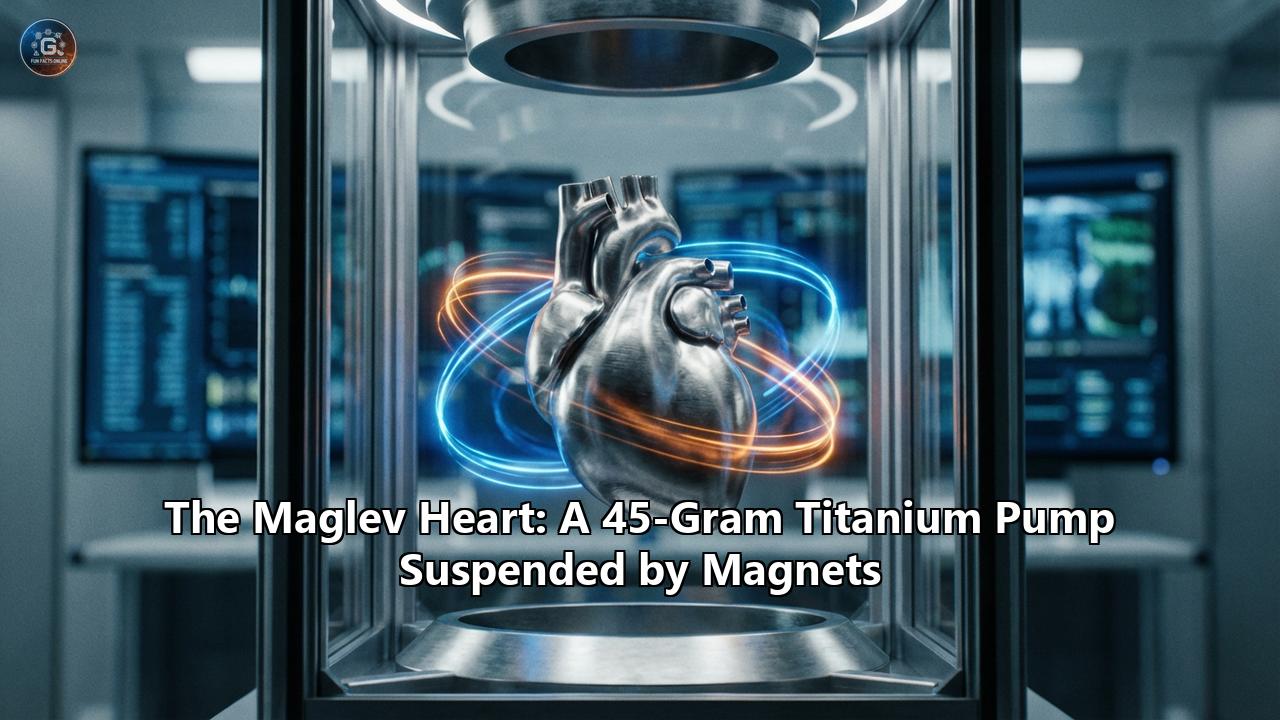
This is the story of the Maglev Heart—specifically the BiVACOR Total Artificial Heart (TAH)—a device that represents the most significant leap in cardiac engineering since the first transplant. It is a machine with only one moving part: a titanium rotor, levitated by magnetic fields, spinning without friction, without wear, and without a heartbeat. It is a pump that does not pulse; it hums. And for the first time in history, it has allowed a patient to walk out of a hospital, go home, and live a life while waiting for a transplant, carrying a 45-gram technological marvel spinning inside their chest.
Part I: The Problem with Pulse
To understand why the Maglev Heart is such a revolution, one must first understand the graveyard of failures that preceded it.
Since Dr. Denton Cooley implanted the first total artificial heart in 1969, the field has been plagued by a simple engineering problem: friction. The human heart is a positive displacement pump—it squeezes and relaxes. Early artificial hearts, like the famous Jarvik-7 (later the SynCardia), tried to mimic this action. They used diaphragms, sacs, and valves that snapped open and shut.
While these devices saved lives, they came with a heavy price. The mechanical violence of "beating" caused parts to wear out. The flexing membranes created zones of stagnation where blood could clot, leading to strokes. And they were loud—patients described the sound as a constant, rhythmic "clop-clop-clop" that kept them (and their spouses) awake at night, a relentless reminder of their precarious existence.
The engineering challenge was a paradox: how do you build a machine that moves enough blood to sustain an adult (about 5 to 10 liters per minute) but never touches itself? Any surface that rubs against another will eventually grind to dust. Any valve that snaps shut will eventually crack.
The answer, it turned out, was to stop trying to be a heart.
Part II: The Plumber’s Son and the Bunnings Pipes
The origin of the Maglev Heart is not found in a sterile high-tech laboratory, but in a backyard shed in Brisbane, Queensland.
Daniel Timms was a PhD student in biomedical engineering when his father, Gary, a plumber, suffered a massive heart attack. Watching his father’s heart fail, Timms became obsessed with finding a solution. He realized that nature’s design—the flexing, pumping chambers—was too complex to replicate mechanically with durability. He needed something simpler.
Drawing on his father’s trade, they went to Bunnings (an Australian hardware chain) and bought PVC pipes, building a rudimentary circulatory loop in their garage. They tinkered with the idea of a rotary pump—like a garden sprinkler or a turbocharger—rather than a pulsing sack.
Rotary pumps were already used in Ventricular Assist Devices (VADs), which help a failing heart pump but don't replace it. These pumps spun a propeller to push blood. But they had a fatal flaw for a total heart replacement: they required bearings. Bearings generate heat, friction, and blood clots.
Timms had a radical idea. What if the propeller didn't touch anything? What if it floated?
He looked to the technology used in high-speed trains: Magnetic Levitation, or Maglev. If powerful magnets could float a 50-ton train above a track to eliminate friction, surely they could float a small titanium disc inside a heart.
Part III: The Anatomy of the Maglev Heart
The device that emerged from those early experiments, the BiVACOR TAH, is a masterclass in minimalist engineering. It is roughly the size of a human fist and weighs about 650 grams (1.4 lbs), but the magic lies in its single moving component: the rotor.
The 45-Gram Soul
At the core of the titanium casing sits the rotor, a double-sided impeller that weighs roughly 45 grams. This single disc is the only part of the machine that moves.
The rotor is a double-sided centrifugal pump. On one side, it has large vanes designed to push blood to the body (systemic circulation) against high pressure. On the other side, it has smaller vanes to push blood to the lungs (pulmonary circulation) against lower pressure.
This design solves one of the hardest problems in artificial heart design: Left-Right Balance.
The left ventricle of a human heart must pump much harder than the right. If an artificial heart pumps equally to both, it will flood the lungs with blood (pulmonary edema) while starving the body.
The BiVACOR’s single rotor handles this elegantly. Because both sides of the impeller are on the same spinning disc, they turn at the same speed. However, the hydraulic design of the vanes ensures that the output is proportional. The device uses a smart "Virtual Zero Power" controller that adjusts the magnetic field thousands of times a second. If the patient coughs or stands up, changing the pressure in their chest, the magnetic field detects the shift in the rotor’s position and adjusts instantly, effectively "autobalancing" the blood flow just like a biological heart.
Suspended in Silence
When the device is turned on, electromagnets lift the titanium rotor and hold it suspended in the center of the casing. There is no contact. No ball bearings. No friction.
Because there is no contact, there is no mechanical wear. Theoretically, the device could run for decades without degrading. And because there is no "thumping" compression, the device is silent. Patients don't hear a beat; they feel a vibration, a quiet hum of life.
Part IV: The "Continuous Flow" Paradox
One of the most mind-bending aspects of the Maglev Heart is that it produces pulseless blood flow.
If you were to feel the wrist of a patient with a BiVACOR heart, you might not find a pulse. Their blood flows in a continuous stream, like water from a tap, rather than in spurts. This was initially a concern for doctors: would the body’s organs survive without the rhythmic shock of a pulse?
Years of research with VADs have shown that the body is surprisingly adaptable. The kidneys, liver, and brain function perfectly well with continuous flow. However, to prevent stagnation and mimic biology slightly, the BiVACOR controller is programmed to cycle its speed rapidly—changing the RPM (revolutions per minute) to create an artificial "pulse" sensation. This helps wash out the pump chambers and keeps the blood vessels healthy, but it is a digital ghost of a heartbeat, created by code, not muscle.
Part V: The First Human Trials
After years of testing in calves—who famously jogged on treadmills while powered by the device—the BiVACOR TAH was ready for humanity.
The Texas Milestone
In July 2024, at the Texas Heart Institute in Houston, a 57-year-old man with end-stage heart failure became the first human to receive the device. The surgery was a high-wire act. Surgeons removed his failing ventricles and clicked the titanium cuffs of the BiVACOR into place.
When they switched it on, the room didn't fill with the sound of a compressor. The monitors simply showed flow. The patient lived for eight days with the titanium heart before a donor organ became available—a successful "bridge to transplant." It proved the concept worked in a human chest.
The Australian Discharge: A History-Making Moment
But the true turning point came months later, in late 2024, at St. Vincent’s Hospital in Sydney.
A 40-year-old Australian man, dying of total heart failure, received the implant. Unlike previous patients who were tethered to hospital consoles, this man recovered, stood up, and eventually went home.
He carried a small, portable controller bag—about 4 kg—containing the batteries and the computer that drove the maglev field. He spent 105 days supported by the device. He slept in his own bed. He spent Christmas with his family. He walked around his neighborhood.
For the first time, a patient with a total artificial heart was not a prisoner of the hospital. The device simply hummed away in his chest, levitating that 45-gram rotor day and night, until a donor heart was found in early 2025. When he was wheeled in for his transplant, he was strong, healthy, and nourished—a stark contrast to the wasted state of many patients waiting on hospital wards.
Part VI: Titanium vs. The Waiting List
Why is this device so important? The math of heart failure is cruel.
Globally, roughly 20 to 30 million people suffer from heart failure. Every year, hundreds of thousands reach "end-stage," where medicines no longer work. Their only hope is a transplant.
But there are only about 6,000 donor hearts available worldwide each year.
The gap is catastrophic. For every one person who gets a heart, thousands die waiting. The goal of the BiVACOR and the Maglev Heart technology is to change the paradigm from "Bridge to Transplant" to "Destination Therapy."
Destination Therapy means the device is the cure. If the Maglev Heart is durable enough—if it truly doesn't wear out because of that frictionless suspension—a patient could receive it and live out the rest of their natural life without ever needing a donor organ.Imagine a future where a diagnosis of heart failure isn't a lottery ticket for a transplant, but a scheduled appointment to install a titanium upgrade.
Part VII: Challenges and the Road Ahead
Despite the triumph, challenges remain.
- Power: The device still requires external power. A driveline (cable) exits the patient's abdomen to connect to batteries. This is an infection risk. The "holy grail" is a fully implantable system with wireless charging (TET - Transcutaneous Energy Transfer), which BiVACOR and others are developing.
- Blood Trauma: Even without friction, spinning blood at thousands of RPM can shear red blood cells (hemolysis). The BiVACOR’s large gaps and magnetic suspension are designed to minimize this, but long-term data is needed.
- Cost: Titanium and rare-earth magnets are expensive. Scaling this to thousands of patients will be an economic challenge as much as a medical one.
Conclusion: The Heart of the Matter
The Maglev Heart is more than a pump. It is a symbol of human resilience. It is the realization of a son’s promise to his dying father, forged in a shed and refined in the world’s best laboratories.
It challenges our very definition of life. For millennia, life has been defined by the pulse. Doctors check for a pulse to declare death; poets write about the beating heart of passion. But the patients of the future may have no pulse at all. They will be alive, warm, thinking, and loving, sustained by a 45-gram titanium disc spinning silently in a magnetic cradle.
As the Australian patient proved, you don't need a heartbeat to be alive. You just need flow. And thanks to the Maglev Heart, the flow is stronger than ever.
Reference:
- https://www.reddit.com/r/STEW_ScTecEngWorld/comments/1k93jyv/wuhan_boy_implanted_with_the_worlds_smallest/
- https://www.popsci.com/technology/titanium-heart-transplant/
- https://trial.medpath.com/news/92362c5b3d6b9a44/australian-man-survives-100-days-with-bivacor-artificial-titanium-heart-in-groundbreaking-trial
- https://bivacor.com/
- https://www.giikorea.co.kr/report/moi1836584-cardiac-assist-devices-market-share-analysis.html
- https://www.medtechdive.com/news/bivacor-fda-breakthrough-titanium-total-artificial-heart/749506/
- https://www.criver.com/eureka/man-titanium-heart-lives-unprecedented-100-days
- https://www.mordorintelligence.com/industry-reports/global-artificial-organs-bionics-market-industry