
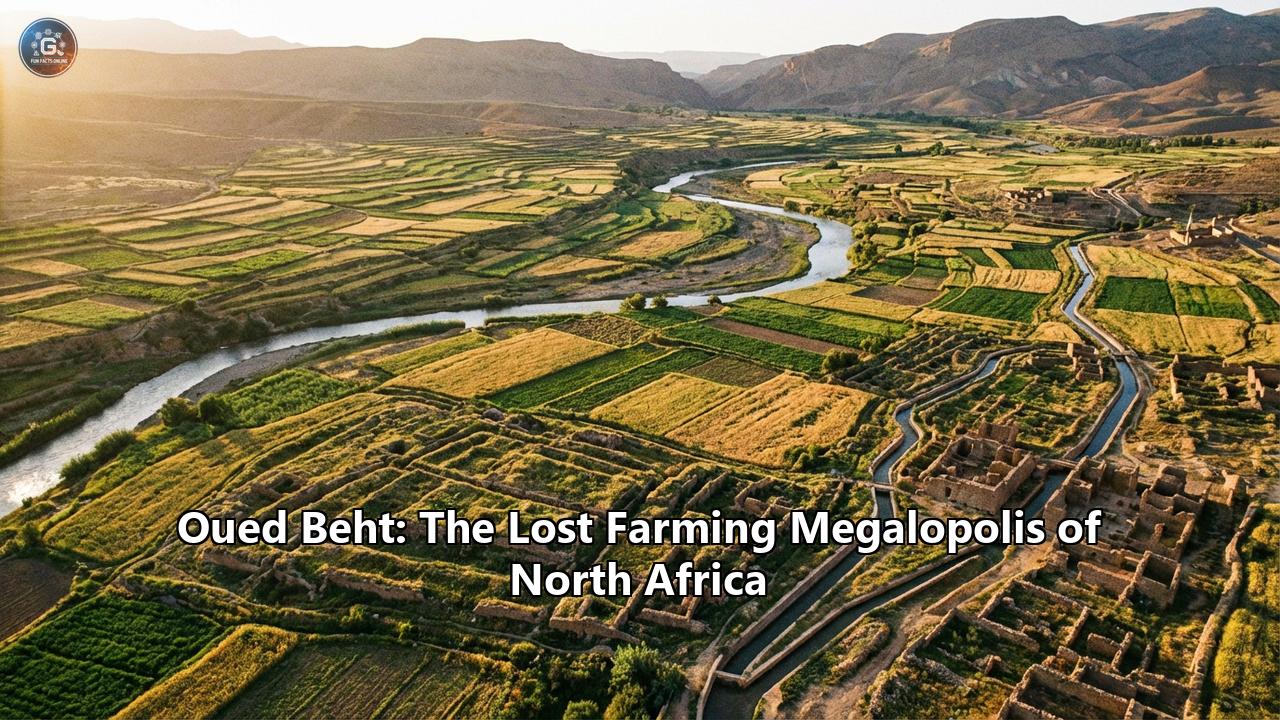
The wind blows hot across the rolling Zemmour plateau, kicking up dust from fields that have been farmed for thousands of years. Today, this region, situated between the chaotic bustle of Rabat and the historic imperial city of Meknes, is a quiet agricultural backwater. But beneath the feet of modern farmers lies a secret that has recently shattered the timeline of human history.
For over a century, archaeologists looked at the map of the ancient Mediterranean and saw a glaring hole. To the east, the Nile Valley was a beacon of civilization, with the dynastic power of Egypt rising from the sands. To the north, across the narrow Strait of Gibraltar, the Iberian Peninsula was alive with the activity of the Copper Age, where complex societies were building massive ditch enclosures and megalithic tombs. But the Maghreb—the western wing of North Africa—was blank. On archaeological maps, it was a "terra incognita," a purported void inhabited only by scattered, nomadic bands of shepherds who left behind little more than the ashes of their campfires.
That narrative was wrong.
The discovery of Oued Beht has obliterated the idea of a prehistoric void in North Africa. Hidden in plain sight, overlooking the river that gives it its name, lies the ghost of a bustling, complex, and massive community that thrived more than 5,000 years ago. This was not a campsite. It was a metropolis of its time—a settled, organized, and wealthy society that rivaled the size of Early Bronze Age Troy.
This is the story of Oued Beht: the lost farming megalopolis that is forcing us to rewrite the history of the ancient world.
Part I: The Phantom in the Archives
To understand the magnitude of the Oued Beht discovery, one must first understand the silence that preceded it. For decades, the prehistory of North Africa was viewed through a distorted lens, shaped largely by colonial arrogance and a fixation on the monumental architectures of later eras.
When French colonial administrators and amateur archaeologists surveyed Morocco in the early 20th century, their eyes were drawn to the stone skeletons of the Roman Empire. They marveled at the ruins of Volubilis, with its triumphal arches and mosaics, which confirmed the narrative they wanted to tell: that civilization was a gift brought to Africa by Rome (and, by extension, by Europe). The prehistoric past of the indigenous Amazigh (Berber) peoples was largely dismissed. If it wasn't built of marble, it wasn't worth their time.
Yet, there were clues. In the 1930s, French construction crews working near the town of Khemisset stumbled upon something strange. As they dug into the earth, they didn't hit Roman foundations. Instead, they found stone axes. Not just a few, but hundreds of them. Polished, heavy, and meticulously crafted. Alongside these tools were grinding stones—massive slabs of rock used to process grain.
The find was noted, briefly described in obscure journals, and then largely forgotten. The site was labeled merely as a place where "many axes" were found, perhaps a workshop or a seasonal gathering spot. The dots were never connected. The "Colonial Gaze" could not conceive of a complex indigenous society in the Neolithic Maghreb, so they did not look for one.
For nearly ninety years, Oued Beht slept.
It wasn't until the 2020s that a new generation of archaeologists decided to return to the ridge. This was a "dream team" of international collaboration: the Moroccan Institut National des Sciences de l'Archéologie et du Patrimoine (INSAP), the Italian National Research Council (CNR), and the University of Cambridge. Leading the charge were Professors Youssef Bokbot, Cyprian Broodbank, and Giulio Lucarini.
They came armed not just with shovels, but with modern technology—radiocarbon dating, photogrammetry, and seed analysis. They suspected the site was important, but they were unprepared for what they would actually find.
As the first trenches were cut into the soil, the "workshop" theory evaporated. Oued Beht was not a temporary camp. It was a permanent, sprawling settlement covering nearly ten hectares. The radiocarbon dates came back with a shock: 3400 to 2900 BCE.
This placed Oued Beht squarely in the Final Neolithic period, exactly the time when the archaeological map of North West Africa was supposed to be empty. Instead of a void, they had found a heavy anchor of civilization. The scale was staggering. In the ancient world of 3000 BCE, a settlement of ten hectares was not a village; it was a major town, a hub of power and production.
"For over thirty years I have been convinced that Mediterranean archaeology has been missing something fundamental in later prehistoric North Africa," Professor Broodbank would later say. "Now, at last, we know that was right."
Part II: The Megalopolis of the Maghreb
Imagine standing on the ridge of Oued Beht in 3000 BCE. The landscape looks different than it does today. The Sahara, far to the south, is in the final gasps of its "Green" phase, but the climate here in the north is benevolent—slightly wetter than the modern era, supporting open woodlands of cork oak, wild olive, and pine.
The settlement bustling around you is a hive of activity. It is not a city of stone palaces like Egypt, nor a mud-brick maze like Mesopotamia. It is an architecture of earth and wood, materials that perish with time, which explains why it remained hidden for so long. But its footprint is indelible.
The most striking feature of the town is the ground beneath your feet. It is honeycombed with pits. These are not trash heaps; they are the bank vaults of the Neolithic world. Archaeologists have uncovered dozens of these deep, bell-shaped cavities, known as silos.
In the ancient world, the ability to store food was the ultimate form of power. A society that lives hand-to-mouth cannot build, cannot trade, and cannot wage war. But a society that can dig massive pits—some capable of holding tons of grain—is a society that has mastered its environment. These silos at Oued Beht tell us that the people here were producing a massive surplus.
They were not just gardening; they were engaged in industrial-scale agriculture. The team recovered thousands of charred seeds from these pits. The inventory reads like a modern grocery list: barley, wheat, peas, olives, and pistachios. This was a diverse, sophisticated diet.
Surrounding the silos were the sounds of animals. The bones found at the site reveal a heavy reliance on domesticated livestock. Sheep and goats bleated from pens; cattle lowed in the fields; pigs rooted in the waste piles. This "full package" of Neolithic farming—crops plus animals—was operating here at a level of intensity never before seen in Africa outside the Nile.
But Oued Beht was not just a farm. It was a factory.
The "abundance of axes" noted by the French in the 1930s was no exaggeration. The modern excavations have recovered countless polished stone tools. These were the chainsaws of the Neolithic. They were used to clear the forests, to till the heavy clay soil, and to shape timber for homes and fortifications. The sheer volume of these tools suggests a population that was growing, expanding, and transforming the landscape on a massive scale.
Then there is the pottery. The residents of Oued Beht were master ceramicists. They produced thousands of vessels, from huge storage jars to delicate drinking cups. Most shockingly, many of these pots were painted in a distinct style—Polychrome decoration with geometric motifs. This artistic flair suggests a society that had moved beyond mere survival. They had the time and the cultural impetus to create beauty.
Part III: The Iberian Connection
Perhaps the most revolutionary aspect of Oued Beht is not what was found in the ground, but where the evidence points to.
For decades, archaeologists working in Spain and Portugal (Iberia) have been puzzled by certain finds in their Copper Age sites. At massive ditch enclosures like Valencina de la Concepción near Seville, or Perdigões in Portugal, they kept finding exotic items that didn't belong in Europe.
They found ivory—tusk fragments that DNA testing confirmed came from African elephants. They found ostrich eggshells, carved into beads or used as containers. Ostriches and elephants had been extinct in Europe for tens of thousands of years. These items had to come from Africa.
The assumption was always that these were sporadic trade goods, perhaps passed hand-to-hand by simple nomads to the complex societies of Europe. The "civilized" Europeans were the consumers; the Africans were merely the suppliers.
Oued Beht flips this dynamic on its head.
The pottery found at Oued Beht bears a striking resemblance to the pottery found in those Iberian mega-sites. The design of the storage pits is nearly identical to the "silos" of the Iberian Copper Age. The radiocarbon dates match perfectly.
We can now see the Strait of Gibraltar not as a barrier—a terrifying 14-kilometer stretch of ocean—but as a bridge. A maritime highway.
The people of Oued Beht were not isolated farmers. They were mariners and merchants. They were likely the partners who sat at the other end of the table from the Iberian chieftains. They were the ones hunting the elephants and ostriches (or trading for them with deep-Saharan tribes) and shipping these luxury goods north. In exchange, ideas, technologies, and perhaps even people flowed south.
This redefines the prehistoric Mediterranean. It wasn't just a story of the "East" (Egypt/Mesopotamia) influencing the West. It was a story of a Mediterranean-Atlantic Gateway, a distinct cultural sphere that spanned both continents. The people of Southern Spain and the people of Northern Morocco likely had more in common with each other than they did with the people of France or the people of Libya.
Part IV: The Genetic Melting Pot
Who were the people of Oued Beht? Were they migrants from the Middle East? Indigenous Africans? Or visitors from Europe?
Thanks to the revolution in ancient DNA (aDNA) analysis, we are beginning to piece together their identity, and the picture is one of a vibrant, multicultural melting pot.
Genetic studies from the region paint a complex picture of the Maghreb during the Neolithic. The foundational population was the indigenous Maghrebi stock (related to the makers of the Iberomaurusian culture, like those found at the Taforalt cave). These people had lived in North Africa for over 15,000 years.
But around the time Oued Beht was rising, new blood was arriving. The DNA shows a clear influx of Early European Farmers—people who had their ancestral roots in Anatolia (modern Turkey), migrated into Europe, and then crossed the sea back into Africa.
Simultaneously, there are genetic signals arriving from the Levant (the Middle East), brought by pastoralists moving across the top of Africa.
Oued Beht, therefore, was likely a cosmopolitan hub. Walking through its dusty streets in 3000 BCE, you might have seen a diverse population. You would have heard a language that was likely an ancestor to the Amazigh (Berber) tongues spoken today—a language family that itself may have crystallized during this period of intense interaction.
This genetic mixing disproves the old "diffusion of ideas" theory. For a long time, cautious archaeologists argued that perhaps only farming techniques moved, not people. The DNA proves them wrong. People moved. They braved the currents of the Strait of Gibraltar in wooden boats and reed rafts. They married, they traded, and they built a new society that fused African, European, and Eastern traditions into something unique.
Part V: A Day in the Life of the Lost City
Let us try to reconstruct a day in Oued Beht, circa 3200 BCE, based on the forensic evidence.
The day begins before dawn. The air is cool, a respite before the midday sun heats the Zemmour plateau. The settlement is not a grid of streets, but a cluster of round, wattle-and-daub houses with thatched roofs, organized into family compounds.
The smell of woodsmoke is ubiquitous. In the courtyards, women are already grinding grain. The rhythmic scrape-scrape-scrape of the quern stones is the heartbeat of the town. They are processing barley into a coarse flour to bake flatbreads on hot ceramic plates—the ancestors of the modern Moroccan batbout or khobz.
Men are heading out to the fields that stretch down the slopes toward the Beht River. They carry polished stone axes, hafted onto wooden handles. Today, a group is clearing a new patch of oak forest to plant more wheat. The sound of stone striking wood rings out across the valley. Others are tending to the olive groves—one of the earliest evidences of arboriculture in the region.
Down by the river, the clay pits are active. Potters are kneading the local earth, forming the large, belly-shaped storage jars that will line the silos. An artist is carefully painting a bowl with red ochre, drawing zig-zags and triangles that mirror the tattoos on her own skin.
In the center of the town, a trade delegation has just arrived. They have come from the coast, a few days' walk away. They bring with them sacks of salt and, more importantly, strange, shiny trinkets—copper. The Metal Age is just beginning to dawn. In exchange, the elders of Oued Beht open one of the great silos. They hoist out baskets of grain and present bundles of ostrich feathers and carved ivory tusks, procured from the nomadic herdsmen who visited from the deep south weeks ago.
There is a sense of security here. The deep pits are full. The herds are fat. The gods—perhaps spirits of the river or the ancestors buried in the nearby caves—are appeased. Oued Beht feels permanent. It feels like the center of the world.
Part VI: The Great Silence
And then, it ended.
Around 2900 BCE, the lights went out at Oued Beht. The radiocarbon dates stop. The silos were filled in or abandoned. The pottery ceases to be made.
Why?
This is the great mystery that still hangs over the site. The abandonment of Oued Beht coincides with a period of significant climatic and social upheaval.
Environmentally, the African Humid Period (the "Green Sahara") was coming to a definitive end. The rains that had watered the deep desert were retreating south. While Northern Morocco remained habitable, the drying of the hinterlands would have pushed desperate nomadic populations northward, potentially leading to conflict.
Whatever the cause, the "Megapolis" vanished. For the next two thousand years—from roughly 2900 BCE to the arrival of the Phoenicians around 1100 BCE—the archaeological record of Morocco goes dark again.
This "gap" is likely an illusion, a failure of modern archaeology to find the successor sites, but the contrast is stark. We go from the booming, Troy-sized intensity of Oued Beht to a silence that lasts two millennia. Did the people return to a mobile, pastoral lifestyle to cope with a changing climate? Did they disperse into smaller, less visible hamlets?
The disappearance of Oued Beht serves as a humbling reminder of the fragility of civilization. A society can be massive, wealthy, and connected, and yet, within a few generations, vanish so completely that it takes 5,000 years to find it again.
Part VII: The Legacy
The discovery of Oued Beht is not just an archaeological triumph; it is a restoration of dignity.
For too long, the history of the Mediterranean has been written as a monologue by Europe and the Near East. Africa (outside of Egypt) was treated as a silent stage on which others acted. The Romans acted. The Vandals acted. The Arabs acted. The French acted. The indigenous people were seen merely as scenery.
Oued Beht gives the Maghreb its voice back. It proves that long before Carthage or Rome, the ancestors of the Amazigh people were building, farming, and innovating on a grand scale. They were not passive recipients of civilization; they were active architects of the Neolithic world.
They were part of a "circle of culture" that connected the Pillars of Hercules. You cannot understand the history of prehistoric Spain without understanding Morocco, just as you cannot understand the history of Morocco without Oued Beht.
As excavation teams continue to brush away the dirt on the Zemmour plateau, more secrets will emerge. There are still kilometers of the site left to explore. There are burials to find, more seeds to analyze, more pottery to reconstruct.
But the main lesson has already been delivered. The "Lost Farming Megalopolis" is lost no more. It stands now as a monument to human ingenuity, a testament to the deep roots of North African culture, and a warning that history is never fully written—it is only waiting to be dug up.
Reference:
- https://archaeologymag.com/2024/09/unknown-5000-year-old-farming-society-in-morocco/
- https://geneticliteracyproject.org/2018/03/21/ancient-dna-from-mysterious-culture-highlights-north-africas-role-as-important-crossroads/
- https://www.ancient-origins.net/news-evolution-human-origins/neolithic-society-morocco-0021479
- https://www.cambridge.org/core/journals/antiquity/article/oued-beht-morocco-a-complex-early-farming-society-in-northwest-africa-and-its-implications-for-western-mediterranean-interaction-during-later-prehistory/D4C36054F6B0D2D3FB4F0A0FE9BCE6C0
- https://accedacris.ulpgc.es/bitstream/10553/141185/1/the-prehistoric-site-of-oued-beht-khemisset-morocco-an-interpretative-report-on-2021-2022-fieldwork-and-associated-research.pdf
- https://www.foxnews.com/world/archaeologists-discover-5000-year-old-ancient-community-morocco
- https://www.smithsonianmag.com/smart-news/the-discovery-of-a-5000-year-old-society-in-morocco-reveals-an-ancient-farming-culture-180985190/
- https://www.researchgate.net/publication/384271780_Oued_Beht_Morocco_a_complex_early_farming_society_in_north-west_Africa_and_its_implications_for_western_Mediterranean_interaction_during_later_prehistory
- https://prehistoricportugal.com/perdigoes-archaeological-complex/
- https://www.researchgate.net/publication/262494523_Tomb_3_-_Perdigoes_Prehistoric_Enclosure_Reguengos_de_Monsaraz_Portugal_first_anthropological_results
- https://www.jpost.com/archaeology/archaeology-around-the-world/article-833490
- https://www.arch.cam.ac.uk/news/unknown-Neolithic-society-Morocco-Mediterranean-prehistory
- https://mwnlifestyle.com/2025/07/04/dna-of-4600-year-old-egyptian-reveals-strong-genetic-link-to-neolithic-morocco/
- https://www.researchgate.net/publication/325729790_Ancient_genomes_from_North_Africa_evidence_prehistoric_migrations_to_the_Maghreb_from_both_the_Levant_and_Europe