
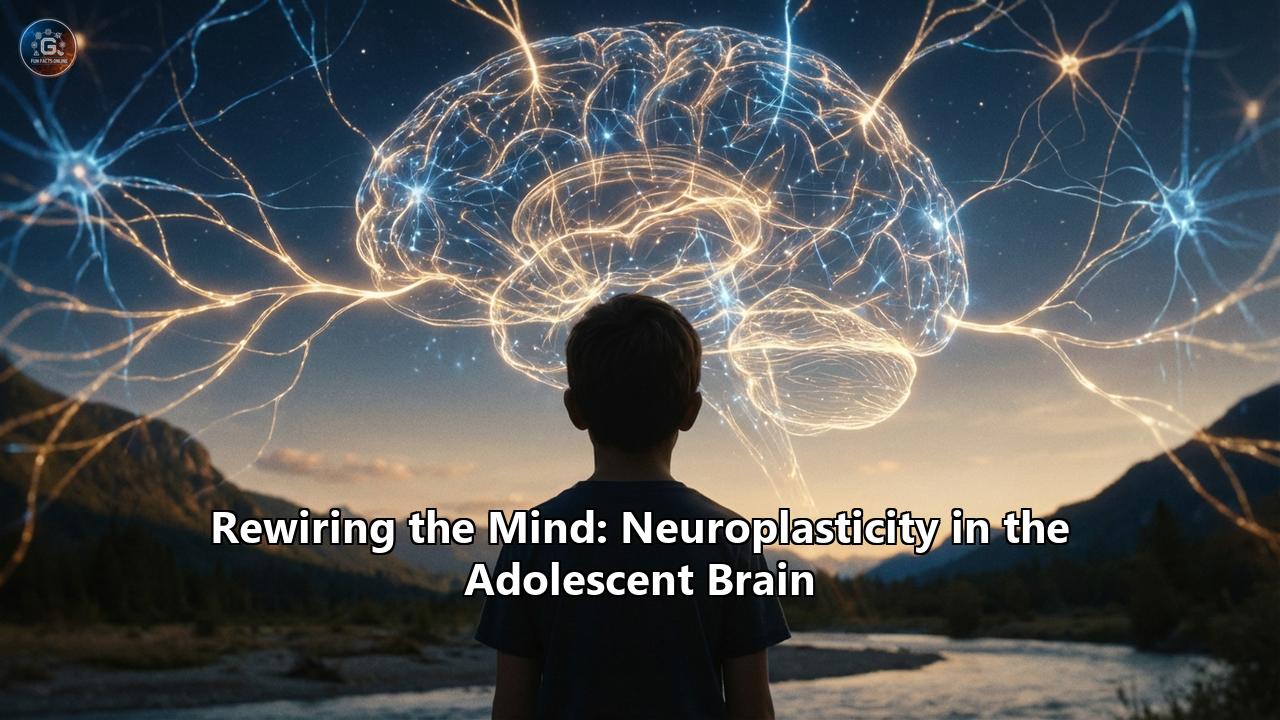
The human brain is often compared to a computer, but this analogy fails to capture its most miraculous feature: its ability to rewire itself. Nowhere is this biological alchemy more potent, more volatile, and more transformative than during the years of adolescence. For decades, society viewed the teenage years as a period of "endurance"—a time of hormonal tempests, reckless judgement, and baffling behavior that parents simply hoped to survive. The prevailing scientific view was that the brain’s most critical development occurred in the first three years of life, leaving the adolescent brain as merely a "work in progress" adult brain, fully formed but lacking experience.
We now know this is fundamentally incorrect.
Modern neuroscience has revealed that adolescence is not a period of stagnation or mere hormonal chaos, but a "second critical period" of neuroplasticity—a window of opportunity as significant as early childhood. It is a time when the brain is dismantled, reconfigured, and fine-tuned to adapt to the specific environment in which it finds itself. This process, known as "rewiring," determines the cognitive architecture that will support the individual for the rest of their life.
This article explores the mechanics of this transformation, the double-edged sword of plasticity, and how parents, educators, and adolescents themselves can harness this power to shape a more resilient, intelligent, and emotionally balanced adult mind.
Part I: The Biological Renaissance
The Great Pruning: Less is More
To understand the adolescent brain, one must first understand the concept of synaptic pruning. In childhood, the brain is an exuberant over-producer of connections. A child’s brain is like a dense jungle, with billions of neurons forging trillions of synaptic connections. This "over-wiring" allows a child to learn anything—any language, any instrument, any cultural norm—but it is inefficient. The signal-to-noise ratio is low.
As puberty hits, the brain shifts strategy. It moves from "accumulation" to "specialization." The brain begins to identify which connections are being used frequently and which are dormant. The dormant ones are ruthlessly eliminated in a process called synaptic pruning. It is a biological implementation of the "use it or lose it" principle.
During adolescence, the brain loses approximately 1% of its gray matter volume every year. While "losing brain matter" sounds alarming, it is actually a sign of maturation. The brain is carving a statue out of a block of marble; the chipping away of the stone reveals the refined form within. By eliminating weak connections, the remaining circuits become faster, more efficient, and more precise.
Myelination: The Superhighway
Simultaneously, a process called myelination is occurring. Myelin is a fatty white substance that wraps around the axons of neurons, acting like insulation on an electrical wire. This insulation prevents signal leakage and increases the speed of neural transmission by up to 100 times.
If a child’s brain is a series of winding dirt roads, the myelinated adolescent brain is a network of fiber-optic cables. This increase in speed allows for more complex cognitive processes—integration of memory with emotion, abstract reasoning, and rapid decision-making. However, this process does not happen evenly across the entire brain at once. It occurs in a wave, generally moving from the back of the brain (sensory and motor processing) to the front.
The Imbalance: The Engine and the Brakes
The chronological mismatch in this development is the source of almost all "typical" teenage behavior. The limbic system—the brain's emotional center, responsible for fear, reward, and arousal—matures early. It is fully online and highly sensitive by early adolescence. This is the "engine" of the car, and in teenagers, it is a Ferrari engine, primed for high-intensity experiences and social rewards.
The prefrontal cortex (PFC), however, is the last area to mature. Located behind the forehead, the PFC is the CEO of the brain. It is responsible for impulse control, future planning, and weighing consequences. This is the "braking system."
The result is a high-performance vehicle with a race-car engine and bicycle brakes. When a teenager drives recklessly, ignores a curfew, or engages in risky social behavior, it is not necessarily because they cannot understand the risk. In a cool, calm laboratory setting, teenagers can evaluate risk just as well as adults. But in the "heat of the moment"—when the limbic system is flooded with dopamine or social pressure—the immature PFC cannot generate enough "braking power" to override the emotional impulse.
Part II: The Chemical Symphony
The Dopamine Spike
The structural changes are driven by a potent chemical cocktail. The baseline levels of dopamine—the neurotransmitter associated with pleasure, motivation, and learning—are lower in adolescents than in adults. This means teens often feel a chronic sense of "boredom" or malaise. However, when they do experience something rewarding, the release of dopamine is significantly higher than in adults.
This "dopamine spike" explains the extreme highs and lows of adolescence. It explains why a crush feels like soul-bonding love and a minor embarrassment feels like a death sentence. The brain is wired to seek out experiences that trigger this release, driving adolescents toward novelty, sensation-seeking, and risk.
Evolutionarily, this makes perfect sense. If the brain didn't reward risk and novelty, a young human would never leave the safety of the family cave to find a mate or new hunting grounds. The "risk-taking" is a feature, not a bug; it is nature's way of pushing the fledgling out of the nest.
Oxytocin and the Social Hunger
Alongside dopamine, the adolescent brain becomes hyper-sensitive to oxytocin, the "bonding hormone." This makes social connections visceral and vital. To an adult, a friend not texting back is an annoyance; to a teen, it triggers a neural pain response similar to physical injury.
This social sensitivity is the primary driver of neuroplasticity during these years. The brain is trying to calibrate itself to the social hierarchy of its peers. It is asking: What do I need to do to belong? to be respected? to be loved? The answers it finds—whether they involve academic excellence, athletic prowess, or delinquent behavior—will shape the neural pathways that persist into adulthood.
Part III: The Digital Architect
In previous centuries, the adolescent brain was shaped by the village, the tribe, and the natural world. Today, it is shaped by Silicon Valley. The digital environment is not just a "distraction"; it is a potent neuro-modulator that interacts directly with the plastic nature of the teen brain.
The Algorithmic Loop
Social media platforms are engineered to exploit the specific vulnerabilities of the adolescent brain. The "pull-to-refresh" mechanism is a variable reward schedule, identical to a slot machine. Because the reward (a like, a comment, a funny video) is unpredictable, the dopamine system stays in a state of hyper-arousal.
For a brain currently pruning its connections, this is significant. If a teen spends six hours a day scrolling TikTok, the brain interprets this as a "survival skill." It devotes massive resources to the visual processing of rapid-fire images and the social processing of micro-validation. Conversely, the circuits required for sustained, deep attention—reading a long book, solving a complex math problem without interruption—are used less. Following the "use it or lose it" rule, these deep-focus circuits risk being pruned away.
The Video Game Paradox
Video games offer a more nuanced example of environmental plasticity. Not all screen time is created equal. "Action" video games (like first-person shooters) have been shown to improve visual-spatial attention, reaction time, and the ability to track multiple objects. These games train the brain’s "attentional spotlight" to be wider and faster.
However, the mechanism of reward in games—instant feedback, clear progress bars, achievable goals—is rarely found in the real world. A brain rewired to expect a "level up" every 30 minutes may struggle with the slow, invisible progress of learning a language or building a relationship. This mismatch can lead to "motivational deficits" in real-world tasks, not because the teen is lazy, but because their brain has been calibrated to a different density of reward.
Part IV: The Learning Window
While the plasticity of adolescence poses risks, it also offers unparalleled opportunities for skill acquisition. This is the "golden age" for complex learning.
The Musician’s Advantage
Research on musical training illustrates the physical reality of rewiring. Adolescents who practice an instrument show thickening in the corpus callosum—the bridge between the left and right hemispheres. This allows for superior communication between the analytical and creative sides of the brain. Importantly, studies show that even if a child didn't start at age four, starting in adolescence still yields significant structural changes. The window is still open.
Language and the "Native" Myth
It is often said that you cannot learn a language perfectly after age 10. While it is true that "native-like" accent acquisition becomes harder, the adolescent brain is actually better at learning the grammar and vocabulary of a new language than a young child, due to superior metacognition (thinking about thinking). The difference is the strategy: children "absorb" language implicitly; adolescents must "learn" it explicitly. The plasticity of the teen years allows for rapid fluency if the learner is immersed, leveraging the social nature of the brain. If learning French becomes a social survival mechanism (e.g., a study abroad trip), the adolescent brain will absorb it with startling speed.
Part V: The Dark Side of Plasticity
The openness of the adolescent brain makes it vulnerable to toxicity.
Stress and the Amygdala
Chronic stress during adolescence can be neurotoxic. High levels of cortisol (the stress hormone) can arrest the growth of the hippocampus, the region responsible for memory and learning. Simultaneously, stress enlarges the amygdala, the fear center.
A teen growing up in a high-stress environment (poverty, domestic instability, high-pressure schooling) may literally grow a brain wired for "threat detection" rather than "exploration." This manifests as anxiety, hyper-vigilance, and reactivity in adulthood. The "brakes" of the prefrontal cortex may never fully develop the capacity to calm the overactive "engine" of the amygdala.
The Sleep Crisis
Sleep is when the "save button" is hit. During REM sleep, the brain consolidates what it learned during the day and cleans out neurotoxins. Adolescents have a biological "phase delay"—their circadian rhythms shift, making them naturally wakeful until late at night.
When early school start times force them awake at 6:00 AM, they are chronically sleep-deprived. This is not just about being tired. It is about missing the critical window for memory consolidation and synaptic pruning. A sleep-deprived teen brain is a plastic brain that is being denied the raw materials it needs to build itself.
Part VI: The Toolkit for Rewiring
Understanding neuroplasticity shifts the paradigm from "fixing a broken teen" to "optimizing a developing supercomputer." Here are evidence-based protocols for parents, educators, and adolescents.
1. The "Pause" Protocol (For Parents)
Since the teen PFC (brakes) is slow, parents must act as the "external frontal lobe." However, this doesn't mean controlling them. It means scaffolding their decision-making.
- The Strategy: When a teen wants to do something risky, do not say "No." Ask "How?"
- Prompts: "What is the plan if X happens?" "How will you get home if the driver drinks?"
- The Neuroscience: This forces the teen’s PFC to come online and simulate the future. You are training their brain to run "if-then" scenarios, strengthening the synaptic pathways for foresight.
2. Positive Risk-Taking (For Educators)
Teens need dopamine. If they don't get it from healthy risks, they will get it from unhealthy ones.
- The Strategy: Encourage "positive risks"—activities that have a chance of failure and high social visibility but are safe.
- Examples: Auditioning for a play, running for student council, rock climbing, competitive debate.
- The Neuroscience: These activities trigger the same dopamine and adrenaline rush as reckless driving or drug use, but they wire the brain for resilience, mastery, and social competence.
3. Metacognition Training (For Students)
Teens can consciously rewire their own anxiety.
- The Strategy: Mindfulness practices like the "Three Minute Breathing Space" or CBT (Cognitive Behavioral Therapy) journaling.
- The Neuroscience: When a teen feels anxious and observes the anxiety rather than becoming it, they activate the prefrontal cortex to dampen the amygdala. Repeated practice strengthens this "top-down" control circuit, physically shrinking the amygdala over time.
4. The Dopamine Detox (For Everyone)
To reclaim attention spans, we must re-sensitize the dopamine receptors.
- The Strategy: "Tech-free zones" or "Tech-free times" (e.g., no phones one hour before bed).
- The Neuroscience: By removing the constant, low-effort dopamine hits of social media, the brain re-calibrates. Tasks that seemed "boring" (like reading or walking) begin to feel rewarding again as the dopamine baseline resets.
Conclusion: The Second Birth
Adolescence is not a disease to be cured; it is a second birth. It is the moment when the individual steps out of the genetic and familial programming of childhood and begins to write their own source code.
The intensity, the moodiness, the risk-taking—these are not flaws. They are the sound of a brain revving up its engines, testing its limits, and preparing to leave the nest. By understanding the science of neuroplasticity, we can stop fighting against the tide of adolescent development and instead learn to surf it. We can provide the environments, the challenges, and the support that allow this pliable, powerful brain to wire itself for wisdom, resilience, and joy.
The adolescent brain is not broken. It is merely under construction. And the architecture built during these years will house the adult for the rest of their life.
Reference:
- https://consensus.app/search/longitudinal-studies-on-music-training-and-cogniti/UYXPN88MRjKE7iUlg2NQcA/
- https://brainwave.org.nz/article/understanding-adolescent-risk-taking/
- https://www.brainfacts.org/thinking-sensing-and-behaving/childhood-and-adolescence/2025/teens-take-risks-we-should-be-happy-they-do-081225
- https://www.talktoangel.com/blog/adolescent-brain-s-reward-system-and-risk-taking-behaviors
- https://www.youtube.com/watch?v=DryHvm8-jxw
- https://pmc.ncbi.nlm.nih.gov/articles/PMC11804976/
- https://nurturingtomorrow.org/2025/11/10/hooked-on-dopamine-how-social-media-shapes-teen-mental-health/