
A fascinating aspect of Albert Einstein's special theory of relativity is how it predicts that objects moving at speeds approaching the speed of light undergo peculiar transformations in their length and the passage of time, relative to a stationary observer. While many of these relativistic effects, like length contraction (also known as Lorentz contraction), have been experimentally verified, one intriguing visual phenomenon, the Terrell-Penrose effect, eluded direct observation for decades.
Proposed independently by physicists James Terrell and Roger Penrose in 1959, the Terrell-Penrose effect, also sometimes referred to as Terrell rotation or the Lampa-Terrell-Penrose effect due to earlier work by Anton Lampa in 1924, describes a counterintuitive visual distortion. Contrary to the simple expectation that an object moving at relativistic speeds would merely appear compressed in its direction of motion, Terrell and Penrose predicted that it would instead appear rotated. This apparent rotation isn't a physical rotation of the object itself but rather an optical illusion arising from the interplay of two key factors: Lorentz contraction and the finite speed of light.
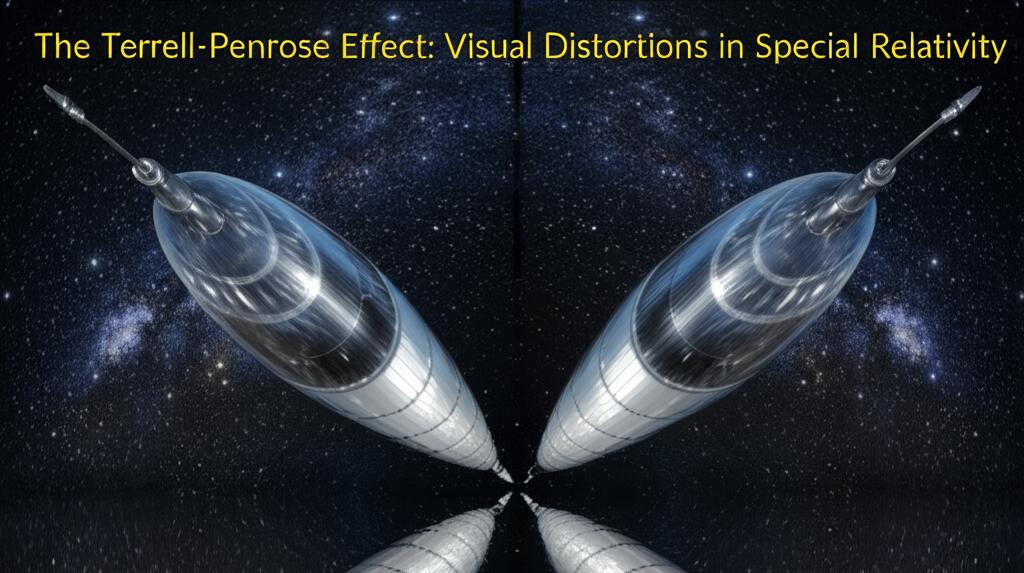
Imagine trying to photograph a rocket корабль (korabl') speeding past at, say, ninety percent the speed of light. Due to Lorentz contraction, the rocket would indeed be physically shorter than its length at rest. However, the image captured by a camera (or perceived by our eyes) is not an instantaneous snapshot of the object in its entirety. Light from different parts of the rocket takes different amounts of time to reach the observer. Light from the parts of the rocket farther away must be emitted earlier to arrive at the camera at the same instant as light from the closer parts. When the object is moving at near light speed, the distances covered by the object during these tiny time differences in light travel become significant.
This combination of the object's physical contraction and the differential travel times of light from its various points results in the object appearing rotated. For example, a cube moving at relativistic speeds wouldn't look like a flattened cuboid but rather as if it were twisted or rotated. Interestingly, a sphere, while also subject to these effects, would still appear as a sphere, though its surface features, like a "North Pole," would seem to be in a different position.
The challenge in observing the Terrell-Penrose effect directly has been the immense technological hurdle of accelerating macroscopic objects to speeds where these visual distortions become apparent. However, in a groundbreaking development reported in May 2025, physicists from TU Wien and the University of Vienna successfully demonstrated the Terrell-Penrose effect in a laboratory setting for the first time.
Their ingenious approach didn't involve physically accelerating objects to near light speed. Instead, they simulated the conditions by effectively "slowing down" the speed of light. Using ultra-short laser pulses and high-speed precision cameras, the researchers moved objects like a cube and a sphere within the lab. They meticulously recorded the laser flashes reflected from different points on these objects at different times. By precisely synchronizing the laser flashes and the camera's operation, they created a scenario equivalent to light moving at a mere two meters per second.
The team then combined these carefully timed still images to create short video clips. The results were strikingly consistent with the predictions made by Terrell and Penrose over six decades ago. The cube appeared twisted, and while the sphere remained spherical, its orientation seemed altered.
This experimental confirmation is a significant milestone, not only reaffirming a key prediction of Einstein's special relativity but also opening new avenues for visualizing and understanding complex relativistic phenomena. The technique developed by the Vienna researchers could potentially be adapted to demonstrate other thought experiments in relativity, making the often counterintuitive concepts of special relativity more accessible. The work also serves as a tribute to earlier physicists like Anton Lampa, whose foundational explorations into the visual perception of relativistic length contraction paved the way for Terrell and Penrose's insights. This recent achievement underscores the enduring power of theoretical predictions and the innovative spirit of experimental physics.