
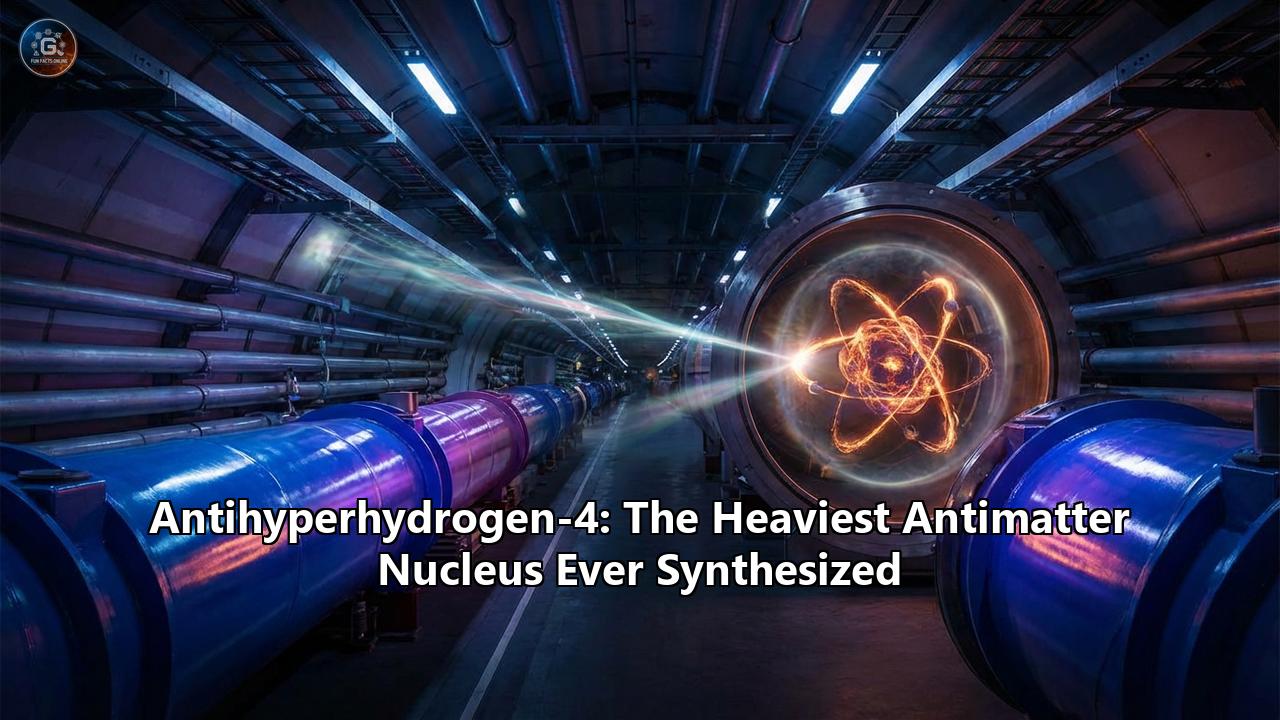
In the vast, subatomic debris of a machine built to recreate the Big Bang, a ghost appeared. It was a fleeting apparition, surviving for barely a fraction of a nanosecond, but its existence has rewritten the record books of physics. It is Antihyperhydrogen-4, a clump of antimatter so exotic and heavy that its discovery is being hailed as a milestone in our quest to understand the very fabric of the universe.
For decades, scientists have hunted for the "mirror universe"—the realm of antimatter that should, by all rights, be as abundant as the stars and galaxies we see today. Instead, it is missing. We live in a universe of matter, a lopsided reality that defies the fundamental symmetries of physics. To solve this mystery, researchers at the Relativistic Heavy Ion Collider (RHIC) in New York have been smashing gold ions together at nearly the speed of light, melting protons and neutrons into a primordial soup to see what bubbles up.
In August 2024, they found something extraordinary: the heaviest antimatter nucleus ever synthesized. This is the story of that discovery, the mind-bending physics behind it, and what this "strange" antimatter tells us about the origins of everything.
Part I: The Antimatter Enigma
To understand why Antihyperhydrogen-4 is such a monumental discovery, we must first confront the greatest detective story in the history of science: The Case of the Missing Antimatter.
The Mirror UniverseIn 1928, the physicist Paul Dirac formulated an equation that combined quantum mechanics with special relativity. It was a brilliant piece of mathematics, but it had a quirk: it allowed for particles with negative energy. Dirac realized that for every particle of matter (like an electron), there must exist a "mirror" particle with the same mass but opposite electric charge. He called it antimatter.
When matter meets antimatter, they annihilate instantly, releasing a burst of pure energy. This isn't just science fiction; it is a daily reality in particle physics. Bananas emit antimatter (positrons) as they decay, and PET scans in hospitals use these antiparticles to map the human brain.
The Great AsymmetryAccording to the Standard Model of cosmology, the Big Bang should have produced equal amounts of matter and antimatter. They should have annihilated each other completely in the first instants of cosmic time, leaving behind nothing but a sea of light.
But that didn't happen. We are here. The stars are here. Somehow, matter won the war. Roughly one billion and one particles of matter survived for every one billion particles of antimatter that were destroyed. This tiny imbalance—this "broken symmetry"—is the reason existence is possible. But what caused it?
Physicists believe the answer lies in subtle differences between matter and antimatter, violations of a rule called CPT Symmetry (Charge, Parity, and Time reversal). To find these differences, they need to study antimatter closely. But you can't just catch it in a jar; it explodes upon contact with air. You have to make it, and you have to make it heavy.
Part II: Anatomy of a Monster
Antihyperhydrogen-4 is not your garden-variety antimatter. It is a "hypernucleus," a rare and exotic breed of atomic core that contains a "strange" quark.
Breaking Down the ComponentsNormal atomic nuclei are made of protons and neutrons. These, in turn, are made of "up" and "down" quarks.
- Proton: 2 up quarks, 1 down quark.
- Neutron: 1 up quark, 2 down quarks.
Antihyperhydrogen-4 is the "anti" reflection of a very specific, unstable isotope of hydrogen. Its composition is a heavy metal band of subatomic particles:
- One Antiproton: The negatively charged twin of the proton.
- Two Antineutrons: The neutral twin of the neutron.
- One Anti-Lambda Hyperon: This is the special ingredient.
A Lambda particle is a "hyperon"—a baryon that contains a strange quark (or in this case, an anti-strange quark). Strange quarks are heavier cousins of the up and down quarks. Their presence makes the nucleus "hyper."
Because the Anti-Lambda particle is heavier than a proton or neutron, Antihyperhydrogen-4 is massive. In fact, it is the heaviest antimatter nucleus ever detected. It tips the scales significantly higher than Antihelium-4 (the previous record holder), despite both having a "baryon number" of 4. The extra mass comes from that heavy, exotic anti-strange quark lurking inside.
Part III: The Forge of the Gods
How do you create such a complex object? You need a machine that can melt atoms.
The Relativistic Heavy Ion Collider (RHIC)Located at Brookhaven National Laboratory (BNL) on Long Island, RHIC is a 2.4-mile atomic racetrack. It operates on a principle of brute force. It strips the electrons off gold atoms and accelerates the heavy nuclei to 99.995% the speed of light.
When two of these gold nuclei collide head-on, the energy density is so extreme that it momentarily exceeds the temperature of the sun by hundreds of thousands of times (trillions of degrees Celsius). At this temperature, the boundaries between protons and neutrons dissolve. The quarks and gluons inside them are liberated, creating a state of matter known as Quark-Gluon Plasma (QGP).
This plasma is a time machine. It recreates the conditions of the universe as it existed microseconds after the Big Bang.
The Soup of CreationIn this cooling fireball, quarks and antiquarks condense out of the vacuum E=mc² style. They frantically grab partners to form new particles. Most form pions (simple pairs of quarks). Some form protons and antiprotons.
But in very rare events—true "needles in a haystack"—particles group together in just the right way to form complex nuclei. To make Antihyperhydrogen-4, the chaotic soup has to spontaneously spit out an antiproton, two antineutrons, and an anti-Lambda hyperon all within a fraction of a femtometer of each other, moving in the same direction, at the same speed, so they can bind together before flying apart.
The odds of this happening are astronomically low. And yet, the STAR detector was watching.
Part IV: The Discovery
The STAR (Solenoidal Tracker at RHIC) detector is a house-sized camera that tracks the thousands of particles erupting from every collision. It doesn't "see" the particles directly; it records their ionization trails in gas, measuring their curvature in a magnetic field to determine their charge and momentum.
Needle in a HaystackThe research team, led by physicists from the Institute of Modern Physics (IMP) of the Chinese Academy of Sciences, sifted through the data from 6.6 billion collisions.
They weren't looking for the Antihyperhydrogen-4 itself. The nucleus is unstable; it decays after traveling only a few centimeters. Instead, they were looking for its "fingerprint"—the specific debris it leaves behind when it falls apart.
The Decay ChannelWhen Antihyperhydrogen-4 dies, it undergoes a very specific decay:
- The Anti-Lambda inside the nucleus decays into an Antiproton and a Pion (π+).
- This new antiproton joins the existing antiproton and two antineutrons to form a stable Antihelium-4 nucleus.
- The Pion (π+) flies off.
So, the researchers looked for tracks of Antihelium-4 and positive Pions that seemed to originate from the same point in space away from the main collision. This "secondary vertex" is the smoking gun. It proves that a neutral or charged parent particle flew out of the fireball, survived for a moment, and then decayed.
The SignalAfter filtering billions of events, the computer algorithms found them. Amidst the noise, they identified 16 candidates.
It sounds small, but in high-energy physics, 16 clear events of such a complex antiparticle is a landslide. The statistical significance was undeniable. They had found it.
Part V: Why It Matters
The discovery of Antihyperhydrogen-4 is not just a stamp-collecting exercise for the periodic table of antimatter. It is a stress test for the laws of physics.
1. Testing CPT SymmetryThe fundamental theorem of CPT symmetry states that matter and antimatter should be perfect mirror images. They should have the exact same mass and the exact same lifetime (half-life).
The researchers measured the lifetime of Antihyperhydrogen-4 and compared it to its matter counterpart, Hyperhydrogen-4.
- Result: Their lifetimes were identical within the margin of error.
While this might seem like a "boring" result (no new physics found), it is actually a triumph for the Standard Model. It confirms that even in heavy, strange, composite objects, the symmetry between matter and antimatter holds strong. If there had been a difference, it would have cracked the foundation of modern physics.
2. Understanding Neutron StarsHypernuclei (matter with strange quarks) are thought to exist in the ultra-dense cores of neutron stars. By studying how these particles bind and interact—even in their antimatter forms—scientists gain data on the "strong force" interactions that prevent neutron stars from collapsing into black holes. Antihyperhydrogen-4 provides a new data point for these extreme environments.
3. The Nucleosynthesis of AntimatterThe fact that we can produce such heavy antimatter clusters tells us about how nuclei form in the quark-gluon plasma. It supports a model called coalescence, where particles swimming close to each other in the cooling plasma "clump" together. This helps cosmologists understand how the first nuclei formed in the early universe.
Part VI: The Future of Antimatter
The discovery of Antihyperhydrogen-4 is likely the limit of what we can find for a while. As you add more particles to a nucleus, the probability of creating it drops exponentially. To find the next heaviest antimatter nucleus (perhaps Antihyperhelium-5?), we would need collision rates hundreds or thousands of times higher than what RHIC can currently provide.
However, the future is bright. The ALICE experiment at the Large Hadron Collider (LHC) in Europe is also hunting for these exotic nuclei. Future upgrades to RHIC and the construction of new facilities like the Electron-Ion Collider (which will reuse RHIC's tunnel) will continue to push the boundaries.
For now, Antihyperhydrogen-4 reigns supreme. It is the king of antimatter—a heavy, strange, paradox of a particle that shouldn't exist, yet briefly did, reminding us that the universe is far more complex and symmetrical than our daily lives suggest.
Conclusion
In the flash of a gold-on-gold collision, humanity has glimpsed the mirrored edge of reality. We have forged the heaviest piece of the "anti-world" ever seen. While it didn't solve the mystery of why we exist (the matter/antimatter asymmetry remains), it proved that our understanding of the mirror world is precise.
We are capable of recreating the Big Bang. We are capable of catching ghosts. And in the 16 tiny tracks left by Antihyperhydrogen-4, we see the beautiful, terrifying symmetry of a universe that, but for a tiny roll of the cosmic dice, might have been made entirely of antimatter.
Reference:
- https://scitechdaily.com/unmasking-antihyperhydrogen-4-the-heaviest-antimatter-hypernucleus-ever-discovered/
- https://www.iasgyan.in/daily-current-affairs/heaviest-antimatter-particle-9
- https://english.cas.cn/head/202408/t20240819_683185.shtml
- https://www.rdworldonline.com/researchers-discover-the-heaviest-antimatter-hypernucleus-ever-observed/
- https://english.cas.cn/newsroom/cas_media/202408/t20240826_684016.shtml
- https://www.livescience.com/physics-mathematics/particle-physics/scientists-discover-the-heaviest-antimatter-particle-ever-and-it-could-hold-secrets-to-our-universes-origins
- https://scienceinpoland.pl/en/news/news%2C104606%2Cphysicists-produce-heaviest-exotic-antimatter-nucleus-date-antihyperhydrogen-4
- https://www.bnl.gov/newsroom/news.php?a=121912
- https://www.eurekalert.org/news-releases/1055236
- https://www.sci.news/physics/antihyperhydrogen-4-13197.html