
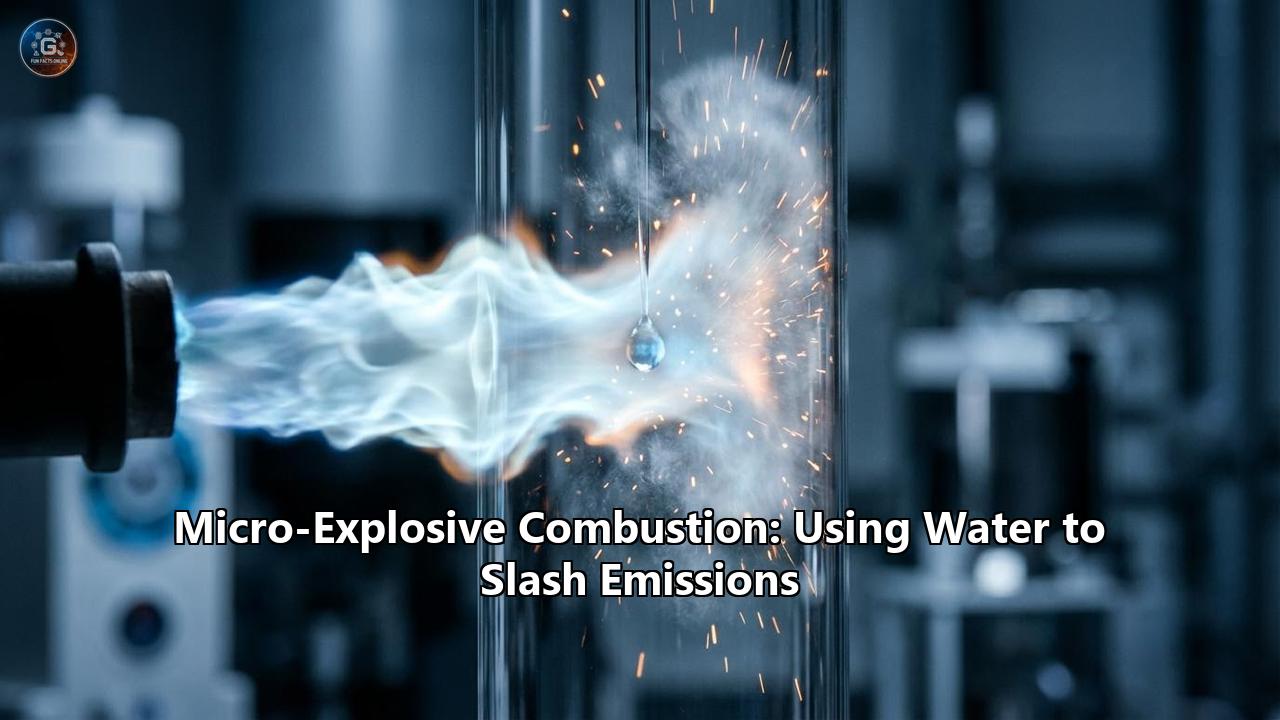
Fire and water are the ultimate elemental adversaries. For thousands of years, human civilization has relied on water to extinguish flames. Yet, in a fascinating twist of thermodynamics and chemical engineering, modern science has turned this ancient rivalry on its head. By deliberately injecting water into the fiery heart of an internal combustion engine or an industrial furnace, engineers are unlocking a paradoxical phenomenon: a cleaner, more efficient, and vastly more environmentally friendly burn.
This counterintuitive marvel is driven by a process known as micro-explosive combustion. At the intersection of fluid dynamics, thermal physics, and physical chemistry, micro-explosive combustion leverages the unique properties of water-in-fuel emulsions to literally blow apart fuel droplets from the inside out. The result? A dramatic slashing of toxic emissions—such as nitrogen oxides (NOx) and particulate matter (PM)—coupled with a boost in combustion efficiency.
As the world races toward stringent environmental regulations, from the International Maritime Organization’s (IMO) Tier III standards to the Euro 6 limitations, the heavy industries that power our global economy are desperate for transitional technologies. Micro-explosive combustion stands out as a brilliantly elegant solution that requires little to no engine retrofitting while delivering immediate, massive reductions in greenhouse gases and toxic pollutants.
To truly understand how adding water to fire saves the air, we must journey into the microscopic world of a fuel droplet during the violent, split-second chaos of combustion.
The Paradox of Water-in-Fuel Emulsions
If you pour water into a standard diesel fuel tank, you will ruin the engine. The two liquids are famously immiscible; they separate, causing the water to sink to the bottom where it rusts fuel lines, destroys lubricity, and shatters high-pressure fuel pumps.
However, when water and oil are forcefully blended with the help of a chemical binding agent known as a surfactant (surface active agent), they form an emulsion. In a Water-in-Diesel Emulsion (WiDE) or a heavy fuel oil emulsion, the oil acts as the "continuous phase" while the water becomes the "dispersed phase". Imagine millions of microscopic water balloons floating in a sea of liquid fuel. The surfactant, which features a hydrophilic (water-loving) head and a lipophilic (oil-loving) tail, wraps around these tiny water droplets, preventing them from coalescing and separating out of the oil.
When this engineered, milky-white emulsified fuel is injected into the scorching, high-pressure environment of a combustion chamber, the stage is set for a violent and highly beneficial physical reaction.
The Physics of the Pop: Decoding Micro-Explosion
To generate power, a diesel engine compresses air until it becomes superheated, and then atomizes liquid fuel into this inferno. The fuel must evaporate into a gas before it can ignite and burn. In a traditional engine, the fuel injector handles this "primary atomization," breaking the fuel stream into fine droplets. However, even the best fuel injectors leave droplets that are relatively large on a microscopic scale. These traditional droplets burn from the outside in, often leaving a fuel-rich, oxygen-starved core that turns into unburned black soot (particulate matter).
Emulsified fuels fundamentally rewrite this process through secondary atomization.
When an emulsified droplet enters the combustion chamber, it is subjected to intense convective and radiative heat. Because water and diesel fuel have vastly different boiling points, they do not heat up and vaporize at the same rate. Water boils at 100°C (at atmospheric pressure), while diesel fuel and heavy fuel oils have much higher boiling ranges, typically between 150°C and 350°C or higher.
Here is the microsecond-by-microsecond timeline of a micro-explosion:
- Transient Heating: The emulsified droplet enters the hot combustion chamber. Heat transfers rapidly from the compressed air to the surface of the oil droplet.
- Superheating the Water: The heat penetrates the continuous oil phase and reaches the dispersed water droplets trapped inside. Because the surrounding oil has not yet reached its own boiling point, it remains a liquid, acting as a pressure vessel. The water inside is rapidly heated past its normal boiling point, becoming a superheated liquid.
- Nucleation and Bubble Growth: At a critical threshold, vapor bubbles nucleate inside the trapped water droplets. This can be homogeneous nucleation (spontaneous vapor formation) or heterogeneous nucleation (forming on microscopic impurities or the water-oil interface).
- The Puffing Stage: Before a full explosion, the droplet may undergo "puffing." As smaller water droplets near the surface boil, they forcefully eject small jets of vapor and oil, causing the main droplet to distort and fluctuate violently in size. This puffing action alone increases the surface area and speeds up evaporation.
- The Micro-Explosion: As the internal water reaches its superheated limit, it undergoes an instantaneous phase change into steam. When water turns to steam, it expands volumetrically by roughly 1,700 times. This massive, instantaneous expansion vastly exceeds the surface tension of the surrounding oil. The oil droplet is violently shattered from the inside out, tearing the parent droplet into thousands of vastly smaller "child" droplets.
- Mist Formation: Recent high-speed imaging studies and digital image processing have revealed that this violent rupture can actually generate a highly localized micro-mist. As the droplet fragments and vaporizes, localized temperature drops caused by the rapid expansion can even cause some vapor to briefly condense into a fine mist, further propagating the dispersion of combustible material.
This secondary atomization is the holy grail of combustion physics. By blowing the parent droplet into thousands of microscopic fragments, the fuel's total surface area increases exponentially. These minuscule child droplets mix perfectly with the surrounding oxygen, ensuring a lightning-fast, highly uniform, and incredibly clean burn.
The Chemistry of Clean: How Water Slashes Emissions
The modern internal combustion engine faces a dual-headed environmental demon: Nitrogen Oxides (NOx) and Particulate Matter (PM).
Historically, diesel engine designers faced the infamous "diesel dilemma" or the "NOx-PM trade-off". If you tune an engine to run hotter and leaner to burn up all the soot (PM), the extreme temperatures cause nitrogen and oxygen in the air to fuse, creating toxic NOx. If you cool the combustion down to prevent NOx formation, the fuel doesn't burn completely, resulting in heavy, black clouds of toxic soot.
Micro-explosive combustion via water emulsion breaks this trade-off entirely, allowing for the simultaneous reduction of both pollutants.
1. Squelching Nitrogen Oxides (NOx)
Nitrogen oxides are primary contributors to smog, acid rain, and respiratory diseases. They are formed primarily through the Zeldovich mechanism, which is highly temperature-dependent. When combustion temperatures exceed roughly 1,500°C, the inert nitrogen ($N_2$) in the intake air breaks apart and reacts with oxygen.
Water acts as an internal chemical heat sink. Because water possesses an exceptionally high specific heat capacity and a high latent heat of vaporization, the phase change from liquid to steam absorbs a massive amount of thermal energy from the surrounding flame. This localized cooling effect lowers the peak flame temperature just enough to fall below the critical threshold for rapid NOx formation. Studies show that depending on the water content (typically ranging from 5% to 20%), NOx emissions can be slashed drastically, easily bringing older engines into compliance with modern regulatory standards. In some applications combining water injection with non-thermal plasma (NTP), NOx has been shown to drop by nearly 12% to 38% without major mechanical redesigns.
2. Obliterating Particulate Matter (PM) and Soot
Soot is born in the rich, oxygen-deprived inner core of a burning fuel droplet. Because micro-explosions shatter the fuel droplets into microscopic fragments, oxygen can instantly reach every molecule of the hydrocarbon fuel. The improved air-fuel mixing completely eliminates the rich core zones where unburned carbon chains agglomerate into soot. Furthermore, the presence of water vapor supplies hydroxyl radicals (OH) during the chemical reaction, which actively oxidize and burn away any nascent soot precursors before they can grow into larger particulate matter. The result is an exhaust stream that is virtually entirely free of the characteristic black smoke associated with heavy diesel and fuel oils.
3. Carbon Monoxide (CO) and Unburned Hydrocarbons (HC)
The impact of emulsified fuels on Carbon Monoxide and Hydrocarbons can be complex and depends heavily on the engine's operating parameters. On one hand, the enhanced mixing from the micro-explosion promotes complete combustion, which should theoretically reduce CO and HC. On the other hand, the cooling effect of the water can sometimes quench the flame too early near the cylinder walls, leading to slight increases in CO. However, engineers have found that by precisely tuning the ignition timing—which can be advanced safely because water suppresses engine knocking—and optimizing the surfactant blend, HC and CO emissions can be controlled and even reduced.
The Engineering of Emulsified Fuels
Creating a fuel that purposefully contains water is a delicate science. The effectiveness of the micro-explosion is highly stochastic—meaning it relies on probabilities and specific physical conditions. The magic happens only when the emulsion is engineered perfectly.
The Role of Surfactants
Surfactants are the unsung heroes of micro-explosive combustion. Without them, the water and oil would simply phase-separate inside the fuel tank. Surfactants are categorized by their Hydrophilic-Lipophilic Balance (HLB). For a Water-in-Oil (W/O) emulsion, a low HLB value (typically around 4 to 6) is required. Common industrial surfactants like Span 80 (Sorbitan monooleate, HLB = 4.3) are frequently used to bridge the chemical gap between the non-polar diesel molecules and the highly polar water molecules.
However, the surfactant content is a double-edged sword. Research shows that increasing the surfactant content improves the long-term stability of the emulsified fuel, allowing it to sit in a tank for months without separating. But too much surfactant creates an interfacial membrane that is too strong. If the emulsion is overly stable, the water droplets struggle to coalesce and explode violently, which reduces the probability of an intense micro-explosion and diminishes the mist formation necessary for secondary atomization. Therefore, engineers must strike a delicate balance: enough surfactant to ensure storage stability, but little enough to allow the water to violently rupture the oil drop upon heating.
Droplet Size and Water Content
The geometry of the emulsion dictates the strength of the micro-explosion. There are two vital metrics: the diameter of the overall emulsion droplet (controlled by the engine's fuel injector) and the diameter of the dispersed water particles inside the fuel (controlled by the mixing process and surfactants).
If the internal water droplets are too small (nanometer scale), they may simply dissolve or evaporate gently without building up the volumetric pressure required to shatter the oil phase. If they are too large, they can cause engine misfires or cause the fuel line to corrode. Studies indicate that a specific range of dispersed water diameter—often between 2 and 5 micrometers—combined with a water volume of 10% to 20%, yields the most violent and beneficial micro-explosions.
Emulsions vs. Direct Water Injection
It is important to distinguish emulsified fuels from Direct Water Injection (WI) or intake manifold water injection, though both share the goal of utilizing water to improve engine dynamics.
Water Injection (WI), also known historically as Anti-Detonant Injection (ADI), has a storied past. During World War II, fighter aircraft like the P-47 Thunderbolt utilized water-methanol injection to cool the intake charge. This allowed the superchargers to force massively increased amounts of air into the cylinders without the engine suffering from destructive premature detonation (engine knock). Today, companies like BMW use Bosch WaterBoost technology in high-performance engines to spray fine water mist directly into the intake tract. This cools the air, increases air density, and allows for much more aggressive ignition timing and higher compression ratios.However, direct water injection primarily provides a thermodynamic cooling benefit. Because the water is injected separately from the fuel, it does not trap water inside the fuel droplets. Therefore, direct WI cannot produce the violent micro-explosion and secondary atomization that emulsified fuels achieve.
Emulsified fuels introduce the water directly into the combustion flame area intimately bound to the hydrocarbon molecules. While both methods reduce peak temperatures and lower NOx, only the water-in-fuel emulsion method physically shatters the fuel droplets to drastically eradicate soot and particulate matter through enhanced mixing.
Real-World Applications and Heavy Industries
The sheer scale of global industry means that adopting micro-explosive combustion technologies can yield planetary-scale environmental benefits. While running passenger cars on emulsified fuel poses logistical challenges (such as the risk of water freezing in winter and the need for new fuel distribution infrastructure), large-scale industrial and commercial applications are actively deploying this technology today.
The Maritime Shipping Sector
The global shipping industry consumes hundreds of millions of tons of Heavy Fuel Oil (HFO) annually. HFO is essentially the dregs of the oil refining process—a thick, tar-like substance loaded with sulfur, heavy metals, and carbon. When burned, it produces massive plumes of black soot and extreme levels of NOx.
With the International Maritime Organization (IMO) enforcing strict Tier III NOx regulations and tightening sulfur and PM limits, shipowners are facing multi-million dollar retrofits. Emulsified fuel technology offers a plug-and-play solution. Ships can be equipped with onboard blending units that mix raw seawater (desalinated) or fresh water with HFO and surfactants right before it reaches the engine. The resulting micro-explosions break apart the highly viscous HFO, resulting in a significantly cleaner burn that complies with international law without requiring the complete replacement of massive two-stroke marine diesel engines.
Stationary Power Generation and Industrial Boilers
In remote areas, mining operations, and developing nations, stationary diesel generators and heavy oil-fired boilers provide baseline power. These units often run continuously, emitting vast quantities of localized pollution. Upgrading these plants to run on Water-in-Diesel Emulsion (WiDE) allows for an immediate, capital-efficient reduction in toxic emissions. Furthermore, because the micro-explosion enhances combustion efficiency—meaning more of the carbon is converted to useful heat rather than wasted as soot—the specific fuel consumption can be optimized.
Co-Incineration of Toxic Waste
A fascinating new frontier for micro-explosive combustion is in waste management. Cement kilns and industrial incinerators are increasingly used to dispose of multi-source organic liquid wastes. By treating these mixed, often highly toxic liquid wastes as emulsified fuels, operators can induce the micro-explosion effect. This not only reduces the combustion energy consumption required to incinerate the waste but vastly improves operational safety by ensuring complete destruction of toxic compounds, leaving Carbon Monoxide emissions at incredibly low levels.
Overcoming the Engineering Hurdles
Despite its near-magical benefits, injecting water into engines is not without its engineering challenges, many of which are the subject of intense ongoing research.
1. Corrosion and Lubricity:Internal combustion engines are built to tight tolerances using steel and iron alloys. Water introduces the constant threat of oxidation (rust). Furthermore, high-pressure diesel injection pumps rely on the fuel itself to act as a lubricant. Water possesses zero lubricity, and introducing it can accelerate wear on vital engine components. To mitigate this, modern emulsified fuels rely on specialized anti-corrosive additives and lubricity enhancers packaged within the surfactant blend.
2. The Energy Density Penalty:Water does not burn; it contains no caloric energy. Therefore, replacing 15% of a fuel tank's volume with water reduces the total energy density of the fuel. In a vehicle, this would technically mean a slightly reduced driving range per tank. However, from a thermodynamic perspective, the expansion of the superheated steam actually adds to the mechanical force pushing down on the piston. Studies show that while peak engine power might see marginal drops (e.g., ~1.7%), the engine torque can actually increase because the mass of the working fluid is expanded efficiently during the power stroke. The brake-specific fuel consumption (BSFC)—the measure of how efficiently the engine uses the combustible portion of the fuel—often remains stable or improves because less fuel is wasted as soot.
3. Phase Separation over Time:While onboard blending units solve the issue for large ships, utilizing emulsified fuels in long-term storage (like backup generators or retail gas stations) requires extreme stability. If the emulsion breaks, the engine will ingest pure water, leading to catastrophic failure. Advances in nanotechnology and nano-emulsions—where droplet sizes are reduced to the nanometer scale—are currently being tested to create permanently stable emulsified fuels that can sit on a shelf for years without separating.
The Future: Biodiesel, Nanotech, and Plasma
The future of micro-explosive combustion lies in combining it with other bleeding-edge green technologies to create truly sustainable, zero-harm combustion architectures.
Multi-Component Bio-Emulsions:As the world shifts away from fossil fuels, researchers are extensively testing micro-explosions in multi-component fuels, such as mixtures of Jatropha oil, biodiesel, and ethanol. Biodiesels often suffer from higher viscosity and poor low-temperature flow properties. By emulsifying them with water and lighter, highly volatile organic compounds like 2,5-dimethylfuran (DMF), engineers can force the heavy, thick biofuels to undergo massive micro-explosions. This unlocks the ability to efficiently burn highly viscous, next-generation renewable fuels that standard engines would normally struggle to atomize.
Non-Thermal Plasma (NTP) Integration:Recent experimental setups have combined water vapor injection with Non-Thermal Plasma (NTP) systems mounted on the intake manifold. The NTP system bombards the water vapor with high voltage, inducing electrolysis and thermolysis. This splits a fraction of the water molecules into Hydrogen ($H_2$) and Oxygen ($O_2$), alongside highly reactive hydroxyl radicals (OH). The hydrogen acts as a powerful combustion-supporting accelerant, vastly increasing the flame speed and power output, while the oxygen and hydroxyl radicals scrub the exhaust of unburned hydrocarbons and carbon monoxide. Under these conditions, torque can actually increase by over 7% while simultaneously reducing total hydrocarbons by 16% and NOx by nearly 12%.
Advanced Predictive Modeling:The chaotic nature of a microscopic explosion is difficult to optimize purely by trial and error. Today, researchers utilize Planar Laser-Induced Fluorescence (PLIF) and ultra-high-speed backlit imaging shooting at hundreds of thousands of frames per second to visually track the chaotic convection currents of water droplets inside the oil. Machine learning algorithms and deep neural networks are now being trained on this empirical data to predict the exact moment of nucleation, the intensity of the puffing phase, and the optimal surfactant ratio for any given ambient temperature and pressure.
The Ultimate Conclusion on Aqueous Combustion
Micro-explosive combustion represents one of the most poetic ironies in modern engineering: utilizing the very substance used to extinguish fires to make our fires burn brighter, cleaner, and more efficiently.
As we navigate the transition from a fossil-fuel-dominated world to an era of total electrification and hydrogen power, the reality is that heavy-duty internal combustion engines will remain the workhorses of global logistics for decades to come. Ships, generators, and industrial machinery cannot be replaced overnight. Through the mastery of water-in-fuel emulsions, we have a scientifically proven, economically viable bridge technology.
By manipulating thermodynamics at the microscopic level—forcing superheated water to shatter oil into an oxygen-hungry mist—we can effectively castrate the toxic byproducts of the diesel cycle. Micro-explosion turns the internal combustion engine against its own dirty nature, slashing NOx, obliterating soot, and buying our planet precious time and cleaner air in the relentless pursuit of a sustainable future.
Reference:
- https://pmc.ncbi.nlm.nih.gov/articles/PMC3916022/
- https://www.semanticscholar.org/paper/36d228838318db95ad217dd6d0c14d46f7745b8d
- https://www.researchgate.net/publication/235897730_Water-in-diesel_emulsion_and_its_micro-explosion_phenomenon-review
- https://kh.aquaenergyexpo.com/wp-content/uploads/2023/03/A-Review-Of-Water-Injection-Applied-On-The-Internal-Combustion-Engine.pdf
- https://dieselnet.com/tech/engine_water.php
- https://arxiv.org/html/2504.14140v1
- https://www.researchgate.net/publication/222666329_Recent_advances_in_the_combustion_of_water_fuel_emulsion
- https://pubs.aip.org/aip/pof/article/36/12/123373/3327004/An-experimental-study-on-flame-propagation-and
- https://www.researchgate.net/publication/370427602_Mist_formation_during_micro-explosion_of_emulsion_droplets
- https://www.mdpi.com/2071-1050/13/16/9229
- https://www.atlantis-press.com/article/125993991.pdf
- https://en.wikipedia.org/wiki/Water_injection_(engine))