
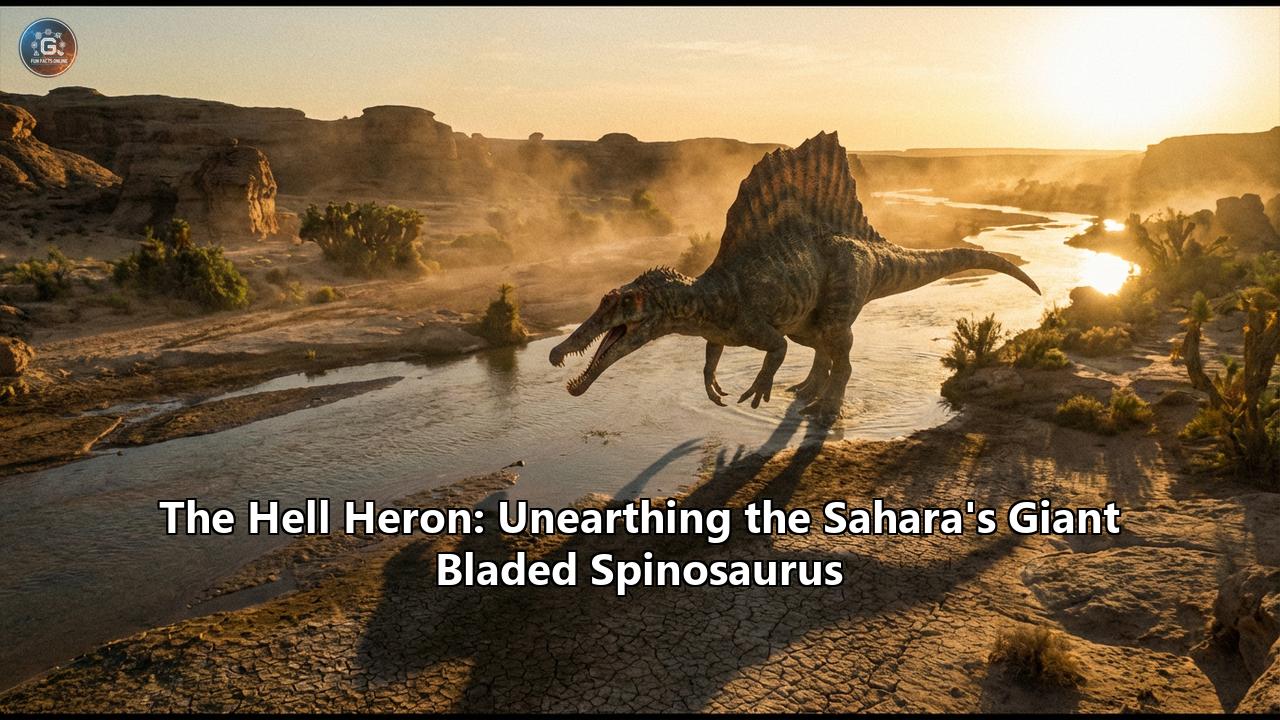
The Sahara Desert, a boundless ocean of sun-scorched dunes and jagged rock formations, seems an unlikely resting place for a river monster. Yet, beneath the arid surface of modern-day Niger lies a prehistoric secret that has just rewritten our understanding of dinosaur evolution. Imagine a predator the size of a school bus, adorned with a vibrant, scimitar-shaped blade on its head, wading through deep, slow-moving rivers to snap up massive fish in a crocodile-like jaw.
This is Spinosaurus mirabilis, a newly discovered species that paleontologists have dubbed the ultimate "hell heron". Announced to the world in early 2026, this astonishing 40-foot-long giant is the first new Spinosaurus species identified in over a century. Its unearthing not only resurrects the ghosts of Cretaceous Africa but also strikes at the heart of a decades-long debate over how the largest predatory dinosaurs lived, hunted, and dominated their watery realms.
The Trail of the Scimitar: A Decades-Old Clue
The journey to find Spinosaurus mirabilis did not begin with modern satellite imagery or ground-penetrating radar. It started with a solitary sentence scribbled by a French geologist in the 1950s, noting the presence of fossilized bones deep in the central Sahara. Decades later, a 20-member expedition team led by paleontologist Paul Sereno of the University of Chicago decided to chase that cryptic lead. Guided by a local Tuareg man who recalled seeing massive bones weathering out of the rock, the team rode motorbikes into the unforgiving depths of the Nigerien desert.
In November 2019, amidst the desolate sands of the Jenguebi fossil bed, the team spotted a blade of bone half-buried in the earth. Shaped remarkably like a scimitar, the fossil was so bizarrely proportioned that the researchers initially struggled to comprehend what they had found. It was accompanied by massive, fragmented jaw bones. The outbreak of global disruptions delayed their return, but in 2022, a larger crew descended upon the site, ultimately uncovering two additional crests, highly specialized teeth, and other crucial skeletal elements.
The defining moment of the expedition came under the canvas of a desert tent. Relying on solar power, a team member fed 3D scans of the scattered fragments into a laptop, digitally stitching the skull together for the first time. The screen illuminated a face unlike any other in the fossil record. "I'll forever cherish the moment in camp when we crowded around a laptop to look at the new species for the first time," Sereno remarked, noting the sudden, emotional realization that they had found a completely new species of Spinosaurus.
Anatomy of an "Astonishing" Giant
The scientific name Spinosaurus mirabilis translates to "astonishing spine lizard," and the moniker is well-earned. Measuring roughly 40 feet in length and weighing between 10,000 and 14,000 pounds, this apex predator rivaled the legendary Tyrannosaurus rex in sheer mass, though its body plan was radically different.
The most striking feature of S. mirabilis is its nasal-prefrontal crest. Unlike its more famous cousin, Spinosaurus aegyptiacus—the star of Jurassic Park III—which possessed a smaller, vertically fluted bump between its eyes, this new dinosaur flaunted a massive, scimitar-shaped crest that arched aggressively upward and backward over its eye sockets. Paleontologists discovered that the crest's dense bone was laced with internal blood vessel channels and covered in deep grooves, indicating it was heavily sheathed in keratin. In life, this biological billboard was likely brightly colored, serving as a visual display structure used to intimidate rivals or attract mates.
Beneath this magnificent crown lay a jaw engineered for aquatic slaughter. S. mirabilis possessed a long, slender snout filled with conical teeth that interdigitated—meaning the teeth of the lower jaw protruded outward and seamlessly locked between the teeth of the upper jaw when the mouth snapped shut. This created an inescapable trap for the slippery, heavily armored fish that populated the ancient rivers. Similar dental adaptations are seen in modern semi-aquatic crocodiles and were present in extinct flying pterosaurs, but among dinosaurs, it is the undeniable hallmark of the spinosaurid family.
The "Hell Heron" Hypothesis: Wading vs. Swimming
For years, the paleontological community has been locked in a fierce debate regarding the lifestyle of Spinosaurus. Because previous fossils of S. aegyptiacus were largely found in coastal sediments near ancient shorelines—such as the famous Kem Kem beds of Morocco—some scientists proposed that the animal was a fully aquatic pursuit predator. They envisioned a dinosaur that swam like a giant crocodile, using its paddle-like tail to dive and chase down prey in open waters.
The discovery of Spinosaurus mirabilis shatters that absolute assumption. The Jenguebi site in Niger is located between 500 and 1,000 kilometers away from any prehistoric marine shoreline. The geology of the site reveals that 95 million years ago, during the Cenomanian stage of the Late Cretaceous, this region was a forested, inland environment crisscrossed by shallow fluvial river systems. Furthermore, the riverbed deposits that yielded S. mirabilis also contained the articulated skeletons of massive, long-necked rebbachisaurid and titanosaurian sauropods. The proximity of these land-dwelling giants leaves no doubt that Spinosaurus mirabilis lived in an inland riparian habitat, far from the crashing waves of the ancient Tethys Sea.
This inland context heavily supports the "hell heron" ecological model. "I envision this dinosaur as a kind of 'hell heron' that had no problem wading on its sturdy legs into two meters of water but probably spent most of its time stalking shallower traps for the many large fish of the day," Sereno explained.
Instead of an agile underwater swimmer, picture an incredibly patient, terrifyingly massive wader. Much like modern herons, Spinosaurus mirabilis likely stood perfectly still in the shallows or waded purposefully on strong hind legs. When a giant coelacanth or lungfish swam too close, the dinosaur would strike downward with lightning speed, its dense skull and interlocking teeth instantly securing the meal. This semi-aquatic ambush strategy perfectly bridges the gap between terrestrial theropods and the highly specialized aquatic niche these dinosaurs evolved to conquer.
A Family of River Dragons: Tracing the Lineage
To truly appreciate the majesty of Spinosaurus mirabilis, one must look back at the evolutionary journey of its family tree. The term "hell heron" was actually first coined in 2021 by a different team of paleontologists working on the Isle of Wight in the United Kingdom. There, they discovered Ceratosuchops inferodios—a name that literally translates to "horned crocodile-faced hell heron".
Ceratosuchops lived around 125 million years ago, a full 30 million years before the Saharan Spinosaurus. Alongside its contemporary, Baryonyx, these early European spinosaurids (baryonychines) were smaller, measuring around 26 feet in length, but they already showcased the evolutionary shifts that would define their lineage: elongated snouts, conical teeth, and a shift away from hunting terrestrial dinosaurs to plucking fish from rivers.Paleontologists now believe that the Spinosauridae family likely originated in Laurasia—the northern supercontinent that included modern-day Europe. As continental landmasses shifted, these early river-stalkers migrated southward into Gondwana, dispersing into what is now Africa. Once there, they thrived in the vast mangrove swamps and humid river deltas of the continent. Free from the intense competition of massive terrestrial apex predators like the carcharodontosaurids, African spinosaurids evolved to monstrous proportions. The lineage split, culminating in the towering, sail-backed Spinosaurines that ruled the waterways of the Late Cretaceous.
The River of Giants: The Cretaceous Ecosystem
The world Spinosaurus mirabilis inhabited was a paradise of titanic proportions. Ninety-five million years ago, the Sahara was not a desert but a lush, humid greenhouse. The river systems were teeming with aquatic life that seems almost alien by today's standards.
The rivers of Cretaceous Niger and Morocco were choked with massive prey. There were giant, armored sawfish (Onchopristis) with snouts covered in barbed spikes, lungfish the size of modern great white sharks, and prehistoric coelacanths that weighed hundreds of pounds. To hunt these aquatic titans required a predator of equal or greater magnitude.
By adapting to a semi-aquatic lifestyle, Spinosaurus bypassed the evolutionary arms race happening on dry land. While terrestrial carnivores fought over the carcasses of sauropods, the "hell heron" monopolized the rivers, growing to a length of 40 feet because the aquatic food web was incredibly rich and entirely uncontested by other dinosaurs. Its massive dorsal sail—formed by elongated neural spines extending from its vertebrae—would have sliced through the water's surface like a shark's fin, signaling its dominance over the prehistoric waterways.
A Century of Shifting Paradigms
The revelation of Spinosaurus mirabilis marks a poetic milestone in the history of paleontology. The saga of Spinosaurus has always been fraught with mystery and tragedy. The genus was first introduced to the world in 1915 by German paleontologist Ernst Stromer, who discovered the original fossils of Spinosaurus aegyptiacus in Egypt in 1912. Stromer recognized the animal's bizarre crocodile-like jaw and massive sail, but his revolutionary findings met a catastrophic end. In April 1944, during the height of World War II, the Allied bombing of Munich completely destroyed the museum housing Stromer's holotype skeleton.
For decades, Spinosaurus was effectively a ghost, surviving only in Stromer’s surviving sketches and photographs. It wasn't until the late 20th and early 21st centuries that new fragments began emerging from the Kem Kem beds of Morocco, allowing scientists to piece together a neo-type of the beast. Over the last twenty years, the dinosaur has undergone numerous revisions—from a bipedal movie monster to a short-legged aquatic swimmer, and now, to a gigantic, wading heron.
The discovery of S. mirabilis provides a crucial new anchor in this turbulent history. By offering an entirely new species, complete with 3D-scanned cranial anatomy and a clear inland ecological context, researchers finally have a secondary reference point to understand how these animals functioned. It confirms that the spinosaur body plan was highly adaptable, capable of surviving both in coastal mangroves and deep inland forests.
The Enduring Reign of the River Kings
Today, the wind sweeps across the barren dunes of the Jenguebi fossil bed, offering no immediate hint of the vibrant, water-logged world that once existed there. But the unearthing of Spinosaurus mirabilis stands as a testament to the resilience of the fossil record and the relentless curiosity of those who seek to read it.
The "hell heron" of the Sahara is more than just a new species; it is a vivid illustration of evolutionary ingenuity. It shows us how a lineage of meat-eating dinosaurs looked at the rivers of the ancient world and saw an empire waiting to be conquered. Armed with a scimitar crest, trap-door jaws, and an unyielding patience, Spinosaurus mirabilis waded into the depths of history—and today, millions of years later, it has finally surfaced to astonish us all.
Reference:
- https://www.popularmechanics.com/science/archaeology/a70437513/new-spinosaurus-species/
- https://scitechdaily.com/new-hell-heron-spinosaurus-discovered-in-the-sahara-with-giant-blade-crest/
- https://www.smithsonianmag.com/smart-news/this-massive-meat-eating-dinosaur-was-a-hell-heron-that-waded-into-shallow-waters-to-nab-slippery-fish-180988232/
- https://www.fossilera.com/pages/spinosaurus
- https://www.thebrighterside.news/post/hell-heron-dinosaur-fossils-uncovered-in-the-central-sahara/
- https://en.wikipedia.org/wiki/Spinosaurus
- https://modernsciences.org/staging/4414/spinosaurus-century-shifting-paradigms-paleontology-june-2025/
- https://en.wikipedia.org/wiki/Ceratosuchops
- https://www.nationalgeographic.com/science/article/fierce-hell-heron-dinosaur-puts-new-wrinkles-in-spinosaurus-origin-story
- https://www.youtube.com/watch?v=iKNakcr7lYE
- https://www.eurekalert.org/news-releases/989425
- https://eartharchives.org/articles/cracking-the-secrets-of-spinosaurus/index.html
- https://en.wikipedia.org/wiki/Spinosauridae
- https://news.uchicago.edu/story/massive-hunter-prowled-waters-edge