
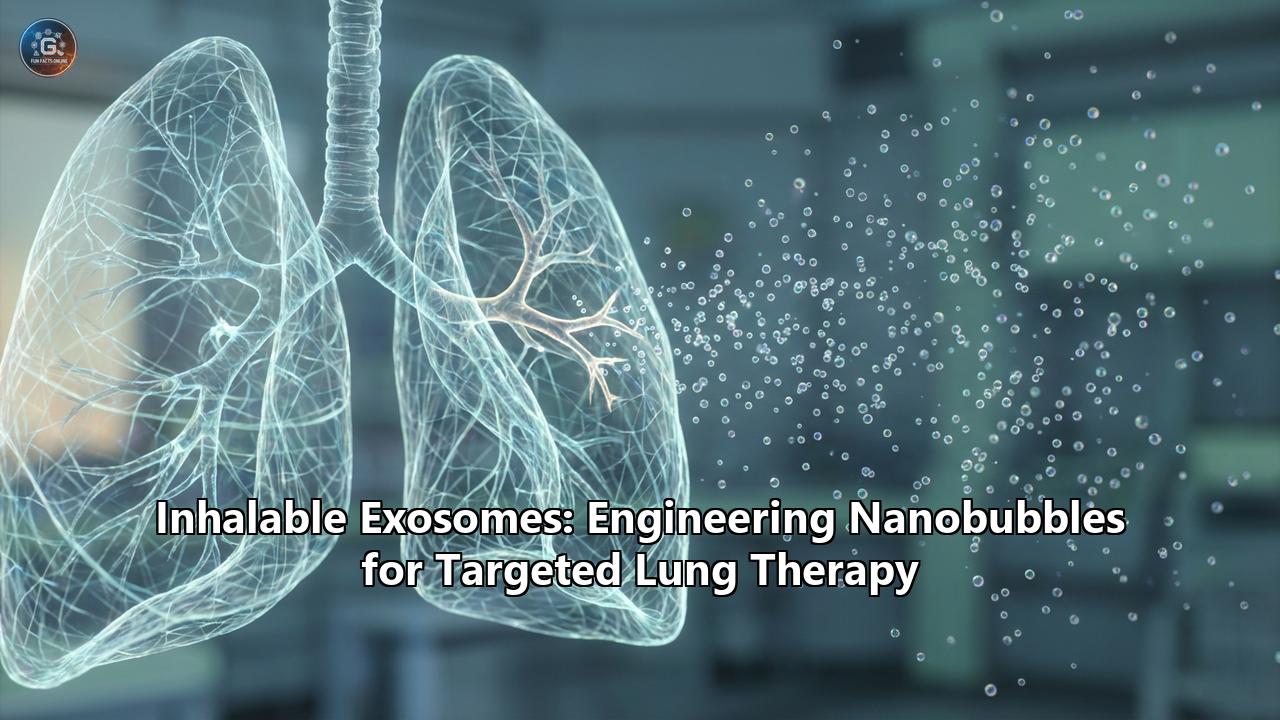
In the vast landscape of nanomedicine, a quiet revolution is taking place—not in a syringe or a pill, but in a mist. For decades, treating lung diseases has been a battle against biological barriers, systemic side effects, and the sheer complexity of the respiratory system. Traditional therapies often struggle to penetrate the deep lung or are cleared too quickly by the body’s formidable defense mechanisms. Enter the inhalable exosome: a naturally engineered "nanobubble" that promises to deliver potent therapeutics directly to the source of disease with unprecedented precision.
This is not just another drug delivery system; it is a paradigm shift. By harnessing the body’s own intercellular postal service, scientists are engineering these microscopic vesicles to treat everything from lung cancer and cystic fibrosis to idiopathic pulmonary fibrosis (IPF) and acute respiratory distress syndrome (ARDS).
Part 1: The Biological Super-Courier
Beyond the Liposome
To understand why inhalable exosomes are generating such excitement, we must first distinguish them from their synthetic cousins, liposomes and lipid nanoparticles (LNPs). While LNPs—famous for their role in COVID-19 vaccines—are triumphs of chemical engineering, they are ultimately foreign entities. The body often recognizes them as intruders, triggering immune responses or rapid clearance.
Exosomes are different. They are extracellular vesicles (EVs) naturally secreted by cells, measuring between 30 and 150 nanometers. Think of them as the body’s encrypted DMs (direct messages). They are lipid bilayers embedded with specific proteins ("surface markers") that act like address labels, allowing them to dock with specific recipient cells and unload their cargo—RNA, proteins, lipids, and signaling molecules—directly into the cytoplasm.
The "Homing" Phenomenon
One of the most critical properties of exosomes for lung therapy is tropism, or the ability to "home" in on specific tissues. Research has shown that exosomes derived from lung cells (like lung spheroid cells or bronchial epithelial cells) have an innate affinity for lung tissue. When inhaled, they don't just float aimlessly; they actively seek out their cells of origin. This "return to sender" mechanism allows for a level of passive targeting that synthetic carriers struggle to mimic.
Part 2: Engineering the "Nanobubble"
While nature provides the chassis, bioengineers are customizing the engine. "Naive" exosomes (those unmodified from the cell) have therapeutic potential, particularly those from stem cells, but the real power lies in engineered exosomes.
1. Surface Engineering: The GPS System
To ensure these nanobubbles reach the exact tumor or fibrotic lesion, scientists modify the exosome surface.
- Ligand Display: By genetically modifying the parent cells, researchers can force exosomes to display specific peptides on their surface. For example, attaching a RAGE-binding peptide helps exosomes target alveolar epithelial cells in inflamed lungs.
- Cloaking Devices: To evade the immune system even more effectively, exosomes can be engineered to display "don't eat me" signals, such as CD47, which prevents macrophages from swallowing the therapeutic payload before it reaches its target.
2. Cargo Loading: The Warhead
The interior of an exosome can be packed with a diverse arsenal of therapeutics.
- mRNA Therapeutics: A breakthrough 2024 study from Columbia University demonstrated the use of inhalable exosomes to deliver IL-12 mRNA directly to lung tumors. IL-12 is a powerful cytokine that stimulates the immune system to kill cancer, but it is too toxic to be given systemically. By encasing the mRNA in an exosome and having the patient inhale it, the therapy stays local, turning the lung tumor into its own vaccination site without wrecking the rest of the body.
- Small Molecules & Chemotherapy: Hydrophobic drugs like paclitaxel or curcumin (a potent anti-inflammatory) can be loaded into the lipid membrane of the exosome, increasing their solubility and lung retention times significantly compared to free drugs.
- CRISPR/Cas9: For genetic diseases like Cystic Fibrosis, exosomes are being explored as vectors to deliver gene-editing tools directly to the airway epithelium to correct the CFTR mutation.
Part 3: The Route of Administration – Why Inhalation?
The lung is a fortress. It is designed to keep things out. The mucus layer traps particulates, and cilia sweep them away (mucociliary clearance). However, inhalable exosomes have unique advantages in breaching these walls.
Overcoming the Mucus Barrier
Synthetic nanoparticles often get stuck in the negatively charged, dense mesh of lung mucus. Exosomes, however, possess a slightly negative surface charge and a hydrophilic (water-loving) corona that allows them to slip through mucus pores more easily than many synthetic counterparts. This "muco-penetrating" ability is vital for treating diseases like Cystic Fibrosis, where thick, sticky mucus is the primary obstacle.
The Nebulization Challenge
Not all nanoparticles survive the sheer forces of being turned into a mist. Vibrating mesh nebulizers and jet nebulizers create high shear stress that can rip liposomes apart. Exosomes are surprisingly robust. Their lipid bilayer is reinforced with proteins (tetraspanins like CD9, CD63, CD81) that provide structural integrity. Studies confirm that exosomes retain their morphology and cargo functionality even after being aerosolized, making them ideal candidates for at-home nebulizer therapy.
Part 4: Therapeutic Frontiers
Lung Cancer: Turning the Immune System On
Lung cancer remains the leading cause of cancer death, partly because the lung microenvironment suppresses the immune system. Inhalable exosomes are changing this dynamic.
- The Strategy: Instead of poisoning the tumor with chemotherapy, inhaled exosomes deliver "hot" cytokines (like IL-12) or immune-priming RNA.
- The Result: In preclinical models, this approach has triggered a "cold" tumor to become "hot," attracting T-cells and Natural Killer cells to the site. Because the delivery is local via inhalation, the systemic toxicity (cytokine storm) is virtually eliminated.
Pulmonary Fibrosis: Reversing the Scar
Idiopathic Pulmonary Fibrosis (IPF) is a progressive, fatal scarring of the lungs. Current drugs only slow the decline; they don't fix the damage.
- The Solution: Exosomes derived from Mesenchymal Stem Cells (MSCs) or Lung Spheroid Cells (LSCs) carry a "secretome"—a cocktail of regenerative microRNAs (like miR-21 and let-7) and proteins that inhibit fibrosis and promote tissue repair.
- The Breakthrough: Inhalation of these "stem cell soups" has been shown to reduce collagen deposition and improve lung function in rodent models, acting as a regenerative signal rather than just an anti-inflammatory block.
ARDS and COVID-19: Quelling the Storm
During the COVID-19 pandemic, the concept of the "cytokine storm" became household knowledge. In ARDS, the immune system overreacts, flooding the lungs with fluid.
- EXO-CD24: One of the most promising clinical candidates (developed by Nano24) uses exosomes enriched with CD24, a protein that acts as a brake on the immune system. When inhaled, these exosomes tell the overactive immune cells in the lungs to "calm down," preventing the devastating tissue damage associated with severe COVID-19 and ARDS.
Part 5: The Manufacturing Bottleneck
If inhalable exosomes are so perfect, why aren't they in every pharmacy? The answer lies in scalability.
From Petri Dish to Bioreactor
Producing exosomes is not like mixing chemicals in a vat; it requires growing billions of living cells.
- 2D vs. 3D Culture: Traditional 2D flasks are inefficient. The industry is moving toward 3D hollow-fiber bioreactors and stirred-tank bioreactors where cells grow on microcarriers. These 3D environments not only allow for higher density culture but surprisingly stimulate cells to secrete more exosomes—sometimes 10 to 100 times more than in 2D cultures.
- Purification Purgatory: Separating exosomes from cell debris, proteins, and other waste is difficult. Traditional ultracentrifugation is too slow for mass production. New techniques like Tangential Flow Filtration (TFF) and Chromatography are becoming the gold standards, allowing for the continuous purification of liters of "exosome broth."
Part 6: The Future Outlook
Regulatory Hurdles
The FDA and EMA are still writing the rulebook for exosomes. Because they are complex biological products (containing thousands of different molecules), defining "batch consistency" is hard. Regulatory agencies are currently focusing on potency assays—tests that prove a specific batch of exosomes actually works (e.g., "Does Batch A reduce inflammation in lung cells as well as Batch B?").
The Era of "Cell-Free" Cell Therapy
Inhalable exosomes represent the maturation of regenerative medicine. We have realized we don't always need to transplant the stem cell; we just need its message. By packaging that message into a nebulizable nanobubble, we are creating a future where a patient with lung cancer or fibrosis can sit at home, put on a mask, and inhale a mist that programs their own body to heal.
Conclusion
Inhalable exosomes sit at the intersection of biology and engineering. They are safe, precise, and potent. As manufacturing technologies mature and clinical trials progress, these engineered nanobubbles are poised to become the "standard of care" for respiratory diseases, turning the simple act of breathing into a powerful medical intervention.
Reference:
- https://www.sciencedaily.com/releases/2024/02/240215142239.htm
- https://www.cellgs.com/blog/exosome-therapeutics-rising-to-manufacturing-challenges.html
- https://www.enablebiotech.com/news/exosome-manufacturing-overcoming-purification-and-scalability-challenges-on-the-path-to-clinical-readiness
- https://pmc.ncbi.nlm.nih.gov/articles/PMC9095511/
- https://www.engineering.columbia.edu/about/news/study-finds-new-inhalable-therapy-big-step-forward-lung-cancer-research
- https://www.barchart.com/story/news/36632948/exosomes-clinical-trial-pipeline-gains-momentum-80-companies-lead-the-charge-in-pioneering-new-treatments-delveinsight
- https://www.creative-biostructure.com/nebulized-inhalation-exosomes.htm
- https://pmc.ncbi.nlm.nih.gov/articles/PMC9213043/
- https://pubmed.ncbi.nlm.nih.gov/41341867/
- https://www.mekostem.com/en/study-finds-new-inhalable-therapy-is-a-big-step-forward-in-lung-cancer-research/