
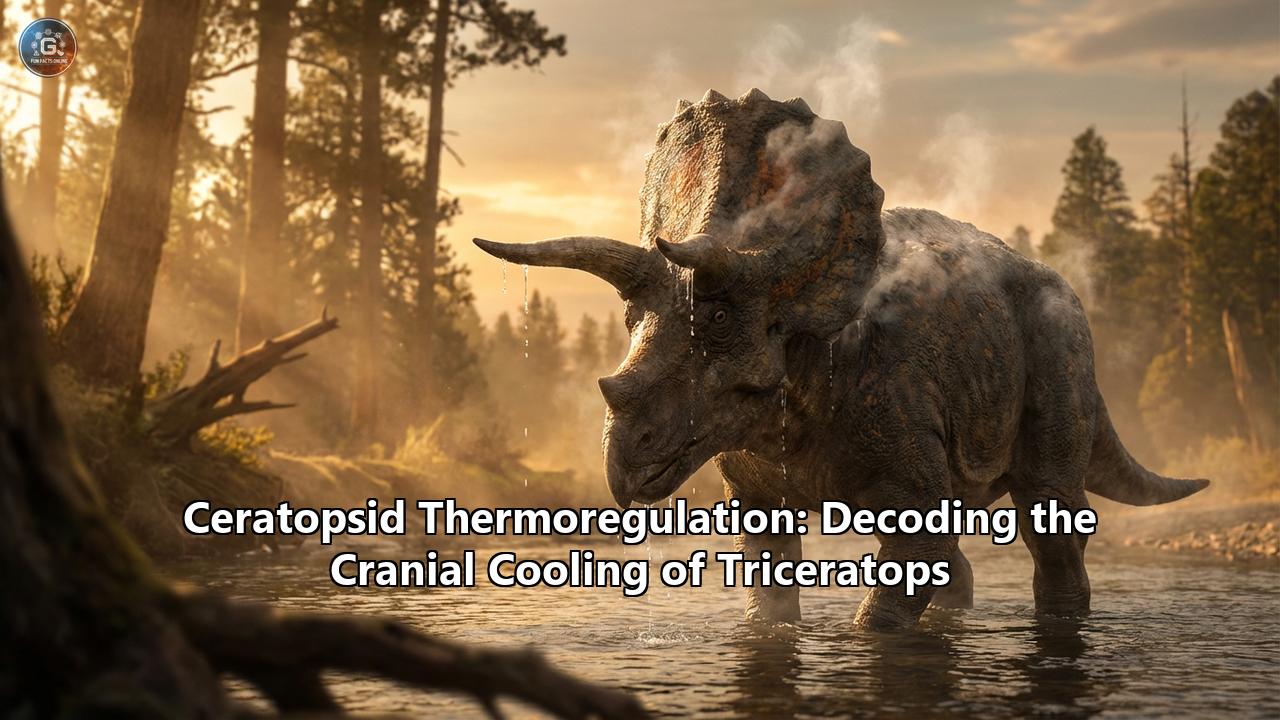
Sixty-six million years ago, under the sweltering sun of the Late Cretaceous period, the subtropical floodplains of what is now North America echoed with the heavy footfalls of giants. Among them stood Triceratops, a magnificent three-horned herbivore that was essentially a biological tank. Weighing in at up to nine tons, this colossal animal possessed one of the largest, most formidable skulls ever evolved by a terrestrial vertebrate. But beneath the fearsome brow horns and the expansive bony frill lay a hidden, perilous vulnerability—one dictated not by the jaws of a Tyrannosaurus rex, but by the relentless laws of physics.
To build an absolute unit like Triceratops, nature had to get creative with its internal engineering. Massive animals face a constant, existential battle against their own body heat. While the dinosaur is famously celebrated for its three-horned combat stance and armored visage, the internal anatomy of its skull has long presented paleontologists with a massive thermal engineering problem: How do you keep an animal's brain cool inside a giant, bony, heavily insulated helmet?
For decades, the mechanisms of ceratopsid thermoregulation remained a mystery shrouded in fossilized bone. But thanks to cutting-edge isotopic analyses, fluid dynamic modeling, and groundbreaking 3D vascular reconstructions published as recently as 2026, science has finally decoded the cranial cooling system of Triceratops. It turns out that this iconic dinosaur was equipped with a highly sophisticated network of biological radiators, utilizing its frill, its horns, and an astonishingly specialized giant nasal cavity to ward off lethal heatstroke.
The Physics of Giants: The Overheating Paradox
To understand why Triceratops needed such an elaborate cooling system, we must first look at the thermodynamics of large-bodied animals. As an organism grows, its volume increases much faster than its surface area—a mathematical reality known as the surface-area-to-volume ratio. Small animals have a high surface-area-to-volume ratio, allowing them to shed body heat into the environment rapidly. Giants, however, are essentially walking furnaces. Their massive bulk retains heat exceptionally well, a phenomenon known as gigantothermy.
Coupled with modern understandings of dinosaur metabolisms, the heat problem becomes even more acute. Dinosaurs were not the sluggish, cold-blooded (ectothermic) reptiles depicted in vintage textbooks. Mounting histological and isotopic evidence suggests that many dinosaurs, including ceratopsids, were highly active creatures with elevated metabolic rates. Generating the energy required to haul a multi-ton frame across the Cretaceous landscape produced immense amounts of internal, metabolic heat.
This heat had to go somewhere. If the core temperature of the body rises too high, arterial blood heated in the torso flows directly up the neck and into the skull. The brain and sensitive optic nerves are notoriously vulnerable to temperature fluctuations. If the temperature of this blood exceeded the physiological limits of the neural tissues, the result would be fatal hyperthermia. The massive head of Triceratops, covered in thick bone and insulating layers of keratin, was a structure highly prone to trapping heat. Therefore, a powerful, integrated cooling system was not just an evolutionary luxury; it was a biological imperative.
The Parietosquamosal Frill: A Cretaceous Solar Panel and Radiator
For over a century, the defining feature of Triceratops—its expansive parietosquamosal frill—has been the subject of intense debate. Early paleontologists viewed it primarily as a shield to protect the vulnerable neck from the bone-crushing jaws of predators. Later, behavioral scientists argued that the frill was a colorful billboard used for species recognition, sexual display, and dominance rituals. While both of these functions were likely crucial, a third, equally vital role has been uncovered: the frill acted as a biological heat radiator.
The surface of the Triceratops frill is deeply scarred with meandering networks of vascular grooves—fossilized impressions left behind by a massive complex of blood vessels that once pulsed just beneath a keratinous sheath. This dense vascularization is reminiscent of modern anatomical structures explicitly used for heat exchange, such as the ears of an African elephant or the oversized beak of a Toco toucan.
Evidence from Oxygen Isotopes
The most compelling evidence for the frill’s role in temperature regulation comes from the field of geochemistry, specifically the analysis of oxygen isotopes. In a landmark 1998 study, researchers applied a technique that measures the ratio of oxygen isotopes (specifically $\delta^{18}O_p$) preserved in the bone phosphate of a Triceratops skeleton. Because the incorporation of certain oxygen isotopes into living bone tissue is temperature-dependent, scientists can use these ratios as a prehistoric thermometer to reconstruct the internal heat flow of an individual dinosaur.
The results were revelatory. The isotopic variations indicated a very high and remarkably uniform heat flow through the parietal frill. During life, the blood pumped into the frill maintained the structure at a mean temperature of 0°C to 4°C below the body’s core temperature. When the animal was at risk of overheating, it could presumably dilate the blood vessels (vasodilation) coursing over the broad surface of its frill, flushing it with hot blood from the body core. The immense surface area of the frill would then allow that heat to radiate out into the cooler surrounding air.
Fluid Dynamics and Wind Convection
Interestingly, physicists and paleontologists have also applied fluid dynamics to understand how the frill interacted with the environment. By calculating Reynolds numbers—a fluid mechanics principle used to predict flow patterns—on scale models of Triceratops, researchers discovered that the shape of the frill and horns generated specific aerodynamic turbulence.
When a Triceratops faced into the wind, the air flowing past its facial horns and over the margins of the frill created vigorous turbulence, which drastically increased the rate of convective heat exchange. If the wind came from behind, a strong retrograde flow swept across the front surface of the frill. In essence, the sheer aerodynamic profile of the Triceratops skull maximized the efficiency with which the wind could strip heat away from its blood-engorged crest.
The Horns: Specialized Cooling for the Brain
While the frill served a broad role in regulating overall body temperature, the iconic facial horns played a more targeted, critical role. The postorbital horn-cores—the massive bony struts above the eyes that supported the keratinous horn sheaths—were also highly vascularized.
Isotopic analysis of these horn cores showed that heat flow through them was highly variable, much more so than the frill. This variability mirrors what is seen in the horns of modern bovids, like goats and cattle, which use their horns for supplementary heat dissipation. For Triceratops, the horns are interpreted as an emergency thermal fail-safe. Because the base of the horns sits in close proximity to the braincase, surging blood through the horn cores during extreme ambient temperatures or periods of high physical exertion (such as fighting or fleeing) could rapidly dump heat away from the skull. This localized cooling mechanism was explicitly dedicated to the stabilization of brain temperatures, preventing the dinosaur's central nervous system from cooking itself.
The 2026 Breakthrough: The Giant Nasal "Air Conditioner"
While the frill and the horns were powerful tools for shedding heat, they were external structures subject to the whims of the environment. If the ambient air temperature was exceptionally hot, radiating heat through the skin became less efficient. Triceratops needed an active, internal cooling system.
For years, the sheer size of the ceratopsid snout was a major paleontological mystery. While the horns and frill stole the spotlight, the front of the skull housed an extremely large, well-developed "bony naris" (nasal opening). The anatomical understanding of this region lagged because the delicate soft tissues—nerves, blood vessels, and cartilage—do not fossilize. The nasal structure of ceratopsians was so uniquely specialized that comparing it to other dinosaurs proved incredibly difficult.
However, in February 2026, a groundbreaking joint research study led by Seishiro Tada at the University of Tokyo Museum fundamentally rewrote our understanding of the Triceratops face. By performing highly advanced 3D micro-CT analyses on the intricate networks of microscopic tubes and grooves inside the skull bones, the researchers successfully inferred the layout of the lost soft tissues.
What they discovered was a biological masterpiece of thermal engineering.
Rewiring the Cranial Plumbing
The study revealed that Triceratops possessed highly unusual "wiring" in its face. In most reptiles, the main nerves and blood vessels reach the snout by traveling along the jawline. But in Triceratops, the extreme evolutionary specialization of its massive, parrot-like beak and deep skull blocked the traditional jaw route. Forced to adapt, the evolutionary process completely reorganized the dinosaur's facial plumbing. The vital blood vessels and nerves were rerouted to take the nasal branch.
This massive influx of blood supply directly into the nasal cavity transformed the dinosaur's nose from a simple respiratory and olfactory organ into a highly advanced heat exchanger.
The Respiratory Turbinate Hypothesis
Within this giant nasal cavity, the Tokyo team identified ridges on the bones that strongly resemble the attachment points for structures known as "respiratory turbinates". Found today in modern birds and mammals, turbinates are intricate, labyrinthine, scroll-like structures of bone or cartilage that are densely wrapped in moist, vascularized mucous membranes.
Turbinates act exactly like a radiator in a car engine. As a Triceratops inhaled, the dry, relatively cooler outside air passed over the massive surface area of these moist, blood-rich folds. Through the process of evaporative cooling, the air absorbed heat from the warm venous blood that had just arrived from the body core. Simultaneously, the moisture in the nasal passages cooled the blood.
This newly chilled blood was then selectively routed backward, directly toward the braincase, providing a constant flow of refrigerated venous blood to bathe and protect the delicate brain tissues. With every single breath the giant beast took, it was actively air-conditioning its brain. The sheer volume of the Triceratops nasal cavity meant that this evaporative cooling system operated on an industrial scale, more than capable of handling the immense thermal load trapped beneath its thick, armored skull.
A Diverse Arsenal: Dinosaurs and Thermal Innovation
The revelation of the Triceratops nasal radiator fits perfectly into an emerging, broader paradigm in paleontology: large dinosaurs survived extreme climates by evolving highly specialized cranial air-conditioning systems. Research pioneered by scientists like Ruger Porter, Jason Bourke, and Lawrence Witmer has demonstrated that different lineages of dinosaurs solved the overheating problem in entirely different, bizarre ways.
- Ankylosaurs (The Armored Tanks): Lacking the turbinates of ceratopsians, the heavily armored ankylosaurs evolved ridiculously long, convoluted "crazy straw" nasal passages that coiled back and forth inside their snouts. As air traveled the long, winding path through the snout, it achieved incredible rates of heat transfer, dropping the temperature of the blood heading to the brain by over 50%.
- Theropods (The Giant Predators): Meat-eaters like Tyrannosaurus rex solved the heat problem differently. They utilized a massive "antorbital sinus"—a large air-filled cavity in front of the eyes. Every time the predator opened and closed its massive jaws to bite or breathe, it acted like a bellows pump, actively ventilating a highly vascularized chamber that flushed heat away from the skull.
- Sauropods (The Long-Necked Titans): The largest animals to ever walk the earth increased blood flow to vastly expanded cooling regions in the fleshy oral and nasal cavities, prioritizing brain protection above all else.
Compared to its contemporaries, Triceratops stands out for its multi-tiered approach. It didn't rely on just one mechanism. It utilized the convective properties of its massive frill, the specialized thermal dumping of its horn cores, and the evaporative refrigeration of its turbinate-filled nasal cavity.
The Living, Breathing Triceratops
By synthesizing these decades of biomechanical, isotopic, and micro-CT research, we can paint an incredibly vivid, scientifically accurate picture of a living Triceratops.
Imagine a massive bull Triceratops emerging from the dense cycad forests of Late Cretaceous Montana into the blistering midday heat. Weighing roughly 18,000 pounds, its internal metabolic furnace is roaring just to keep the animal moving. As it steps into the sunlight, it automatically shifts its massive head. It turns slightly, angling its five-foot-wide parietosquamosal frill to catch the prevailing wind. Blood vessels deep within the bone dilate, rushing hot core blood to the surface of the frill, where the wind strips the heat away in swirling eddies of aerodynamic turbulence.
As the animal begins to forage, ripping tough vegetation with its beak, its breathing quickens. With every deep inhalation, vast volumes of air are pulled into the cavernous nasal openings at the front of its snout. Inside, the air cascades over the moist, scroll-like networks of its respiratory turbinates. The water evaporates, drawing heat out of the intricate vascular wiring. The newly chilled blood flows backward, enveloping the brain in a protective, cooling embrace.
Suddenly, a threat appears—a territorial rival or perhaps a hungry predator. The Triceratops tenses. Its heart rate skyrockets, generating an immediate, dangerous spike in internal heat. Instantly, the thermal fail-safes engage. Surges of hot blood are redirected into the massive brow horns. The horns radiate the acute heat spike away from the cranium, ensuring the dinosaur’s brain remains perfectly calibrated and fiercely alert as it lowers its three spears and prepares to charge.
Redefining the Dinosaur
The decoding of the Triceratops cranial cooling system represents far more than just anatomical trivia. It forces a fundamental shift in how we perceive these extinct giants. For a long time, the massive head of Triceratops was viewed purely as a medieval weapon—a blunt instrument of defense and display.
But the fossilized traces of blood vessels, the isotopic signatures locked in phosphate, and the micro-architecture of the nasal cavity tell a different story. They reveal that Triceratops was not a sluggish, oversized reptile lumbering passively through a sweltering world. It was a highly active, metabolically dynamic creature equipped with a staggeringly sophisticated, multi-layered thermoregulatory network. The very shape of its iconic face was dictated as much by the invisible forces of thermodynamics and fluid mechanics as it was by the need to ward off predators.
Through the lens of modern science, Triceratops emerges as one of evolution's ultimate thermal machines—a masterpiece of prehistoric engineering capable of conquering the heat of the Mesozoic world.
Reference:
- https://www.zmescience.com/science/paleontology/triceratops-huge-nose-radiator/
- https://dinosaurmuseum.jp/en/triceratops-nose-radiator-study/
- https://experts.illinois.edu/en/publications/the-thermoregulatory-functions-of-the-triceratops-frill-and-horns/
- https://www.reddit.com/r/askscience/comments/1pm3pn4/how_did_dinosaurs_heat_regulate_given_their/
- https://people.ohio.edu/witmerl/Downloads/2019_Porter_&_Witmer_dinosaur_cooling_strategies.pdf
- https://www.sciencedaily.com/releases/2019/10/191016153635.htm
- https://www.physicsforums.com/threads/thermodynamics-and-the-frill-of-members-of-ceratopsidae.654511/
- https://pubs.geoscienceworld.org/paleosoc/paleobiol/article/31/2/291/86455/The-evolution-and-function-of-thyreophoran
- https://www.tandfonline.com/doi/abs/10.1080/02724634.1998.10011103
- https://www.researchgate.net/publication/229194326_The_thermoregulatory_potential_of_Ovis_horn_cores
- https://www.eurekalert.org/news-releases/556802