
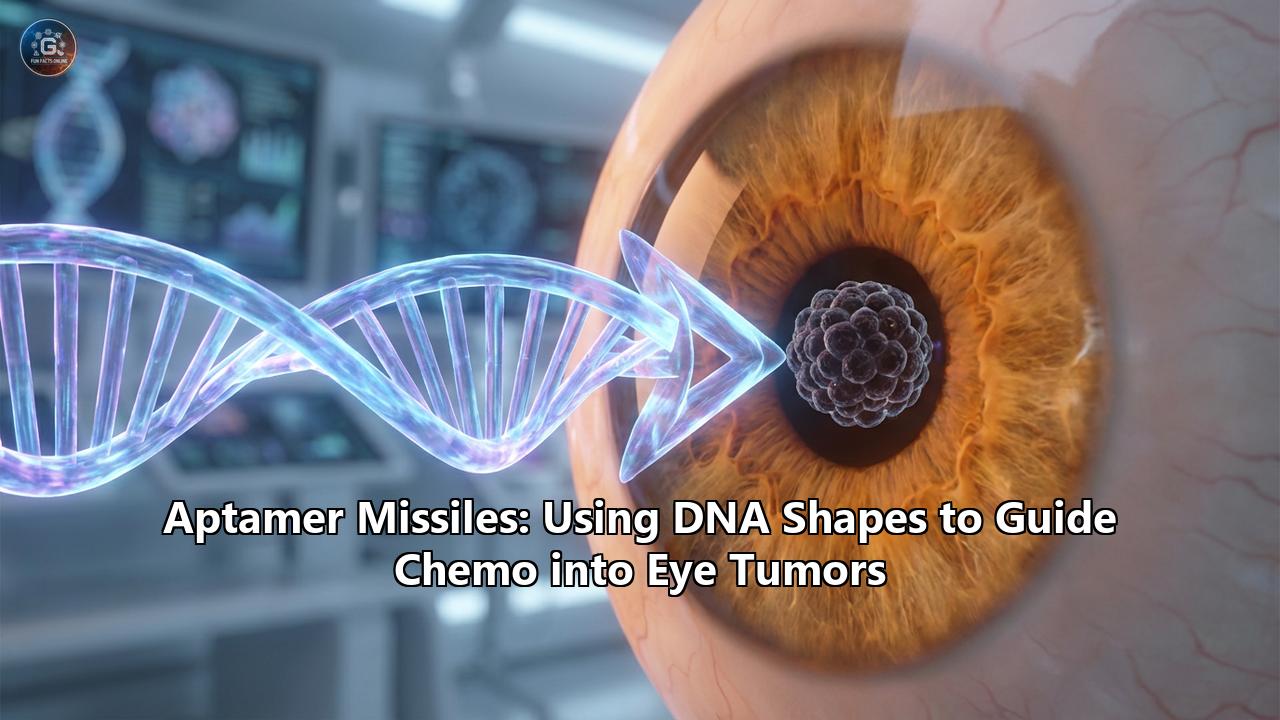
To understand the brilliance of aptamer missiles, we must first understand the enemy they are fighting. Retinoblastoma (RB) is the most common eye cancer in children, typically affecting infants and toddlers. It begins in the retina—the light-sensing tissue at the back of the eye.
The Current Battlefield
For decades, doctors have fought RB with "blunt instruments":
- Systemic Chemotherapy: Powerful drugs are injected into the bloodstream. While they kill cancer cells, they also attack healthy cells throughout the body, leading to hair loss, immune suppression, and long-term organ damage.
- Intra-arterial Chemotherapy: A catheter is threaded through the groin up to the eye artery to deliver drugs. This is more targeted but invasive and risky for small children.
- Enucleation: In advanced cases, the only way to save the child’s life is to surgically remove the eye, resulting in permanent vision loss.
The challenge has always been the Blood-Retina Barrier (BRB). The eye is a sanctuary organ, designed to keep foreign substances out. Getting drugs in usually requires high doses or invasive needles. We needed a way to slip a "trojan horse" past the defenses, one that only attacks the enemy.
Enter the Aptamer.
What Are "Aptamer Missiles"?
An aptamer is often described as a "chemical antibody." Technically, it is a short strand of synthetic DNA or RNA. But unlike the DNA in your genes, which carries the code for life, aptamers are engineered to act as structural tools.
The Power of "DNA Shapes"
We usually think of DNA as a long, twisted ladder (double helix). However, single-stranded DNA is flexible. It can fold upon itself, creating loops, hairpins, and complex 3D knots.
- The Key-and-Lock Mechanism: Just as a metal key is cut to a specific shape to open a specific lock, an aptamer is folded into a specific 3D shape that fits perfectly into a target molecule on the surface of a cell.
- The Specificity: Because this folding is precise down to the atomic level, an aptamer can distinguish between a cancer cell and a healthy cell based on the unique proteins (antigens) sticking out of their surfaces.
When researchers attach a chemotherapy drug to this guided DNA shape, they create an Aptamer-Drug Conjugate (ApDC)—or, more coolly, an Aptamer Missile.
How the Missile Works: A Step-by-Step Strike
The process of using aptamer missiles to treat eye tumors involves a sophisticated dance of molecular engineering. Here is the mission profile of one of these microscopic weapons:
1. Target Acquisition (The Homing Beacon)
Retinoblastoma cells are covered in specific proteins that are rare or absent on healthy eye cells. Two of the most common targets are:
- Nucleolin (NCL): A protein usually found inside the nucleus, but in rapidly dividing cancer cells, it migrates to the surface.
- EpCAM (Epithelial Cell Adhesion Molecule): A marker often found on cancer stem cells, which are responsible for tumor growth and recurrence.
Scientists synthesize a DNA aptamer that folds into a shape that binds only to Nucleolin or EpCAM. This is the missile's guidance system.
2. Loading the Payload (The Chemo)
The aptamer needs a weapon. The drug of choice is often Doxorubicin (Dox), a potent chemotherapy agent.
- Intercalation: Doxorubicin has a natural affinity for DNA; it likes to tuck itself between the base pairs of the DNA strand.
- The Cargo Hold: The aptamer is designed with a specific "stem" structure where Doxorubicin molecules can hide. This protects the drug from degrading and prevents it from leaking out and damaging healthy cells while it travels.
3. Infiltration (The Trojan Horse)
When the aptamer missile is injected near the tumor (or into the eye), it floats harmlessly past healthy retinal cells (Müller glial cells) because its shape doesn't match their surface receptors.
- Docking: When it bumps into a Retinoblastoma cell, the aptamer "clicks" into the target protein (e.g., Nucleolin).
- Endocytosis: This docking tricks the cancer cell. The cell membrane wraps around the aptamer-protein complex and swallows it, pulling the missile inside the cell.
4. Detonation
Once inside the acidic environment of the cancer cell's interior (lysosomes), the DNA shape changes or degrades.
- Release: The "cargo hold" opens, and the Doxorubicin is released.
- The Kill: The chemotherapy attacks the cancer cell's nucleus, stopping it from dividing and causing the tumor to shrink or die (apoptosis).
The "Origami" Revolution: Next-Gen DNA Shapes
The term "Aptamer Missile" also encompasses an even more advanced technology called DNA Origami.
While a simple aptamer is like a single homing missile, DNA Origami is like an aircraft carrier.
- Building with DNA: Scientists use hundreds of DNA strands to weave 3D nanostructures—cubes, stars, tetrahedrons (pyramids), or tubes.
- Multivalency: A simple aptamer might have one binding site. A DNA Origami tetrahedron can have four aptamers attached to its corners. This makes it bind to the tumor much tighter (like holding on with four hands instead of one).
- Larger Payloads: A DNA nanostructure can carry not just chemo, but also gene-silencing tools (siRNA) or heating agents for thermal therapy, all packed inside a hollow DNA cage that only opens when it finds a tumor.
Recent studies have shown that DNA tetrahedrons loaded with Doxorubicin and guided by aptamers can penetrate deep into dense eye tumors better than free drugs, overcoming drug resistance.
Why This Matters for Eye Cancer Patients
The implications of this technology for patients—especially young children—are profound.
1. Saving Vision (Globe Salvage)
Current treatments often damage the delicate retina, leading to vision loss even if the cancer is cured. Aptamer missiles are so specific that they spare the photoreceptors (rods and cones) that allow us to see. This increases the chances of saving the eye and the sight.
2. Zero Systemic Toxicity
Because the "missile" does not release its payload until it is inside the cancer cell, the rest of the body is protected. This means:
- No nausea or hair loss.
- No damage to the developing heart or kidneys (a common risk with Doxorubicin in children).
- A stronger immune system to help fight the cancer.
3. Overcoming Drug Resistance
Tumors are smart; they often learn to pump chemotherapy drugs back out before they work. Aptamer missiles enter the cell via a different "door" (endocytosis) that bypasses these pumps, effectively sneaking the drug behind enemy lines where the tumor cannot expel it.
The Road Ahead: From Lab to Clinic
While "Aptamer Missiles" are currently the stars of preclinical research (showing incredible success in cell lines like Y79 and animal models), the path to the hospital is the next frontier.
- Stability: DNA is naturally fragile (enzymes in the blood love to eat it). Researchers are using "chemical armor" (modifying the DNA backbone) to make these missiles indestructible until they reach their target.
- Clinical Trials: We are on the cusp of seeing these therapies move into human trials. The FDA has already approved aptamers for other eye conditions (like Macular Degeneration), paving a regulatory highway for cancer-fighting aptamers.
Conclusion
We are witnessing the dawn of molecular surgery. Aptamer missiles represent a shift from "carpet bombing" cancer to "sniping" it. By harnessing the simple, programmable nature of DNA shapes, we can guide chemotherapy into the heart of an eye tumor with unprecedented precision.
For the parents of children with retinoblastoma, and for patients facing ocular melanoma, this technology offers something more valuable than just a cure: it offers a future where surviving cancer doesn't mean sacrificing the ability to see the world.
Reference:
- https://pmc.ncbi.nlm.nih.gov/articles/PMC9519959/
- https://www.cancer.org/cancer/types/retinoblastoma/treating/chemotherapy.html
- https://brieflands.com/journals/jai/articles/113991
- https://pubmed.ncbi.nlm.nih.gov/23213278/
- https://pmc.ncbi.nlm.nih.gov/articles/PMC3513190/
- https://www.researchgate.net/publication/233850037_Target-specific_delivery_of_doxorubicin_to_retinoblastoma_using_epithelial_cell_adhesion_molecule_aptamer
- https://www.researchgate.net/publication/307510985_Nucleolin-aptamer_therapy_in_retinoblastoma_molecular_changes_and_mass_spectrometry-based_imaging
- https://www.researchgate.net/publication/337333319_Multivalent_Aptamer-modified_DNA_Origami_as_Drug_Delivery_System_for_Targeted_Cancer_Therapy