
The scent of a madeleine dipped in tea.
For Marcel Proust, that sensory trigger didn’t just retrieve a fact; it unlocked a universe. It didn't merely tell him that he once ate a cookie in Combray; it transported him to Combray. He felt the Sunday morning air, the geometry of the town square, the specific emotional timbre of his aunt’s bedroom. This is the miracle of Episodic Memory—the brain’s time machine.
Contrast this with the knowledge that Paris is the capital of France. You likely cannot recall the specific moment you learned this fact. You don’t remember the temperature of the room, the color of the teacher’s shirt, or what you had for lunch that day. The context has been stripped away, leaving only the crystallized kernel of truth. This is the domain of Semantic Memory—the brain’s encyclopedia.
For decades, neuroscientists and psychologists treated these two systems as distinct, sovereign nations. They were believed to reside in different brain regions, operate under different rules, and fail independently of one another. We built walls between the "remembering of self" (episodic) and the "knowing of facts" (semantic).
But as we stand in 2026, the walls have crumbled.
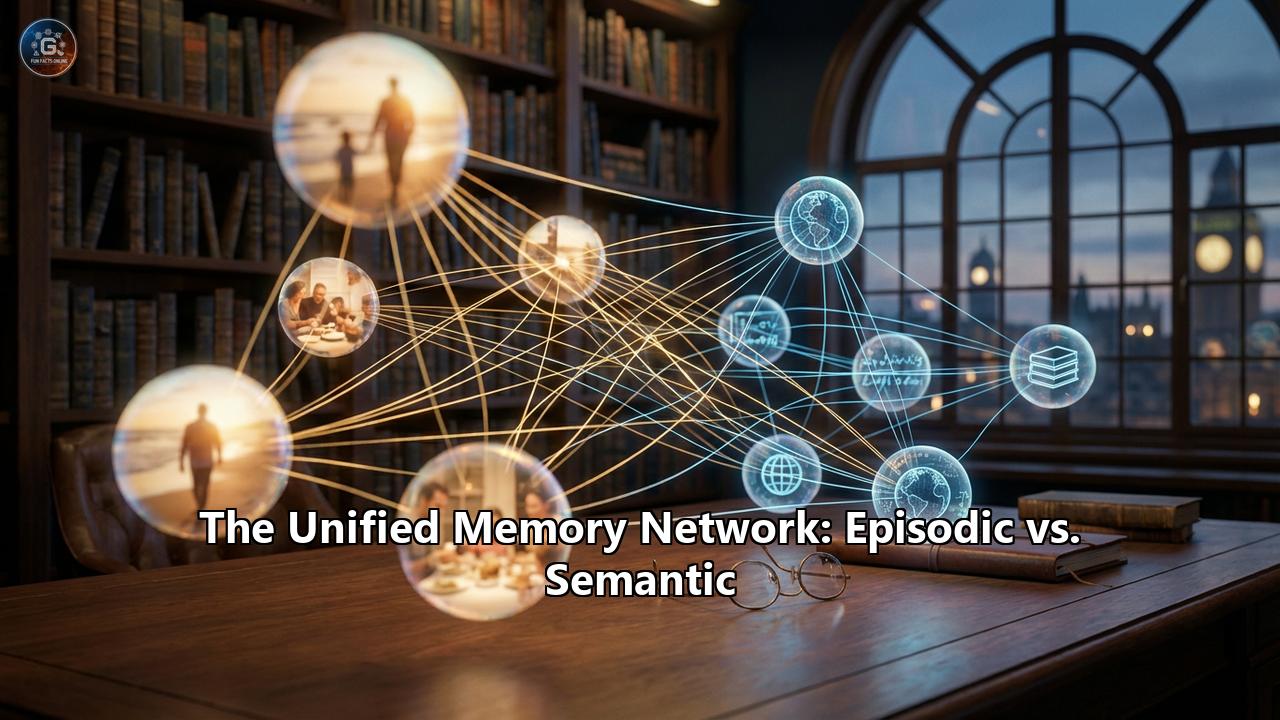
Recent breakthroughs in neuroimaging, computational modeling, and artificial intelligence have revealed a far more elegant reality. We do not possess two separate memory systems; we possess a single, dynamic, Unified Memory Network. It is a continuous spectrum of abstraction, a restless dialogue between the specific and the general, the posterior and the anterior, the raw experience and the refined wisdom.
This is the story of that network—how your brain transmutes the fleeting moments of your life into the permanent architecture of your mind.
Part I: The Historical Divide
The Tulving Era
To understand the unified view, we must first appreciate the division it replaced. In 1972, the cognitive psychologist Endel Tulving proposed a radical distinction. He argued that long-term memory was not a monolith. He separated it into two categories:
- Episodic Memory: This is memory for personally experienced events. It is defined by autonoetic consciousness—the ability to mentally travel back in time and re-experience the event from a first-person perspective. It is inherently fragile, context-dependent, and chronologically organized.
- Semantic Memory: This is memory for general knowledge, concepts, and facts. It is defined by noetic consciousness—a sense of knowing without the re-living. It is robust, context-independent, and organized conceptually (e.g., a dog is an animal, not "the dog I saw on Tuesday").
This framework was revolutionary. It explained why a patient like H.M., whose hippocampus was surgically removed, could not form new episodic memories (he lived in a permanent present) yet could still access his semantic knowledge of the world and even learn new motor skills. It cemented the idea that the Hippocampus was the seat of episodes, and the Neocortex was the warehouse of facts.
However, cracks in this binary model began to appear. Patients with hippocampal damage often struggled to imagine the future as well as remember the past. Conversely, patients with semantic dementia (damage to the anterior temporal lobes) lost the meaning of words but could sometimes recall recent episodes involving those words. The systems were clearly talking to each other. The question was: how?
Part II: The Anatomy of the Unified Network
The modern "Unified Memory Network" is not a collection of boxes, but a gradient. This gradient runs physically along the long axis of the hippocampus and extends out into the cortex.
The Hippocampal Axis: From Detail to Gist
The most profound shift in recent years (supported by the Trace Transformation Theory) is the realization that the hippocampus itself is divided.
- The Posterior Hippocampus (The Recorder): This region acts as the high-fidelity recorder. It captures the raw, pixel-perfect details of an experience—the specific shade of blue, the exact layout of the room. It is connected to the perceptual centers of the brain.
- The Anterior Hippocampus (The Summarizer): As we move forward along the hippocampal axis, the resolution drops. The anterior hippocampus doesn't care about the pixel-perfect details; it cares about the gist. It compresses the experience. It recognizes that "I am in a restaurant," rather than cataloging every fork on the table.
The Cortical Partners
The hippocampus does not work in isolation. It dances with the Medial Prefrontal Cortex (mPFC).
The mPFC is the home of Schemas. A schema is a mental framework—a blueprint of how the world works. You have a schema for "Birthday Party" (cake, candles, singing). When you attend a specific party, your brain doesn't need to relearn the concept of a party. It just plugs the specific details (Episodic) into the existing framework (Semantic).
This interaction is the physical manifestation of the Unified Network: The Posterior Hippocampus grabs the unique Episode, while the Anterior Hippocampus and mPFC match it to the Semantic Schema.
Part III: Trace Transformation Theory (TTT)
This is the heartbeat of the modern understanding.
The old "Standard Consolidation Theory" argued that memories are born in the hippocampus and then "moved" to the cortex for permanent storage, becoming semantic in the process. Once moved, the hippocampus was thought to be no longer needed.
Trace Transformation Theory (TTT), championed by researchers like Moscovitch and Nadel, and refined in 2024-2026, argues something far more nuanced. It suggests that memories don't just move; they transform.Every time you retrieve a memory, you create a new trace.
- The Contextual Trace: If you recall the experience (the sights, sounds, feelings), you must engage the hippocampus. No matter how old the memory is, if you are "re-living" it, the hippocampus is online.
- The Semantic Trace: Simultaneously, every retrieval strips away a little bit of noise. The brain extracts the statistical regularities. After visiting ten different coffee shops, the specific details of each shop (episodic) fade, but the concept of "ordering coffee" (semantic) becomes reinforced.
The Unified Network is a distillation machine. It constantly churns through your episodic experiences, filtering out the noise of the specific to harvest the gold of the general.
Part IV: The Mechanics of Integration
How does the brain physically merge the specific into the general?
1. The Sleep Switch: Ripples and Replay
The work of the Unified Network happens largely when you are not looking. During Slow-Wave Sleep (SWS), the brain engages in Sharp-Wave Ripples.
Imagine the hippocampus as a temporary buffer where the day's events are held. During sleep, the hippocampus "replays" these events at high speed—20 times faster than reality. It fires the neural pattern of the memory up to the neocortex.
The neocortex, however, is a slow learner. It is the "Deep Learning" model of the brain. It requires thousands of repetitions to change its weights. The hippocampus acts as a teacher, blasting the lesson (the memory) into the cortex over and over again while you sleep.
This is where Semantization occurs. The cortex doesn't record the specific event; it updates its statistical model of the world based on the event. It integrates the new data point into the existing graph.
2. The Semantic Scaffold
The relationship is bidirectional. We used to think Episodic Memory came first, and Semantic Memory was built from it. We now know that Semantic Memory is required to form Episodic Memories.
Try to memorize a paragraph of text about "Quantum Chromodynamics" if you have no background in physics. You will fail. You have no "hooks" to hang the information on. Now, try to memorize a story about a walk in the park. You will succeed easily.
Your Semantic Schemas provide the Scaffold. When you enter a room, your brain activates the "Room Schema." It predicts walls, a floor, a ceiling. You don't need to "remember" the walls. You only need to remember the deviation from the schema—the weird painting, the broken chair.
The Unified Network is an efficiency engine. It uses Semantic knowledge to compress Episodic data. "Standard Living Room + Broken Chair" is a much smaller file size than recording every pixel of the room.
Part V: Clinical Perspectives
When the network breaks, we see the distinct roles of the spectrum.
The Case of the Eternal Present (Hippocampal Amnesia)
Patients like K.C. (similar to H.M.) had total destruction of the hippocampus. K.C. could not remember a single thing he had ever done. He had no episodic memory.
However, K.C. knew that his family possessed a summer cottage. He knew where it was. He knew what it looked like. But he could not recall a single specific time he had been there. He had the map (semantic), but no journey (episodic).
Crucially, recent research has shown that K.C. also could not imagine the future. When asked to picture what he would do tomorrow, his mind went blank. This confirmed that the "Time Machine" works both ways. The Unified Network uses the same scraps of episodic memory to reconstruct the past and construct the future.
The Case of the Lost Meaning (Semantic Dementia)
In Semantic Dementia, the anterior temporal lobes degenerate. These patients lose the "Encyclopedia."
If you show a patient a picture of a dog, they might say "animal." Later, "thing." Eventually, they don't know what it is.
But here is the paradox: If a patient with Semantic Dementia sees a dog today, they might remember seeing it tomorrow. They might say, "I saw a creature yesterday with a wagging tail." They have the specific episode (hippocampus is intact), but they have lost the general concept (cortex is damaged).
Over time, however, because they cannot link the episode to a concept, the memory fades rapidly. Without the Semantic Scaffold, the Episode collapses.
Part VI: The Future of Memory (AI & Synthetic Networks)
The most exciting developments in 2026 are not just in neuroscience, but in the replication of this Unified Network in Silicon.
Catastrophic Forgetting and the Solution
Artificial Neural Networks (like the LLMs of the early 2020s) suffered from "Catastrophic Forgetting." If you taught a model French, then taught it Python, it would overwrite the French to make room for the Python. It lacked an Episodic Memory. It was pure Semantic Memory—a giant, static ball of weights.
New architectures, like EverMemOS and Neuro-Symbolic Hybrids, are mimicking the human Unified Network.
- The Fast Weights (Digital Hippocampus): These systems now have a "fast" memory buffer that records specific interactions instantly (One-Shot Learning).
- The Slow Weights (Digital Cortex): Over "sleep cycles" (offline processing), the AI consolidates these specific interactions into general principles.
- MemCells and MemScenes: Current AI research distinguishes between MemCells (atomic, time-stamped traces of a user saying "I like pizza") and MemScenes (the consolidated user profile: "User is a fan of Italian cuisine").
This biomimicry suggests that the Episodic-Semantic division is not just a biological quirk; it is a fundamental requirement for any intelligent system that needs to learn quickly (episodic) without losing the stability of its worldview (semantic).
Part VII: The Human Application
How can we, as users of this Unified Network, optimize it?
1. The Power of "Schema-Based Learning"
If you want to learn faster, do not just memorize facts. Build the schema first.
Before reading a dense textbook, read the summary. Read the Wikipedia entry. Look at the diagrams. Build the "empty shelves" of the semantic structure. Once the scaffold is up, the detailed episodic facts you read will stick instantly. You are hacking the Anterior Hippocampus to help the Posterior Hippocampus.
2. Episodic Self-Correction
To change a deep-seated belief (Semantic), you need powerful contradictory Episodes.
The brain’s model of the world is resistant to change. Reading a fact that contradicts your worldview rarely changes your mind. You need experience.
To "re-wire" a bias, you must actively seek out experiences (episodes) that violate your prediction errors. The Unified Network updates its weights most aggressively when an episode is surprising. Surprise is the learning signal.
3. The Memory Palace 2.0
The ancient technique of the Memory Palace is essentially a hack to force Semantic information into an Episodic format.
You want to remember a list of dry facts (Semantic). You place them in a mental journey through your house (Episodic/Spatial). You are tricking your hippocampus into treating "Milk, Eggs, Bread" as "A journey through a dairy farm in my hallway." You are utilizing the high-bandwidth recording capability of the Episodic system to store Semantic data.
Conclusion: The Continuum of Self
We are not made of two memories. We are made of a single, flowing current.
At one end, the water is fast and turbulent—this is the Episode, the raw, chaotic, beautiful crash of the now.
As the river flows, it slows and deepens. It drops the silt of detail and retains only the volume of water—this is the Semantic, the deep, calm ocean of what we know.
The Unified Memory Network is the mechanism of this flow. It is what allows us to be both a witness to the present and a wise scholar of the past. It turns the "Monday morning" into "Career Experience." It turns "The first kiss" into "Love."
It is the alchemy of the mind, turning the lead of daily existence into the gold of human wisdom.
Reference:
- https://pmc.ncbi.nlm.nih.gov/articles/PMC2952732/
- https://www.news-medical.net/news/20251204/Scientists-reveal-how-the-brain-reshapes-episodic-memories-over-time.aspx
- https://direct.mit.edu/neco/article/30/2/293/8339/The-Interaction-between-Semantic-Representation
- https://scitechdaily.com/new-brain-study-challenges-decades-of-memory-research/
- https://charleywu.github.io/downloads/nagy2025interplay.pdf
- https://www.researchgate.net/publication/324960223_The_hippocampus_and_related_neocortical_structures_in_memory_transformation
- https://neuropsychologylab.psych.utoronto.ca/files/The%20hippocampus%20and%20related%20neocortical%20structures%20in%20memory%20transformation.pdf
- https://www.youtube.com/watch?v=_dpzdqEpxks
- https://www.researchgate.net/publication/303947391_Interaction_between_episodic_and_semantic_memory_networks_in_the_acquisition_and_consolidation_of_novel_spoken_words
- https://www.cambridge.org/core/journals/journal-of-the-international-neuropsychological-society/article/abs/memory-transformation-and-systems-consolidation/18511C7CFD1671AA7A5F2A3E93BED12D
- https://huggingface.co/papers?q=Episodic%20Trace%20Formation