
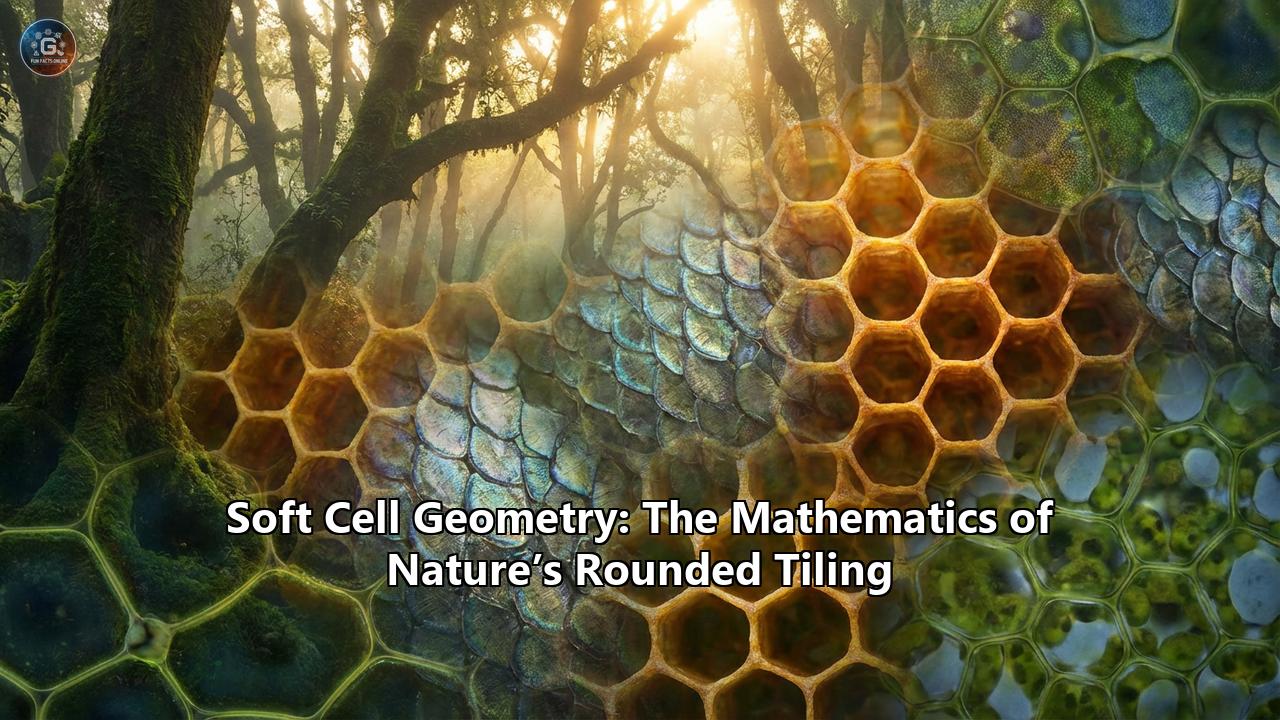
For centuries, the human understanding of geometry has been dominated by the straight line and the sharp corner. We build our cities in grids, tile our floors with squares, and conceptualize the fundamental building blocks of space—the "atoms" of geometry—as polyhedra: cubes, tetrahedra, and dodecahedra. This obsession with sharpness is a legacy of the ancient Greeks, particularly Plato, who associated the classical elements of earth, air, fire, and water with regular solids possessing distinct vertices and flat faces.
But when we look away from our blueprints and out a window, we see a world that starkly refuses to conform to these rigid rules. Nature does not build in squares. You will not find a perfect cube in a riverbed, nor a rectangular grid in the cross-section of an onion. The natural world is a symphony of curves, undulations, and smooth transitions. For a long time, this discrepancy was dismissed as "messiness"—the result of erosion, biological imperfection, or the chaotic forces of growth. We assumed that if nature could be perfect, it would build like us.
We were wrong.
In 2024, a groundbreaking mathematical discovery shattered this assumption. A team of researchers led by Gábor Domokos at the Budapest University of Technology and Economics, along with Alain Goriely at the University of Oxford, identified a new class of geometric shapes that bridge the gap between the sharp, tiling world of mathematics and the soft, curved reality of biology. They call these shapes Soft Cells.
This discovery is not merely a curiosity; it is a fundamental rewriting of the rules of tiling. It reveals that nature’s avoidance of corners is not an accident of erosion but a sophisticated geometric strategy. Soft cells are the missing link in our understanding of how the universe fills space, offering a new lens through which to view everything from the chambers of a nautilus shell to the architecture of our own muscle tissue, and potentially revolutionizing how we design the buildings and materials of the future.
Part I: The Tyranny of the Corner
To understand the magnitude of the "soft cell" revolution, one must first appreciate the "hard" history that preceded it. For over two millennia, the problem of tiling (or tessellation)—covering a surface or filling a volume with shapes so that there are no gaps and no overlaps—has been one of the central pillars of geometry.
The story begins in antiquity. The Egyptians and Babylonians used square and hexagonal tiles for decoration, but it was the Greeks who formalized the study. They discovered that in two dimensions, only three regular polygons can tile the plane by themselves: the equilateral triangle, the square, and the regular hexagon. These are the "Euclidean tilings." They are efficient, stackable, and, crucially, they are defined by their vertices—sharp, angular corners where edges meet.
When mathematicians moved to three dimensions, the obsession with corners only intensified. They sought shapes that could pack together to fill space. The cube is the most obvious candidate, creating the familiar lattice of 3D Cartesian space. But mathematicians wanted to know what else was possible. In the late 19th century, the great physicist Lord Kelvin asked a deceptively simple question: What is the most efficient way to divide space into cells of equal volume with the least amount of surface area?
Kelvin proposed a shape called the truncated octahedron (a 14-sided polyhedron). It was a brilliant solution, but it was still a shape of flat faces and sharp corners. Even when lighter, more complex "foams" were discovered—like the Weaire-Phelan structure used in the Beijing Olympics' Water Cube—they remained fundamentally polyhedral. They were "hard" tilings.
This mathematical framework created a cognitive bias. We began to view "structure" as synonymous with "polyhedral." When biologists looked at cells under a microscope, they often modeled them as irregular polyhedra, assuming the curvature was just a deviation from a straight-edged ideal. When geologists studied crack patterns in rocks, they measured angles and counted vertices.
But there was always a dissonance. The "Platonic" view of the world clashed with the "Organic" view. The fundamental difference lay in the corner. In mathematics, a corner is a singularity—a point of abrupt change, a discontinuity in the tangent. In physics and biology, however, singularities are expensive. Sharp corners concentrate stress; they are weak points in a material; they require high energy to maintain against the smoothing forces of surface tension.
Nature operates on the principle of energy minimization. A soap bubble does not form a cube; it forms a sphere to minimize surface area. A drop of water does not have corners. So, if nature hates corners, but needs to pack cells together to form tissues and shells, how does it solve the tiling problem?
The answer, it turns out, was hiding in plain sight. Nature uses soft cells.
Part II: Defining the Soft Cell
The breakthrough came when Domokos, Goriely, and their colleagues decided to challenge the fundamental definition of a tile. They asked: Is it possible to tile space with shapes that have few or no sharp corners?
In the rigid world of classical geometry, the answer seemed to be "no." If you try to pack spheres, you get gaps (interstices). If you deform the spheres to close the gaps, you usually end up with faces and corners, effectively turning them back into polyhedra.
The researchers, however, took a different approach. They developed a mathematical algorithm to "soften" the edges of traditional tiles. They discovered that by curving the boundaries in a very specific way, they could eliminate almost all sharp corners while still maintaining a perfect, gap-free fit.
The 2D Definition: The Cusp
In two dimensions, a standard tile like a square has four corners. A hexagon has six. The researchers discovered that you cannot eliminate all corners in a 2D tiling. There is a topological limit. However, you can minimize them.
They defined a 2D Soft Cell as a shape with curved boundaries that has the minimum possible number of corners. That minimum number is two.
But these are not corners in the traditional sense of a 90-degree angle. They are cusps. A cusp is a point where two curved edges meet tangentially, meaning the internal angle is zero degrees. Think of the shape of a tear-drop or an eye. The ends are sharp, but they are "soft" sharp—they taper smoothly to a point.
The researchers proved that these 2-cornered soft cells can tile the plane perfectly. You can see this geometry if you look at the cross-section of an orange or an onion. The segments are not triangles; they are curved spindles that taper to points at the center and the edge. They fit together seamlessly, yet they have no "hard" angles.
The 3D Revelation: The Cornerless Tile
It was when the team moved to three dimensions that the math became truly magical. In 2D, you are stuck with at least two corners. But in 3D, the topological constraints relax.
The researchers proved that in three dimensions, it is possible to create a soft cell with zero corners.
These 3D soft cells are objects of profound beauty. They have no vertices. Their edges are smooth curves, and their faces are undulating surfaces. They flow into one another. If you were to hold one, it would feel like a smooth river stone, yet a bucket of them would pack together as tightly as a stack of cubes, with absolutely no air in between.
This was the "Eureka" moment. The team realized they had discovered a new class of matter—a "soft matter geometry" that described the elusive building blocks of the biological world.
Part III: The Edge Bending Algorithm
How do you find these shapes? You cannot simply draw them by hand. They are the solutions to complex geometric equations. To generate them, the team devised a method called the Edge Bending Algorithm.
The concept is roughly as follows:
- Start with a Hard Tiling: Imagine a standard grid of squares (in 2D) or cubes (in 3D).
- Select the Edges: Identify the straight lines that form the boundaries of the cells.
- Bend the Edges: Systematically deform these straight lines into curves.
- The Tangency Constraint: The bending is not random. It follows a strict rule: at every "node" where edges meet, the curves must be adjusted so that their tangents align perfectly.
In a traditional square grid, four edges meet at a vertex at 90-degree angles. The algorithm bends these edges so that, instead of colliding, they flow into the vertex tangentially. As the curvature increases, the "sharpness" of the corner decreases until the angle becomes zero (a cusp) or, in 3D, the corner disappears entirely, replaced by a smooth saddle point.
The algorithm revealed that there is not just one "soft cell," but an entire universe of them. Depending on how you bend the edges of a cube, a hexagonal prism, or a dodecahedron, you get different families of soft cells.
The researchers even developed a metric to measure "softness." They quantified how much a shape deviates from a sphere. The "softest" possible tiles, they found, often take on complex, saddle-like shapes with "flanges" or wings—geometry that looks suspiciously like certain anatomical structures in biology.
Part IV: Nature’s Gallery
Once the mathematicians knew what to look for, they began to see soft cells everywhere. It was as if a filter had been removed from their eyes. The rigid polyhedra of the textbooks vanished, replaced by the flowing curves of soft geometry.
1. The Nautilus Shell
The most iconic poster child for soft cell geometry is the chambered nautilus. For centuries, the nautilus has been a symbol of natural beauty, often cited for its logarithmic spiral. But the chambers inside the shell—the series of voids the creature leaves behind as it grows—had always puzzled geometers.
In a 2D cross-section (the view we usually see in jewelry or textbook diagrams), the chamber walls look like curved lines meeting at sharp corners. They look like 2D soft cells with two cusps.
But the researchers performed 3D CT scans of actual nautilus shells. When they reconstructed the 3D void of a single chamber, they found something remarkable: It has no corners. The 3D chamber of a nautilus is a perfect, cornerless soft cell. The sharp corners we see in the cross-section are an illusion created by slicing through the 3D shape.
The nautilus shell is essentially a "soft tiling" of space. The creature builds a new chamber that fits perfectly against the previous one, sealing the volume without ever creating a stress-concentrating sharp corner.
2. Muscle Tissue
The researchers then turned their attention to the microscopic. They analyzed images of smooth muscle tissue—the type of muscle found in our intestines and blood vessels. Unlike skeletal muscle, which is often striated and organized into bundles, smooth muscle consists of individual cells that must pack tightly together to form a cohesive, watertight sheet.
When viewed in cross-section, these muscle cells exhibit the classic signature of 2D soft cells: spindle-like shapes with two pointed tips (cusps) and curved bodies. They tile the tissue plane with minimal gaps, allowing the muscle to contract and expand without structural failure. The soft cell geometry allows for dynamic movement; a "hard" tiling of squares would lock the tissue in place.
3. The Onion
Go to your kitchen and cut an onion in half, horizontally. Look at the rings. Now look closer at the individual cells within those rings. You will see a tessellation of shapes that are roughly hexagonal but with curved walls and "pointy" corners.
These are soft cells. The onion grows layer by layer, and the cells must accommodate the curvature of the bulb. A rigid rectangular grid would fail to wrap around the sphere. Soft cells, with their flexible, curved boundaries, are the perfect solution for tiling a curved surface (a "manifold") like the layers of an onion.
4. River Islands and Geomorphology
The theory extends beyond biology into geology. Braided rivers often form islands that split the current. Over time, erosion sculpts these islands. The water flows around them, smoothing their upstream and downstream ends into sharp points to minimize drag.
The result? The islands take on the shape of 2D soft cells—curved bodies with two cusps. Viewed from a satellite, a braided river system is essentially a 2D soft tiling of the water channel. The physics of fluid dynamics arrives at the same geometric solution as the genetics of the nautilus: minimize the corners, streamline the flow.
Part V: The Biological Why
Why has nature converged on this geometry? Why are soft cells the "universal" shape of biological tiling? The researchers propose several compelling physical and evolutionary reasons.
1. Surface Tension and Energy Minimization:In the microscopic world, surface tension is a dominant force. It acts like an elastic skin, trying to pull everything into the tightest possible shape (a sphere). Sharp corners are energetically expensive. Maintaining a 90-degree corner in a soap film or a cell membrane requires a rigid scaffold and extra energy to fight the surface tension that wants to smooth it out. Soft cells, which rely on curves and cusps, work with surface tension rather than against it.
2. Tip Growth:Many biological structures grow via a mechanism called "tip growth." This is seen in fungal hyphae, pollen tubes, and root hairs. The cell expands by pushing out a single point—the tip. This localized expansion naturally generates shapes with high curvature at the leading edge and smooth sides. The mathematics of tip growth naturally produces shapes that fall into the "soft cell" classification. The "cusp" of a soft cell is effectively the fossilized trajectory of a growing tip.
3. Structural Integrity:In engineering, it is well known that cracks propagate from sharp corners. A square window in an airplane fuselage is a disaster waiting to happen (as discovered in the tragical Comet disasters of the 1950s). Rounded windows distribute stress. By building with soft cells, nature ensures that tissues and shells are resilient. A nautilus shell made of cubes would likely shatter under the pressure of the deep ocean. A shell made of soft cells distributes the hydrostatic pressure evenly along its curved surfaces.
4. Packing on Curved Manifolds:Biological forms are rarely flat. They are tubes, spheres, and twists. Tiling a flat floor with squares is easy; tiling a sphere with squares is impossible (you inevitably get distortions). Soft cells, with their deformable, curved boundaries, are much more adaptable. They can tile the complex, non-Euclidean geometries of living organisms without breaking the pattern.
Part VI: The Gömböc Connection
There is a fascinating narrative thread linking this discovery to a previous mathematical sensation: the Gömböc.
Gábor Domokos, the lead researcher on the soft cell paper, is also the co-inventor of the Gömböc (along with Péter Várkonyi) in 2006. The Gömböc is the first known homogenous object with exactly one stable and one unstable equilibrium point. It is a "self-righting" shape—no matter how you place it on a table, it will wobble and return to its upright position, like a "weeble-wobble" toy, but without any hidden weights.
The Gömböc is the "ultimate" convex shape. It represents a sort of geometric perfection in terms of stability and smoothness.
The discovery of soft cells can be seen as a spiritual successor to the Gömböc. Both discoveries arise from a desire to understand the "smoothness" of nature. The Gömböc explained how erosion turns jagged rocks into smooth pebbles (pebbles evolve toward the Gömböc shape). Soft cells explain how biological growth turns jagged tiles into smooth tissues.
In both cases, Domokos and his team have shown that the "platonic" ideals of sharp vertices are actually the exceptions in the universe. The rule is curvature. The rule is softness. The Gömböc is the champion of the single object; the Soft Cell is the champion of the collective.
Part VII: Architectural Resonance
While mathematicians are just now defining soft cells, artists and architects have been intuitively using them for decades. The human aesthetic sense often predates mathematical proof. We are drawn to curves; they feel more "natural" and welcoming than jagged edges.
The research paper explicitly cites the work of the late, great architect Zaha Hadid. Known as the "Queen of Curves," Hadid liberated architecture from the 90-degree angle. Her buildings, such as the Heydar Aliyev Center in Baku, Azerbaijan, or the London Aquatics Centre, are characterized by flowing, swooping roofs and seamless transitions between wall and ceiling.
Hadid did not use the "Edge Bending Algorithm"—she used her artistic intuition. But when Domokos and his team analyzed her designs, they found that she was effectively building with soft cells. She was intuitively solving the problem of tiling complex 3D spaces without corners.
This validation is profound. It suggests that "beauty" in architecture might not just be subjective preference, but a subconscious recognition of biological efficiency. We find Zaha Hadid’s buildings beautiful for the same reason we find a nautilus shell beautiful: they adhere to the deep geometric logic of nature.
The discovery of soft cells gives architects a new vocabulary and a new toolkit. Previously, generating these complex curved surfaces required heavy computation and often resulted in structures that were difficult to manufacture (tessellating a curve with flat panels is a nightmare). The mathematics of soft cells proves that these shapes can tile space perfectly. This could lead to a new era of "Soft Architecture"—buildings composed of standardized, interlocking curved modules that are structurally sound, aesthetically pleasing, and biologically resonant.
Part VIII: The Future of Soft Geometry
The implications of soft cell geometry extend far beyond satisfying intellectual curiosity. This new "periodic table" of shapes opens doors in various fields of science and engineering.
1. Tissue Engineering and Regenerative Medicine:If we want to 3D print artificial organs or grow replacement tissues in a lab, we need scaffolds that mimic the natural environment. For decades, we have used cubic or hexagonal scaffolds because they were easy to manufacture. But biological cells are not cubes. Forcing a soft biological cell into a hard polyhedral scaffold creates stress and can change the cell's behavior.
By designing scaffolds based on soft cell geometry, we can create environments that physically match the native tissue. This could improve the survival rate of lab-grown tissues and accelerate the development of artificial organs.
2. Soft Robotics:Robotics is moving away from rigid metal skeletons toward "soft robotics"—robots made of silicon and fluids that can squeeze through tight spaces and handle delicate objects. The geometry of soft cells provides a mathematical framework for designing the "skin" and internal structure of these robots. A robot built from soft-tiled modules would be flexible, crush-resistant, and capable of complex deformations without creating gaps in its armor.
3. Advanced Materials:Metamaterials are engineered structures that have properties not found in nature (like invisibility cloaks or ultra-light shock absorbers). Most metamaterials currently use lattice structures based on trusses and octahedra. Soft cell lattices could lead to materials with unique mechanical properties—materials that absorb impact better because they lack stress-concentrating corners, or materials that flex in novel ways.
4. A New Geometry Curriculum:Ideally, this discovery will trickle down into education. Currently, children learn geometry starting with the square and the triangle. They are taught that "space" is a grid. Imagine a future where children are introduced early to the concept of the "cusp" and the "soft cell"—where they learn that the smooth curve is just as fundamental, and perhaps more "real," than the sharp corner. It would foster a way of thinking that is more aligned with the organic world they inhabit.
Conclusion: The Softening of the World
The discovery of soft cells is a reminder that mathematics is not a finished book. It is a living, breathing language that evolves to describe reality. For too long, we tried to force the round peg of nature into the square hole of Euclidean geometry. We marveled at the complexity of biology and lamented that it was too "messy" to be described by simple equations.
Domokos, Goriely, and their team have shown that the messiness was an illusion. The complexity of the nautilus shell and the muscle tissue is not a deviation from geometry; it is a manifestation of a higher geometry—one that prioritizes smoothness, flow, and continuity over the rigid, stark simplicity of the corner.
We are entering the age of Soft Geometry. It is an age where the distinction between the grown and the built begins to blur. As we learn to speak this language of curves and cusps, we will not only understand nature better, but we will also be able to build better—creating a world that is less sharp, less abrasive, and more in harmony with the soft, tiling rhythms of life itself. The bathroom floor of the future may not be a grid of squares, but a seamless, flowing tessellation of soft cells, reminding us every morning that we are part of a universe that prefers the curve to the corner.
Reference:
- https://www.smithsonianmag.com/smart-news/mathematicians-discover-a-new-class-of-shape-the-soft-cell-180985124/
- https://www.ox.ac.uk/news/2024-09-12-mathematicians-discover-new-universal-class-shapes-explain-complex-biological-forms
- https://www.eurekalert.org/news-releases/1057227
- https://www.researchgate.net/publication/383931969_Soft_cells_and_the_geometry_of_seashells
- https://pmc.ncbi.nlm.nih.gov/articles/PMC11385584/
- https://www.maths.ox.ac.uk/node/71066
- https://www.cna.org.cy/Handlers/SSP/Attachments.ashx?doc=7623148&fname=kgAz%2BvMIAkctg86OBwDTldJoXxFFizBF
- https://www.youtube.com/watch?v=e7b5pAudnKs
- https://math.bme.hu/~ghorvath/apssamp.pdf
- https://entechonline.com/soft-cells-natures-efficient-geometric-shapes/
- https://www.maths.ox.ac.uk/node/71336
- https://mdsayedallislam.wordpress.com/2024/09/22/mathematicians-discover-new-class-of-shape-seen-throughout-nature/
- https://www.gira.com/en/en/g-pulse-magazine/architecture/zaha-hadid-buildings
- https://pubmed.ncbi.nlm.nih.gov/20022245/