
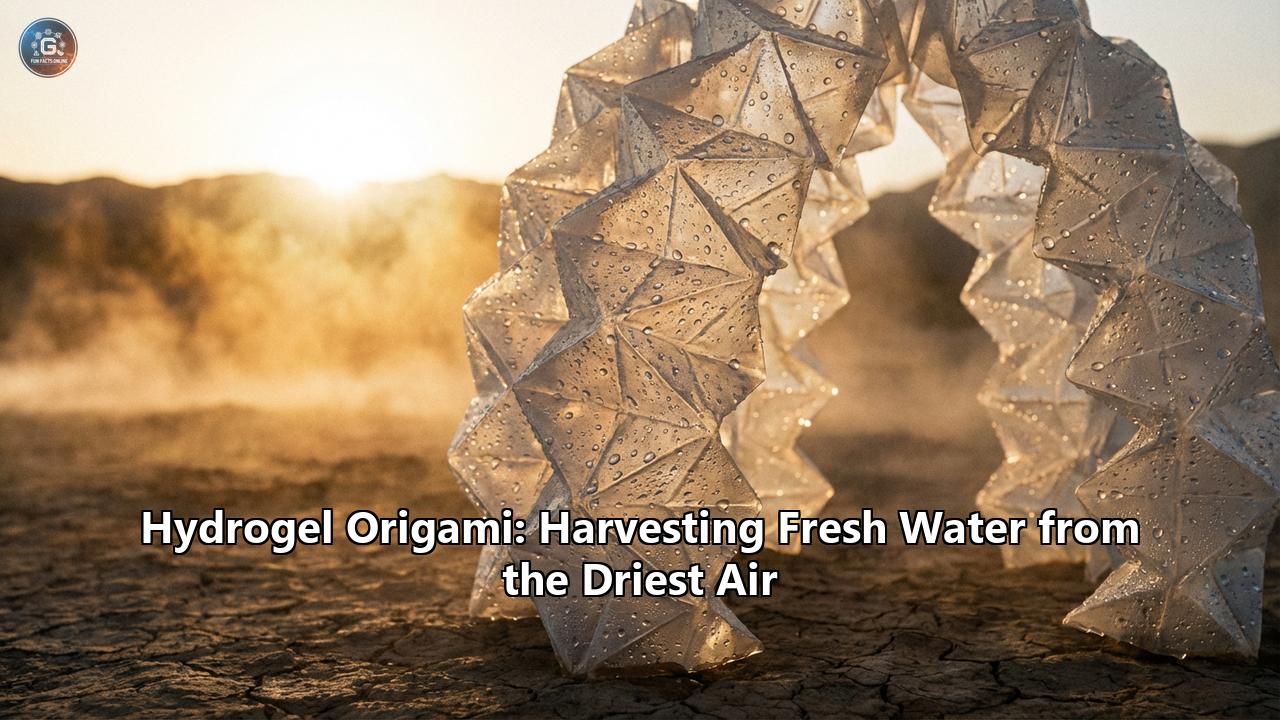
In the heart of Death Valley, where the air is so dry it cracks skin and the sun beats down with relentless ferocity, a new device is performing a miracle. It is not pumping water from deep aquifers, nor is it piping it in from hundreds of miles away. It is pulling it, drop by precious drop, directly from the thin, scorching air.
This is not science fiction. It is the dawn of a new era in Atmospheric Water Harvesting (AWH), led by a groundbreaking innovation known as Hydrogel Origami.
As the global water crisis intensifies, affecting over 2.2 billion people, the search for decentralized, sustainable fresh water has turned our gaze upward. The Earth’s atmosphere holds an estimated 12.9 trillion tons of fresh water—six times more than all the rivers on Earth combined. For decades, this reservoir was inaccessible in arid regions, locked away by low humidity and high energy costs. But recent breakthroughs in materials science, specifically the marriage of hygroscopic hydrogels and ancient origami folding techniques, have unlocked the sky.
This is the story of how a "high-tech bubble wrap" is poised to quench the world's thirst, operating entirely passively, powered only by the sun.
Part I: The Invisible Reservoir
The Limits of Traditional Water
Civilization has always tethered itself to liquid water: rivers, lakes, and underground aquifers. But these sources are finite and failing. Climate change is shifting precipitation patterns, drying up reservoirs, and accelerating desertification. Traditional solutions like desalination are effective but come with a heavy price tag: massive energy consumption, brine pollution, and infrastructure costs that leave the poorest communities behind.
The Problem with "Dew"
Harvesting water from the air is not new. We have used fog catchers (large meshes that trap water droplets) and dew condensers (refrigerated surfaces) for years. However, these technologies have a fatal flaw: they require high humidity.
- Fog catchers need visible fog (100% humidity).
- Condensers (like the AC unit dripping water) become energy vampires below 50% relative humidity (RH). In the desert, where RH often drops below 20%, these methods are useless.
To harvest water in the desert, you don't need a cold surface; you need a molecular sponge. You need a material that actively seeks out and traps water molecules even when they are scarce. This is the domain of sorption-based harvesting.
Part II: The Material Revolution
Enter the Hydrogel
At the core of this revolution is the hydrogel. Hydrogels are 3D networks of hydrophilic (water-loving) polymers that can swell and hold vast amounts of water—sometimes hundreds of times their own weight. You have likely seen simple versions in diapers or potting soil.
But for water harvesting, standard hydrogels aren't enough. Scientists needed a material that could:
- Suck water from bone-dry air (Hygroscopicity).
- Hold it tight so it doesn't evaporate immediately.
- Release it easily when heated by the sun (Desorption).
The Secret Sauce: Lithium Chloride & PVA
The breakthrough came by infusing hydrogels with hygroscopic salts, specifically Lithium Chloride (LiCl). LiCl is a champion water-grabber; it is so thirsty it will dissolve itself in the water it steals from the air (a process called deliquescence).
Researchers at MIT, led by Professor Xuanhe Zhao and Dr. Chang Liu, developed a specific formulation using Polyvinyl Alcohol (PVA) as the structural backbone and LiCl as the active sponge.
- The Problem: Usually, LiCl would turn to liquid and drip out of the gel.
- The Fix: The MIT team engineered the polymer network to entrap the LiCl ions. The salt pulls the water in, but the polymer chains hold the salt in place, creating a stable, swellable solid that doesn't leak.
Part III: The Origami Breakthrough
Why Shape Matters
Creating a great material was only half the battle. The second challenge was speed.
A thick block of hydrogel absorbs water slowly because only the outer layer touches the air. In the short, cool window of a desert night, a thick block wouldn't absorb enough water to be useful. You need surface area—lots of it.
This is where origami changed the game.
The "Bubble Wrap" Architecture
In a landmark study published in Nature Water (2025), the MIT researchers unveiled a device that looked less like a machine and more like a black, geometric art piece. They utilized an origami-inspired design that resembled "high-tech bubble wrap."
- Hemispherical Domes: Instead of a flat sheet, the hydrogel was molded into an array of small, hollow domes.
- Airflow Channels: The space between the domes allowed air to flow freely around the entire surface, maximizing contact.
- Structural Stability: The origami shape allowed the material to swell and shrink without buckling or tearing, a common failure in flat films.
This design doubled the effective surface area, significantly speeding up the absorption kinetics. It allowed the device to "breathe" efficiently, drinking in moisture rapidly during the night.
Part IV: How It Works (The 24-Hour Cycle)
The beauty of the Hydrogel Origami system is its passivity. It has no pumps, no fans, and no batteries. It breathes with the rhythm of the day.
Phase 1: Night (Adsorption)
- The Setting: The sun sets over the desert. The temperature drops, and relative humidity rises slightly (even in dry deserts, nighttime humidity can reach 40%).
- The Action: The box containing the hydrogel panels opens (or uses passive vents). The cool night air flows over the origami domes.
- The Physics: The Lithium Chloride ions grab water molecules from the air. The hydrogel swells, storing the water safely inside its polymer network. It is "charging" with water.
Phase 2: Day (Desorption & Condensation)
- The Setting: The sun rises. The ambient temperature soars.
- The Action: The device is enclosed in a glass case (a solar still). The black hydrogel absorbs sunlight, heating up.
- The Release: The heat breaks the weak bonds holding the water molecules. The water evaporates out of the gel, turning into hot vapor inside the glass case.
- The Harvest: The hot vapor hits the relatively cooler glass walls of the case. It condenses into liquid droplets, which slide down gravity-fed channels into a collection reservoir.
Part V: Field Test: Death Valley
To prove this wasn't just a lab curiosity, the researchers took their device to the ultimate proving ground: Death Valley, California.
- Conditions: Daytime temperatures scorching, relative humidity as low as 21%.
- Performance: The meter-scale device produced between 57 ml and 161.5 ml of water per square meter per day.
- Quality: The water was tested and found to be pristine. The specialized polymer network successfully kept the toxic Lithium ions trapped; the lithium concentration in the water was <0.06 ppm, far below the safety limit for drinking water.
While 160ml might sound small, it is a triumph of physics. It proves that scaling this up to a few square meters (the size of a solar panel array) could provide the 3-4 liters of survival water needed for an adult daily, entirely off-grid.
Part VI: The Competitors (Hydrogels vs. MOFs vs. Fog)
How does Hydrogel Origami stack up against other water harvesting techs?
1. vs. Metal-Organic Frameworks (MOFs)
MOFs are the "Ferrari" of sorbents—highly engineered, porous crystals that are incredible at trapping water.
- MOF Pros: Work at even lower humidity (10% RH).
- MOF Cons: Extremely expensive (requires exotic metals like Zirconium) and complex to manufacture.
- Hydrogel Advantage: Hydrogels use cheap, abundant materials (PVA, Salt, Cellulose). They are the "Toyota" of the industry—reliable, affordable, and scalable.
2. vs. Active Cooling (Dehumidifiers)
- Active Cooling Pros: Can produce massive volume if humidity is high.
- Active Cooling Cons: Requires a generator or grid connection. Useless in dry deserts.
- Hydrogel Advantage: Zero energy cost. Works in the desert.
Part VII: Beyond MIT – The Rise of "Super Sponges"
The MIT study is the tip of the iceberg. Other institutions are joining the hydrogel revolution, most notably UT Austin's "Super Sponge" developed by Guihua Yu's team.
The Biomass Approach
While MIT focused on synthetic polymers, UT Austin has explored bio-derived hydrogels using Konjac gum, cellulose, and chitosan (from shellfish).
- Benefit: These materials are biodegradable and sustainable.
- Innovation: They developed "microgels" that release water at lower temperatures (as low as 60°C), making the solar heating phase even more efficient.
Self-Watering Soil
One of the most exciting applications isn't drinking water, but agriculture. Researchers are mixing these hydrogels directly into the soil.
- Night: The soil absorbs water from the air.
- Day: The soil heats up, releasing water directly to the plant roots.
- Impact: This could allow farming in regions where rain is non-existent, creating a self-sustaining irrigation cycle powered by the atmosphere.
Part VIII: The Economics of Air Water
Is this affordable? The economics are promising.
- Material Cost: The estimated material cost for the MIT device to supply daily water for one adult is approximately $3.20.
- Levelized Cost of Water (LCOW): Current estimates for passive sorption AWH put the cost at roughly $0.05 - $0.10 per liter. While this is higher than tap water ($0.004/L), it is vastly cheaper than bottled water ($1.00/L) and competitively priced for remote, off-grid communities where the alternative is trucking in water.
As manufacturing scales up—imagine roll-to-roll printing of these hydrogel sheets like newspapers—the costs will plummet.
Part IX: Future Horizons
The potential applications of Hydrogel Origami extend far beyond a box in the desert.
1. Green Architecture
Imagine skyscrapers with "skin" made of hydrogel panels.
- Passive Cooling: As the building releases the harvested water, the evaporation process cools the structure (evaporative cooling), slashing air conditioning costs.
- Water Independence: The building could harvest its own greywater or drinking water from the wind blowing past it.
2. Emergency Response
Disaster zones often face a paradox: floodwaters everywhere, but not a drop to drink. Lightweight, foldable hydrogel sheets could be air-dropped into disaster zones. Unfold them, leave them overnight, and by noon, survivors have sterile water.
3. Wearable Water
Textile engineers are exploring weaving hydrogel fibers into clothing. A "water-harvesting jacket" could collect moisture from the air (or your own sweat) and condense it into a drinking pouch for hikers or soldiers.
Conclusion: The Blue Revolution
We are standing on the precipice of a "Blue Revolution." Just as solar panels decentralized energy, Hydrogel Origami has the potential to decentralize water.
It democratizes access to life's most essential resource. No longer bound by the proximity to a river or the grid, communities can thrive in the arid lands that cover 40% of our planet's landmass. The technology is proven. The materials are cheap. The geometry is perfected.
The sky is no longer empty. It is a vast, floating ocean, and thanks to the folds of a simple hydrogel sheet, we finally know how to drink from it.
Reference:
- https://en.reset.org/solar-powered-super-sponge-can-harvest-water-thin-air-03262019/
- https://oxfordre.com/environmentalscience/display/10.1093/acrefore/9780199389414.001.0001/acrefore-9780199389414-e-613?d=%2F10.1093%2Facrefore%2F9780199389414.001.0001%2Facrefore-9780199389414-e-613&p=emailAcuGwbKzd6Sms
- https://www.gaiadiscovery.com/water-crisis-management/atmospheric-water-harvesting-techniques-and-technologies.html
- https://news.utexas.edu/2019/03/13/solar-powered-moisture-harvester-collects-and-cleans-water-from-air/
- https://www.wateronline.com/doc/harvesting-water-from-air-with-hydrogels-and-mofs-0001
- https://scitechdaily.com/scientists-develop-new-system-that-produces-drinking-water-from-thin-air/