
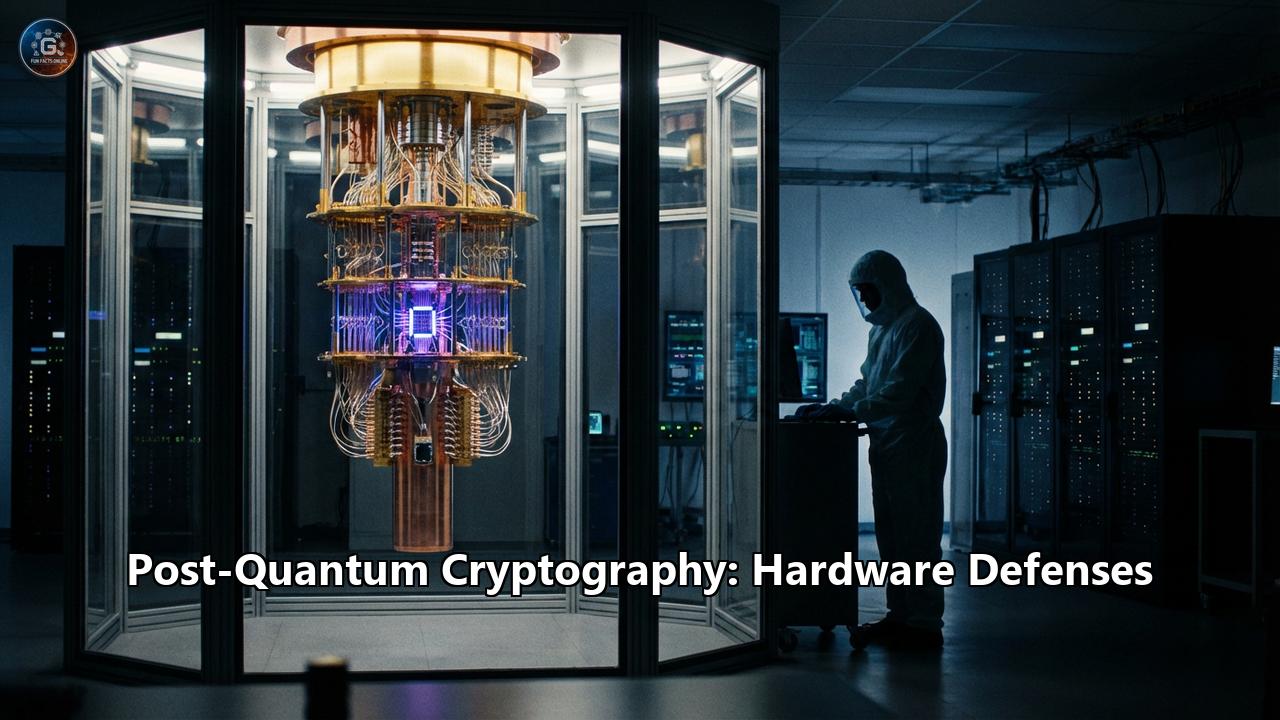
The clock is ticking on a countdown most of the world cannot see. It is not measured in seconds or minutes, but in qubits and error rates. It is the race to Y2Q—the year a quantum computer becomes powerful enough to shatter the cryptographic foundations of our digital society. For decades, we have relied on the mathematical difficulty of factoring large integers (RSA) and solving discrete logarithm problems (ECC) to secure everything from state secrets to credit card transactions. But these defenses are brittle; they are mathematically destined to fall before the might of Shor’s algorithm running on a sufficiently large quantum machine.
The solution is Post-Quantum Cryptography (PQC)—a new suite of algorithms designed to withstand the quantum onslaught. But here lies a critical, often overlooked paradox: algorithms that are mathematically secure in the abstract world of software can be fatally fragile when instantiated in the physical world of hardware.
When a PQC algorithm like ML-KEM (Kyber) or ML-DSA (Dilithium) runs on a silicon chip, it interacts with the physical laws of our universe. It consumes power; it emits electromagnetic radiation; it takes measurable time to execute. These physical byproducts are not just noise; they are leaks. To a sophisticated adversary, the fluctuations in a chip's power consumption during a polynomial multiplication can reveal the secret key just as surely as a mathematical break. Furthermore, the complexity of these new algorithms introduces new attack surfaces—complex memory access patterns, delicate rejection sampling loops, and heavy reliance on specific mathematical transforms—that did not exist in the RSA/ECC era.
This article serves as a comprehensive technical deep-dive into the hardware battleground of the post-quantum era. We will explore the new NIST standards, dissect the unique hardware vulnerabilities they introduce, and examine the cutting-edge engineering defenses—from masking gadgets to lattice-based PUFs—that are being forged to secure the silicon root of trust for the next century.
Part 1: The New Pantheon—NIST PQC Standards and Hardware Implications
In August 2024, the National Institute of Standards and Technology (NIST) finalized the first batch of PQC standards. Understanding their hardware behavior requires understanding their mathematical engines. Unlike RSA (based on number theory), the new champions are largely built on structured lattices and hash functions.
1. ML-KEM (formerly CRYSTALS-Kyber)
The Mechanism: ML-KEM is a Key Encapsulation Mechanism (KEM) based on the Module Learning-With-Errors (ML-WE) problem. In simple terms, it involves finding a vector of secret numbers that, when multiplied by a public matrix and obscured by small "error" noise, produces a given result. Hardware Profile: The heavy lifter here is polynomial multiplication. The algorithm operates over a ring of polynomials, requiring thousands of multiplications and additions. The Hardware Bottleneck: The Number Theoretic Transform (NTT). Similar to a Fast Fourier Transform (FFT), the NTT allows for rapid polynomial multiplication. In hardware, this translates to a massive demand for modular arithmetic units and complex memory addressing schemes ("butterfly" operations) that shuffle data back and forth. This shuffling is a prime target for side-channel leakage.2. ML-DSA (formerly CRYSTALS-Dilithium)
The Mechanism: A digital signature scheme, also based on Module Lattices. It uses the "Fiat-Shamir with Aborts" paradigm. The signer generates a candidate signature, checks if it leaks information about the secret key (or if it's too large), and if so, "aborts" and tries again with a new random nonce. Hardware Profile: Like Kyber, it relies heavily on NTT. However, it introduces a unique hardware beast: Rejection Sampling. The Hardware Bottleneck: The nondeterministic nature of rejection sampling is a nightmare for hardware designers. A circuit that loops an unpredictable number of times creates a variable timing signature. If an attacker can correlate the time taken to generate a signature with the secret key, the system is broken.3. SLH-DSA (formerly SPHINCS+)
The Mechanism: A stateless hash-based signature scheme. It doesn't rely on lattices; instead, it uses a massive tree of hashes (Merkle trees) to authenticate a one-time signature key. Hardware Profile: It is extremely conservative and computationally heavy. It requires millions of calls to a hash function (like SHA-3 or SHA-256). The Hardware Bottleneck: Throughput. A hardware accelerator for SLH-DSA is essentially a massive, parallel hashing engine. The sheer volume of memory access required to traverse the hash trees consumes significant power, making it challenging for energy-constrained IoT devices.4. FN-DSA (formerly Falcon)
The Mechanism: A lattice-based signature scheme that uses "Gaussian sampling" rather than uniform sampling. Hardware Profile: It offers the smallest public keys and signatures but requires high-precision floating-point arithmetic (or complex fixed-point emulation) to sample from a Gaussian distribution. The Hardware Bottleneck: Floating-point units (FPUs) are large, expensive, and notoriously leaky in terms of side-channels. Implementing constant-time Gaussian sampling on hardware without leaking information via the FPU is one of the hardest challenges in PQC engineering.Part 2: The Attack Surface—Why Silicon Bleeds Secrets
In the classical world, hardware attacks were well-understood. In the PQC world, the attack vectors have mutated.
1. Side-Channel Attacks (SCA): The Whisper of Electrons
SCA exploits the correlation between physical measurements and internal data.
- Power Analysis (DPA/CPA): When a register flips from 0 to 1, it consumes a tiny amount of dynamic power. By averaging thousands of traces, an attacker can see the "Hamming weight" of the data being processed. In PQC, the large polynomial coefficients (e.g., 12-bit or 23-bit integers) are much "louder" than the single bits often analyzed in AES.
- Electromagnetic (EM) Emanation: The "butterfly" operations in NTT move data across the chip in specific patterns. These physical movements create spatial EM patterns that can reveal which coefficients are being processed, allowing an attacker to reconstruct the polynomial.
- Timing Attacks: PQC algorithms often have conditional branches. For instance, in the decapsulation phase of Kyber, a comparison is made between a re-encrypted ciphertext and the received ciphertext (the Fujisaki-Okamoto transform). If this comparison is not perfectly constant-time—down to the clock cycle—an attacker can deduce the message.
2. Fault Injection Attacks (FIA): Glitching Reality
FIA involves actively disturbing the chip—zapping it with a laser, under-volting the power supply, or glitching the clock—to cause a specific error.
- Loop Abort Attacks: In Dilithium’s rejection sampling, the hardware loops until it finds a safe signature. A precisely timed voltage glitch can force the loop to exit early, outputting a "bad" signature that leaks information about the secret key.
- Skipping the check: In Kyber, the decapsulation integrity check is crucial. If an attacker can glitch the instruction pointer to skip this check, they can perform a "Chosen Ciphertext Attack" (CCA) on a device that is supposed to be CCA-secure, recovering the key with just a few thousand queries.
- Zeroing Memory: In Lattice schemes, if an attacker can force the memory storing the "error" polynomial to zero, the math collapses into a simple linear system that can be solved with Gaussian elimination, instantly revealing the key.
Part 3: Hardware Defenses—Fortifying the Silicon
Defending PQC hardware requires a "Defense-in-Depth" approach, combining architectural changes, logical countermeasures, and physical hardening.
1. Masking: The Art of Digital Camouflage
Masking is the gold standard for defeating power analysis. The idea is to split every sensitive variable $x$ into multiple random shares $x_1, x_2, \dots, x_n$ such that $x = x_1 \oplus x_2 \oplus \dots \oplus x_n$. The hardware never operates on $x$ directly; it operates on the shares independently.
The PQC Challenge: Classical boolean masking (XOR-based) works great for AES. But PQC relies on Arithmetic Masking (modular addition).- Conversion Overhead: PQC algorithms constantly switch between boolean operations (hashing) and arithmetic operations (polynomial math). This requires Boolean-to-Arithmetic (B2A) and Arithmetic-to-Boolean (A2B) conversion gadgets. These converters are computationally expensive (often quadratic complexity) and are hotspots for leakage.
- Gadgets: Engineers are developing specialized "masking gadgets" for lattice operations. For example, a "masked butterfly unit" that can perform the NTT butterfly operation on split shares without ever recombining them.
2. Shuffling and Hiding
If masking is camouflage, shuffling is a shell game.
- Randomized NTT: Instead of processing polynomial coefficients in a fixed order (0 to 255), hardware accelerators can use a Linear Feedback Shift Register (LFSR) to generate a random permutation of indices. The NTT is computed in a random order every time. An attacker averaging power traces will just see a blur of noise because the "interesting" operation happens at a different time in every trace.
- Dummy Cycles: To defeat timing analysis on rejection sampling, the hardware can be designed to always run for the "worst-case" number of cycles. If the valid signature is found early, the circuit continues to perform dummy math (burning power) until the counter runs out. This flattens the power profile and hides the rejection rate.
3. Redundancy and Infection
To defeat Fault Injection, the hardware must be paranoid.
- Temporal Redundancy: Critical operations (like the signature verification check) are executed twice. If the results don't match, the hardware assumes a glitch occurred and locks down.
- Infective Computation: Instead of a simple if (check_passed) { output key }, PQC hardware uses "infective" logic. The result of the check is mathematically mixed into the output key. If the check fails (or is glitched), the output key becomes garbled and useless to the attacker, rather than revealing the true key.
Part 4: Architectural Innovations—The Rise of the PQC Accelerator
General-purpose CPUs are too slow and too leaky for high-security PQC. The industry is moving toward dedicated hardware accelerators.
1. The NTT Accelerator
The heart of any lattice-based cryptosystem is the NTT core. Modern designs use a Unified Butterfly Architecture. This logic block is configurable to support the slightly different parameters of ML-KEM and ML-DSA (different modulus sizes, different root-of-unity tables).
- Memory Management: To prevent memory bottlenecks, these accelerators use "conflict-free" memory banking. This ensures that the parallel compute units can fetch 4, 8, or 16 coefficients simultaneously without stalling, maximizing throughput.
2. The Keccak/SHA-3 Engine
Since PQC algorithms use SHA-3 (specifically SHAKE128 and SHAKE256) for generating the massive pseudorandom matrices, a standard SHA-3 core is insufficient.
- Sponge Acceleration: PQC accelerators implement "full-width" sponge functions that can absorb and squeeze data at the maximum rate of the memory bus.
- Parallel Hashing: For SLH-DSA (SPHINCS+), which requires hashing thousands of tree nodes, hardware architectures are evolving to include vector-hashing units, capable of processing 4 or 8 independent hash streams in parallel.
3. RISC-V PQC Extensions
The open-source RISC-V architecture has become a playground for PQC innovation. The Zvk (Vector Cryptography) extension is being adapted for PQC.
- New instructions are being proposed specifically for finite field arithmetic. Instead of needing 50 assembly instructions to perform a modular reduction (the "Barrett reduction"), a RISC-V core with PQC extensions can do it in a single cycle.
- Tightly Coupled Memory: To avoid the latency of the main system bus, PQC coprocessors are often given their own private scratchpad memory (Tightly Coupled Memory or TCM) to store the large intermediate polynomials, keeping them out of the reach of other processes and cache-timing attacks.
Part 5: Secure Boot and the Root of Trust
The most critical application of PQC today is Secure Boot. The code that runs when a computer is first turned on (the Root of Trust) validates the operating system. If a quantum computer can forge the signature on a malicious OS update, the device is permanently compromised.
The OpenTitan Case Study:The OpenTitan project, an open-source silicon root of trust, faced a dilemma. They needed a quantum-secure signature for boot verification. They chose SLH-DSA (SPHINCS+) over Dilithium.
- Why? Dilithium is faster, but it is complex and relies on lattice hardness (a newer assumption). SPHINCS+ is slow and has large signatures, but its security rests solely on the security of the hash function (SHA-2 or SHA-3).
- The Hardware Trade-off: For a ROM (Read-Only Memory) implementation that cannot be patched, "boring" security is better than "fast" security. OpenTitan accepts the slower boot time (milliseconds vs microseconds) in exchange for the certainty that as long as SHA-2 is secure, their boot process is secure.
Traditional PUFs use manufacturing variations in silicon to create a unique fingerprint (key). PQC offers a new paradigm: the Lattice PUF.
- Instead of storing a secret key, the device uses its physical variation (e.g., delay differences in paths) as the "error" term in a Learning-With-Errors (LWE) instance.
- The helper data stored on the chip is the public matrix. To reconstruct the key, the chip measures its own physical error and runs the LWE decoding algorithm. This mathematically binds the post-quantum key directly to the atomic structure of the silicon.
Part 6: The Future—Crypto-Agility and Hybrid Schemes
The transition to PQC is not a "flip the switch" event. We are entering an era of Hybrid Cryptography.
- X25519 + Kyber: Hardware of the near future will run both classical ECC (like X25519) and ML-KEM (Kyber) simultaneously. The keys are derived from both. If Kyber breaks, the ECC part protects the data. If Quantum Computers arrive, Kyber protects the data.
- Hardware Agility: Hard-wiring PQC algorithms into silicon (ASIC) is risky because the standards might be tweaked or broken. The solution is eFPGA (embedded FPGA) technology. A small patch of reconfigurable logic is embedded next to the CPU. If a vulnerability is found in the hardware accelerator, the logic can be reprogrammed in the field to patch the circuit structure itself, not just the software.
Conclusion
The arrival of Post-Quantum Cryptography is the biggest overhaul of digital security history. But the math is only the blueprint; the hardware is the building. As we move toward Y2Q, the focus of the security industry is shifting from the whiteboard to the cleanroom.
The challenges are immense—masking quadratic lattice operations, stabilizing rejection sampling against glitches, and accelerating hash trees without draining batteries. But the defenses are evolving just as fast. From RISC-V vector extensions to self-correcting lattice logic, the hardware of tomorrow is being hardened today. The quantum computer may be inevitable, but with robust hardware defenses, the data it seeks to decrypt will remain ghost in the machine—mathematically accessible, but physically out of reach.