
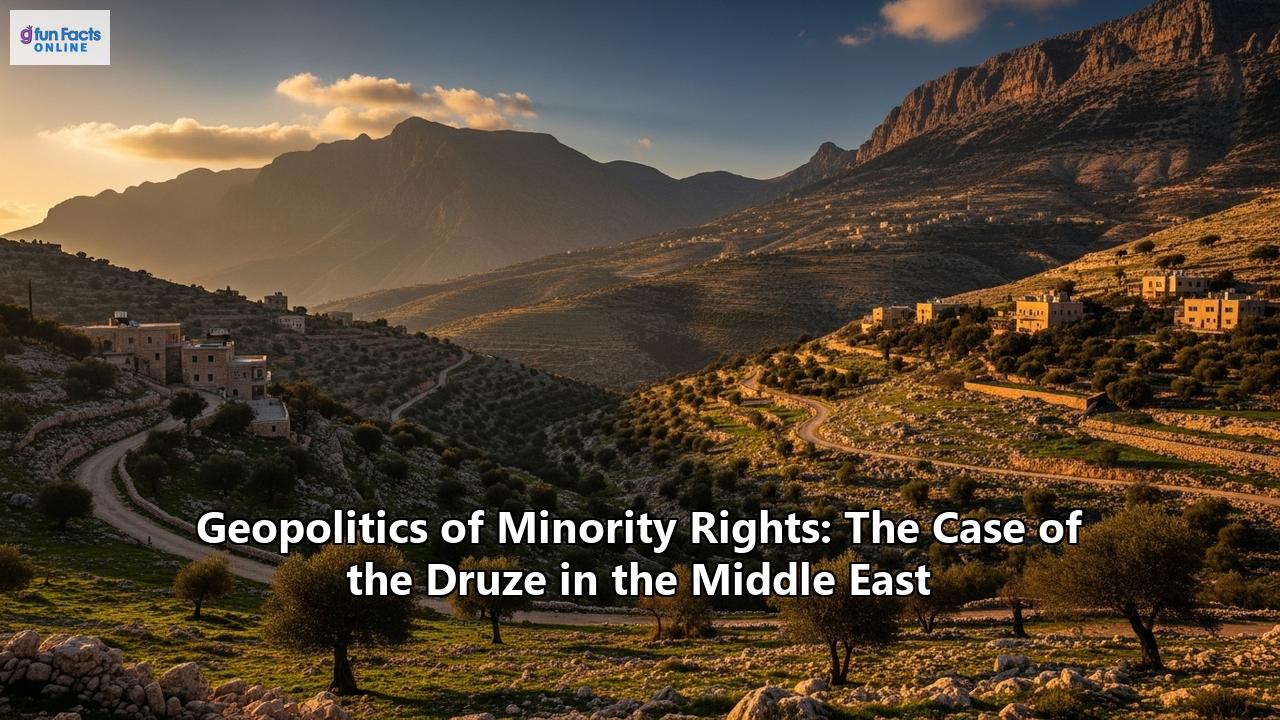
The Druze of the Middle East: Navigating a treacherous geopolitical landscape
An ethnoreligious group with a faith that draws from a multitude of sources, the Druze have for centuries been a resilient and influential minority in the Middle East. Their history is one of persecution and adaptation, of fierce independence and pragmatic alliances. Today, scattered across the politically charged territories of Syria, Lebanon, Israel, and Jordan, the Druze find their fate intrinsically linked to the volatile geopolitics of the region. This article delves into the intricate world of the Druze, exploring their unique identity, their political standing in their respective countries, and the complex web of regional and international interests that shape their present and future.
The People of Tawhid: A Glimpse into the Druze Faith and History
The Druze call themselves "al-Muwahhidun," meaning "the monotheists" or "Unitarians," a name that reflects the core tenet of their faith: the absolute oneness of God. Their religion, which emerged in the 11th century in Fatimid Egypt, is a syncretic faith that incorporates elements of Isma'ili Shi'a Islam, Gnosticism, Neoplatonism, and other philosophies. While they revere many prophets recognized in Islam, Judaism, and Christianity, such as Moses, Jesus, and Muhammad, the Druze have their own distinct theological interpretations and practices, which are largely kept secret from outsiders and even from the uninitiated within their own community, known as the juhhal (the ignorant). The initiated, or uqqal (the knowledgeable), are the custodians of the faith's esoteric teachings, contained in their holy texts, the Epistles of Wisdom.
Historically, the Druze have faced persecution from various ruling powers, which led them to seek refuge in the mountainous regions of the Levant. This has fostered a strong sense of community and a tradition of taqiyya, or concealing one's true beliefs to avoid persecution. This history of persecution has also instilled in the Druze a pragmatic approach to politics, often leading them to align with the ruling powers in the countries where they reside to ensure their survival and security.
The Geopolitics of Minority Rights: A Theoretical Framework
The situation of the Druze is a compelling case study for understanding the geopolitics of minority rights in the Middle East. This framework examines how the rights, recognition, and political agency of minority groups are influenced by and, in turn, influence the strategic interests of regional and international powers. Minority groups in the Middle East have often been used as pawns in larger geopolitical games, with external actors supporting or suppressing them to advance their own agendas.
The concept of "minority" itself is a complex and often politicized term in the region. The formation of modern nation-states in the 20th century, often with artificially drawn borders, left many ethnic and religious groups as minorities within newly formed countries. These states, in their quest for national unity, have often adopted policies that range from assimilation to outright persecution of minorities. In this context, the struggle for minority rights is not just a domestic issue but is deeply intertwined with regional power dynamics, sectarian rivalries, and the foreign policies of global powers.
The Druze in the Levant: A Country-by-Country Analysis
The approximately one million Druze in the world are primarily concentrated in Syria, Lebanon, and Israel, with a smaller community in Jordan. While they share a common faith and a strong sense of kinship, the political realities of each country have shaped their experiences and strategies for survival in distinct ways.
Lebanon: The Kingmakers of the Mountain
In Lebanon, the Druze, who constitute about 5.5% of the population, have historically wielded a level of political influence that far outweighs their numbers. Concentrated in the Chouf Mountains, they have been a major force in Lebanese politics, often acting as "kingmakers" in the country's delicate sectarian power-sharing system.
The most prominent figure in modern Lebanese Druze politics is Walid Jumblatt, who for decades led the Progressive Socialist Party (PSP), a party founded by his father, Kamal Jumblatt. The PSP was a major player in the Lebanese Civil War (1975-1990), and Walid Jumblatt has been a master of shifting alliances, at times aligning with Syria, and at other times opposing it, always with the aim of protecting the interests of the Druze community.
The Lebanese political system, based on the unwritten National Pact of 1943, allocates specific positions to different religious groups. While the presidency is reserved for a Maronite Christian, the premiership for a Sunni Muslim, and the speakership of parliament for a Shi'a Muslim, the Druze have traditionally held the position of the Chief of Staff of the army. However, they have also felt marginalized by this system, which denies them a top leadership position.
The rise of Hezbollah, the powerful Iran-backed Shi'a militant group, has further complicated the political landscape for the Druze. Jumblatt has had a complex and often fraught relationship with Hezbollah, at times aligning with them against common enemies and at other times opposing their growing influence in the country. The Druze in Lebanon find themselves in a precarious position, navigating the treacherous currents of Lebanese sectarian politics and the broader regional rivalry between Iran and its adversaries.
Syria: Between Neutrality and Self-Defense
Syria is home to the largest Druze population, estimated to be around 700,000, concentrated in the southern province of Suwayda, also known as Jabal al-Druze (the Mountain of the Druze). Historically, the Druze of Syria have a proud tradition of resistance against foreign occupation, most notably the Great Syrian Revolt of 1925-1927, led by the charismatic Druze leader Sultan Pasha al-Atrash, against the French Mandate.
During the rule of the al-Assad family, the Druze, like other minorities, were largely co-opted into the Ba'athist regime, which offered them a degree of protection and stability in exchange for their loyalty. However, the outbreak of the Syrian civil war in 2011 placed the Druze in a difficult position. While they largely sought to remain neutral in the conflict, they were targeted by extremist groups like ISIS and al-Nusra Front, who view them as heretics. This led to the formation of local Druze militias to defend their communities.
The recent fall of the Assad regime in late 2024 has created a new set of challenges for the Syrian Druze. They are now faced with a new government in Damascus and are wary of its intentions. Tensions have already flared between Druze and Bedouin groups in the south, raising fears of wider sectarian conflict. The Druze spiritual leadership has been cautious in its dealings with the new authorities, demanding guarantees for their rights and autonomy.
The situation in Syria has also drawn the attention of external powers. Israel, which shares a border with Syria and has a significant Druze population of its own, has warned Damascus against harming the Druze and has even carried out airstrikes in their defense. This has led to accusations that Israel is using the Druze to create a buffer zone on its border. Iran, a key backer of the former Assad regime, is also closely watching the situation, seeking to maintain its influence in post-Assad Syria. The Druze in Syria are thus at the epicenter of a complex geopolitical struggle, with their future depending on the outcome of the power dynamics both within Syria and in the broader region.
Israel: The Covenant of Blood and the Crisis of Identity
The Druze in Israel, numbering around 143,000, have a unique and complex relationship with the state. Unlike other Arab citizens of Israel, Druze men are subject to mandatory military service in the Israel Defense Forces (IDF). This has created a "covenant of blood" between the Jewish and Druze communities, with Druze soldiers fighting and dying alongside their Jewish counterparts in all of Israel's wars. In return, the Druze have been granted a degree of recognition and have achieved high positions in the Israeli military and politics.
However, this integration has come at a cost. The Druze are often seen as a "model minority" by the Israeli state, which has sought to separate them from the broader Palestinian Arab community. This has created a crisis of identity for many Druze, who are culturally and linguistically Arab but are expected to be loyal to a state that is often in conflict with the Arab world.
The controversial 2018 Nation-State Law, which defines Israel as the nation-state of the Jewish people without guaranteeing equal rights for its non-Jewish citizens, has further exacerbated these tensions. Many Druze felt betrayed by this law, which they saw as a demotion of their status as equal citizens.
The Druze in the Israeli-occupied Golan Heights, who are technically Syrian citizens, have a different experience. For decades, they have maintained their Syrian identity and have largely refused Israeli citizenship. However, the Syrian civil war and the collapse of the Assad regime have led to a shift in attitudes, with an increasing number of Golan Druze now applying for Israeli citizenship.
The Druze in Israel are thus caught between their loyalty to the state and their Arab identity, a dilemma that has been brought into sharp focus by the recent events in Syria. The Israeli government's vocal support for the Syrian Druze has been met with mixed reactions within the Israeli Druze community, with some welcoming it and others viewing it as a cynical attempt to use their brethren for geopolitical gain.
Jordan: A Quiet and Integrated Community
The Druze community in Jordan is the smallest in the region, with an estimated population of around 20,000. They are well-integrated into Jordanian society and have a long history of loyalty to the Hashemite monarchy. The first Prime Minister of Transjordan, Rashid Tali'a, was a Druze, a testament to the community's early and significant role in the formation of the state.
The Jordanian government officially classifies the Druze as Muslims, and they do not have separate religious courts like in Israel and Lebanon. They are not subject to the same political pressures as their brethren in other countries and have largely managed to stay out of the regional conflicts. However, they maintain strong ties with Druze communities in other countries and share their concerns about the challenges they face.
The Role of External Powers
The fate of the Druze is not only shaped by the domestic politics of the countries they inhabit but also by the interests and actions of external powers.
- Israel: Israel's relationship with the Druze is complex and multifaceted. It views the Druze in Israel as a loyal and integrated minority, a key component of its security forces. In Syria, Israel has positioned itself as the protector of the Druze, a policy that serves its strategic interest of creating a friendly buffer zone on its northern border. However, this policy is viewed with suspicion by many Druze, who fear being used as pawns in Israel's conflict with its adversaries.
- Iran: Iran's influence on the Druze is primarily felt in Lebanon and Syria. As the main backer of Hezbollah and the former Assad regime, Iran has sought to extend its influence over the Druze in these countries. However, the Druze have largely resisted being drawn into Iran's orbit, with leaders like Walid Jumblatt often vocally opposing Iranian hegemony in the region.
- Saudi Arabia: Saudi Arabia, as a major Sunni power and a rival of Iran, has also sought to cultivate ties with the Druze. In Lebanon, the Saudis have supported anti-Syrian and anti-Hezbollah factions, which have at times included the Druze. In Syria, Riyadh has supported various opposition groups, some of which have clashed with the Druze. The Saudis are also wary of Israel's growing influence over the Syrian Druze.
- United States: The United States has had a more indirect role in the affairs of the Druze. In Lebanon, Washington has supported the Lebanese state and its army, which includes Druze soldiers. In Syria, the US has been involved in the conflict against ISIS and has called for a political solution that protects the rights of all minorities, including the Druze. However, the US has also been criticized for not doing enough to protect the Druze and other minorities from the violence of the civil war.
Influential Druze Figures
Throughout their history, the Druze have produced a number of influential figures who have left their mark on the region.
- Sultan Pasha al-Atrash (1891-1982): A Syrian Druze leader who led the Great Syrian Revolt against the French Mandate. He is revered as a national hero in Syria and a symbol of resistance against foreign domination.
- Kamal Jumblatt (1917-1977): A Lebanese Druze leader who founded the Progressive Socialist Party. He was a prominent intellectual and a major figure in Lebanese politics until his assassination in 1977.
- Walid Jumblatt (b. 1949): The son of Kamal Jumblatt, he led the PSP for decades and has been a dominant figure in Lebanese politics. Known for his political pragmatism and his ability to navigate the complex sectarian landscape of Lebanon, he has been a key player in the country's major political developments.
- Asmahan (1912-1944): A Syrian-born singer and actress who became a cultural icon in the Arab world. Born Amal al-Atrash, she was a member of the prominent al-Atrash clan. Her powerful voice, glamorous lifestyle, and mysterious death have made her a legendary figure.
Conclusion: A Future in the Balance
The Druze of the Middle East find themselves at a critical juncture. The collapse of the old order in Syria, the ongoing political and economic crisis in Lebanon, and the persistent challenges to their identity in Israel have created a new and uncertain landscape. Their ability to navigate this treacherous terrain will depend on their continued resilience, their political acumen, and their capacity to maintain their unity in the face of sectarian divisions and external pressures.
The geopolitics of minority rights will continue to play a central role in shaping their future. The Druze are not simply passive victims of larger geopolitical forces; they are active agents who are constantly negotiating their position and striving to secure their rights and their future. Their story is a powerful reminder of the complex and often tragic interplay between identity, politics, and power in the Middle East. As a bellwether for the region's religious and ethnic politics, one could argue that as the Druze go, so goes the Middle East.
Reference:
- https://www.bohrium.com/paper-details/ethnic-minorities-in-the-middle-east-realities-and-prospects-of-status-transformation-in-the-geopolitical-system/864991672390385956-37943
- https://www.geopoliticalmonitor.com/syrias-next-chapter-iran-reshapes-its-influence/
- https://christianitymiddleeast.gr/resources/annotated-bibliography/572-religious-freedom-the-minority-question-and-geopolitics-in-the-middle-east
- https://www.dw.com/en/us-eu-express-concern-following-israeli-strikes-on-damascus/live-73303286
- https://jstreet.org/amidst-rising-tensions-seizing-historic-opportunity-for-syria-israel-and-the-us/?utm_source=rss&utm_medium=rss&utm_campaign=amidst-rising-tensions-seizing-historic-opportunity-for-syria-israel-and-the-us
- https://en.wikipedia.org/wiki/Druze
- https://www.numberanalytics.com/blog/geopolitics-minorities-middle-east
- https://today.lorientlejour.com/article/1459125/-hacking-lebanese-politics-7-whats-up-with-the-druze.html
- https://www.middleeastmonitor.com/20220128-druze-leader-jumblatt-says-iran-gains-in-lebanon-as-arabs-abandon-it/
- https://global.oup.com/academic/product/minority-rights-in-the-middle-east-9780199679492
- https://www.hoover.org/research/lebanon-under-iranian-influence-little-peace-and-no-prosperity
- https://www.researchgate.net/publication/262088603_The_Nusayri_and_Druze_Minorities_in_Syria_in_the_Nineteenth_Century_The_Revolt_against_the_Egyptian_Occupation_as_a_Case_Study
- https://interstices-fajawat.org/the-druze-of-lebanon-and-syria-a-long-history-of-insubordination/
- https://carnegieendowment.org/research/2025/03/syria-becomes-a-front-line-in-protecting-saudi-security?lang=en
- https://www.timesofisrael.com/liveblog-july-16-2025/
- https://www.twz.com/news-features/israel-strikes-at-the-heart-of-syrias-military-command-in-dramatic-escalation
- https://www.researchgate.net/publication/356687803_As_the_Druze_Go_So_Goes_the_Middle_East
- https://www.arabnews.com/Druze
- https://online.ucpress.edu/currenthistory/article/120/830/366/118989/As-the-Druze-Go-So-Goes-the-Middle-East