
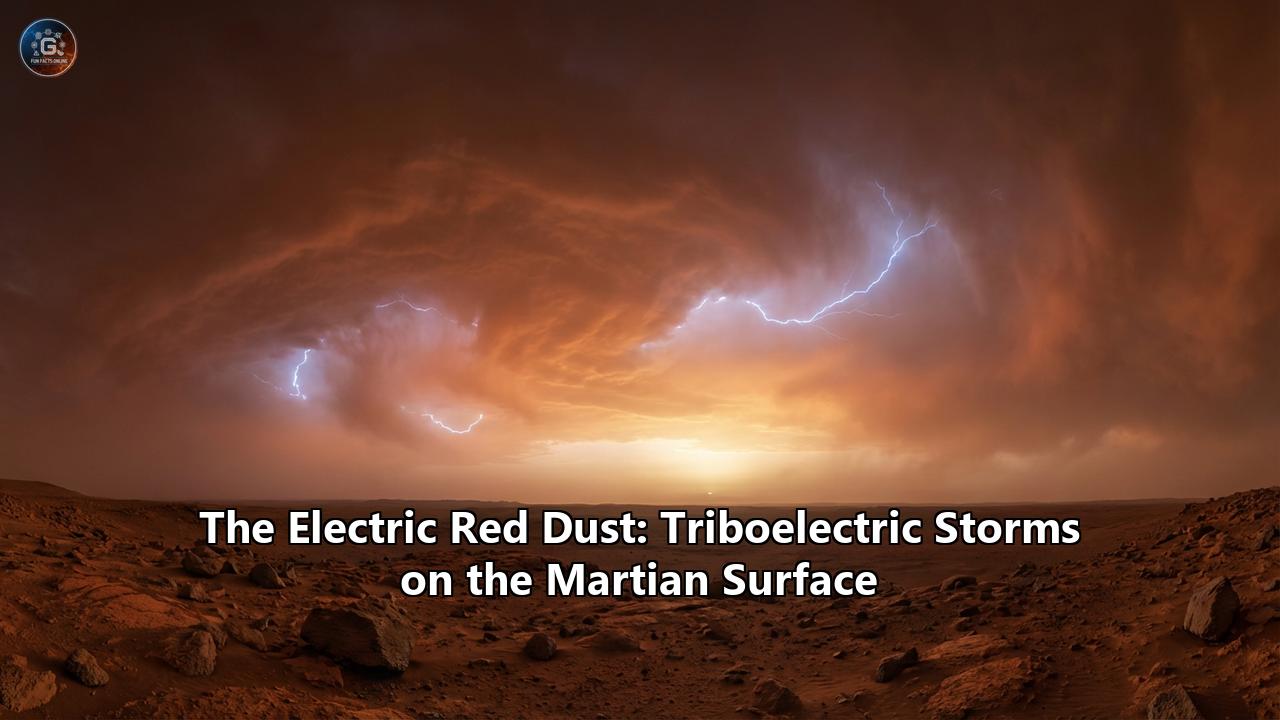
The wind on Mars does not howl; it hisses. It is a thin, serpentine sound, the ghost of an atmosphere scraping against a world of rust. To the naked eye, the approaching dust storm looks like a towering wall of dried blood, swallowing the pale salmon sky and plunging the landscape into a premature, suffocating twilight. But if you were standing there, clad in a hypothetical surface suit with your visor tuned to the ultraviolet or wearing eyes evolved for this alien dark, you would see something else entirely. You would see the storm coming alive.
Inside the swirling opacity, the dust is not just moving; it is dancing with invisible fire. Billions of microscopic grains of basalt and hematite are colliding, rubbing, and fracturing. They are trading electrons in a frenzied chaotic barter. The ground beneath the storm begins to hum with a negative charge, while the lofted dust billows with a positive potential. The air, thin and rich in carbon dioxide, strains under the mounting electrical stress. It does not crack with the deafening thunderclaps of Earth. Instead, it begins to glow.
Faint, ephemeral halos of violet and blue flicker around the sharp edges of rocks. The whirling rotors of a drone drone entrap a corona of ghostly light, looking like a phantom buzzsaw in the gloom. And deep within the belly of the storm, tiny, biting sparks—miniature lightning bolts no longer than a finger—snap and hiss, weaving a web of dry electricity that sterilizes the soil and bleaches the very history of life from the planet.
This is the electric reality of the Red Planet. For decades, it was a theory, a debate, a mathematical probability. But as we stand here in January 2026, fresh off the heels of the groundbreaking confirmations from the Perseverance rover and the latest orbital analyses, we finally know the truth: Mars is an electric world. The "Red Dust" is not just dead rock; it is a global battery that shapes the climate, the chemistry, and the future of human exploration.
This is the story of Martian triboelectricity.
Part I: The Engine of the Storm
To understand the electric storm, one must first understand the dust. Martian dust is ubiquitous. It is the defining feature of the planet, a powder so fine that it behaves more like cigarette smoke than sand. It is the product of billions of years of erosion, meteorite impacts, and thermal cycling, ground down into particles often smaller than two micrometers.
On Earth, dust is an annoyance. On Mars, it is a climatological engine. When the planet nears its perihelion (its closest point to the sun), the increased solar insolation triggers a feedback loop. The ground heats up, warming the thin air just above it. This air rises, carrying dust with it. The suspended dust absorbs more sunlight, warming the atmosphere further, which increases wind speeds, which lifts more dust. This "runaway greenhouse" effect can balloon a local squall into a planet-encircling global dust storm in a matter of weeks.
But as these storms grow, a silent physics takes hold: Triboelectricity.
Triboelectric charging is the same phenomenon that causes a balloon to stick to a wall after you rub it on your hair, or the zap you feel when touching a doorknob after walking in socks on a carpet. It is contact electrification. When two materials collide or rub against each other, chemical bonds are momentarily formed and broken on their surfaces. In this molecular violence, electrons are torn free.
On Mars, this happens on a scale that defies comprehension. In the saltation layer—the zone just above the ground where sand grains bounce and skip—heavier particles crash into the surface, kicking up lighter, finer dust.
The physics of this charge separation is specific and strange. Through a mechanism that physicists are still unraveling, smaller dust grains tend to acquire a negative charge, while larger grains generally charge positively. However, on Mars, the specific mineralogy and the low pressure alter this dynamic. Recent studies suggest that the smaller, lighter particles lofted high into the atmosphere carry a net charge (often negative in Earth analogs, but Mars' specific mineralogy suggests complex polarity switching), while the heavier grains staying near the surface carry the opposite charge.
The result is a planet-sized capacitor. The ground and the lower atmosphere become one plate, the upper dust clouds the other. The voltage potential between them begins to climb. On Earth, the breakdown voltage of air—the electrical pressure needed to turn air from an insulator into a conductor (lightning)—is about 30,000 volts per centimeter. But Mars is different. Its atmosphere is 100 times thinner, and it is made of carbon dioxide.
This brings us to Paschen’s Law.
Part II: The Paschen Paradox and the Violet Glow
Friedrich Paschen, a German physicist in the 19th century, discovered that the voltage required to spark an arc between two electrodes depends on the pressure of the gas and the distance between them.
The relationship is not linear; it is a curve—a "U" shape.
- If the pressure is very high (like on Venus), it’s hard for electrons to gain enough speed to smash into gas molecules and ionize them; they just keep bumping into things too frequently.
- If the pressure is very low (like in a vacuum), there aren't enough gas molecules to hit to start a chain reaction.
- But at a sweet spot—the "Paschen minimum"—it becomes incredibly easy to ionize the gas.
The surface pressure of Mars (roughly 600 Pascals or 6 millibars) sits uncomfortably close to the Paschen minimum for carbon dioxide. This means that the Martian atmosphere is a surprisingly poor insulator. It wants to conduct. It wants to spark.
However, because the air is so thin, it cannot support the massive, superheated plasma channels we call lightning on Earth. A terrestrial lightning bolt requires a massive buildup of charge that rips a channel miles long, heating the air to 30,000 Kelvin and creating a shockwave (thunder).
On Mars, the "breakdown" happens much sooner, at lower voltages. Instead of a single, catastrophic bolt, the Martian atmosphere likely bleeds off the charge in a continuous, lower-energy fashion. This is known as a Glow Discharge or Townsend Discharge.
Imagine a dust storm at night in the Jezero Crater. You might not see a jagged white bolt. Instead, you would see a diffuse, eerie luminosity. The dust cloud itself might glow with a faint violet or blue hue (the spectral signature of ionized CO2). The tips of the rover’s antennas would be wreathed in St. Elmo’s Fire, a steady plasma glow caused by the ionization of the air in the strong electric field.
This does not mean "lightning" is impossible. It just looks different. As confirmed by the breaking news from the Perseverance team in late 2025, we now have evidence of "micro-lightning."
Part III: The 2025/2026 Breakthroughs
For fifty years, the question of "Is there lightning on Mars?" was one of the most contentious debates in planetary science.
The Viking landers in the 1970s saw nothing, but their instruments weren't designed for it.
In 2006, researchers from the University of Michigan detected non-thermal microwave radiation during a dust storm, a strong hint of electrical discharge, but it wasn't definitive.
Then came the visual searches. Cameras on Curiosity and trace gas orbiters stared into the dark, looking for flashes. They found nothing. Skeptics argued that perhaps the dust grains on Mars were too conductive, or the atmosphere too thin, preventing charge pile-up.
But the silence broke in late 2025.
In a landmark paper published in Nature, researchers analyzing data from the Perseverance rover’s SuperCam microphone announced the detection of electrical discharges. The microphone, originally designed to listen to the zap of lasers hitting rocks, had been recording the ambient sounds of the Martian wind.
During a series of dust devils and a regional storm, the microphone picked up distinct, rapid-fire crackles—"clicks" that did not match the aerodynamic rumble of wind. These were the acoustic signatures of electrostatic discharges.
They weren't the sonic booms of Earth thunder. They were the snaps of sparks only inches or centimeters long. Thousands of them.
Simultaneously, a new study led by planetary scientist Alian Wang (published Jan 2026) provided the chemical smoking gun. Her team demonstrated that these "small" sparks are chemically potent enough to explain one of Mars' biggest mysteries: the Chlorine Cycle.
We had found the spark. Now we had to deal with the fire.
Part IV: The Chemical Cauldron
The discovery of a global, electric circuit on Mars resolves a chemical mystery that has baffled astrobiologists for decades: Perchlorates.
When the Phoenix lander touched down in the Martian arctic in 2008, it found the soil was rich in perchlorates (ClO4-)—salts derived from perchloric acid. This was a shock. Perchlorates are toxic to humans (they attack the thyroid) and are relatively rare on Earth (found mostly in the ultra-dry Atacama Desert). On Mars, they are everywhere, covering the planet in a concentration of roughly 0.5% to 1%.
For years, scientists struggled to explain how so much highly oxidized chlorine could form. Solar UV radiation alone wasn't enough to drive the reaction at the observed rates.
The electric storm provides the missing energy.
When triboelectric sparks—even tiny ones—snap through the Martian air, they act as miniature chemical reactors. The electron impact splits atmospheric carbon dioxide (CO2) and nitrogen (N2). It creates free radicals and highly reactive species like ozone, atomic oxygen, and superoxides.
When these airborne oxidants crash into the chloride salts (remnants of ancient dried-up seas) in the dust, they oxidize them aggressively, turning benign chlorides into toxic perchlorates.
This has profound implications for the hunt for life.
- The Viking Confusion: In 1976, the Viking landers mixed Martian soil with nutrients and saw a fizz of gas. They thought it might be biology. Then, their GCMS (Gas Chromatograph Mass Spectrometer) detected no organic molecules, only simple chlorinated methanes. We now realize that the soil was likely filled with perchlorates. When Viking heated the soil, the perchlorates activated, burning up any organics present and destroying the evidence.
- The Sterilizer: If electric storms are constantly churning the soil and bombarding it with reactive oxygen species, the surface of Mars is effectively a self-sterilizing operating table. Any organic molecule exposed to the "Electric Red Dust" is torn apart by oxidation. To find life, we must dig deep—below the reach of the electric field and the chemically aggressive "active layer" of the soil.
Part V: The Glow of Ingenuity
One of the most visually arresting consequences of this science involves our robotic explorers.
Before it was grounded, the Ingenuity helicopter (and the future generation of hexacopters now being designed for the Sample Return mission) inadvertently became a physics experiment.
Rotor blades spinning at 2,400 RPM in a dusty atmosphere are the ultimate triboelectric generators. As the blades slice through the air, they strike dust grains. The blade material (carbon fiber/insulators) strips electrons from the dust.
According to NASA models and recent lab tests, a drone flying at dusk on Mars would likely glow. The charge accumulation on the leading edge of the blades would become so high that the air would break down continuously. A pilot flying alongside Ingenuity would see rings of violet fire tracing the path of the rotors—a phenomena known as the "corona effect."
This is not just a special effect; it is a design challenge. If the helicopter lands and the chassis is charged to 20,000 volts relative to the ground, what happens when the metal legs touch the soil? Zap. A rapid discharge current flows through the legs. If the flight computer isn't shielded, it crashes. If the sensors aren't grounded, they fry.
Future "Science Copters" are now being designed with static wicks—spiky conductors on the trailing edges of wings/rotors (similar to those on Earth airplanes) to bleed off the charge back into the atmosphere before it builds up to dangerous levels.
Part VI: The Hazard to Human Exploration
As we look toward the human landings planned for the 2030s (Artemis/Moon to Mars), the electric dust moves from a scientific curiosity to a safety critical hazard.
1. The "Apollo 12" Risk:In 1969, Apollo 12 launched into a cloudy sky. The exhaust plume of the Saturn V rocket created a conductive channel to the ground, triggering a lightning strike that knocked out the spacecraft's guidance platform.
On Mars, a lander descending through a dust storm, or an ascent vehicle launching from the surface, generates massive amounts of triboelectric charge via its engine plume stirring up dust. The risk of triggering a "megaspark" or a coronal discharge that interferes with telemetry is real. Launch windows may need to be scrubbed not just for wind, but for "electric potential."
2. The Cling:Static cling on Earth is annoying. On Mars, it is blinding. Because of the intense electrostatic charging, Martian dust adheres to surfaces with tenacious force. It is not just resting on the surface; it is magnetically clamped to it.
- Solar Panels: We have lost rovers (Opportunity, InSight) because they could not clean their panels. The electrostatic adhesion makes the dust difficult to wipe off. It resists wind. Future panels may need "electrodynamic dust shields"—transparent electrode grids that pulse a wave of electricity to repel the charged dust, flicking it off like a calm hand brushing away a fly.
- Spacesuits: For an astronaut, this is critical. If a suit is charged negatively and the dust is positive, the astronaut will become a walking dust magnet. The dust is abrasive (unweathered basalt). It grinds into joints and seals. Furthermore, if an astronaut walks back into the airlock fully charged and touches the equalization valve, the resulting discharge could ignite sensitive materials or damage suit life-support electronics. Grounding straps and conductive outer fabrics will be mandatory fashion on Mars.
During the height of a global storm, the background static noise (RF interference) generated by billions of constant micro-discharges could swamp radio communications. An outpost might find itself electrically isolated, listening to the crackle of the storm rather than the voice of Mission Control.
Part VII: The Future – Harvesting the Storm?
Where there is energy, there is opportunity.
Some futurists and electrical engineers are already looking past the hazards. If the Martian atmosphere is a giant battery, can we plug into it?
Concepts for "Triboelectric Nanogenerators" (TENGs) have been proposed for Martian rovers. Instead of fearing the wind, these devices would use the friction of the blowing dust against special polymer surfaces to generate power. While it wouldn't replace a nuclear reactor or a solar array, it could power low-energy sensor networks. Imagine a weather station that has no battery, powered entirely by the storm it is measuring.
Furthermore, understanding the electric field is key to terraforming—or at least, agriculture. We know that high-voltage electric fields can influence plant growth (electro-culture). While speculative, the management of the electrostatic environment inside Martian greenhouses will be essential. We cannot simply vent in outside air; we have to de-ionize it, scrub the perchlorates, and neutralize the charge.
Conclusion: The Living Planet
Mars is often called a dead planet. Geologically, its volcanoes have slept for millions of years. Biologically, it is silent. But Electrically, it is vividly, violently alive.
The Red Planet breathes electricity. Its storms are not just moving dirt; they are vast, glowing electrochemical processors that constantly rework the surface of the world. They create the poison in the soil, they scream in the radio spectrum, and they light the way for the robotic explorers that brave the dark.
For the future astronauts who will walk the rust-colored dunes, the "Electric Red Dust" will be a constant companion. They will hear it crackle in their headsets. They will see it dance on their viewports. And they will learn, as we are learning now, that to survive on Mars, you don't just need to master the cold and the vacuum. You need to master the spark.
The storm is coming. And it is electric.
Reference:
- https://www.nationalacademies.org/read/10360/chapter/5
- https://www.livescience.com/mars-electric-dust-storm-glow.html
- https://ntrs.nasa.gov/citations/19910017755
- https://scitechdaily.com/mars-isnt-just-red-its-electrically-alive-scientists-reveal/
- https://www.researchgate.net/publication/222830201_Electric_discharge_in_the_Martian_atmosphere_Paschen_curves_and_implications_for_future_missions
- https://digitalcommons.calpoly.edu/cgi/viewcontent.cgi?article=1120&context=aerosp
- https://skyandtelescope.org/astronomy-news/tiny-sparks-of-lightning-detected-on-mars-for-the-first-time/
- https://www.sciencealert.com/nasa-recorded-lightning-crackling-on-mars-for-the-first-time
- https://www.cbsnews.com/news/scientists-mini-lightning-mars-nasa-perseverance-rover/
- https://astronomynow.com/090623FirstdirectevidenceoflightningonMars.html
- https://eeps.wustl.edu/news/electrifying-science-behind-martian-dust
- https://scitechdaily.com/glowing-helicopters-on-mars/
- https://www.space.com/mars-helicopters-ingenuity-glow-in-the-dark
- https://timesofindia.indiatimes.com/etimes/trending/real-life-stranger-things-nasa-rover-records-55-electric-sparks-in-mars-dust-devil-storms/articleshow/126433477.cms
- https://source.washu.edu/2018/10/electricity-in-martian-dust-storms-helps-to-form-perchlorates/