
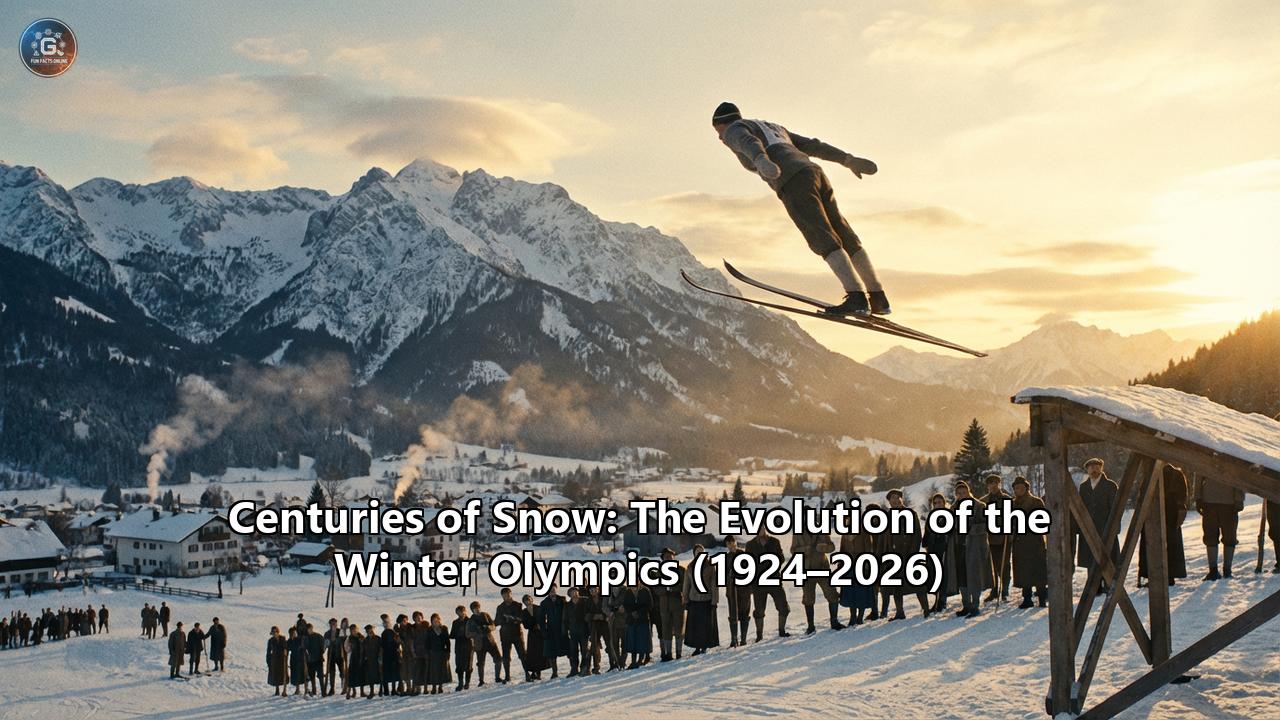
The village of Chamonix, France, sits in the shadow of Mont Blanc, a cathedral of rock and ice that has watched over the valley for geological eons. In January 1924, this quiet commune witnessed a peculiar gathering: men in wool sweaters and newsboy caps, dragging wooden sleds and carrying seven-foot hickory skis. They were the pioneers of what was then called the "International Winter Sports Week." There were no billion-dollar broadcast deals, no artificial snow cannons, and certainly no halfpipes. The spectators were few, the temperatures were brutal, and the idea that this modest event would evolve into a global juggernaut was as thin as the mountain air.
Yet, as we look toward the 2026 Games in Milano Cortina, the arc of the Winter Olympics reveals itself as one of the most fascinating narratives in modern history. It is a story not just of sport, but of human resilience, technological revolution, geopolitical maneuvering, and our complex, shifting relationship with the natural world. From the amateur gentleman-skiers of the Roaring Twenties to the high-tech, climate-conscious spectacles of the 21st century, the Winter Games have served as a mirror to the world—reflecting our wars, our peace, our prejudices, and our progress.
Part I: The White Stage (1924–1936)
The Nordic Roots and the "Week" that Changed EverythingTo understand the Winter Olympics, one must first understand the resistance to them. For decades, the Nordic nations—Sweden and Norway in particular—viewed a separate Winter Olympics with deep suspicion. They already had their "Nordic Games," a celebration of Scandinavian culture and winter prowess. They feared an international version would dilute their traditions and, perhaps more privately, threaten their dominance.
But the International Olympic Committee (IOC), led by the tenacious Pierre de Coubertin, persisted. The compromise was the 1924 Chamonix event. It was a humble affair. The "stadium" was a natural ice rink. The bobsleigh run was a terrifying chute of natural ice packed by hand. The athletes were true amateurs, many holding day jobs as lumberjacks, soldiers, or students. The star of these games was arguably not a person, but the weather—unpredictable and fierce—and the sheer novelty of seeing nations like Great Britain and the United States attempt to slide on frozen water.
It was here that the first legend was born: Clas Thunberg of Finland, who won five medals, including three golds, on the speed skating oval. But the public imagination was captured by the 11-year-old Norwegian figure skater Sonja Henie. She finished last in 1924, confused and frequently skating over to the boards to ask her coach what to do next. It was an inauspicious start for a woman who would soon become the first global superstar of the Winter Games.
St. Moritz and the erratic nature of IceBy 1928, the "Winter Sports Week" had been retroactively deemed the first Winter Olympics, and the circus moved to St. Moritz, Switzerland. These Games highlighted a problem that would haunt the event for a century: reliance on weather. A warm spell melted the cross-country course and ruined the ice. The 10,000-meter speed skating event had to be cancelled because the ice was literally dissolving under the skaters' blades. It was a stark reminder that unlike the Summer Games, which could be played in rain or shine, the Winter Games were at the mercy of the elements.
Garmisch-Partenkirchen 1936: The Shadow of the EagleThe 1936 Games in Germany remain the most controversial. Paired with the Berlin Summer Games, they were part of the Nazi regime's propaganda machine. Adolf Hitler opened the Games, and the efficient, militaristic organization offered a chilling preview of the efficiency Germany would soon apply to war. Alpine skiing made its debut, a controversial addition that led to a boycott by Swiss and Austrian instructors who were deemed "professionals" for teaching skiing for money—a conflict between amateurism and professionalism that would simmer for decades.
On the ice, however, Sonja Henie, now a polished woman of 23, won her third consecutive gold medal. Her influence was total; she had transformed figure skating from a stiff, academic exercise into a glamorous ballet. Her short skirts and white boots became the standard, and her subsequent move to Hollywood cemented the potential for Olympic fame to translate into fortune.
Part II: The Post-War Renaissance (1948–1968)
The Games of RenewalAfter the carnage of World War II, which caused the cancellation of the 1940 and 1944 Games, the Olympics returned to St. Moritz in 1948. They were dubbed the "Games of Renewal." Germany and Japan were banned, but the atmosphere was one of healing. These games were austere; equipment was scarce, and athletes were underfed. Yet, the spirit of competition had survived.
The Cold War on IceBy 1956 in Cortina d'Ampezzo, Italy, a new player entered the arena: the Soviet Union. The USSR’s debut changed the geopolitical stakes instantly. They treated sport as a proxy for ideology. Their athletes were "state amateurs"—officially students or soldiers, but in reality, full-time professionals supported by the government. They crushed the competition in speed skating and ice hockey, instantly ending Canada's long-held dominance in the latter.
Cortina was also the first Games to be televised. The flickering black-and-white images beamed into living rooms across Europe changed the relationship between the athlete and the spectator. Suddenly, the lonely struggle of the cross-country skier in the woods was a shared public drama.
Squaw Valley 1960: Disney and DataThe 1960 Games in Squaw Valley, California, marked the Americanization of the Winter Olympics. Walt Disney himself was chairman of the Pageantry Committee, orchestrating opening ceremonies that were more spectacle than solemn ritual.
Technologically, Squaw Valley was a quantum leap. It saw the first use of instant replay (prompted by a disputed ski gate) and IBM computers to tabulate results. It was also the only Games to refuse to build a bobsleigh track because only nine nations wanted to compete, a decision that infuriated the traditionalists but highlighted the growing cost and complexity of hosting.
Innsbruck 1964: The Army Saves the DayIn 1964, the Games faced a disaster: no snow in Innsbruck. The Austrian army was mobilized to carve out 40,000 cubic meters of ice and snow from higher elevations and transport it by truck to the ski slopes. It was the first major intervention of man against nature to save the Games, a precursor to the 100% artificial snow of Beijing 2022.
Part III: The Golden Age of Expansion (1968–1988)
Grenoble 1968: The Man in BlueThe 1968 Grenoble Games gave the world Jean-Claude Killy. The handsome Frenchman swept all three Alpine skiing events (Downhill, Slalom, Giant Slalom), becoming an instant icon of "cool." But his victory in the slalom was shrouded in fog and controversy, with his rival Karl Schranz claiming interference by a mysterious "man in black" on the course. The dispute was messy, but it only added to the allure. These Games were broadcast in color for the first time, making the blue skies and white snow a dazzling visual product for TV.
Sapporo 1972: East Meets WestThe Winter Games finally left Europe and North America, landing in Sapporo, Japan. It was a coming-out party for post-war Japan, much like Tokyo 1964. But the headlines were dominated by the "Amateurism Scandal." Austrian ski idol Karl Schranz was expelled by IOC President Avery Brundage for accepting money from ski manufacturers. It was the last gasp of the old strict amateur code, a hypocritical stance that ignored the state-sponsored funding of Eastern Bloc athletes while punishing Westerners for endorsements.
Lake Placid 1980: The MiracleFor Americans, the history of the Winter Olympics is often condensed into a single game of hockey. The "Miracle on Ice"—a team of US college kids defeating the juggernaut Soviet machine—is perhaps the greatest sports upset of the 20th century. It was more than a game; occurring during the height of Cold War tensions and the Iran Hostage Crisis, it was a cathartic release of national anxiety.
But Lake Placid was also the stage for Eric Heiden, who achieved the impossible: winning all five speed skating gold medals, from the 500m sprint to the grueling 10,000m endurance race. It is a feat of physiological range that has never been matched and likely never will be.
Sarajevo 1984 & Calgary 1988: The End of InnocenceSarajevo 1984 was a triumph of spirit, the first Winter Games in a socialist country (Yugoslavia). The warmth of the hosts was legendary. Tragically, less than a decade later, the bobsleigh track would be used as an artillery position during the Bosnian War, and the podiums would be used as execution sites—a heartbreaking reminder of the fragility of the "Olympic Peace."
Calgary 1988 introduced the world to the "lovable loser." Eddie "The Eagle" Edwards (ski jumping) and the Jamaican Bobsleigh team finished last but won the hearts of the global audience. They embodied the Coubertin ideal—"The important thing is not to win, but to take part"—even as the IOC subsequently tightened qualification rules to prevent such "amateurs" from competing again.
Part IV: The Modern Era & The X-Games Generation (1992–2014)
The Split and the ShiftIn 1986, the IOC voted to separate the Winter and Summer Games, alternating them every two years starting in 1994. This gave the Winter Games their own spotlight and doubled the marketing revenue for the IOC.
The 1990s and 2000s saw a desperate bid for relevance with the youth. Traditional sports like biathlon and speed skating were seen as "old." The answer was "extreme" sports. Moguls were added in 1992, aerials in 1994, and the game-changer—snowboarding—in 1998 at Nagano.
The arrival of snowboarders was a culture shock. They wore baggy clothes, listened to punk music, and didn't care about Olympic tradition. When Ross Rebagliati won the first snowboard gold, he was briefly disqualified for testing positive for marijuana, cementing the counter-culture reputation. But by 2006, Shaun White, the "Flying Tomato," was the face of the Winter Olympics. The halfpipe had saved the Games from irrelevance.
Salt Lake City 2002: Scandal and SecurityThe 2002 Games were overshadowed by the bribery scandal involving the bid committee and IOC members. It forced a cleanup of the IOC's ethics. Held just months after 9/11, they were also the first "Security Games," with unprecedented police presence. Yet, the sport shined. The Canadian men's hockey team ended a 50-year drought to win gold, and the women's bobsleigh made its debut, continuing the slow march toward gender equality.
Sochi 2014: The $51 Billion ShowRussia's return to the stage in 2014 was a display of sheer financial will. President Vladimir Putin wanted to show a resurgent Russia. They spent a record $51 billion, transforming a subtropical resort into a winter wonderland. The Games were spectacular but marred by the state-sponsored doping scandal that would eventually lead to Russia being banned as a nation from subsequent Olympics.
Part V: The Warming Planet & The Future (2018–2026)
PyeongChang 2018: Peace (Briefly)The 2018 Games in South Korea were defined by the "Unified Team." North and South Korean athletes marched together under a unified flag, and a joint women's hockey team competed. It was a powerful diplomatic gesture, though the geopolitical thaw was temporary.
Beijing 2022: The Artificial RealityBeijing became the first city to host both Summer and Winter Games. But the images of Big Air jumps set against the backdrop of cooling towers in a region with almost no natural snow highlighted the existential crisis of the Winter Games: Climate Change. 100% of the snow was artificial. It was a technological marvel but an ecological warning.
Part VI: The Road to Milano Cortina 2026
The Return to the CradleIn 2026, the Games will return to their spiritual home in the Alps. Milano Cortina represents a new philosophy: sustainability. Instead of building "white elephants" (venues that rot after the Games), Italy will use existing infrastructure. Ice sports will be in the metropolis of Milan; snow sports in the historic resort of Cortina d'Ampezzo.
The 2026 Games will be the most gender-balanced in history, with 47% female participation. New events like Ski Mountaineering (SkiMo) harken back to the roots of winter travel, while the inclusion of more mixed-gender events (in luge, skeleton, and skiing) reflects a modern approach to sport.
The Legends of the Ice
The history of the Winter Olympics is written in the sweat and tears of its titans.
- Ole Einar Bjørndalen (Norway): The "King of Biathlon." With 13 medals, he combined the heart rate of a sprinter with the steady hand of a sniper. His longevity was astounding; he won gold at age 40 in Sochi.
- Ireen Wüst (Netherlands): The most decorated speed skater of all time. She won gold at five consecutive Winter Olympics (2006–2022), a record of consistency that defies the aging process.
- Steven Bradbury (Australia): The "accidental hero." In the 2002 short track final, he was dead last. In the final corner, every other skater crashed. Bradbury glided across the line to win Australia's first winter gold. He remains the patron saint of "staying on your feet."
- Yuzuru Hanyu (Japan): The "Ice Prince." He brought a rock-star status to figure skating, winning back-to-back golds in 2014 and 2018. His fans, who would rain Winnie the Pooh bears onto the ice, created an atmosphere of hysteria rarely seen in winter sports.
The Technological Arms Race
The evolution of equipment has been as dramatic as the athletic performances.
- Skis: From the solid hickory planks of 1924 to the honeycomb-core, carbon-fiber composites of today.
- Clothing: From heavy wool that absorbed water and froze, to the aerodynamic "shark skin" suits of speed skaters and the heated uniforms of 2026.
- Ice: Ice making is now a science. The water used is purified to remove minerals that create friction. The temperature of the ice is adjusted by fractions of a degree depending on the sport (harder for hockey, softer for figure skating).
The Geopolitical Theater
The Winter Olympics have never been just about sports.
- 1968: The two Germanys competed as separate teams for the first time, symbolizing the solidification of the Iron Curtain.
- 1980: The US boycott of the Moscow Summer Games loomed over Lake Placid, adding immense pressure to the American athletes.
- 2014: The Sochi Games took place as the crisis in Ukraine was unfolding, leading to a strange juxtaposition of Olympic truce and active conflict.
- 2026: The ban on Russian and Belarusian athletes (due to the war in Ukraine) continues to be a flashpoint, raising questions about neutrality and the rights of individual athletes vs. the actions of their governments.
Conclusion: The fragile beauty of the Winter Games
As we approach the centenary of the Winter Olympics, the event stands at a crossroads. The list of cities capable of hosting the Games is shrinking due to global warming. By 2050, it is estimated that only half of the previous host cities would be cold enough to host again.
The Milano Cortina Games in 2026 will be a test of a new model: dispersed, sustainable, and reliant on tradition rather than construction. If Chamonix 1924 was the birth of a dream, and Sochi 2014 was the peak of excess, 2026 must be the beginning of adaptation.
The Winter Olympics differ from the Summer Games in one fundamental way: they require a hostile environment. They require us to dance on ice and fly over frozen hills. They are a celebration of human warmth in the face of the cold. From the silence of the Chamonix valley to the roar of the Milanese crowds, the "Centuries of Snow" tell us that no matter how hard the winter, the human spirit—and the desire to play—endures.
Reference:
- https://en.wikipedia.org/wiki/Winter_Olympic_Games
- https://www.veniceevents.com/history-of-the-winter-olympic-games/
- https://thewellesleynews.com/22560/sports/2026-sees-highest-gender-parity-in-winter-olympics-history/
- https://www.brabners.com/insights/sport/milan-2026-winter-olympics-a-major-milestone-for-female-participation
- https://www.youtube.com/watch?v=QkRGspwcTbI
- https://tlptech.co.uk/technological-advancements-of-the-olympic-games-part-2-of-2/
- https://protectourwinters.uk/blog/climate-change-and-the-olympic-winter-games