
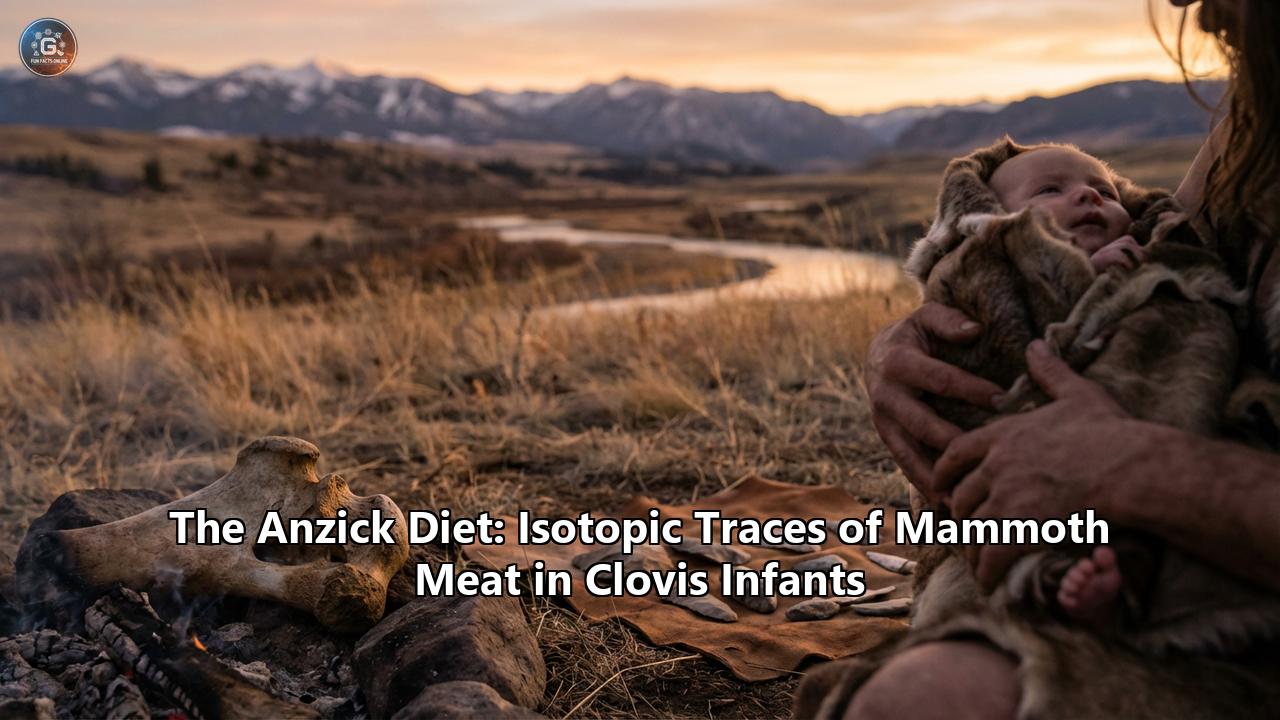
The wind howls across the Pleistocene steppe of what is now western Montana, a landscape dominated not by the familiar forests of today, but by vast, open grasslands locked in the grip of the last Ice Age. It is a world of giants. Colossal beasts—the Columbian mammoth, the ancient bison, the short-faced bear—roam these plains, their breath steaming in the frigid air. Among them moves a different kind of predator, small in stature but terrifying in efficiency: a band of humans. They are the Clovis people, the manufacturers of the finest stone weaponry the world has ever seen, and they are hungry.
For decades, archaeologists have argued over the menu of these ancient pioneers. Were they daring big-game hunters who specialized in bringing down the megafauna that shook the earth? Or were they opportunistic foragers, generalists who subsisted on rabbits, roots, and berries, only occasionally taking down a sick or trapped behemoth?
The answer has lain buried for nearly 13,000 years, hidden not in a stone tool or a kill site, but in the microscopic chemical signature of a toddler’s bones. This is the story of Anzick-1, the only known child of the Clovis culture, and the groundbreaking scientific revelation that has finally reconstructed the breakfast, lunch, and dinner of the First Americans.
Part I: The Boy in the Red Ochre
To understand the diet, we must first understand the diner. The story begins in 1968, near the small town of Wilsall, Montana. Construction workers moved earth and rock near a sandstone outcrop on the Anzick family ranch, inadvertently exposing a treasure trove that would change the history of American archaeology.
Tumbling out of the shelter were over one hundred stone and bone artifacts: magnificent bifaces, fluted projectile points, and elk-antler foreshafts, all stained with a brilliant red ochre. But amidst this arsenal of survival was something far more fragile: the partial skeletal remains of a small child.
Known to science as Anzick-1, this male infant was roughly 12,800 years old. He had lived only 18 months to two years before succumbing to unknown causes. His people had buried him with immense care, dusting his body and the accompanying artifacts with red iron oxide powder—ochre—a substance deeply linked to ritual, life, and blood in Paleolithic cultures worldwide.
For decades, the Anzick child remained an enigma. He was the only known human burial directly associated with Clovis artifacts—the iconic "fluted" spear points found scattered across North America. In 2014, his genome was sequenced, revealing him to be a direct ancestor of many modern Native American groups, particularly in Central and South America. This cemented his status as a key figure in the story of the peopling of the Americas.
But while his DNA told us who he was, it couldn't tell us how he lived. It couldn't describe the daily struggle for calories in a landscape of ice and megafauna. For that, scientists needed to look deeper than the genes. They needed to look at the atoms.
Part II: The Chemical Time Capsule
In 2024, a team of researchers led by Dr. James Chatters and Dr. Ben Potter published a study in Science Advances that turned the Anzick child’s bones into a menu. The key to this discovery lay in Stable Isotope Analysis, a method that operates on the principle that "you are what you eat."
Every living organism is built from chemical elements like carbon and nitrogen. However, these elements come in different weights, or "isotopes."
- Carbon-13 vs. Carbon-12: Plants photosynthesize in different ways. Tropical grasses (like corn) use a pathway that accumulates more Carbon-13, while temperate bushes, trees, and shrubs use a pathway that results in less. By measuring the ratio of these carbons in bone collagen, scientists can determine if the base of a person’s food chain was a forest or a savannah.
- Nitrogen-15 vs. Nitrogen-14: This is the predator’s signature. Nitrogen-15 accumulates as you move up the food chain. A herbivore has higher Nitrogen-15 levels than the grass it eats. A carnivore that eats the herbivore has even higher levels. An "apex predator" has the highest levels of all.
There was a catch. Anzick-1 was a toddler, likely still breastfeeding. In isotopic terms, a breastfeeding infant is technically a "carnivore" of its mother. It is consuming her tissues (milk). This raises the infant's nitrogen levels even higher than the mother's—essentially adding another step on the food chain.
To reconstruct the diet, the researchers had to mathematically "reverse engineer" the milk effect. By subtracting the isotopic enrichment caused by breastfeeding, they were able to model the diet of the mother. What they found was a woman who was not gathering berries or trapping rabbits. She was eating like a wolf.
Part III: Dining with Saber-Tooths
The results of the analysis were staggering. The chemical signature of the Anzick mother did not resemble that of a generalist forager. It didn't look like the diet of later hunter-gatherers who relied on a mix of plants, small game, and deer.
Her isotopic profile showed a massive reliance on high-trophic level protein. Specifically, the data indicated that Mammoth meat comprised approximately 35% to 40% of her diet.
To put this in perspective, the researchers compared her isotopic "fingerprint" to other animals living in the same region at the same time. Her closest dietary match wasn't a bear (which eats a mix of berries and fish) or a wolf (which eats a variety of game). Her closest ecological peer was the Scimitar-toothed Cat (Homotherium serum).
The Scimitar cat was a specialized killing machine, evolved specifically to hunt juvenile mammoths. For the Anzick mother to have a chemical signature overlapping with this specialized feline predator, she must have been consuming a diet nearly identical in its composition. She was, for all intents and purposes, a human hyper-carnivore.
The remainder of the diet was filled out by other large grazers:
- Elk (Wapiti): A significant portion of the protein intake.
- Bison: The massive Bison antiquus, ancestor to the modern buffalo.
- Camelops: The now-extinct American camel.
Crucially, the study found negligible evidence of small game (rabbits, hares) or plant protein. While they likely consumed some plants for micronutrients, calories were coming almost exclusively from the fat and muscle of megafauna.
Part IV: The End of the "Generalist" Debate
This discovery struck a decisive blow in one of American archaeology’s longest-running arguments: The "Clovis Specialist" vs. "Clovis Generalist" debate.
The Generalist Argument:For years, skeptics argued that hunting mammoths was too dangerous and energetically expensive to be a daily strategy. They posited that the iconic Clovis points were "swiss army knives," used for everything from processing plants to killing turtles. They argued that the "Mammoth Hunter" image was a romanticized myth and that these people were actually broad-spectrum foragers who just got lucky with a mammoth now and then.
The Specialist Reality:The Anzick study dismantles the Generalist view for the Western Clovis people. You do not achieve an isotopic signature that matches a saber-toothed cat by snacking on roots and rabbits.
- Energy Density: A single mammoth offered millions of calories. In the harsh, cold environment of the Pleistocene, fat was the currency of survival. Plant foods available in the arid West would have been insufficient to fuel the high-metabolism demands of active nomadic hunters.
- The Technology: The Clovis point—a lanceolate, fluted blade—is an armor-piercing weapon. It is designed to penetrate thick hide and cause massive internal bleeding. The diet confirms the tool's purpose: it was a big-game munition.
Part V: Life of the Mammoth Hunters
If the Anzick people were eating mammoth regularly, what does that tell us about their daily lives? The diet implies a specific and rigorous lifestyle.
1. Extreme Mobility:Mammoths are not sedentary. They are enormous grazers that must move constantly to find enough fodder. To rely on them for 40% of your diet, you cannot live in a village. You must be highly mobile, trailing the herds across hundreds of miles. This aligns with the archaeological record, where stone tools made of rock from a quarry in one state are found hundreds of miles away in another. The Clovis people were the ultimate nomads.
2. High-Risk Society:Hunting a 6-to-8-ton Columbian mammoth with stone-tipped spears is not a safe profession. It requires profound coordination, bravery, and strategy. The high dependence on such dangerous game suggests a society that valued cooperation and hunting prowess. It also implies that women (like Anzick-1’s mother) were intimately involved in the processing, and perhaps the hunting, of these beasts to sustain such a high protein intake.
3. The "Fast" Expansion:This specialized diet helps explain how humans colonized the Americas so quickly. If you are a generalist, you have to learn the specific plants and small animals of every new valley you enter. But if you are a Mega-fauna specialist, the "menu" is the same from Alaska to Patagonia. A mammoth in Montana looks and tastes much like a Gomphothere in South America. By focusing on big game, the Clovis people could sweep across the continent without needing to reinvent their survival strategy in every new ecosystem.
Part VI: The Echo of Extinction
The revelation of the Anzick diet also casts a shadow over the extinction of the megafauna. Roughly coincident with the arrival and spread of the Clovis people, the great beasts of North America vanished. The mammoth, the camel, the horse, and the giant ground sloth all disappeared.
While climate change at the end of the Ice Age undoubtedly stressed these populations, the Anzick data confirms that humans were not passive observers. They were active, high-frequency consumers of these animals. If human bands were successfully targeting mammoths at the rate suggested by the Anzick isotopes, human predation was almost certainly the "coup de grâce" that drove these dwindling populations into oblivion.
Conclusion: A Message from the Earth
The Anzick-1 infant, buried with such grief and reverence 12,800 years ago, has given us a gift greater than gold. Through the distinct chemistry of his bones, he has allowed us to peer back through the veil of time and sit at the hearth of his ancestors.
We now see them not as desperate scavengers, but as masters of their environment—apex predators who walked side-by-side with lions and saber-tooths, competing for the caloric wealth of the Ice Age. They were a people of stone and blood, powered by the flesh of giants, whose specialized resilience allowed them to conquer a new world.
The "Anzick Diet" is more than just a list of ingredients; it is a testament to the audacity of the human spirit. In a frozen world of monsters, our ancestors didn't just survive; they feasted.
Reference:
- https://www.zmescience.com/science/news-science/native-american-ancestors-diet-mammoth/
- https://www.dnagenics.com/ancestry/sample/view/profile/id/anzick
- https://grokipedia.com/page/Anzick-1
- https://en.wikipedia.org/wiki/Anzick-1
- https://popular-archaeology.com/article/western-clovis-people-were-mammoth-hunting-specialists-according-to-new-dietary-analysis/
- https://pmc.ncbi.nlm.nih.gov/articles/PMC11616702/
- https://www.anthropology.net/p/tracing-the-clovis-diet-how-mammoths
- https://www.livescience.com/archaeology/early-americans-ate-tons-of-mammoth-13-000-year-old-bones-from-clovis-culture-baby-reveal
- https://en.wikipedia.org/wiki/Clovis_culture
- https://www.youtube.com/watch?v=DT4KROLf3rU
- https://archaeologymag.com/2024/12/mammoths-were-a-key-food-source-for-ancient-americans/
- https://www.uaf.edu/news/study-reveals-mammoth-as-key-food-source-for-ancient-americans.php