
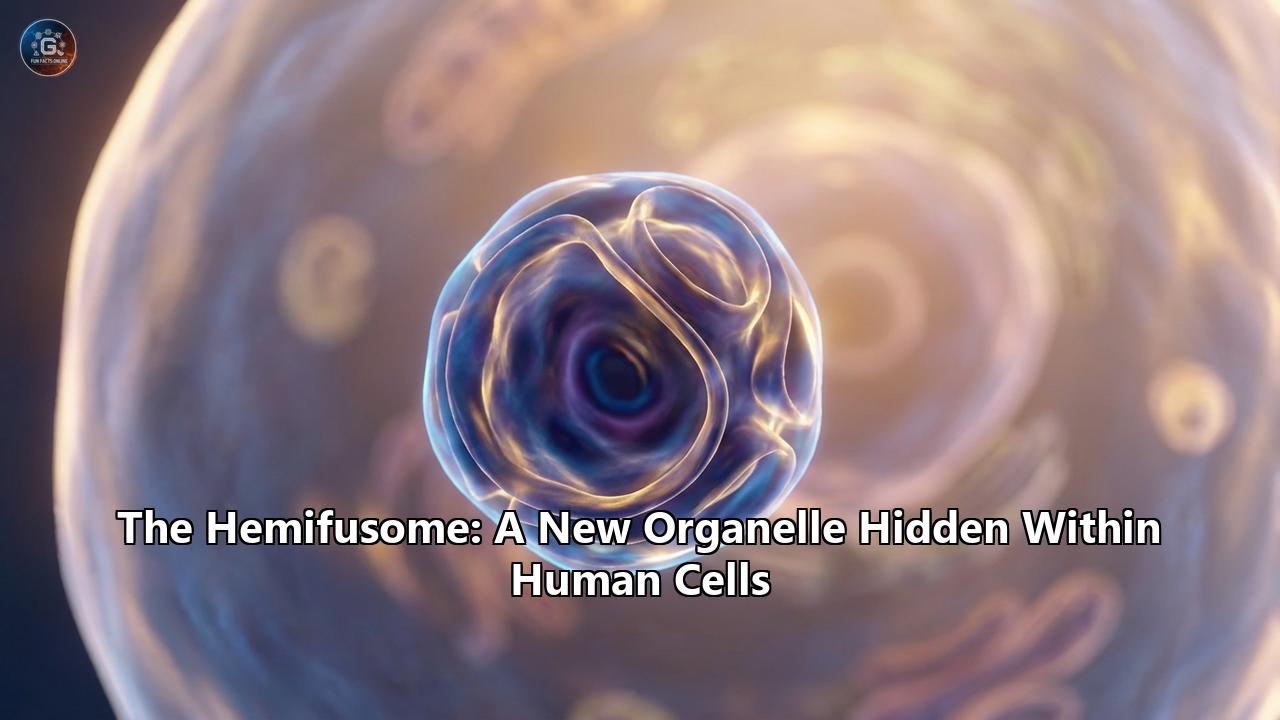
It is a rare moment in the history of science when the map of human biology is fundamentally redrawn. We live in an age where we believe we have cataloged the gross anatomy of our existence. We have mapped the human genome, traced the neural pathways of the brain, and categorized the cellular machinery that keeps us alive. For decades, the textbook diagram of a human cell has been a fixed constellation: the powerhouse mitochondria, the command-center nucleus, the protein-packing Golgi apparatus, and the waste-disposal lysosomes. These were the known actors on the stage of life.
But in 2025, that stage suddenly expanded. In a discovery that stunned the biological community, researchers from the University of Virginia School of Medicine and the National Institutes of Health (NIH) announced the existence of a new, previously invisible organelle hiding in plain sight within human cells. They named it the hemifusome.
This is not merely a new footnote in cellular biology; it is a revelation that challenges our understanding of how life organizes itself. The hemifusome acts as a master logistician, a "cellular loading dock" that manages the chaotic traffic of materials inside our cells. Its discovery solves mysteries that have plagued scientists for years—specifically, how cells handle the complex recycling and sorting of cargo without relying solely on the known, protein-heavy mechanisms we have studied for decades.
This is the story of the hemifusome: how it was found, what it looks like, the revolutionary technology that revealed it, and why its discovery might hold the key to curing some of our most devastating genetic diseases.
Part I: The Invisible City
To understand the magnitude of this discovery, one must first appreciate the complexity of the environment in which it was found. The human cell is often compared to a city, but this analogy, while helpful, fails to capture the sheer frenetic energy of the cellular cytoplasm. It is a metropolis of molecular density, packed with millions of proteins, lipids, and organelles, all buzzing with kinetic energy.
For the last century, our view of this city has been somewhat distorted. The traditional tools of cell biology—optical microscopes and standard electron microscopes—require trade-offs. To see a cell under an electron microscope, scientists historically had to "fix" the sample. This process involves using harsh chemicals like formaldehyde or glutaraldehyde to cross-link proteins and stabilize the cell structure, followed by dehydration and staining with heavy metals.
Imagine trying to understand the flow of traffic in Tokyo by pouring concrete over the entire city, slicing it into thin sheets, and then looking at the cross-sections. You would see the buildings and the roads, but you would miss the delicate, transient interactions—the pedestrians crossing the street, the signals changing, the temporary construction zones. The fixation process kills the cell and freezes it, but it also distorts it. Delicate membrane structures often collapse or are washed away.
For decades, the hemifusome was a victim of this distortion. It is a structure of nuance, defined not by a thick protein shell but by a delicate architectural arrangement of lipid membranes. Under the harsh gaze of traditional microscopy, the hemifusome likely looked like a smudge, a broken vesicle, or a random artifact of the preparation process. It was "dark matter" in the cellular universe—present, gravitational, and influential, yet completely invisible to our instruments.
It wasn't until the refinement of a technique called cryo-electron tomography (cryo-ET) that the fog lifted.
The Cryo-ET Revolution
The discovery of the hemifusome is as much a triumph of technology as it is of biology. Cryo-electron tomography is the equivalent of a "pause button" for life. Instead of chemically embalming the cell, researchers flash-freeze it in liquid ethane at temperatures below -180 degrees Celsius. This freezing happens so instantly—in a fraction of a millisecond—that water molecules do not have time to crystallize into ice. Instead, they form a glass-like solid, preserving the cell's internal structures in a state of suspended animation.
Nothing is dehydrated. Nothing is stained. The cell is preserved in its native, hydrated state.
Researchers then use an electron microscope to tilt the sample, taking images from multiple angles. High-powered computers stitch these 2D images together to reconstruct a 3D volume of the cell's interior. It is akin to a CT scan, but on a nanometer scale.
It was using this technology that Dr. Seham Ebrahim of UVA and her collaborators at the NIH, including Dr. Bechara Kachar, Dr. Amirrasoul Tavakoli, and Dr. Shiqiong Hu, began to notice something strange. In the periphery of the cells they were studying, amidst the known chaos of vesicles and tubules, there was a recurring structure that didn't fit the catalog.
It looked, as Ebrahim later described it, like a "snowman wearing a scarf."
Part II: The Anatomy of a Ghost
The structure was elegant, baffling, and undeniably real. It appeared in not just one cell type, but across four different mammalian cell lines, suggesting it was a fundamental component of mammalian biology, not a quirk of a specific tissue.
The "Snowman" Structure
The hemifusome is a heterotypic vesicular complex. In plain English, this means it is composed of two different types of cargo-carrying bubbles (vesicles) joined together in a very specific way.
- The Granular Vesicle (The Body): The larger of the two components is usually filled with granular material, similar to what scientists see in endosomes (sorting compartments) or ribosome-associated vesicles.
- The Translucent Vesicle (The Head): Attached to this large body is a smaller, chemically distinct vesicle. Unlike its partner, this one is often clear or translucent, containing a dilute aqueous solution or a specific cargo that doesn't scatter electrons as densely.
- The Hemifusion Diaphragm (The Scarf): This is the defining feature. In standard membrane fusion—like when a neurotransmitter vesicle merges with a nerve cell wall to fire a signal—the membranes touch, fuse, and open up a pore almost instantly. It is a millisecond-long event. But in the hemifusome, the two vesicles stop halfway. They fuse their outer layers but not their inner ones, creating a stable, shared wall called a hemifusion diaphragm.
For years, biophysicists believed that a "hemifusion" state was incredibly unstable, a fleeting transition state that lasted for mere microseconds before the membranes fully popped open. The discovery of the hemifusome turned this dogma on its head. Here was a structure where the hemifusion diaphragm wasn't just stable; it was huge. These diaphragms measured around 158 nanometers in diameter—massive compared to the theoretical 10-nanometer contact points predicted by physics models.
The Proteolipid Nanodroplet (PND)
If the "snowman" shape wasn't enough, the researchers found a "jewel" on the scarf. At the exact rim of the hemifusion diaphragm, where the two vesicles meet, sits a dense, spherical particle. This is the Proteolipid Nanodroplet (PND).
Measuring consistently at around 42 nanometers, the PND appears to be the keystone of the structure. It acts as a stabilizer, likely anchoring the dangerous curvature of the membrane where the two vesicles join. Without this droplet, the tension would likely force the vesicles to either fully fuse or pop apart. The PND holds them in this "locked" embrace, creating a permanent loading dock.
The consistency of the PND's size suggests it is a tightly regulated machine, not a random blob of fat. It is likely composed of specific lipids and proteins that guide the formation of the hemifusome, acting as a molecular traffic cone that tells the cell, "Build a loading dock here."
Part III: The Loading Dock of the Cell
So, what does a hemifusome do? Why would a cell want to keep two vesicles stuck in a half-fused state?
To answer this, we must look at cellular logistics. Cells are constant recyclers. They bring in nutrients from the outside (endocytosis), break down old organelles (autophagy), and shuttle proteins to different departments. The primary way they do this is through vesicular transport. Think of vesicles as delivery trucks.
In the traditional model, a delivery truck (vesicle) arrives at a warehouse (organelle), backs into the bay, and opens its doors (membrane fusion), dumping its cargo inside.
The hemifusome represents a different logic. It is not a dumping ground; it is a sorting platform.
Dr. Ebrahim likens it to a "loading dock." By maintaining this stable connection, the hemifusome allows two vesicles to exchange specific materials without fully mixing their contents. It allows for a controlled transfer. The "translucent" vesicle might be offloading bad proteins into the "granular" vesicle for destruction, or it might be picking up recycled lipids to take back to the cell membrane.
The Two Conformations
The researchers observed the hemifusome in two distinct shapes, which hints at a dynamic cycle of operation:
- Direct Hemifusion: The smaller vesicle is attached to the outside of the larger vesicle. This looks like the standard "snowman."
- Flipped Hemifusion: In a mind-bending feat of topology, the smaller vesicle pushes into the larger one. It is still distinct, still wrapped in its own membrane, but it now sits inside the belly of the larger vesicle, connected by the rim.
This "flipping" capability is the smoking gun for the hemifusome's true function: Biogenesis of Multivesicular Bodies (MVBs).
MVBs are crucial organelles. They are like the trash bags of the cell, full of smaller internal vesicles that are destined for the lysosome (the incinerator). For decades, we believed that a complex protein machine called ESCRT (Endosomal Sorting Complexes Required for Transport) was the only way cells could make these internal vesicles.
The hemifusome proves there is another way.
The discovery suggests an ESCRT-independent pathway. The hemifusome allows a cell to create internal vesicles using just lipids and the PND, bypassing the energy-expensive ESCRT machinery. This is a backup generator, a parallel logistical system that the cell uses for specific types of cargo. It suggests that our cells have a "Plan B" for recycling that we never knew existed.
Part IV: Rewriting the Textbooks
The implications of the hemifusome ripple out far beyond basic anatomy. They touch upon the fundamental laws of membrane biophysics.
For fifty years, the "fluid mosaic model" of cell membranes has reigned supreme. We teach students that membranes are fluid, dynamic, and that fusion is a binary event: you are either two vesicles, or you are one. The "transition state"—hemifusion—was a mathematical necessity, a fleeting moment of instability.
The existence of the hemifusome as a stable organelle proves that biological membranes can be sculptured into long-lasting, exotic shapes that defy simple thermodynamic predictions. It implies that the cell has evolved specific molecular tools (like the PND) to "hack" physics, stabilizing unstable states to create functional machinery.
This forces a re-evaluation of thousands of past experiments. How many times did researchers see a "blur" or a "blob" in their data and dismiss it as noise? How many "failed" fusion events were actually functional hemifusomes doing their job?
A Note on Nomenclature
It is worth noting a curious overlap in terminology. The word "hemifusome" has been used previously in the niche field of Drosophila (fruit fly) genetics to describe a bridge between egg cells. However, the authors of the new study have clarified that the human organelle is a distinct entity. The borrowing of the term is appropriate—it describes the "half-fused" state—but it now claims a much grander title as a permanent resident of the human cell.
Part V: The Medical Frontier
While the biology is fascinating, the true weight of the discovery lies in its potential to alleviate human suffering. The hemifusome is not just a passive structure; it is a machine that maintains cellular health. When it breaks, the cell becomes a hoarder, drowning in its own waste.
Hermansky-Pudlak Syndrome (HPS)
The researchers immediately drew a line between the hemifusome and Hermansky-Pudlak Syndrome, a rare and devastating genetic disorder. HPS is characterized by albinism, bleeding problems, and often fatal lung fibrosis.
The root cause of HPS is a failure in the biogenesis of "lysosome-related organelles." Patients with HPS have cells that cannot properly form the pigment granules in skin (melanosomes) or the clotting granules in platelets. These granules are, essentially, specialized vesicles.
The discovery of the hemifusome provides a missing link. If the hemifusome is the "loading dock" responsible for building these complex granules, then a defect in the hemifusome—perhaps a mutation in the protein that forms the PND—would explain the symptoms of HPS perfectly. If the dock is closed, the pigment and clotting factors never get packaged.
Neurodegeneration: Alzheimer’s and Parkinson’s
The implications extend to the most common plagues of aging. Alzheimer's and Parkinson's disease are, at their core, diseases of trash collection. In Alzheimer's, beta-amyloid proteins build up and clump together. In Parkinson's, it is alpha-synuclein.
Healthy cells have robust recycling systems to chew up these misfolded proteins before they become toxic. This "autophagy" process relies heavily on vesicles and lysosomes. If the hemifusome is a key player in the sorting of waste for the lysosome, then a dysfunction in this organelle could be the first domino to fall in neurodegeneration.
Imagine a city where the garbage trucks suddenly stop sorting trash. Within weeks, the streets are impassable. If hemifusomes decline with age, or if they are vulnerable to environmental toxins, their failure could lead to the accumulation of the "molecular trash" that kills neurons.
Cancer and Viral Entry
Cancer cells are metabolic power users; they hijack cellular logistics to fuel their rapid growth. Understanding how they utilize hemifusomes to recycle nutrients could reveal new targets for chemotherapy. If we can "close the loading dock" in cancer cells, we might starve them.
Furthermore, many viruses (including HIV, Influenza, and Coronaviruses) enter cells by membrane fusion. They trick the cell into merging the viral envelope with the cell membrane. The hemifusome represents a master class in fusion regulation. Studying how the PND stabilizes this process could lead to a new class of antiviral drugs that lock viral membranes in a "hemifused" state, preventing them from ever fully entering the cell.
Part VI: The Future of Cell Biology
The discovery of the hemifusome is a humbling reminder of how much we still have to learn. We are not at the end of biology; we are perhaps just leaving the introduction.
Dr. Ebrahim and her team have opened a door, and now the race is on. Laboratories around the world will be rushing to:
- Sequence the PND: What exactly is that nanodroplet made of? Finding the specific proteins will allow us to target the hemifusome with drugs.
- Watch it Live: While Cryo-ET gives us beautiful snapshots, we need to see the hemifusome in motion. New advances in super-resolution lattice light-sheet microscopy may soon allow us to watch a hemifusome form, sort cargo, and dissolve in real-time.
- Map the Genome: Which genes control the hemifusome? Are there people with "super-hemifusomes" who are resistant to Alzheimer's?
As we peer deeper into the "dark matter" of the cell, we are likely to find that the hemifusome is not alone. It may have cousins—other transient, delicate organelles that control the rhythm of life in ways we haven't yet imagined.
For now, we can celebrate a monumental achievement. We have found a new organ in the microscopic body. The hemifusome, the humble "snowman" of the cell, has stepped out of the shadows, reminding us that life is far more intricate, elegant, and mysterious than we ever dared to dream.
Glossary of Terms
- Hemifusome: A newly discovered organelle (2025) consisting of two partially fused vesicles connected by a stable diaphragm.
- Cryo-Electron Tomography (Cryo-ET): An imaging technique that visualizes biological samples in their native, frozen state without chemical fixation.
- Hemifusion Diaphragm: The shared membrane partition between the two vesicles of a hemifusome.
- Proteolipid Nanodroplet (PND): A dense, 42nm particle located at the rim of the hemifusion diaphragm, believed to stabilize the structure.
- ESCRT: A protein complex traditionally thought to be the sole mechanism for inward vesicle budding; the hemifusome offers an alternative pathway.
- Multivesicular Body (MVB): A specialized endosome containing internal vesicles, crucial for sorting and recycling cellular membrane proteins.
(End of Article)
Reference:
- https://www.drugtargetreview.com/news/167964/meet-the-hemifusome-a-new-organelle-with-big-impact/
- https://www.uvahealth.com/news/scientists-discover-unknown-organelle-inside-our-cells/
- https://www.earth.com/news/hemifusome-newly-discovered-organelle-inside-human-cells-with-immense-potential/
- https://www.youtube.com/watch?v=4X6gezZluh8
- https://modernsciences.org/hemifusome-new-organelle-cellular-transport-viewpoint-september-2025/
- https://www.livescience.com/health/scientists-discover-never-before-seen-part-of-human-cells-and-it-looks-like-a-snowman-wearing-a-scarf
- https://newatlas.com/biology/organelle-human-cells/
- https://modernsciences.org/hemifusome-new-organelle-cellular-transport-july-2025/
- https://www.sciencealert.com/mysterious-new-structure-discovered-hiding-inside-human-cells
- https://medium.com/@harvardmicrosociety/the-hemifusome-the-newest-organelle-46cb7f19afbc
- https://www.medigurukulam.com/post/www-yourwebsite-com-hemifusome-new-human-organelle-discovery
- https://en.wikipedia.org/wiki/Hemifusome
- https://entechonline.com/discovering-hemifusomes-a-new-organelle-in-cell-science/
- https://scienceblog.com/scientists-find-hidden-organelle-in-human-cells/
- https://pmc.ncbi.nlm.nih.gov/articles/PMC11537336/