
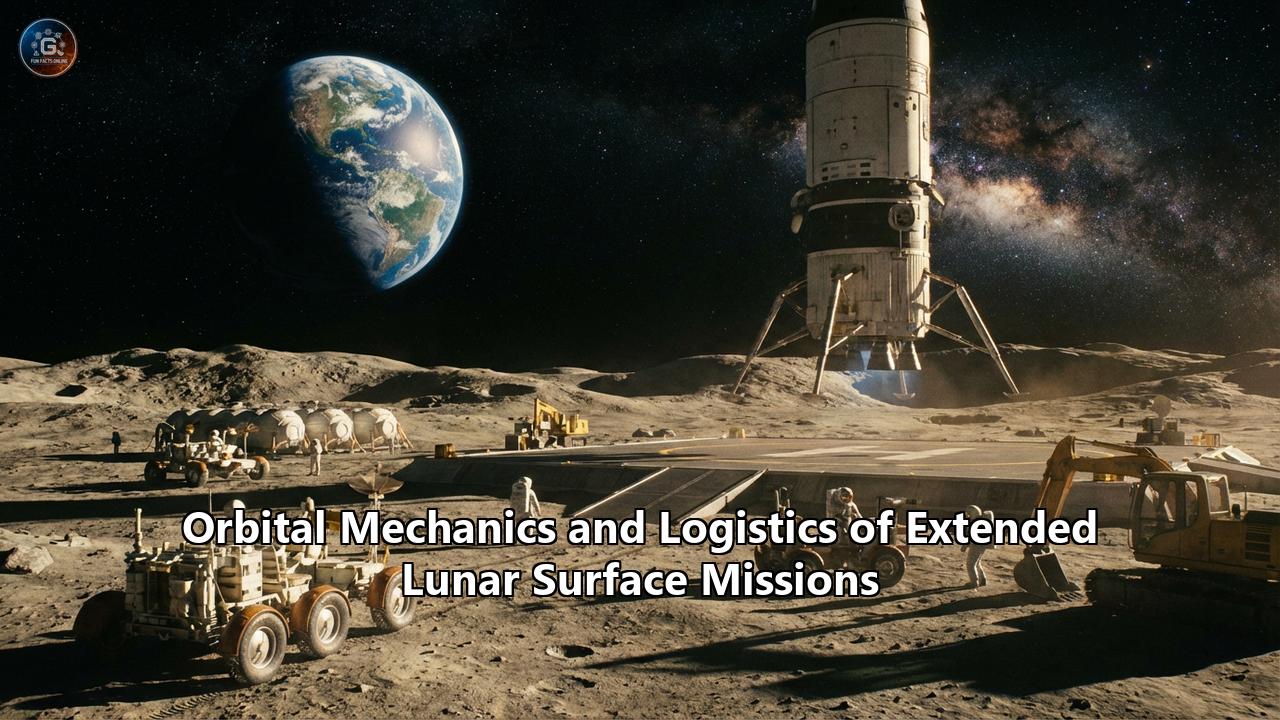
Fifty years ago, humanity approached the Moon as a distant peak to be summited. We packed everything we needed into a single, specialized vehicle, planted a flag, gathered a few rocks, and rushed home before the air, water, and power ran out. It was a masterpiece of mid-20th-century engineering, but it was fundamentally unsustainable. Today, the paradigm has shifted. As we embark on the Artemis era and look toward establishing a permanent human presence on the lunar surface, the Moon is no longer just a destination; it is a bustling deep-space port under construction.
To move from short-term "sortie" missions to extended lunar surface operations requires a mastery of two deeply intertwined disciplines: the celestial ballet of orbital mechanics and the unforgiving mathematics of deep-space logistics. Surviving and thriving on the Moon for weeks, months, or eventually years demands a continuous, flawless supply chain that spans 384,400 kilometers of hard vacuum. It requires orchestrating fleets of cargo landers, orbiting space stations, and robotic scouts, all navigating complex gravitational pathways.
Here is a comprehensive look into the orbital mechanics and logistical architectures that make extended lunar surface missions possible, transforming humanity from visitors into permanent inhabitants of the cislunar frontier.
The Celestial Ballet: Orbital Mechanics of Cislunar Space
In the vacuum of space, you do not steer a ship the way you drive a truck on Earth. Spaceflight is a game of energy management, dictated by gravitational wells and the orbital velocities required to traverse them. In cislunar space—the area between and around the Earth and the Moon—gravity from both bodies interacts to create a complex, dynamic environment.
The Three-Body Problem and Lagrange Points
Traditional orbital mechanics often rely on the two-body problem (e.g., a spacecraft orbiting the Earth). But when a spacecraft travels near the Moon, it enters a three-body system: the Earth, the Moon, and the spacecraft. In this system, there are five points in space where the gravitational pull of the Earth and the Moon equal the centripetal force required for a small object to move with them. These are known as Lagrange points.
For lunar exploration, the L1 (between Earth and Moon) and L2 (behind the Moon) points are of extreme interest. They serve as gravitational "parking spots" or gateways. However, hovering exactly at a Lagrange point is unstable, like balancing a marble on top of a bowling ball. Instead, spacecraft orbit around these invisible points in space, creating halo orbits.
The Masterstroke: Near-Rectilinear Halo Orbit (NRHO)
The cornerstone of modern lunar orbital mechanics is a highly specialized path called the Near-Rectilinear Halo Orbit (NRHO). Unlike the low lunar orbit (LLO) used by the Apollo command modules, which circled the Moon's equator a mere 100 kilometers above the surface, an NRHO is a highly eccentric, polar orbit that balances the gravity of the Earth and the Moon.
Why choose an NRHO for long-term lunar operations?
- Uninterrupted Communication: In an LLO, a spacecraft disappears behind the Moon for half of its orbit, severing communications with Earth. An NRHO, however, is oriented so that the spacecraft always has a direct line of sight to Earth, eliminating communication blackouts.
- Access to the South Pole: The Artemis program is heavily focused on the lunar South Pole due to the presence of water ice. The NRHO chosen for the Artemis architecture is highly asymmetric: it sweeps within 1,500 kilometers of the lunar North Pole and swings out to a massive 70,000 kilometers over the lunar South Pole. This gives a spacecraft hanging at the aposelene (the farthest point) a long, lingering view of the South Pole, making it an ideal staging ground for polar landings.
- Propellant Efficiency: LLO is notoriously unstable due to the Moon's "mascons" (mass concentrations)—dense regions of the lunar crust that warp the local gravity field, pulling orbiting spacecraft off course. Maintaining a low orbit requires constant fuel-burning course corrections. An NRHO, balancing between Earth and Moon gravity, is remarkably stable. It requires minimal delta-V (change in velocity) for station-keeping, saving massive amounts of propellant over a multi-year mission.
Trajectories and the Cislunar Highway
Logistics dictates that not all cargo needs to travel at the same speed. Human crews require fast, direct trajectories (like a Hohmann transfer) to minimize their exposure to deep-space radiation and zero-gravity degradation. This fast route takes about three to four days but requires massive amounts of propellant.
Conversely, uncrewed logistics modules, cargo landers, and habitat components can take their time. By utilizing Ballistic Lunar Capture or Low-Energy Transfers, cargo ships can ride the Interplanetary Superhighway—a network of pathways generated by the overlapping gravity of the Earth, Moon, and Sun. These low-energy transfers take months rather than days, but they reduce the propellant requirements significantly. This dual-speed logistical approach allows space agencies to pre-position heavy infrastructure on the Moon long before the crew even launches from Earth.
The Lunar Gateway: The Ultimate Deep-Space Port
The linchpin of extended lunar logistics is the Lunar Gateway, humanity’s first space station located beyond low Earth orbit (LEO). Orbiting in the NRHO, the Gateway functions as a communications hub, a staging point, a scientific laboratory, and a safe haven for astronauts.
Modular Assembly and Purpose
Unlike the International Space Station (ISS), which is continuously crewed and massive, the Gateway is designed to be lean, autonomous, and intermittently crewed. Its foundational elements—the Power and Propulsion Element (PPE) and the Habitation and Logistics Outpost (HALO)—are slated to be assembled on Earth and launched together aboard a heavy-lift rocket like the Falcon Heavy, reaching lunar orbit after a multi-month low-energy transfer. Subsequent modules, such as the European Space Agency and JAXA's International Habitat (I-Hab), will expand its capabilities.
The Gateway fundamentally alters the mathematics of landing on the Moon. During Apollo, the Saturn V rocket had to push everything—the command module, the lunar module, the crew, and all the return propellant—all the way to Low Lunar Orbit. This required an impossibly massive rocket.
With Gateway, the logistics are decoupled. Heavy-duty Human Landing Systems (HLS)—such as SpaceX's Starship and Blue Origin's Blue Moon—can launch empty, refuel in Earth orbit or at the Gateway, and then park at the station. When astronauts launch from Earth aboard the Orion spacecraft, they only need enough fuel to reach the Gateway. There, they transfer into the waiting lander, descend to the surface, and return to the Gateway. The lander can then be refueled and reused for the next mission, transforming lunar access from a disposable model into a sustainable, reusable transit system.
Cryogenic Fluid Management (CFM)
A major hurdle in this orbital logistics chain is Cryogenic Fluid Management (CFM). High-performance rocket propellants, like liquid oxygen and liquid hydrogen, must be kept at incredibly low temperatures. In the vacuum of space, heat from the Sun boils these liquids, causing them to vent and be lost to space. For landers to wait at the Gateway or be refueled in orbit, engineers must master zero-boil-off technologies, active cryocoolers, and complex fluid dynamics to transfer super-chilled liquids between spacecraft in microgravity. This technology is the invisible backbone of the entire Artemis architecture.
Earth-to-Moon Supply Chains: Bridging the Void
To sustain human life and scientific operations on the lunar surface for extended durations, an uninterrupted supply chain of food, water, oxygen, scientific equipment, and surface infrastructure must be established. NASA and its international partners have architected a tiered approach to cargo delivery.
Commercial Lunar Payload Services (CLPS)
For smaller logistical needs and robotic precursors, NASA established the Commercial Lunar Payload Services (CLPS) program. Think of CLPS as the courier service of cislunar space. By purchasing end-to-end delivery services from private companies rather than building the landers themselves, space agencies can send scouting rovers, scientific instruments, and early infrastructure testbeds to the Moon quickly and cost-effectively.
CLPS missions are actively charting the treacherous terrain of the lunar South Pole. Landers from companies like Intuitive Machines, Astrobotic, and Firefly Aerospace carry instruments to test the soil, assess landing hazards, and prove out technologies before human crews arrive. For example, Firefly's Blue Ghost lander was tasked with testing crucial dust mitigation technologies on the lunar surface.
Heavy Cargo Landers
While CLPS handles the small packages, sustained human presence requires heavy freight. NASA has advanced plans for dedicated Artemis Cargo Landers capable of delivering massive infrastructure to the surface. Both SpaceX and Blue Origin have been tasked with developing cargo variants of their human landing systems.
The logistical capability of these cargo landers is staggering. By the early 2030s, a SpaceX Starship cargo variant is expected to deliver a massive pressurized rover—developed by the Japan Aerospace Exploration Agency (JAXA)—to the lunar surface. Shortly thereafter, Blue Origin's cargo lander is slated to deliver a fully outfitted lunar surface habitat. These heavy deliveries are the prerequisites for Artemis Base Camp, allowing astronauts to transition from sleeping in their landers to living in dedicated, radiation-shielded bases and undertaking weeks-long expeditions across the lunar terrain.
In-Situ Resource Utilization (ISRU): Living Off the Land
The "Tyranny of the Rocket Equation" states that for every kilogram of payload you want to land on the Moon, you must launch many more kilograms of fuel to push it there. If a lunar base relies entirely on water, oxygen, and propellant shipped from Earth, it will quickly bankrupt any space agency. The only way to achieve sustainable, extended lunar surface missions is through In-Situ Resource Utilization (ISRU)—the practice of living off the land.
Mining the Permanently Shadowed Regions (PSRs)
The primary reason the lunar South Pole is the target of modern exploration is the presence of Permanently Shadowed Regions (PSRs). Because the Moon's axis is barely tilted, the sun always sits low on the horizon at the poles. The bottoms of deep craters never see sunlight, creating some of the coldest environments in the solar system, plunging down to -250 °C (-418 °F).
Over billions of years, these ultra-cold traps have captured volatile compounds, primarily water ice, deposited by comet impacts and solar wind interactions. Water is the ultimate currency of deep space exploration.
- Life Support: It can be melted and purified for drinking water.
- Breathable Air: Through electrolysis, water can be split into hydrogen and oxygen to provide a breathable atmosphere for habitats.
- Rocket Propellant: Most importantly, liquid hydrogen and liquid oxygen are the most potent chemical rocket propellants.
By mining lunar ice, the Moon becomes a deep-space gas station. Missions like the Polar Resources Ice Mining Experiment-1 (PRIME-1) are designed to drill into the regolith, assess the distribution of volatiles, and test the feasibility of extracting this precious resource.
Regolith Processing and Construction
Beyond water, the lunar dirt (regolith) itself is a treasure trove of resources. Regolith is rich in oxygen bound in silicate minerals, as well as metals like iron, aluminum, and titanium. Advanced ISRU technologies are being developed to use molten salt electrolysis to strip the oxygen out of the dirt, providing a secondary source of breathable air and oxidizer.
Furthermore, shipping construction materials from Earth is cost-prohibitive. To build landing pads that prevent rockets from kicking up hazardous debris, and to construct habitats that shield astronauts from cosmic radiation and micrometeorites, logistics planners are looking toward autonomous 3D printing. Robotic rovers will use microwaves or lasers to sinter (melt) the lunar regolith into solid bricks and interlocking structures, essentially building the Artemis Base Camp out of the Moon itself.
Surface Logistics: Moving, Powering, and Surviving
Getting cargo and crew to the Moon is only half the battle. Once there, the harsh realities of the lunar environment demand incredibly resilient surface logistics.
Powering the Base: Surviving the Lunar Night
A lunar day lasts roughly 29.5 Earth days, meaning any location on the equator experiences about 14 days of blistering sunlight followed by 14 days of frigid, absolute darkness. At the South Pole, the lighting is highly dynamic. While some high-elevation ridges—dubbed "Peaks of Eternal Light"—receive near-constant sunlight, the valleys are plunged into deep shadow.
Relying solely on solar panels and batteries is logistically risky for extended missions. To ensure uninterrupted power for habitats, rovers, and ISRU refineries, NASA is developing Fission Surface Power. These compact, lightweight nuclear reactors are designed to be deployed autonomously, providing a continuous 40 kilowatts of electrical power regardless of whether the sun is shining or the base is swallowed by a two-week lunar night.
The Lunar Dust Problem
One of the most insidious logistical challenges on the Moon is dust. Unlike Earth sand, which is rounded by wind and water erosion, lunar dust is composed of microscopic, jagged shards of glass formed by billions of years of meteorite impacts. It is highly abrasive and, due to the solar wind, electrostatically charged, causing it to cling to everything.
During the Apollo missions, dust jammed zippers, degraded the seals on space suits, and caused respiratory irritation when tracked into the lunar module. For an extended mission lasting months, dust mitigation is a matter of life and death. NASA is deploying a suite of technologies to combat this, including the Electrodynamic Dust Shield (EDS), which uses alternating electrical fields to repel dust from spacesuits, camera lenses, and solar panels. Furthermore, mechanical components must be designed to operate in extreme cold without liquid lubricants, which would freeze or attract dust. Innovations like Bulk Metallic Glass Gears (BMGG) allow robotic rovers to move smoothly in the cryogenic temperatures of the PSRs without any lubrication at all.
Surface Mobility: Exploring the Frontier
To maximize scientific return, astronauts cannot be tethered to the immediate vicinity of their lander. Surface logistics require robust mobility solutions.
- Lunar Terrain Vehicle (LTV): An unpressurized, open-air rover that astronauts can drive in their extravehicular activity (EVA) suits. Unlike the Apollo rovers, modern LTVs are designed to be autonomous when the crew is not present, acting as robotic cargo haulers to move supplies between landers and habitats.
- Pressurized Rovers: For extended sorties, astronauts will rely on pressurized rovers, essentially mobile habitats. These massive vehicles allow crews to explore hundreds of kilometers away from the base camp, living comfortably in shirt-sleeve environments for weeks at a time before returning to the main base.
Human Factors, Communications, and Emergency Logistics
The most fragile payload in any space mission is the human crew. The logistics of keeping humans alive and psychologically healthy on the Moon are immense.
Closed-Loop Life Support
The ISS requires constant resupply shipments of water, air, and filtration systems from Earth. A lunar base, sitting hundreds of thousands of kilometers away, must be vastly more self-sufficient. Extended missions rely on closed-loop Environmental Control and Life Support Systems (ECLSS), aiming to recycle nearly 100% of exhaled carbon dioxide and wastewater (including urine and sweat) back into breathable air and potable water.
Communications and LunaNet
Logistics run on data. Operating a sprawling lunar base with multiple rovers, autonomous ISRU plants, orbiting space stations, and ground control on Earth requires a robust digital infrastructure. Enter LunaNet: a framework designed to bring internet-like capabilities to the Moon. Instead of relying on point-to-point communications with Earth—which requires large, power-hungry antennas on every lunar rover—LunaNet utilizes a constellation of lunar relay satellites. This architecture provides high-bandwidth data transfer, weather alerts for solar radiation storms, and GPS-like navigation capabilities, allowing rovers and astronauts to traverse the featureless lunar terrain with pinpoint accuracy.
Emergency Evacuation Constraints
Perhaps the most sobering aspect of lunar logistics is the emergency abort scenario. In Low Earth Orbit, if a medical emergency occurs on the ISS, an astronaut can be back on Earth in a matter of hours. On the Moon, the logistics of a medical evacuation are constrained by the unforgiving laws of orbital mechanics.
If an emergency occurs on the surface, the crew must ascend to the Gateway. However, because the Gateway is in an NRHO with a 7-day orbital period, the ascent windows from the lunar surface are not instantaneous. The crew must wait for the Gateway to sweep into the correct alignment. Once docked with Orion, the transit back to Earth takes an additional three to five days. This means a lunar base must be equipped with advanced medical logistics, including surgical capabilities, extensive pharmacological supplies, and telemedicine connections to stabilize patients for up to a week before they can reach a hospital on Earth.
The Ultimate Proving Ground
The intricate dance of orbital mechanics and the monumental logistical supply chains currently being woven across cislunar space represent the most ambitious engineering project in human history. The Lunar Gateway, the NRHO trajectories, heavy cargo landers, and water ice mining operations are not just about conquering the Moon. They are the critical proving ground for the ultimate prize: Mars.
Every technology developed to survive the abrasive dust, extreme temperatures, and deep-space radiation of the Moon is a direct prerequisite for the Red Planet. Mars is a thousand times further away. The communications delay is measured in minutes, not seconds, and an emergency return trip takes nearly a year, not a few days. If we cannot master the logistics of living off the land, recycling our air, and orchestrating orbital rendezvous three days from home, we cannot hope to survive an interplanetary voyage.
The extended lunar surface missions of the modern era are laying the foundation for a permanent, multi-planetary future. By turning the cold, silent void of cislunar space into a thriving, well-traveled logistical highway, humanity is finally stepping out of its cradle, using the gravity of the Moon to slingshot our species into the stars.
Reference:
- https://en.wikipedia.org/wiki/Lunar_Gateway
- https://www.opsjournal.org/DocumentLibrary/Uploads/Ops-Journal_Publikations_final.pdf
- https://www.satnow.com/community/nasa-s-artemis-space-mission
- https://newspaceeconomy.ca/2026/02/26/artemis-lunar-landers-technical-overview/
- https://en.wikipedia.org/wiki/Commercial_Lunar_Payload_Services
- https://www.nasa.gov/space-technology-mission-directorate/lunar-surface-innovation-initiative/
- https://aerospaceglobalnews.com/news/nasa-advances-plans-for-sustained-lunar-exploration/
- https://www.nasa.gov/wp-content/uploads/2025/02/2025-ia-workshop-wp-lunar-logistics-and-mobility.pdf?emrc=2e65d8
- https://www.dhl.com/global-en/delivered/innovation/how-nasa-plans-a-permanent-return-to-the-moon.html
- https://www.globalspaceexploration.org/wp-content/isecg/GER2024.pdf