
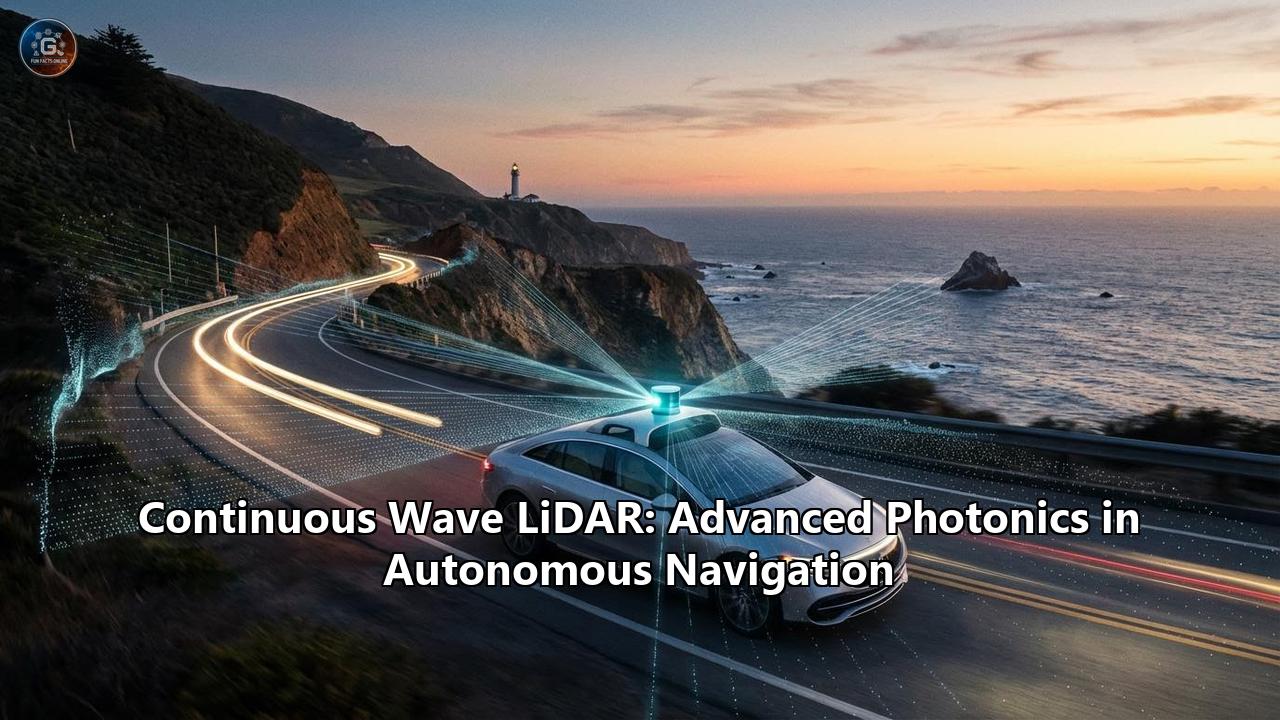
The dawn of the autonomous era promised a world where machines could navigate with the fluidity and intuition of a human driver, unburdened by distraction, fatigue, or error. Yet, as engineers pushed vehicles from controlled test tracks into the chaotic theater of real-world streets, they encountered a formidable adversary: the physical limits of machine perception. How does a machine definitively understand its environment when faced with blinding sunlight, sudden fog, or the unpredictable erraticism of a pedestrian darting into traffic?
For years, the answer relied on a patchwork of cameras, radar, and traditional Time-of-Flight (ToF) LiDAR. While these systems achieved remarkable feats, they ultimately hit a performance ceiling. Cameras struggle in low light and lack innate depth perception; radar provides excellent velocity data but suffers from low spatial resolution; and traditional ToF LiDAR—the crown jewel of early autonomous fleets—proved vulnerable to weather, sunlight interference, and the computationally exhausting task of tracking frame-to-frame object motion.
Enter Continuous Wave LiDAR, specifically Frequency-Modulated Continuous Wave (FMCW) LiDAR. Powered by revolutionary advancements in silicon photonics, this next-generation sensing technology has shifted the paradigm of autonomous navigation. By measuring not just the exact position of an object, but its instantaneous velocity down to the single photon, FMCW LiDAR has granted machines a "fourth dimension" of sight. As we move deeper into 2026, the transition from mechanical, pulsed lasers to solid-state, photonics-driven continuous wave systems is no longer a theoretical roadmap—it is a commercial reality reshaping the automotive, robotics, and aerospace industries.
The Sensory Bottleneck of Early Autonomy
To understand the magnitude of the continuous wave revolution, one must first understand the limitations of the technology it is displacing. Traditional LiDAR relies on Amplitude-Modulated Continuous Wave (AMCW) or, more commonly, Direct Time-of-Flight (dToF) principles. A ToF LiDAR system operates like a high-tech metronome: it fires extremely short, intense pulses of laser light into the environment and counts the nanoseconds it takes for the reflection to return to the sensor. By multiplying the time of flight by the speed of light, the system calculates the distance to the object.
While conceptually straightforward, this brute-force approach presents several critical bottlenecks in complex environments. First, pulsed LiDAR systems are inherently "blind" between pulses. To determine if an object is moving, the vehicle's onboard computer must capture a frame, wait for the next frame, and then calculate the difference in the object's position over time. In a highway scenario where a vehicle is traveling at 70 miles per hour, the milliseconds lost to this computational guesswork can mean the difference between a safe braking maneuver and a catastrophic collision.
Furthermore, ToF systems are highly susceptible to optical noise. A ToF photodetector is designed to capture any photon of the correct wavelength that strikes its surface. If a vehicle is driving directly into a setting sun, the overwhelming influx of solar photons can drown out the returning laser pulses, effectively blinding the sensor. Similarly, as more LiDAR-equipped vehicles populate the roads, the risk of "crosstalk"—where one car's sensor accidentally detects the laser pulse of an oncoming car—grows exponentially, creating ghost objects in the vehicle's perception software.
These limitations forced engineers into a corner, requiring them to compensate for hardware deficiencies with increasingly complex, power-hungry artificial intelligence algorithms. The industry desperately needed a sensor that could capture depth, velocity, and immunity to interference at the hardware level. It found the answer in the physics of continuous waves.
The Physics of Continuous Wave LiDAR
FMCW LiDAR abandons the pulsed approach entirely. Instead of firing discrete bursts of high-peak-power light, an FMCW system emits a continuous, low-power beam of laser light. The magic lies in how this light is manipulated. The frequency of the emitted laser is continuously modulated over time, typically in a "chirp" pattern—meaning the frequency is steadily swept up and down across a specific bandwidth.
When this frequency-chirped light is emitted, a microscopic fraction of it is split off and kept inside the sensor. This retained light is known as the "local oscillator". The rest of the light travels out into the world, reflects off an object—be it a pedestrian, a traffic cone, or a semi-truck—and bounces back to the sensor.
Because the frequency of the emitted light is constantly changing, the returning light (which was delayed by its journey) will have a slightly different frequency than the light currently being produced by the local oscillator. When the returning light enters the sensor, it is optically mixed with the local oscillator. Through a principle known as coherent detection, these two light waves interfere with one another.
This optical interference creates a "beat frequency". Because the rate of the original frequency chirp is precisely known, the sensor can measure this beat frequency to calculate the exact distance the light traveled with sub-millimeter precision.
The Fourth Dimension: The Doppler Effect and Instant Velocity
The most transformative aspect of FMCW LiDAR is its ability to measure instantaneous velocity. If the laser beam reflects off a moving target, the returning light is subjected to the Doppler effect—the same physical phenomenon that causes an ambulance siren to change pitch as it drives past you.
The moving object compresses or stretches the returning light waves, adding an additional frequency shift to the signal. Because FMCW LiDAR uses coherent detection, it can independently isolate the frequency shift caused by the object's distance and the frequency shift caused by the Doppler effect.
The result is a sensor that does not merely map the 3D coordinates of a scene (X, Y, and Z); it natively captures the radial velocity (V) of every single data point in real-time. This "4D" capability is a paradigm shift for autonomous navigation. An autonomous vehicle equipped with FMCW LiDAR does not need to wait for multiple frames to infer motion. In a single microsecond, it inherently knows that the bicycle ahead is traveling at 15 mph, the parked car is perfectly stationary, and the pedestrian is stepping into the crosswalk at 3 mph.
By providing velocity data at the hardware level, FMCW LiDAR dramatically reduces the computational load on the vehicle's central processor. Artificial intelligence algorithms no longer have to burn vital milliseconds calculating trajectories; they are handed the velocity vectors on a silver platter, allowing the AI to focus entirely on predictive modeling and safe path planning.
Unbreakable Perception: Interference Immunity and Weather Resilience
Beyond velocity, the coherent detection mechanism of FMCW LiDAR grants it "superpowers" that traditional ToF systems simply cannot match. Because the sensor only looks for a signal that perfectly matches the highly specific, continuously changing frequency and phase of its own local oscillator, it is virtually immune to interference.
If photons from the glaring sun, a streetlamp, or the ToF LiDAR of an oncoming vehicle strike the FMCW detector, they are ignored as background noise because they do not constructively interfere with the local oscillator's unique chirp signature. This immunity to sensor crosstalk and environmental self-interference guarantees that the 3D point cloud remains pristine, regardless of how crowded or bright the environment becomes.
Furthermore, FMCW LiDAR systems inherently operate at the 1550-nanometer (nm) wavelength, moving away from the 905nm standard used by older systems. The 1550nm wavelength is highly coveted because it is considered "eye-safe." At 905nm, laser light can pass through the human cornea and focus on the retina, meaning regulations strictly limit the power output of 905nm LiDAR to prevent blinding pedestrians. In contrast, 1550nm light is absorbed by the cornea and lens before it ever reaches the retina.
Because 1550nm is eye-safe, FMCW LiDAR can be driven at higher sustained power levels. This allows the sensors to achieve staggering detection ranges—routinely exceeding 250 to 500 meters—while easily piercing through atmospheric obscurants like heavy rain, fog, and snowfall. When a semi-truck is hurtling down a highway at night in a blizzard, that 500-meter detection range provides the crucial seconds of lead time required to execute an evasive maneuver or safely bring 80,000 pounds of metal to a halt.
Silicon Photonics: Shrinking the Optical Laboratory
If FMCW technology is so superior, why has the autonomous industry relied on Time-of-Flight for the past decade? The answer lies in manufacturing physics. FMCW is the foundational principle behind radar, which operates using radio and microwaves. Controlling the frequency of a microwave is relatively simple using standard electronics. But LiDAR operates using light, which has a frequency tens of thousands of times higher than radar.
Historically, executing an FMCW chirp with a laser required meticulously calibrated, temperature-controlled, table-sized optical equipment. Translating this into a rugged, affordable sensor that could survive the vibrations of a pothole-ridden road seemed impossible. The breakthrough that unlocked the commercial viability of FMCW LiDAR is silicon photonics.
Silicon photonics represents the fusion of optical engineering and semiconductor manufacturing. It allows engineers to etch microscopic optical components—tunable lasers, optical waveguides, phase shifters, beam splitters, and photodetectors—directly onto a silicon-on-insulator (SOI) wafer using the same Complementary Metal-Oxide-Semiconductor (CMOS) fabrication facilities used to build computer microchips.
By leveraging Photonic Integrated Circuits (PICs), the entirely of the FMCW optical laboratory is miniaturized onto a chip no larger than a fingernail. This monolithic integration drastically reduces costs and eliminates the fragile mechanical alignments that plagued early LiDAR systems.
Furthermore, silicon photonics enables the use of Optical Phased Arrays (OPAs). Traditional LiDAR relies on mechanical spinning mirrors or vibrating Micro-Electromechanical Systems (MEMS) to physically steer the laser beam across the environment. OPAs, however, are entirely solid-state. By precisely manipulating the phase of the light as it exits hundreds of microscopic emitters on the chip, an OPA can electronically steer the laser beam in any direction instantly, without a single moving part. This complete transition to solid-state architecture radically increases the lifespan, reliability, and shock resistance of the sensor, meeting the stringent durability requirements of the automotive industry.
Recent breakthroughs in materials science, such as the integration of Phase-Change Materials (PCMs) with External Cavity Lasers (ECLs), have pushed silicon photonics even further. By utilizing materials like Antimony Trisulfide (Sb2S3), which can rapidly switch between amorphous and crystalline states, engineers have achieved continuous frequency tuning ranges of up to 100 GHz at microsecond switching speeds. These hybrid photonic circuits ensure the laser chirps are perfectly linear and lightning-fast, resulting in microsecond-level scanning and unmatched spatial resolution.
The 2026 Commercial Landscape: From Prototypes to Production Lines
As the calendar turns deep into 2026, the theoretical promises of FMCW LiDAR and silicon photonics have crystallized into aggressive commercial deployments. The market, once crowded with dozens of experimental startups, has consolidated around a few heavyweight pioneers who have successfully transitioned from the laboratory to high-volume manufacturing.
Aeva and the Era of Windshield IntegrationAeva, one of the foremost pioneers in FMCW 4D LiDAR, has aggressively pushed the boundaries of perception hardware. At CES 2026, Aeva introduced the next evolution of its LiDAR-on-Chip platform, expanding beyond traditional automotive bounds into comprehensive "Physical AI" applications. One of their most transformative milestones is the Aeva Atlas Ultra, a sensor capable of delivering up to three times the resolution of previous generations with a staggering detection range extending to 500 meters.
Crucially, Aeva has solved one of the longest-standing aesthetic and aerodynamic hurdles in autonomous vehicle design: sensor placement. By partnering with automotive glass giants like Wideye by AGC, Aeva has successfully integrated its 4D FMCW LiDAR seamlessly behind the vehicle's windshield. Because FMCW relies on coherent detection, it can effectively filter out the optical distortion and reflection caused by the windshield glass—a feat that heavily crippled traditional ToF systems. This invisible integration allows automakers to maintain sleek, aerodynamic industrial designs without the bulky roof-mounted "taxi signs" that characterized early self-driving prototypes.
With massive financial backing and strategic alignment, Aeva is currently ramping up for a major series production launch with Daimler Truck, aiming for hundreds of thousands of units by 2027, proving that FMCW can scale to meet the brutal demands of global automotive supply chains.
Aurora, Continental, and the Driverless Freight NetworkThe heavy-duty trucking industry has emerged as the ultimate proving ground for Continuous Wave LiDAR. Unlike passenger cars, an 80,000-pound Class 8 semi-truck traveling at highway speeds requires massive stopping distances, necessitating perception systems that can see incredibly far down the road with absolute certainty.
Aurora Innovation, a leader in autonomous trucking, recognized early on that FMCW technology was mandatory for highway-speed autonomy. Through a landmark partnership with tier-one supplier Continental and AI computing juggernaut Nvidia, Aurora is mass-producing its proprietary FMCW-equipped "Aurora Driver" system. Integrated with Nvidia's DRIVE Thor superchip, this hardware-software fusion is driving the rollout of commercially viable Level 4 autonomous freight networks across North America. The ability of Aurora’s FMCW LiDAR to instantly identify a stalled vehicle or debris a quarter-mile ahead, instantly measure its zero-velocity status, and feed that cleanly into Nvidia's predictive algorithms is the linchpin making driverless logistics a reality.
Mobileye and the Intel AdvantageMobileye, heavily backed by Intel’s manufacturing prowess, has also placed its chips entirely on FMCW for its next-generation platforms. Leveraging Intel's rare, cutting-edge silicon photonics fabrication facilities, Mobileye is co-integrating active lasers and passive optical components onto a single die. By combining their deeply established computer-vision expertise with silicon-photonics-based FMCW LiDAR, Mobileye aims to drop the historically prohibitive cost of LiDAR by an order of magnitude. Their software-defined digital imaging radar combined with 4D LiDAR represents a highly redundant, fail-safe sensor suite designed to scale Mobility-as-a-Service (MaaS) and consumer autonomous vehicles globally.
Beyond the Road: Robotics, Warehousing, and Aerospace
While the trillion-dollar automotive industry captures the headlines, the ripple effects of Continuous Wave LiDAR are revolutionizing sectors far beyond the highway.
Agile Robotics and WarehousingIn the dynamic, high-density environments of modern fulfillment centers, factory floors, and distribution hubs, humans and robots are increasingly sharing the same workspace. Traditional safety mechanisms relied on rigid cages or simple 2D scanners that triggered emergency stops at the slightest intrusion.
Companies like Voyant Photonics are leveraging the miniaturization of silicon photonics to equip mobile platforms and robotic arms with microscopic FMCW sensors. In these environments, the 4D capability of FMCW shines through "ego-motion estimation". Because the sensor detects velocity instantaneously, a moving robot can directly measure its own movement against the static environment, vastly improving its localization and mapping (SLAM) accuracy without relying on external GPS. Furthermore, FMCW's velocity-awareness enables predictive collision avoidance. A warehouse robot can differentiate between a stationary pallet and a human worker walking across its path in a single frame, dynamically adjusting its speed and trajectory rather than abruptly halting, thereby maintaining smooth, efficient operational workflows.
Aerospace and DronesThe unmanned aerial vehicle (UAV) and aerospace sectors are also undergoing a quiet revolution fueled by FMCW. For drones executing low-altitude deliveries or conducting inspections of critical infrastructure like power lines and bridges, the ability to operate independently of ambient light is vital. Unlike cameras that fail at dusk, FMCW LiDAR provides highly accurate, high-resolution 3D mapping day or night. The continuous wave architecture's immunity to sunlight interference ensures that a drone flying into the glare of a rising sun will not lose its spatial awareness, safely navigating complex vertical environments and avoiding catastrophic wire strikes.
The Convergence of Hardware and AI: Physical AI and Sensor Fusion
The true power of Continuous Wave LiDAR is realized not in isolation, but in its convergence with modern artificial intelligence. We are entering the era of "Physical AI," where large-scale neural networks are deployed into physical machines to interact with the real world.
The data output of an FMCW LiDAR—a dense 4D point cloud rich with spatial, reflectivity, and velocity data—is the ultimate diet for these advanced AI models. In earlier generations of autonomous design, engineers spent vast amounts of computing power trying to fuse low-resolution radar velocity data with high-resolution camera data, often resulting in conflicting signals (e.g., the radar sees a metallic bridge overhead, but the camera sees an empty road).
FMCW LiDAR resolves this "sensor disagreement" at the hardware level. With optical axis alignment and advanced camera-LiDAR fusion techniques, systems can now overlay high-fidelity RGB pixel data directly onto the velocity-rich 3D point cloud. This provides the AI with a singular, infallible ground truth. Techniques like iterative closest point (ICP) and Kalman filtering are applied seamlessly, allowing AI models to focus entirely on higher-order tasks like semantic understanding, trajectory prediction, and complex decision-making in urban traffic scenarios.
Furthermore, the rise of cloud-based LiDAR data processing and edge computing has democratized the use of this data. High-performance system-on-chips (SoCs) are increasingly integrated directly into the LiDAR housing. These smart sensors process the raw optical data at the edge, outputting clean, highly structured object lists and velocity vectors directly to the vehicle's central brain, drastically reducing bandwidth bottlenecks and latency.
The Road Ahead: Challenges and the Future of Manufacturing
Despite its overwhelming superiority, the path to ubiquitous FMCW LiDAR is not without its hurdles. The primary bottleneck moving forward is not the physics, but the manufacturing yield.
Designing an Electro-Photonic Integrated Circuit (EPIC) that co-integrates low-propagation-loss waveguides, efficient phase shifters, optical amplifiers, and highly sensitive photodetectors onto a single chip is an incredibly complex material science challenge. Silicon is an excellent material for routing light, but it is a poor material for generating it. Therefore, manufacturing FMCW chips often requires hybrid integration—bonding Indium Phosphide (InP) or other III-V semiconductor lasers onto the silicon substrate.
Aligning these disparate materials at the nanometer scale across 300mm wafers while maintaining high yields is the current frontier for foundries. Any microscopic defect in the waveguide can scatter the coherent light, degrading the sensor's range and resolution. However, the billions of dollars pouring into semiconductor manufacturing and silicon photonics supply chains—driven by parallel demands in data center telecommunications and AI computing hardware—are rapidly driving down these fabrication costs and pushing yield rates to commercial viability.
Additionally, the industry is pushing toward standardization. As FMCW transitions from bespoke, proprietary systems to mass-market automotive components, the establishment of common interfaces, data protocols, and cybersecurity standards will be critical for seamless integration across different vehicle platforms and smart city infrastructure.
A Vision of the Autonomous Future
As we look toward 2030, the continuous wave revolution signifies the closing of the sensory gap between human and machine. For decades, autonomous navigation was constrained by the limitations of its eyes. Vehicles were forced to guess, infer, and calculate the physics of the world around them through a stuttering sequence of discrete snapshots.
FMCW LiDAR, powered by the microscopic miracles of silicon photonics, has fundamentally altered this relationship. By bathing the environment in continuous, coherent light, machines now perceive the world as a fluid, dynamic tapestry of motion. They see the exact velocity of a child's bouncing ball, the trajectory of a swaying cyclist, and the dense geometry of a fog-shrouded highway with unblinking, infallible precision.
This technology is more than just an automotive component; it is the foundational sensory cortex for the next generation of automated systems. From the driverless trucks securing our supply chains, to the agile robots working alongside us in warehouses, to the passenger vehicles weaving seamlessly through smart cities, Continuous Wave LiDAR has provided the ultimate key to unlocking safe, ubiquitous, and truly intelligent autonomous navigation.
Reference:
- https://www.automatedwarehouseonline.com/fmcw-lidar-promises-safer-more-efficient-autonomous-systems/
- https://www.mobileye.com/blog/radar-lidar-next-generation-active-sensors/
- https://www.mdpi.com/2076-3417/14/17/7810
- https://britechgroup.com/lidar-innovations/
- https://www.marketreportanalytics.com/reports/lidar-for-autonomous-vehicles-123534
- https://optics.org/news/16/1/6
- https://optics.org/news/15/3/7
- https://www.photonics.com/Articles/Silicon-Photonics-Brings-a-Collaborative/a70612
- https://pmc.ncbi.nlm.nih.gov/articles/PMC11597980/
- https://validate.perfdrive.com/?ssa=59a63fe3-0c1a-2056-4479-eccfb411aa3a&ssb=92411261113&ssc=https%3A%2F%2Fopg.optica.org&ssi=683f4451-d3hy-8fb8-2bb6-1d22345bc568&ssk=botmanager_support@radware.com&ssm=80424154682284679137077023359470&ssn=812c90302965586141322e4767b9e579d7b0615319d2-f0f4-1871-182d17&sso=cbbda71-18d0-e48544ae34b8bc8ee0f0340c91cdcccd160f5cb1c8009e50&ssp=37923346841773287757177324162747794&ssq=53732977689598943404076895017714876736642&ssr=MTgwLjE4OC4xNzQuMjg=&sst=python-requests%2F2.32.3&ssv=&ssw=
- https://www.openpr.com/news/4420001/market-segmentation-major-trends-and-competitive-overview
- https://www.aeva.com/press/aeva-to-showcase-passenger-oem-vehicle-with-windshield-integrated-4d-lidar-and-introduce-new-sensor-technology-for-physical-ai-at-ces-2026/
- https://www.stocktitan.net/news/AEVA/aeva-and-wideye-by-agc-to-showcase-first-fmcw-in-cabin-4d-li-dar-ztzh5t7mv6j0.html
- https://www.gim-international.com/content/article/a-decade-of-developments-in-lidar-technology