
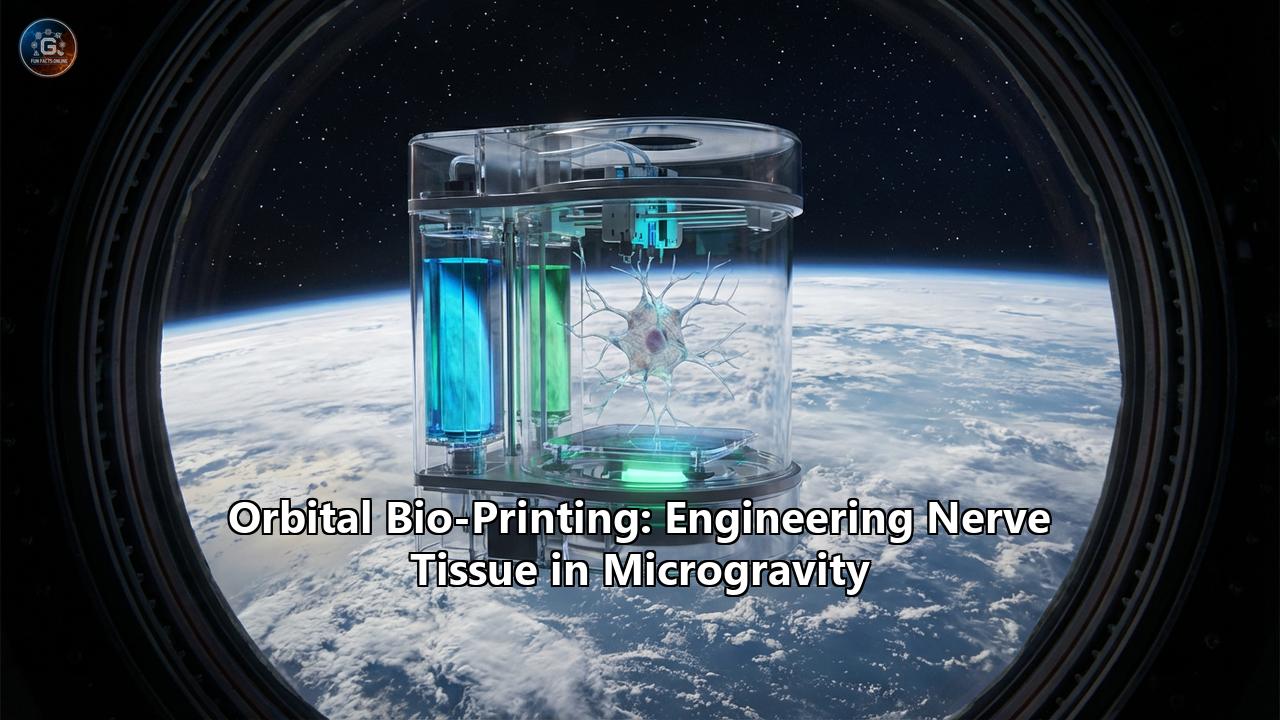
Part I: The Gravity of the Situation
The Terrestrial LimitFor decades, the field of regenerative medicine has been engaged in a silent war against a fundamental force of nature: gravity. On Earth, the dream of engineering complex, functional human tissues—specifically the delicate, intricate architecture of the nervous system—has been consistently hampered by the physics of our own planet.
In terrestrial laboratories, bio-engineers face a persistent dilemma. To build a three-dimensional tissue structure, they must use "scaffolds"—synthetic or biological lattice structures designed to hold cells in place. Without these scaffolds, the pull of gravity causes liquid "bio-inks" (suspensions of living cells and nutrients) to collapse into a puddle before they can set. Cells sediment to the bottom of droplets, nutrients distribute unevenly due to convection currents, and delicate micro-channels intended to guide nerve fibers sag and deform under their own weight.
This limitation is particularly devastating for neural tissue engineering. The human nervous system is not merely a collection of cells; it is a hyper-precise geometric arrangement. A peripheral nerve, for instance, consists of bundles of axons (fascicles) aligned with micron-level precision, encased in protective sheaths. If you attempt to print this architecture on Earth, the tiny channels required to guide regenerating axons—often as small as 10 to 50 microns in diameter—collapse. The result is a structure that looks like a nerve but fails to function like one.
But 250 miles above the Earth’s surface, aboard the International Space Station (ISS), this constraint vanishes. In the microgravity environment of Low Earth Orbit (LEO), the rules of biomanufacturing are being rewritten. Here, surface tension becomes the dominant force, overpowering gravity. Liquids can be manipulated into complex shapes without collapsing. Cells float suspended in their medium, interacting freely in three dimensions just as they do during embryonic development.
This is the dawn of Orbital Bio-Printing, a discipline that has graduated from theoretical science fiction to a commercial reality. It is no longer just about studying how cells react to space; it is about manufacturing medical devices in orbit that are physically impossible to create on Earth. The frontier of this technology is the engineering of nerve tissue—a breakthrough that promises to cure paralysis, reverse traumatic nerve injury, and potentially treat neurodegenerative diseases.
The Physics of Microgravity: A Manufacturing SuperpowerTo understand why orbital bio-printing is revolutionary, one must first understand the fluid dynamics of microgravity. On Earth, printing a vascularized or channel-rich tissue requires a trade-off. You can make the bio-ink thick and viscous to hold its shape, but this suffocates the cells by limiting nutrient diffusion. Or, you can make it thin and watery to keep cells happy, but the structure collapses into a blob.
In microgravity, this trade-off effectively disappears. Because there is no sedimentation (Stokes’ Law is functionally nullified), cells remain perfectly suspended in the bio-ink. This allows for the use of ultra-low viscosity bio-inks that are rich in nutrients and allow for rapid cell signaling. Furthermore, the absence of buoyancy-driven convection means that the biochemical gradients—the chemical "scents" that guide cells to migrate and differentiate—remain stable.
For nerve tissue, this is critical. Nerves grow by following chemical cues (chemotaxis) and physical cues (contact guidance). In space, a bio-printer can extrude a hydrogel containing a specific gradient of nerve growth factor (NGF) that remains perfectly stratified, creating a "highway" for axons to follow that doesn't wash away or blur due to gravity-induced currents.
Part II: The Hardware of the Heavens
The Bio-Printers: BFF and AMP-1The transition from Petri dishes to industrial manufacturing in space has been driven by sophisticated hardware. Two key systems exemplify this leap: the BioFabrication Facility (BFF) by Redwire Space (originally developed by Techshot) and the Auxilium Microfabrication Platform (AMP-1) by Auxilium Biotechnologies.
The BFF was the first American system capable of manufacturing human tissue in microgravity. Unlike terrestrial printers that require fast-curing, hard plastics or thick gels, the BFF can print with soft, ultra-fluid materials. It uses precise syringe pumps to extrude cells into a custom-designed cassette. Once printed, the tissue is conditioned in a separate bioreactor, where it matures and strengthens over weeks before being returned to Earth.
However, the specific requirements of nerve tissue led to the development of even more specialized tools. Auxilium Biotechnologies, a pioneer in this niche, deployed the AMP-1 to the ISS with a singular focus: repairing peripheral nerve damage.
The Auxilium Breakthrough: The NeuroSpan BridgeIn early 2025, Auxilium Biotechnologies achieved a historic milestone. Using the AMP-1 bioprinter aboard the ISS, they simultaneously manufactured eight implantable medical devices known as "NeuroSpan Bridges."
The NeuroSpan Bridge is designed to treat peripheral nerve injuries—severed nerves in the arms or legs resulting from car accidents, machinery trauma, or combat injuries. When a nerve is severed, the two ends retract. If the gap is small, surgeons can sew them together. If the gap is large (critical-sized defects), the standard of care is an "autograft," where a surgeon harvests a sensory nerve from the patient’s leg to bridge the gap. This causes permanent numbness in the leg and has a high failure rate.
Synthetic "nerve guidance conduits" exist on Earth, but they are simple, hollow tubes. Nerves often get "lost" inside them, forming painful tangles called neuromas instead of reconnecting.
The space-manufactured NeuroSpan Bridge is different. Because it was printed in microgravity, Auxilium was able to engineer it with internal micro-channels—tiny, distinct tubes within the larger tube—that mimic the natural "fascicular" architecture of a human nerve. On Earth, printing these 10-micron walls within a soft hydrogel would cause them to sag and fuse together. In space, they remained distinct, open, and perfectly aligned.
These micro-channels act as physical guardrails for regenerating axons. They force the nerve fibers to grow straight across the gap, preventing them from tangling. The result is a device that offers the structural complexity of an autograft without the need to harvest a second nerve from the patient.
Part III: The Cellular Awakening
The "Space-Stem" PhenomenonWhile the structural advantages of microgravity are profound, the biological effects are perhaps even more startling. Research conducted over the last decade has revealed that Neural Stem Cells (NSCs) behave fundamentally differently in orbit.
In a landmark study, researchers found that human NSCs proliferated seven times faster in space than identical control cultures on Earth. This "hyper-proliferation" is not uncontrolled (like cancer) but represents a preservation of "stemness." On Earth, stem cells in culture often spontaneously differentiate or senesce (age) due to mechanical stress. In microgravity, the lack of mechanical shear stress and the alteration of cytoskeletal tension seems to keep cells in a potent, youthful state for longer.
Gene Expression and DifferentiationThe benefits extend beyond growth rates. Gene expression analysis of space-flown neural crest stem cells showed a significant upregulation of survival and proliferation genes. Conversely, simulated microgravity on Earth often upregulated inflammation markers—a sign that "fake" microgravity (using clinostats or rotating wall vessels) cannot perfectly replicate the orbital environment.
Crucially for nerve repair, space-grown NSCs show a bias towards neuronal differentiation rather than astrocytic differentiation. When repairing a spinal cord or nerve injury, one of the biggest enemies is the "glial scar"—a dense wall of astrocyte cells that blocks nerve regeneration. Space-based experiments have shown a decrease in the expression of GFAP (an astrocyte marker) and an increase in Map2 (a neuron marker).
This implies that nerve tissues engineered in space might not just be structurally superior; they might be biologically "tuned" to regenerate neurons rather than forming scar tissue. The unique environment of orbit appears to flip a genetic switch that favors regeneration over scarring, a mechanism that scientists are still racing to fully understand.
Accelerated Maturation: The Time Machine EffectAnother critical observation is the accelerated maturation of "brain organoids"—miniaturized 3D models of the human brain. On Earth, growing a brain organoid to a state of maturity that mimics an adult brain can take months or years, and often the center of the organoid dies (necrosis) because nutrients cannot reach it.
In microgravity, organoids can grow larger and more complex without necrotic cores, thanks to the improved fluid dynamics and lack of sedimentation. More importantly, they mature faster. Features of neural development that take weeks on Earth can appear in days in orbit. This "time machine" effect is invaluable for testing drugs for diseases like Alzheimer’s or Parkinson’s, but for tissue engineering, it means that a functional nerve graft could potentially be grown, matured, and ready for implantation in a fraction of the time required on Earth.
Part IV: Clinical Translation and The Future
From Orbit to Operating RoomThe transition from research to therapy is already underway. Following the successful manufacturing run on the ISS, Auxilium Biotechnologies initiated the Neurospan-1 clinical trial in 2025. This study aims to enroll 80 patients with traumatic nerve injuries. It is the first time a medical device manufactured in space has entered a regulated human clinical trial.
The implications are staggering. If the NeuroSpan Bridge proves superior to terrestrial autografts, it validates the entire economic model of orbital manufacturing. It proves that the high cost of launch is outweighed by the superior clinical efficacy of the product. We are moving from the era of "space for exploration" to "space for production."
The Holy Grail: Spinal Cord InjuryWhile peripheral nerves are the current focus, the "Holy Grail" of orbital bio-printing is the repair of the spinal cord. Spinal cord injuries (SCI) are currently permanent because the Central Nervous System (CNS) lacks the regenerative drive of the peripheral system, and the scar tissue formed at the injury site is impenetrable.
Orbital bio-printing offers a two-pronged solution to SCI:
- Structural Bridging: Printing a scaffold-free, highly aligned neural bridge that can span the lesion site in the spinal cord. The precision possible in microgravity allows for the creation of guidance channels that match the exact diameter of spinal tracts.
- Cellular Therapy: Loading this bridge with space-expanded Neural Stem Cells that are primed to differentiate into neurons and suppress scarring.
Experiments are already in the planning stages to test "spinal patches" printed in orbit. These patches would be customized to the patient’s specific injury geometry (based on MRI scans), printed on a commercial space station, and returned to Earth for implantation.
The "Biomedical Factory" of the 2030sAs the ISS nears its retirement in 2030, the torch will pass to commercial space stations like Orbital Reef (Blue Origin/Sierra Space) and Axiom Station. These platforms are being designed with "biomedical factories" as a core revenue stream.
Unlike the ISS, which is a general-purpose lab, these commercial modules will feature dedicated, automated bio-foundries. We can envision a future where:
- Patient-Specific Organs: A patient’s stem cells are launched to orbit.
- Orbital Incubation: An automated printer creates a nerve graft, a heart patch, or a retina.
- Maturation: The tissue matures in a smart bioreactor for 30 days.
- Return: The finished tissue returns on a cargo glider (like Sierra Space’s Dream Chaser) for immediate implantation.
Despite the optimism, significant hurdles remain.
- The "Re-entry" Problem: Biological tissues are delicate. The high G-forces of re-entry (splashing down in the ocean or landing on a runway) can damage the intricate structures grown in zero-G. Companies are developing specialized "cushioned" re-entry capsules and "fixation" methods to protect tissues during descent.
- Radiation: The space environment is bathed in cosmic radiation, which can damage DNA. While low Earth orbit is largely protected by the Earth’s magnetic field, long-duration growth of tissues must be carefully shielded to prevent ensuring that we aren't implanting cancerous cells into patients.
- Cost: Currently, the cost of a "space nerve" is astronomical. However, as launch costs drop with reusable rockets (Starship, New Glenn), the price per kilogram to orbit is plummeting. If a space-grown nerve graft prevents a lifetime of disability and paralysis, the economic case becomes compelling even at a high price point.
Conclusion: A New Industrial Revolution
Orbital bio-printing represents a fundamental decoupling of manufacturing from the constraints of the planet. For thousands of years, we have built things based on what gravity allows. Now, we are building based on what biology requires.
The engineering of nerve tissue in microgravity is not just a niche experiment; it is the vanguard of a new industrial revolution. It combines the harsh vacuum of space with the delicate complexity of life to heal injuries that were once thought permanent. As the first patients receive their space-manufactured nerve implants, we are witnessing the moment where the "final frontier" becomes the new frontline of modern medicine. The stars, it turns out, are not just for looking at—they are for healing.
Reference:
- https://pmc.ncbi.nlm.nih.gov/articles/PMC8007731/
- https://medtechspectrum.com/news/15/24325/auxilium-biotechnologies-initiates-clinical-trial-of-nerverestore-for-advanced-nerve-regeneration.html
- https://3dprint.com/318279/auxilium-starts-human-trial-for-nerve-implant-first-bioprinted-in-space/
- https://www.medicaldevice-network.com/news/auxilium-biotechnologies-initiates-pivotal-nerve-regeneration-device-trial/
- https://pmc.ncbi.nlm.nih.gov/articles/PMC10944707/
- https://www.heraldopenaccess.us/openaccess/human-neural-stem-cells-in-space-proliferate-more-than-ground-control-cells-implications-for-long-term-space-travel
- https://pubmed.ncbi.nlm.nih.gov/25088840/
- https://www.frontiersin.org/journals/cellular-neuroscience/articles/10.3389/fncel.2017.00434/full
- https://issnationallab.org/iss360/brain-cell-research-published-marotta/
- https://pubmed.ncbi.nlm.nih.gov/34125436/
- https://www.mdpi.com/1422-0067/23/22/14320
- https://trial.medpath.com/news/fe12c9b9837cf99c/auxilium-biotechnologies-initiates-pivotal-trial-for-neurospan-bridge-nerve-regeneration-device