
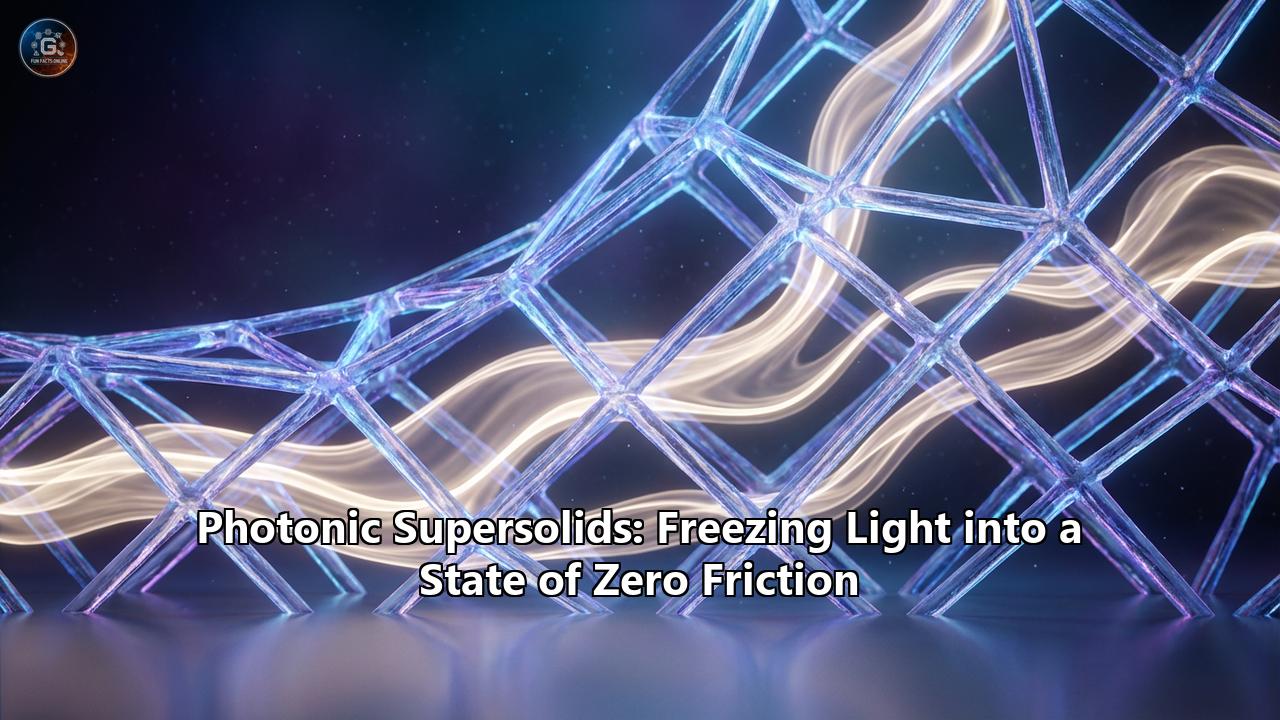
In a landmark achievement that defies the classical boundaries of physics, researchers have successfully coerced light into a state of matter previously thought to be the exclusive domain of ultra-cold atoms: the supersolid. This exotic phase, where material exhibits the rigid crystalline structure of a solid while simultaneously flowing with the zero viscosity of a superfluid, has now been realized using photons. By trapping light within advanced semiconductor nanostructures, scientists have created "solid light"—a breakthrough that promises to revolutionize quantum computing, lossless energy transport, and optical neural networks. This article provides an exhaustive exploration of the science, the history, and the future of photonic supersolids.
Part I: The Impossible State
The Definition of a ParadoxImagine a river that flows endlessly without friction, yet every molecule of water is locked into a rigid, crystalline grid like ice. If you were to push it, it would flow like a liquid; if you were to look at it under a microscope, it would look like a solid. This is a supersolid. For over half a century, it was a theoretical ghost—a mathematical possibility that seemed to contradict our most basic intuitions about matter. Solids are rigid; they resist flow. Fluids flow; they lack rigidity. To be both is to inhabit a quantum purgatory that defies classical logic.
For decades, the hunt for supersolidity was confined to the coldest places in the universe—labs cooling helium-4 or dysprosium atoms to temperatures within a whisper of absolute zero. But in a stunning twist of quantum engineering, a team of researchers from Italy’s CNR Nanotec, along with collaborators from Princeton and other global institutes, has found a new medium for this impossible state: light itself.
Freezing the UnfreezableLight, by its very nature, is the antithesis of a solid. It is energy in motion, defined by a velocity of 299,792,458 meters per second. Photons, the massless particles of light, do not naturally bind to one another. They pass through each other like ghosts. To "freeze" light into a solid structure requires an act of fundamental transformation. It requires turning light into matter.
The breakthrough, published in Nature in early 2025, marks the dawn of "photonic supersolidity." It is not merely a laboratory curiosity; it is a proof-of-concept for a new state of matter that operates under non-equilibrium conditions, opening the door to technologies that were previously the realm of science fiction. From processors that think with light to circuits that conduct energy without loss, the freezing of light is the first step toward a fluid, luminous future.
Part II: The Physics of Light-Matter Coupling
To understand how light can become a solid, we must first understand the "magic trick" of condensed matter physics: the polariton.
The Polariton: Half-Light, Half-MatterPhotons are antisocial. Two beams of light crossing paths do not crash; they pass right through. To make them interact—to make them "feel" each other and organize into a structure—you need a mediator. In the photonic supersolid experiments, this mediator is the exciton.
Inside a semiconductor material (specifically Gallium Arsenide in these experiments), an electron can be excited to a higher energy level, leaving behind a "hole." This electron-hole pair is called an exciton. Excitons are matter; they have mass and they interact with each other via electrostatic forces.
When you trap photons inside a high-quality reflective cavity containing this semiconductor, a strange phenomenon occurs. The photon is absorbed by the semiconductor to create an exciton, which then almost instantly decays back into a photon, which is then re-absorbed. This cycle happens so fast—trillions of times a second—that the photon and the exciton lose their individual identities. They merge into a new quasiparticle called a polariton.
Polaritons inherit the best of both worlds. From the photon, they get speed and the ability to travel over long distances. From the exciton, they get "mass" and the ability to interact. Polaritons can bounce off each other; they can push and pull. They are "liquid light."
Bose-Einstein Condensation (BEC)To create a supersolid, simply having polaritons is not enough. You need them to behave as a single, coherent entity. This is where Bose-Einstein Condensation comes in.
In the classical world, particles are distinct individuals. But in the quantum world, particles like polaritons (which are bosons) act like waves. As you cool them down or increase their density, their "wave packets" expand. Eventually, the waves overlap so much that the individual particles lose their identity entirely. They synchronize. They all collapse into the same quantum state, moving in perfect lockstep.
This "giant matter wave" is a Bose-Einstein Condensate (BEC). It is a superfluid—it flows with zero viscosity because all the particles are effectively one single particle. If you push one part of the wave, the whole wave moves. Polariton BECs have been created before, allowing for "superfluid light." But a superfluid is not a supersolid. To get the "solid" part, you need one more impossible ingredient: crystalline order.
Part III: The Breakthrough Experiment
The experiment that shocked the physics world took place at the advanced photonics laboratories of CNR Nanotec in Lecce, Italy. The team, led by physicists like Daniele Sanvitto and Dario Gerace, devised a trap for light so sophisticated it forced the polaritons to break the symmetry of space itself.
The "Bound State in the Continuum" (BiC)The biggest challenge with polaritons is that they die young. Because they are part photon, they constantly try to escape the semiconductor cavity as light. Typically, a polariton lives for only a few picoseconds (trillionths of a second). This is usually not enough time for them to settle down and organize into a crystal.
The researchers used a brilliant workaround known as a Bound State in the Continuum (BiC).
In quantum mechanics, a "continuum" state is one where a particle is free to fly away (radiate). Usually, if a particle has enough energy to escape, it does. However, by carefully engineering the microscopic structure of the Gallium Arsenide waveguide—etching it with a precise, periodic grating—the researchers created a condition of "destructive interference."
Imagine a prisoner trying to escape a cell. Every time they try to walk out the door, a clone of them walks in the opposite direction, cancelling their motion. The polaritons in a BiC mode are technically free to leave (they are in the continuum spectrum), but the interference patterns of the grating trap them in a "symmetry-protected" state. They cannot radiate.
This trick extended the lifetime of the polaritons significantly, allowing them to accumulate in massive numbers.
The Emergence of StructureWith the polaritons trapped and long-lived, the researchers pumped energy into the system using a laser. As the density of polaritons increased, they condensed into a BEC. But then, something extraordinary happened.
Instead of staying as a uniform fluid, the fluid spontaneously broke into a pattern. The density of the light modulated. It formed "stripes" or "droplets" arranged in a periodic grid.
- Symmetry Breaking 1 (Gauge Symmetry): The polaritons synchronized their phase, creating a superfluid.
- Symmetry Breaking 2 (Translational Symmetry): The polaritons spontaneously arranged themselves into a crystal lattice, creating a solid.
The researchers observed "satellite condensates"—distinct peaks in the momentum distribution of the light—confirming that the light had crystallized. Yet, simultaneously, the phase of the light remained coherent across the entire structure. The crystal was flowing.
They had created a photonic supersolid.
Part IV: Why Is This "Zero Friction"?
The concept of "zero friction" in a solid is counter-intuitive. In a normal solid, atoms are locked in place. If you try to push an atom, it bumps into its neighbors, creating vibrations (phonons) and heat—friction.
In a supersolid, the "atoms" (in this case, density clusters of polaritons) are delocalized. They are not sitting in one specific spot; they are quantum smeared across the lattice sites. Because they share a single quantum wavefunction, the fluid can flow through the crystalline structure without colliding with it.
The "solid" part is the density modulation—the fact that there is a repeating pattern in space. The "super" part is the fact that mass (or in this case, photonic energy) can transport across the system without dissipating energy. It is a superconductor of light.
Part V: Photonic vs. Atomic Supersolids
Why is the photonic supersolid such a game-changer compared to the atomic versions discovered in 2017?
1. Temperature and ScaleAtomic supersolids (using Dysprosium or Erbium) require cooling to nanokelvin temperatures—billionths of a degree above absolute zero. This requires massive, complex dilution refrigerators and laser cooling setups.
Photonic supersolids, while currently often tested at cryogenic temperatures (around 4 Kelvin), have a clear path to room temperature. The "binding energy" of excitons in materials like perovskites or organic semiconductors is high enough that they can survive at room temperature. The structural engineering (BiC) works regardless of temperature. We are looking at the potential for a supersolid chip that runs at room temperature.
2. Interaction ControlIn atomic gases, interactions are fixed by nature. You can tune them slightly with magnetic fields (Feshbach resonances), but it's hard.
In photonic systems, you can engineer the "landscape" of the solid by simply changing the pattern etched into the semiconductor. You can create honeycomb lattices, triangular lattices, or even "topological" lattices that don't exist in nature. You are God of this microworld.
3. DynamicsAtomic supersolids are equilibrium systems; they want to sit still. Photonic supersolids are "driven-dissipative." You constantly pump energy in (laser) and light constantly leaks out. This sounds like a disadvantage, but for information processing, it is a feature. It allows you to encode information in the flow and read it out continuously.
Part VI: Applications – The Future of Solid Light
The realization of photonic supersolids is not just a triumph of theory; it is the blueprint for a new generation of technology.
1. Topological Quantum ComputingThe holy grail of computing is the "topologically protected qubit." Conventional qubits (like those in Google's or IBM's quantum computers) are fragile; a slight vibration destroys their data.
A supersolid lattice can host "topological" states—modes of light that are immune to defects. If you encode data in the winding number of the superfluid phase across the supersolid crystal, the data is protected by the topology of the system. You could literally chip a corner off the semiconductor, and the data would remain intact because it is stored globally in the "knot" of the wavefunction.
2. Optical Neural NetworksArtificial Intelligence currently runs on silicon chips that consume massive amounts of electricity to shuttle electrons back and forth. Optical computing promises to do this with light (which generates no heat), but light is hard to interact with.
A photonic supersolid provides the missing link: a non-linear optical medium. Because the polaritons interact strongly, you can use the supersolid to perform "logic" operations. You can build a neural network where the "neurons" are droplets of the supersolid. They can process information at the speed of light, with the energy efficiency of a superfluid (zero loss).
3. Lossless Energy TransportImagine an optical circuit on a chip that guides light without any scattering losses. In a normal fiber optic cable, imperfections in the glass scatter light. In a supersolid, the "superfluid" nature means the light flows around imperfections without "seeing" them. This could lead to interconnects inside computer chips that transmit data with zero resistance and zero heat, solving the thermal bottleneck of modern processors.
4. Simulation of Exotic PhysicsThere are theories in physics—such as string theory or theories of the early universe—that are impossible to test because the energy required is too high. A photonic supersolid is a tunable quantum simulator. By shaping the lattice, physicists can create "artificial universes" with their own laws of physics. They can simulate how black holes evaporate or how high-temperature superconductors work, all within a chip the size of a fingernail.
Part VII: The Road Ahead
The "freezing" of light is just the beginning. The immediate next steps for the research community are clear:
- Room Temperature Operation: Moving from Gallium Arsenide to Perovskites or Transition Metal Dichalcogenides (TMDs) to achieve supersolidity without liquid helium cooling.
- 2D to 3D: Current experiments are largely in 1D or 2D planar waveguides. Creating a fully 3D block of "solid light" remains a theoretical challenge.
- Electrically Driven Supersolids: Currently, the systems are pumped by lasers. The ultimate goal is to inject electrons directly (like an LED) to create the supersolid state, allowing for direct integration into electronic circuits.
Conclusion
For centuries, we have divided the universe into "matter" (the stuff you can hold) and "light" (the stuff that lets you see). The discovery of photonic supersolids blurs this line until it vanishes. We have taught light to stand still and hold a shape. We have taught matter to flow like a ghost.
In this new state of zero friction and infinite possibility, we find the future of technology. We are no longer just observing the light; we are sculpting it, freezing it, and building the foundations of a new quantum age. The age of solid light has arrived.
Reference:
- https://www.youtube.com/watch?v=uZntj7Irkx0
- https://www.sciencealert.com/world-first-physicists-create-a-supersolid-out-of-light
- https://www.techno-science.net/en/news/light-transformed-into-supersolid-major-breakthrough-in-quantum-physics-N26618.html
- https://www.zmescience.com/science/scientists-just-turned-light-into-a-supersolid-both-solid-and-liquid-at-the-same-time/
- https://www.researchgate.net/publication/389776829_Engineering_Supersolidity_in_a_Photonic_Platform_Are_we_really_freezing_light
- https://ineducationonline.org/2025/12/12/photonic-supersolid-discovered-why-solid-light-is-the-future-of-quantum-physics/
- https://www.researchgate.net/publication/392337505_Engineering_Supersolidity_in_a_Photonic_Platform_Are_we_really_freezing_light
- https://www.livescience.com/physics-mathematics/scientists-turn-light-into-a-supersolid-for-the-1st-time-ever-what-that-means-and-why-it-matters
- https://www.semanticscholar.org/paper/Polariton-Bose%E2%80%93Einstein-condensate-from-a-bound-in-Ardizzone-Riminucci/3bc016b1fe2f0c1216556ae4ec7e93985eb88bb5
- https://physicsworld.com/a/polariton-condensation-emerges-from-a-bound-state-in-the-continuum/
- https://pmc.ncbi.nlm.nih.gov/articles/PMC11026397/
- https://collaborate.princeton.edu/en/publications/polariton-boseeinstein-condensate-from-a-bound-state-in-the-conti/
- https://www.researchgate.net/publication/351744675_Polariton_Bose-Einstein_condensate_from_a_Bound_State_in_the_Continuum
- https://www.jagranjosh.com/general-knowledge/what-is-a-supersolid-and-how-did-scientists-turn-light-into-a-supersolid-1742044430-1
- https://www.uibk.ac.at/en/newsroom/2025/a-supersolid-made-using-photons/