
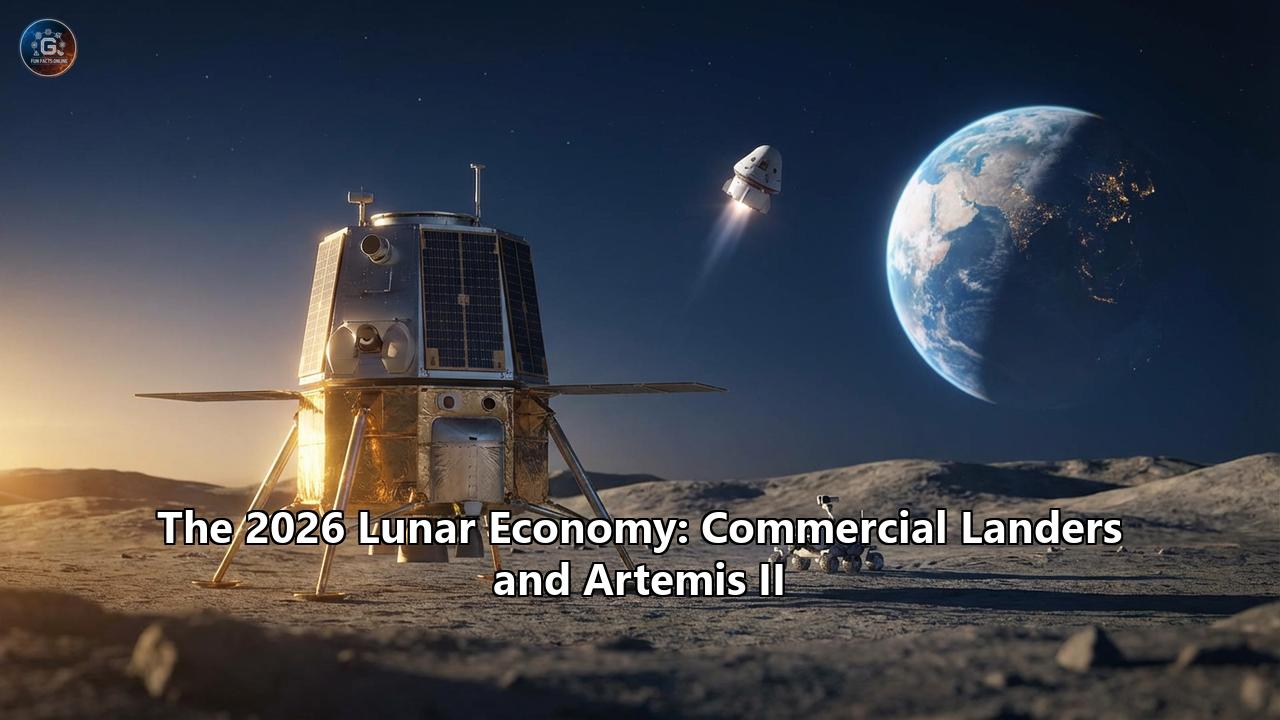
It is January 10, 2026.
The air at Kennedy Space Center is thick with a specific kind of electricity that hasn't been felt in half a century. In the high bay of the Vehicle Assembly Building, a colossus waits. The Space Launch System (SLS), topped with the Orion spacecraft, stands fully stacked, a white pillar against the industrial gray steel, counting down the days to a February launch window. For the first time since Gene Cernan left his footprints in the dust of Taurus-Littrow in 1972, humans are about to leave low Earth orbit.
But looking up at the SLS is only half the story. If you look at the manifest sheets on the desks of mission controllers in Houston, Pittsburgh, Cedar Park, and Beijing, you realize that 2026 is not just the year of the astronaut. It is the year the Moon opened for business.
We have arrived at the "Prove It" year. The experimental stumbling of 2024 and 2025—where commercial landers tipped over, leaked propellant, or fell silent too soon—has given way to a hardened, battle-tested industrial cadence. The Moon is no longer a graveyard of ambitions; it is becoming a warehouse of logistics.
This article explores the landscape of the Lunar Economy as it stands today, in the opening weeks of 2026. From the imminent launch of Artemis II to the fleet of robotic prospectors targeting the magnetic swirls of Reiner Gamma and the shadowed traps of the South Pole, we are witnessing the most significant expansion of the human economic sphere in history.
Part I: The Return of the Human Element — Artemis II
The headline event of 2026 is undoubtedly Artemis II. After a frustrating delay in late 2025 to address heat shield charring issues discovered after Artemis I, NASA has cleared the vehicle for flight. The date is set: February 2026.
The Crew: The First Deep Space Travelers of the 21st Century
For the last year, four names have been on the lips of every schoolchild and space enthusiast: Reid Wiseman, Victor Glover, Christina Koch, and Jeremy Hansen.
In January 2026, these four are in final quarantine. Their training flow has been exhaustive. They haven't just learned to fly the Orion capsule; they have helped build the procedures for deep space survival that will be used for the next fifty years.
- Reid Wiseman (Commander): A naval aviator with a calm, steely demeanor, Wiseman has been the face of the mission's patience. His leadership during the 2025 delay kept the team focused.
- Victor Glover (Pilot): The man who will manually dock Orion in simulations and monitor its systems during the critical Trans-Lunar Injection (TLI). Glover represents the new generation of pilot-astronauts who are as comfortable with software code as they are with stick-and-rudder flying.
- Christina Koch (Mission Specialist): A record-holder for time in space, Koch is the scientific heart of the crew. She is the first woman to leave Earth's orbit, a milestone that has already generated billions of impressions on social media before the rocket has even lit.
- Jeremy Hansen (Mission Specialist): The Canadian Space Agency's representative, marking the first time a non-American has ventured to the Moon. His presence solidifies the Artemis Accords not just as a piece of paper, but as a blood-and-sweat partnership.
The Mission Profile: The Hybrid Free Return
Artemis II is not a landing mission, but do not mistake it for a simple loop. It is a high-stakes test drive. The mission profile, finalized in late 2025, involves a "hybrid free return" trajectory.
After launch, the interim cryogenic propulsion stage (ICPS) will push Orion into a high Earth orbit (HEO) where it will stay for nearly 24 hours. This is a deviation from Apollo. During this day in high orbit, the crew will remove the spacecraft from handling mode and test life support, manual piloting, and communications. They are checking the brakes before they hit the highway.
Once the "Go" is given, they will perform the Trans-Lunar Injection burn. This burn will fling them 230,000 miles outward. They will loop around the far side of the Moon, putting the moon between them and Earth—a silence in radio comms that will last for minutes but feel like hours—and then use the Moon's gravity to slingshot back home.
The 10-day mission is designed to stress-test the life support systems that were merely cargo on Artemis I. In January 2026, the question is no longer "Can the rocket fly?" but "Can the ship keep them alive?"
Part II: The Commercial Crucible — Lessons from the "Tipping Years"
To understand the confidence of the lunar industry in 2026, we must look back at the chaos of 2024 and 2025. Historians are already calling this period the "Hardware Rich Learning Phase."
The Ghosts of 2024
The era began with Astrobotic's Peregrine in January 2024. It was a heartbreaker. A propulsion anomaly shortly after separation doomed the lander before it could even attempt a descent. It burned up in Earth's atmosphere, taking with it the ashes of Star Trek creator Gene Roddenberry and the hopes of Pittsburgh's space sector.
Then came Intuitive Machines' IM-1 (Odysseus) in February 2024. It landed, but it tripped. A failure in the laser rangefinders forced a software patch in transit, and the lander touched down with lateral momentum, breaking a leg and tipping onto its side. It sent back data, it was a success, but it wasn't the upright triumph the public wanted.
The Turning Point: Firefly Blue Ghost (March 2025)
The narrative shifted in March 2025. Texas-based Firefly Aerospace launched its Blue Ghost Mission 1 to Mare Crisium.
By January 2026, Blue Ghost is spoken of with reverence. It didn't just land; it stuck the landing. It landed upright, deployed its solar panels, and operated for a full lunar day (14 Earth days), and—crucially—continued to transmit data a few hours into the lunar night.
Blue Ghost was the proof of concept the market needed. It demonstrated that a private company, under a fixed-price NASA CLPS (Commercial Lunar Payload Services) contract, could deliver precision logistics to the lunar surface. It validated the GPS-on-the-Moon experiment (measuring signals from Earth's GNSS constellations), proving that future astronauts wouldn't be flying blind.
Part III: The 2026 Manifest — The Year of Heavy Traffic
As we stand in January 2026, the manifest for the year is crowded. The Moon is about to get busy.
1. Astrobotic's Redemption: Griffin and FLIP (July 2026)
Pittsburgh is ready for round two. Astrobotic is preparing its massive Griffin lander for a summer launch aboard a SpaceX Falcon Heavy.
This mission has undergone a dramatic identity change. Originally, Griffin was built to carry NASA's VIPER (Volatiles Investigating Polar Exploration Rover), a golf-cart-sized robot designed to hunt for water ice.
However, in a controversial move in mid-2024, NASA cancelled VIPER due to budget overruns and delays. It was a blow to the scientific community, but the commercial sector moved instantly to fill the vacuum.
Enter Astrolab and the FLIP rover.
FLIP (FLEX Lunar Innovation Platform) is a commercial rover that Astrobotic integrated onto Griffin in late 2025. It is smaller than VIPER but faster and more agile. It represents the first purely commercial large-scale rover mission.
- The Mission: Griffin will target the Nobile Region near the South Pole.
- The Stakes: For Astrobotic, this is do-or-die. After Peregrine, they need a clean landing. Griffin is the largest lander in the commercial fleet, capable of delivering heavy cargo. A success here positions them as the primary movers for future lunar habitats.
2. Intuitive Machines' IM-3: The Magnetic Mystery (Late 2026)
Intuitive Machines is the veteran of the group. Having survived the "tipping" incidents of IM-1 and IM-2 (the latter of which landed at the South Pole in early 2025 but struggled with terrain), they are launching IM-3 later this year.
- Target: Reiner Gamma.
This is a destination for the science textbooks. Reiner Gamma is a "lunar swirl"—a bright, tattoo-like marking on the lunar surface that has no topographic relief. It is associated with a strong localized magnetic field.
- The Goal: IM-3 will deploy a suite of magnetometers and a small rover to drive across the swirl. Scientists believe these magnetic bubbles shield the surface from solar wind weathering, keeping the regolith bright. IM-3 is essentially a physics lab on a rocket.
- Payloads: The mission carries the Lunar Vertex payload suite. It will also deploy a swarm of small retro-reflectors to build a permanent navigation grid on the western limb of the Moon.
3. Firefly's Dark Side Run: Blue Ghost Mission 2 (Mid-to-Late 2026)
Fresh off their success in Mare Crisium, Firefly is attempting the hardest trick in the book: a Far Side Landing.
Scheduled for later in 2026, Blue Ghost Mission 2 is heading to the Schrödinger Basin, a massive impact crater on the hidden side of the Moon.
- The Comms Challenge: You cannot talk to Earth from the far side. The moon blocks the signal. To solve this, Firefly is deploying the ESA Lunar Pathfinder satellite into lunar orbit before the lander descends. This relay satellite is the first node in what will eventually be a lunar internet.
- The Science: The far side is radio-quiet, shielded from the noisy chatter of Earth's TV and radio broadcasts. Blue Ghost 2 carries the LuSEE-Night (Lunar Surface Electromagnetics Experiment-Night) instrument. It will listen for the faint radio whispers of the "Dark Ages" of the universe—the time before the first stars turned on.
Part IV: The Dragon in the South — China's Chang'e 7
While the American commercial sector buzzes with capitalism, the Chinese National Space Administration (CNSA) continues its methodical, relentless march.
Chang'e 7 is on the pad for August 2026.If Artemis II is a flyby, Chang'e 7 is an occupation.
- The Hardware: It is a monster mission consisting of an orbiter, a lander, a rover, and—most impressively—a Hopping Probe.
- The Hopper: This small detector is designed to launch from the lander, fly into the permanently shadowed craters of the South Pole (places where sunlight hasn't touched for billions of years), sniff for water ice, and hop out again.
- The Landing Site: Shackleton Crater. This is the prime real estate. The rim of Shackleton offers nearly continuous sunlight for solar power, while the floor offers deep cold traps for water ice.
The geopolitical tension is palpable. The US and China are both targeting the same few kilometers of crater rim for their future bases. In 2026, the "Moon Race" is no longer about planting a flag; it is about claim-staking the water wells.
Part V: The Economy of Water and Dust
Why all this traffic in 2026? Why are investors pouring billions into companies like Firefly, Intuitive Machines, and ispace?
The answer is ISRU (In-Situ Resource Utilization).
By January 2026, the "Cislunar Economy" has transitioned from a PowerPoint buzzword to a commodity market.
- Water is Oil: The water ice at the poles is not just for drinking. It is hydrogen and oxygen. It is rocket fuel. If you can mine fuel on the Moon, you don't have to carry it from Earth. The cost of deep space exploration drops by 90%.
- The Orbital Pharmacy: While not strictly lunar, the success of companies like Varda Space in 2025 (returning pharmaceuticals manufactured in orbit) has proven that space-based products have high value. The Moon is seen as the next manufacturing hub—specifically for high-purity silicon wafers and fiber optics that benefit from the vacuum and low gravity.
- Data as a Service: The most immediate product of 2026 is data. NASA is paying per megabyte. Private universities are booking bandwidth on commercial landers. The "Lunar Cloud" is starting to form, with servers being hardened for deployment in lava tubes.
Part VI: The Infrastructure Layer
You cannot build a town without roads and telephone lines. 2026 is the year the lunar "utilities" are laid down.
The Lunar Internet
ESA's Moonlight Initiative and NASA's LunaNet architecture are coming online. The launch of the Lunar Pathfinder on the Firefly mission is the first active node. By the end of 2026, a lander on the South Pole will be able to video call a lander on the Far Side via a relay network, with data routed back to Earth Ground Stations in New Mexico and Australia.
GPS on the Moon
One of the quietest but most revolutionary breakthroughs of late 2025 was the confirmation that high-sensitivity receivers on the Moon could pick up the side-lobes of GPS and Galileo satellites orbiting Earth. In 2026, every lander carries a "Nav-Receiver." We are mapping the moon with centimeter-precision. The days of "landing within an ellipse of 5 kilometers" are over. The new standard is "landing on a specific landing pad."
Part VII: The Human Future
As we watch the Artemis II crew suit up this February, we are looking at the vanguard. But behind them, the heavy lifters are rising.
SpaceX's Starship HLS (Human Landing System) is in aggressive testing. In South Texas, the cadence of launches has become weekly. They are practicing the orbital refueling dance—transferring cryogenic methane in Low Earth Orbit—that is required to get a Starship to the Moon. Blue Origin is not far behind. Their Blue Moon Mark 1 cargo lander is prepping for its Pathfinder mission. The rivalry between Musk and Bezos has given the world two independent, heavy-lift supply lines to the lunar surface.Conclusion: The Moon in the Morning Sky
Walk outside tonight, January 10, 2026. Look at the waning gibbous moon.
It looks the same as it did to our ancestors. But it isn't.
Right now, robotic sentinels are sleeping in the dust of Mare Crisium. In a clean room in Florida, four astronauts are reviewing their flight plan. In a factory in Pittsburgh, engineers are torquing the bolts on a rover that will drive where no light has ever shone.
The Moon is no longer a distant celestial body. It is the Earth's eighth continent. It has an economy, a shipping schedule, and a population of robots that is about to grow.
Welcome to the Lunar Age. The launch window is open.
Deep Dive: The Tech of the 2026 Fleet
To fully appreciate the scale of operations this year, we must look under the hood of the machines defining the 2026 lunar economy.
The Workhorse: Firefly's Blue Ghost
The success of Blue Ghost is built on its simplicity and robustness.
- Propulsion: It uses a monopropellant hydrazine system for the cruise phase but switches to a bi-propellant system for the landing burn, giving it the thrust-to-weight ratio needed for a soft touchdown.
- Structure: Unlike the tall, top-heavy designs of the past, Blue Ghost is squat and wide. This low center of gravity was the key factor in its stable landing in Mare Crisium, contrasting with the "topple" issues of early CLPS missions.
- Power: Its solar arrays are vertically mounted on the sides, capturing low-angle sunlight which is prevalent at the lunar poles and during the lunar dawn/dusk, maximizing the operational window.
The Heavy Hauler: Astrobotic's Griffin
Griffin is a different beast. It is the "pickup truck" of the moon.
- Capacity: It can deliver nearly 500 kg to the surface.
- Ramps: The most critical mechanical component of Griffin is the ramp deployment system. To get a rover like FLIP (which is the size of a golf cart) off the deck and onto the dirt requires a complex unfolding mechanism. Astrobotic has spent all of 2025 testing this ramp in gravity-offload rigs to ensure it doesn't jam—a single jammed bolt would end the rover's mission before it began.
The Scientist: Intuitive Machines' Nova-C (Upgraded)
The Nova-C lander for IM-3 features significant upgrades from the Odysseus model.
- Landing Legs: After the IM-1 leg failure, the landing gear has been reinforced and equipped with active leveling capability.
- Lidar: The navigation system now uses a triple-redundant Doppler Lidar system to measure velocity relative to the ground, ensuring the computer knows exactly how fast it is moving sideways before engine cutoff.
The Cancelled Hero: Requiem for VIPER
We cannot discuss 2026 without acknowledging the ghost at the banquet: VIPER.
NASA's decision to cancel the rover in 2024 was met with shock. The rover was 100% built. It was sitting in a clean room at Johnson Space Center. The cancellation was purely budgetary—the integration costs with the lander were rising too high.
However, the legacy of VIPER lives on. The instruments built for it—the TRIDENT drill and the MSOLO mass spectrometer—have been cannibalized and fitted onto smaller commercial landers. The "body" of VIPER may never roll on the Moon, but its "senses" will still taste the lunar ice.
And in its place, the commercial FLIP rover represents a shift in philosophy. VIPER was a $450 million government flagship. FLIP is a commercial platform, designed to be cheap, replaceable, and iterative. It is the difference between a custom-built Ferrari and a Ford F-150. The Moon needs F-150s.
The Geopolitics of the South Pole
The map of the Lunar South Pole in 2026 resembles a contested border region.
The Shackleton-de Gerlache Ridge is the most valuable real estate in the solar system. It offers:
- Peaks of Eternal Light: High points that receive sunlight 90% of the year (power).
- Permanently Shadowed Regions (PSRs): Valleys that have been dark for 2 billion years (water).
China's Chang'e 7 is targeting a site known as ILRS-1. The US Artemis III mission (planned for late 2027) is targeting a site known as Peak Near Shackleton. These sites are only kilometers apart.
In 2026, diplomats are as busy as engineers. The implementation of "Safety Zones"—buffers around landing sites to prevent dust from one lander blasting the other—is being hotly debated at the UN Committee on the Peaceful Uses of Outer Space.
Final Thoughts: The View from 2026
As the Artemis II countdown clock ticks down to zero this February, we are reminded that space exploration is a baton pass.
From the Apollo generation to the Shuttle generation, and now to the Artemis generation. But the difference this time is that we aren't just going to look. We are going to build.
The manifest of 2026—Artemis II, Griffin, IM-3, Blue Ghost 2, Chang'e 7—is a declaration of intent. Humanity is packing its bags. This time, we are staying.
Reference:
- https://asgardia.space/en/news/Whats-New-in-Space-64
- https://nowgeorgia.com/back-to-the-moon-artemis-ii/
- https://sg.news.yahoo.com/europe-wants-bring-industry-space-074323037.html
- https://www.americaspace.com/2025/03/22/nasa-accelerates-artemis-2-by-two-months/
- https://en.wikipedia.org/wiki/Artemis_program
- https://en.wikipedia.org/wiki/Artemis_II
- https://www.forbes.com/sites/jamiecartereurope/2025/12/24/nasas-artemis-ii-the-first-crewed-lunar-flyby-in-50-years/
- https://www.nasaspaceflight.com/2025/01/lunar-missions-roundup/
- https://www.planetary.org/space-missions/clps
- https://www.space.com/astronomy/moon/moon-rush-these-private-spacecraft-will-attempt-lunar-landings-in-2026
- https://fireflyspace.com/news/blue-ghost-mission-1-live-updates/
- https://spaceflightnow.com/2025/03/18/firefly-aerospaces-blue-ghost-mission-1-concludes-successful-14-day-mission-on-the-moon/
- https://www.nasa.gov/news-release/touchdown-carrying-nasa-science-fireflys-blue-ghost-lands-on-moon/
- https://www.nasa.gov/news-release/nasa-science-continues-after-fireflys-first-moon-mission-concludes/
- https://en.wikipedia.org/wiki/Chang%27e_7
- https://www.astrobotic.com/astrolabs-flip-rover-joins-astrobotics-griffin-1-to-the-moon/
- https://spaceambition.substack.com/p/2026-wont-be-a-moonshot-year-it-will
- https://aerospaceamerica.aiaa.org/lunar-lander-maker-says-he-welcomes-chinese-competition-to-reach-the-moon/
- https://www.space.com/space-exploration/moon-rovers/private-flip-rover-replaces-nasas-viper-on-astrobotic-moon-mission
- https://english.www.gov.cn/news/202502/04/content_WS67a1612bc6d0868f4e8ef55b.html
- https://dailygalaxy.com/2026/01/moon-4-private-spacecraft-2026/